Santi Pietro e Paolo dei Greci: A Greek Orthodox Church in Naples


Site at a Glance
- Rating
- 4.8
- Popularity
- Very Low
- Country
- Italy
- Primary era
- Early Modern
- External website
- Open
- Eras represented
- Early Modern
- Civilizations
- Kingdom of Naples, Spanish
- Site type
- Religious
- Remains
- Church
On this page10 sections
History
Santi Pietro e Paolo dei Greci is a Greek Orthodox church in Naples, Italy, founded in the early sixteenth century for communities using the Byzantine Rite, the family of worship practices developed in the Byzantine Christian tradition. Construction began in 1518 at the request of Thomas Asen Palaiologos, and the church was completed and authorized for Byzantine worship in 1544. It became the first foreign national church in Naples and served as the center of the city’s Greek School and Greek confraternity.
Foundation under Thomas Asen Palaiologos
The church was initially dedicated to the Twelve Apostles. Thomas Asen Palaiologos financed its construction and sought a site formerly belonging to Pietro Faldes from Charles I of Spain in 1518. A royal charter directed the viceroy Raimondo de Cardona to provide 500 ducats toward the building under royal protection. Thomas was connected to the Palaiologos dynasty, the last ruling house of the Byzantine Empire, and to the Asen dynasty associated with the Second Bulgarian Empire. His descent from both houses linked the foundation to the Christian dynastic traditions of the eastern Mediterranean.
The church also provided a place of worship for exiles from Epirus and the Morea, the historical name for the Peloponnese. The arrival of Arvanite-Albanian refugees from the Morea, including people from Koroni, Modon, and Patras, enlarged Naples’s Arvanite-Albanian population after the Ottoman invasions. Imperial forces occupied Koroni in 1532–1534, contributing to this movement of people. The refugees settled around the street known as Vico dei Greci, obtained the church, and established a confraternity there in 1536.
A papal bull issued on 29 June 1536 permitted the Koronei to profess their faith according to their own rite. A second bull, dated 16 December 1544, authorized Byzantine worship in the church. The building was renamed for Saints Peter and Paul in 1634. Its congregation and institutions brought together Italo-Albanian Catholics of the Greek Rite and, later, a smaller community of Greek Orthodox Christians.
Expansion and institutional struggles
By 1617, the church could no longer accommodate its parishioners adequately, and it was enlarged with the addition of a conservatory for children. During the period associated with the painter Belisario Corenzio, an academy for Greek girls was also established in connection with the church. After the Battle of Lepanto in 1571, the church became a center of one of the largest Greek communities in Italy.
From 1656 to 1721, the church and its confraternity faced continuing pressure as they sought to preserve their distinct identity and the Greek character of their Eastern-rite institution. In 1764, the Roman Catholic archbishops of Naples obtained jurisdiction over the confraternity that possessed the church. The building formally entered the Archdiocese of Naples in 1828.
Return of Orthodox worship
During the early nineteenth century, Greek Orthodox worship and the Greek Rite were prohibited, and Greek-Catholic priests were installed. Orthodox liturgy resumed on 26 September 1865. In May 1866, a court in Naples returned the church to the Orthodox Greeks, who restored the Byzantine Rite.
An appellate ruling in 1868 held that the church had originated with and belonged to the Albanian community of the Greek-Byzantine Rite. The transfer to the Greek Orthodox community was enabled by an Italian law of 1877 that revoked measures adopted under the former Kingdom of the Two Sicilies. Archimandrite Nikolaos Katramis, a senior cleric in the Eastern Christian tradition, worked to restore the church’s historical character. By the end of the nineteenth century, the church had become the property of the Greek state and the Greek Orthodox Church. It is now administered by the Orthodox Archdiocese of Italy and Malta and belongs to the Greek state.
Remains
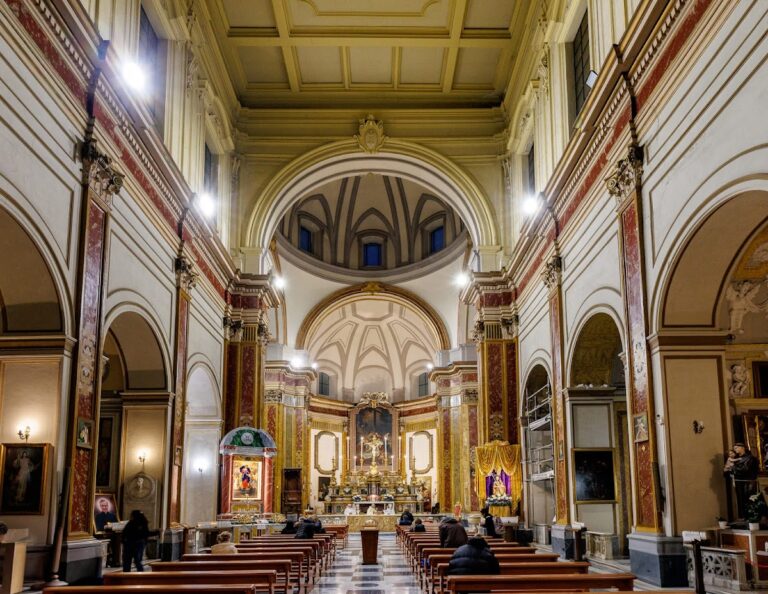
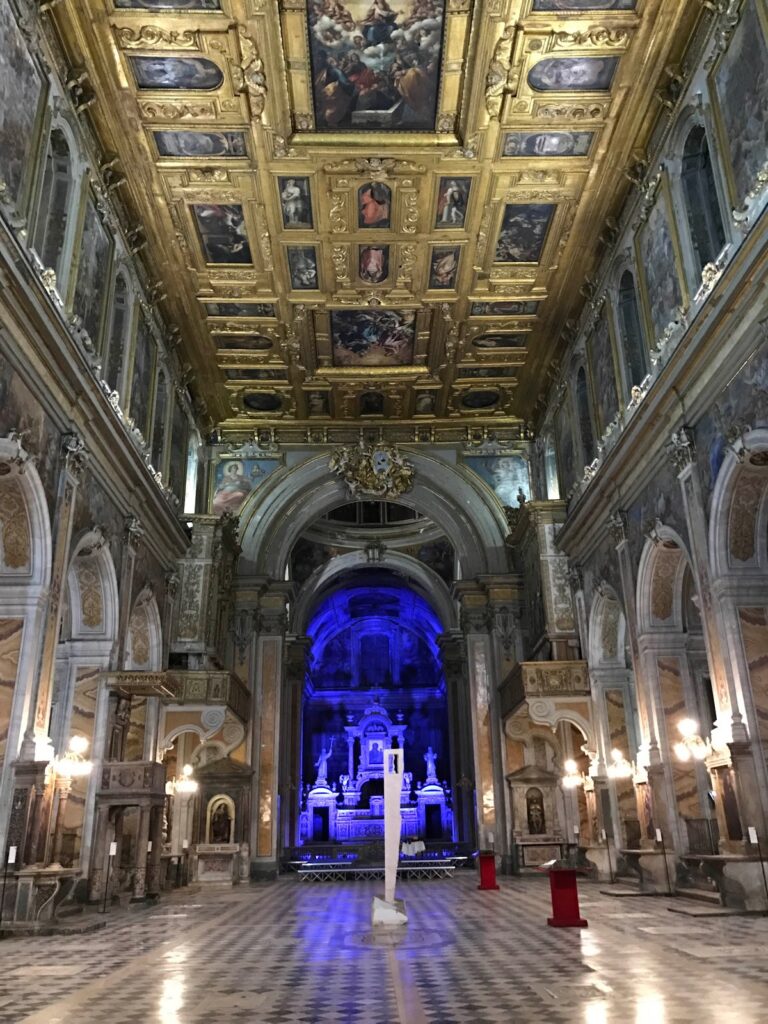
Santi Pietro e Paolo dei Greci survives as a Greek Orthodox church in Naples’s historic center, at the street associated with its Greek community. Its physical and artistic character reflects successive phases of use, including the enlargement of 1617 and the continued presence of Byzantine, or Greek, Rite worship. The surviving decoration combines remnants of earlier Neapolitan painting with a substantial collection of post-Byzantine icons.
Church building and associated spaces
The church was enlarged in 1617, when a conservatory for children was added. Its connection with Greek education also included an academy for Greek girls established during Belisario Corenzio’s period. These additions formed part of the institution’s broader religious and communal setting, which served the confraternity, the Greek School, and the congregations attached to the church.
Painted decoration
Belisario Corenzio’s frescoes
Belisario Corenzio painted frescoes for the church as a member of its confraternity. Only fragmented traces of this decoration survive. His work represents an earlier layer of the church’s artistic history, alongside later paintings by Paolo de Matteis.
Paolo de Matteis’s painting
Paolo de Matteis completed additional work in the church. One of his paintings is placed in the second chapel on the right, where it forms part of the surviving interior decoration.
Post-Byzantine icons
Toward the end of the eighteenth century, the Cephalonian Greek painter Efstathios Karousos decorated the church with subjects that joined elements of the Heptanese School with Neapolitan painting. The Heptanese School developed in the Ionian Islands and combined post-Byzantine religious art with Western European influences. The church contains fifty post-Byzantine icons, more than forty attributed to Karousos, while thirty-eight works by him are preserved there.