Santi Pietro e Paolo: The Parish Church of Anzola dell’Emilia
Site at a Glance
- Popularity
- Very Low
- Country
- Italy
- Primary era
- Early Modern
- Eras represented
- Medieval, Early Modern, Modern
- Civilizations
- Italian, Papal States
- Site type
- Religious
- Remains
- Church
On this page10 sections
History
Santi Pietro e Paolo is the Roman-rite Catholic parish church of Anzola dell’Emilia, Italy, in the Archdiocese of Bologna. The Roman rite is the Catholic Church’s principal liturgical tradition. The present church was begun in 1638 and completed around the middle of the seventeenth century, and its façade is in Tuscan order. It belongs to the Bologna West vicariate, an administrative subdivision of the archdiocese.
Medieval church
A predecessor church at Unciola, an older name for Anzola, apparently stood near the local castle in the tenth century. Dedicated to Saint Peter alone, it is first mentioned in a document issued by Bishop Gerardo Grassi in 1158. In the thirteenth century, the church was counted among the Archdiocese of Bologna’s 44 original parish churches. In 1298, Rolandino Matthioli of Alemannino donated eight Bolognese pounds to restore the altarpiece of the Blessed Virgin Mary.
Repairs and seventeenth-century rebuilding
In 1566, Anzola’s archpriest, Silvestro Bonfiglioli, described the church as being in poor condition and in need of renovation. Extensive repairs followed over the next few years, and the entrance was moved to the west. During an inspection on 24 August 1573, ecclesiastical inspector Ascanio Marchesini found the building generally well maintained but noted cracks in its walls and ordered repairs. Cardinal Gabriele Paleotti’s visits in 1579 and 1584 led to further work, including repainting the church and bell tower red, repairing a window above the main altar, and renovating the interior. The additional interior work was completed in 1588.
Fighting between factions contesting control of the nearby castle badly damaged the church in 1630. In 1638, Cardinal and Archbishop of Bologna Girolamo Colonna judged that rebuilding would be more practical than repairing the structure. Work on a new parish church began that year and finished around the mid-seventeenth century.
Nineteenth- and twentieth-century changes
Lightning damaged the bell tower during the first half of the nineteenth century, and its rebuilding was completed in 1834. In 1844, Vincenzo Pedrazzi paid for the façade to be rebuilt in thanksgiving after a lightning strike tore the gold watch from his waistcoat without injuring him. The apse was rebuilt between 1880 and 1885, and the bell tower was restored in 1893. Renovations carried out between 1908 and 1932 also changed the church’s interior arrangement.
Cardinal Antonio Poma reconsecrated the church in 1978. A comprehensive restoration followed between 1989 and 1991.
Remains
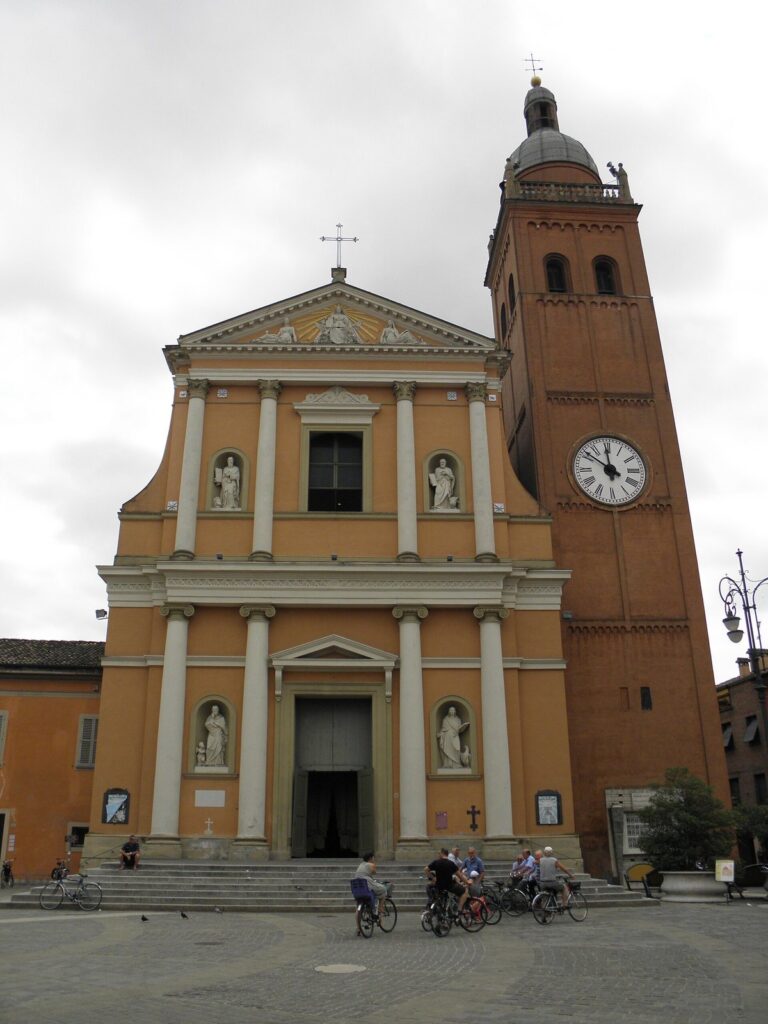
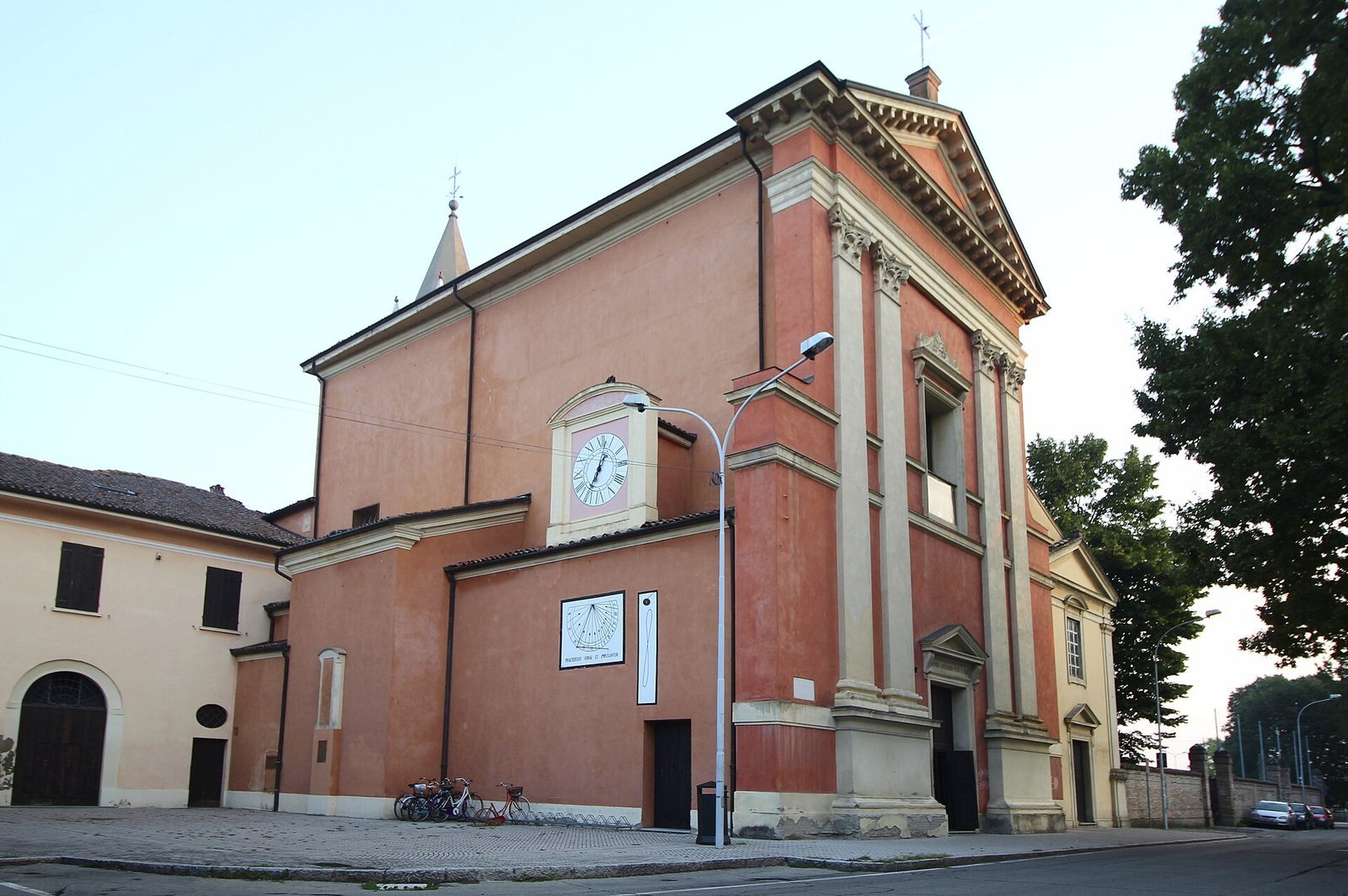
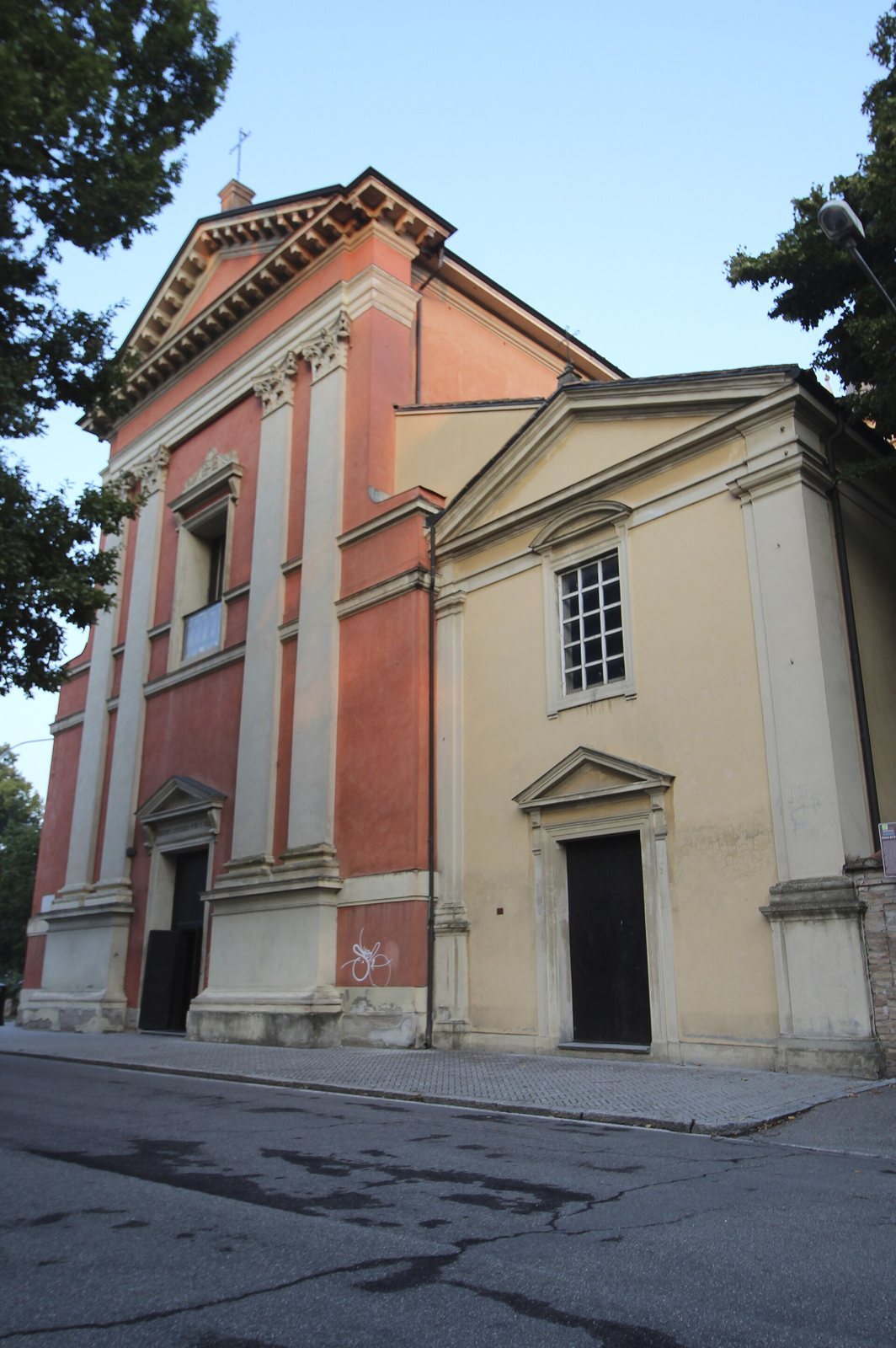
The present church has a single nave, the main space for worship, and a red façade in Tuscan order, a classical architectural design. The smaller oratory of the Blessed Virgin of Suffrage adjoins the church on its right.
Predecessor church
A drawing dated 1578, now held at Bologna’s Archiginnasio Library, depicts the earlier church as a three-aisled building with its apse, the curved end of the church, facing east. The complex also included a bell tower and a rectory.
Present church
Façade
The red façade has two levels divided by a stringcourse, a projecting horizontal band. Four pairs of pilasters, flat wall supports, with Corinthian capitals, classical column tops, divide the lower level into three sections. Its central doorway is topped by a triangular pediment, with a large stone-framed window directly above. The upper level ends in a triangular entablature, the classical upper part of a façade, decorated with modillions, small brackets supporting a cornice. Beside it, the oratory has a smaller white façade. A plaque names Vincenzo Pedrazzi and Lorenzo Landi and commemorates the façade’s construction.
Furnishings and artworks
The interior retains a baptismal font brought from the earlier parish church and a walnut confessional, a booth used for confession, transferred from the chapel of Saint Anthony and present in the church since 1740. Its artworks include a nineteenth-century painting of Saint Anthony the Abbot by Gaetano Serra Zanetti, an eighteenth-century processional cross, and a polychrome statue of the Madonna of the Rosary made by Angelo Piò in the eighteenth century. An eighteenth-century painting of Saint Anne is by Antonio Rossi. Two oval paintings depict Saint Joseph with the Child and Saint Vincent Ferrer. Other works include a seventeenth-century altarpiece, a painting designed for display at an altar, by Lucio Massari depicting Saints Dominic, Lucy, and Apollonia, and a sixteenth-century wooden altarpiece containing a statue of Christ.
Organ
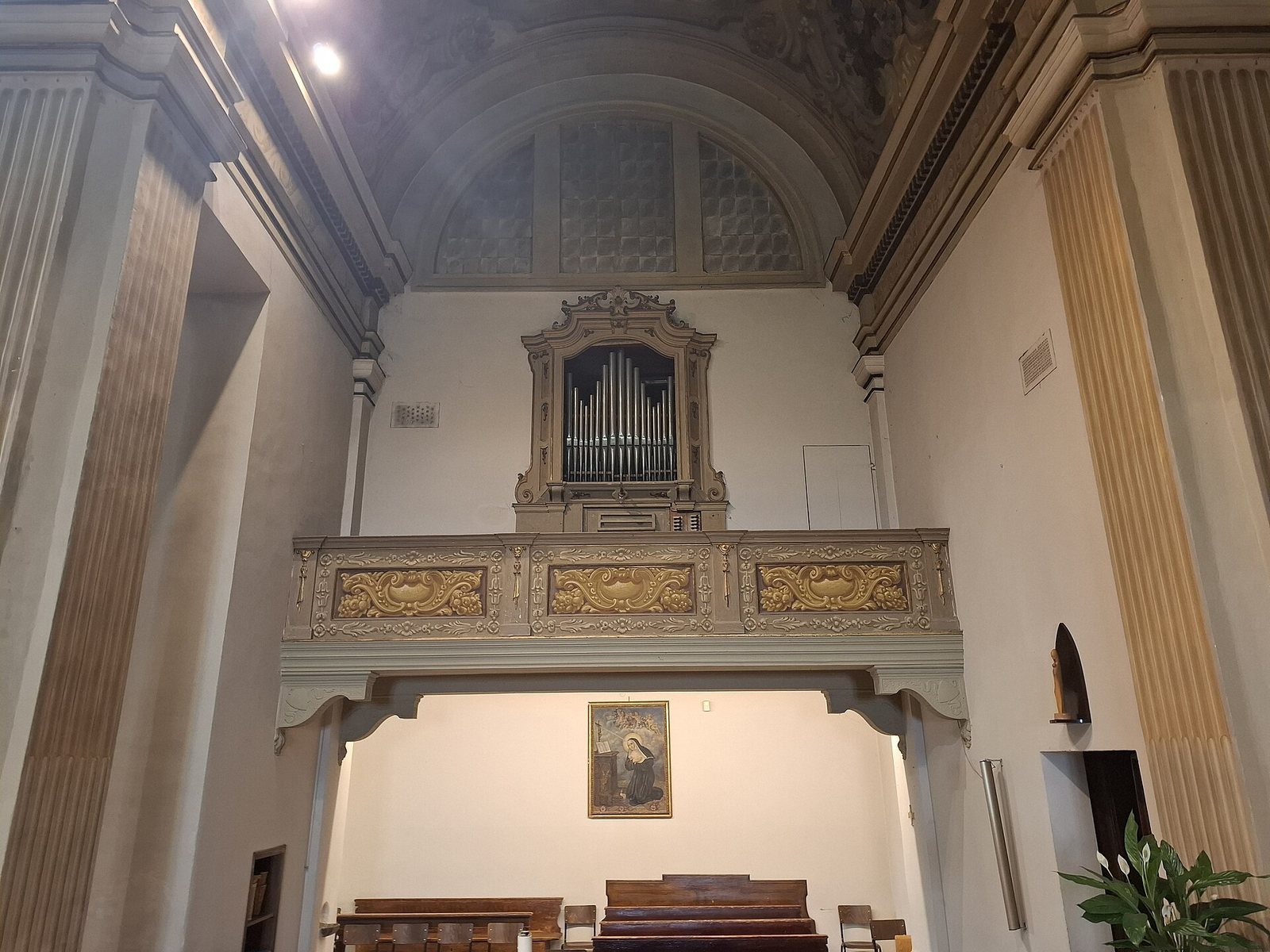
The choir loft, an elevated platform for the choir, stands on the side used for Gospel readings. It contains an organ built in 1857 by the Guermandi brothers of Bologna. In 1981, the Paccagnella firm of Albignasego restored the instrument and added a movable electric console in the nave.