Santi Gioacchino e Anna alle Quattro Fontane: A Baroque Church in Rome
Site at a Glance
- Popularity
- Low
- Country
- Italy
- Primary era
- Early Modern
- Eras represented
- Early Modern, Modern
- Civilizations
- Papal States
- Site type
- Religious
- Remains
- Church
On this page14 sections
History
Foundation and rebuilding
Santi Gioacchino e Anna alle Quattro Fontane is a Baroque church in Rome, Italy, built for the Discalced Carmelites between 1608 and 1611. At the start of the seventeenth century, the Teresian Discalced Carmelites, a reformed branch of the Carmelite order associated with Teresa of Ávila, sought to establish a hospice in Rome. In 1608, the Spanish Carmelite José de Jesús María bought two houses near Quattro Fontane on Via Pia, then the name of the route now occupied by Via del Quirinale and Via XX Settembre. Orazio Zerreni and Cardinal Michelangelo Tonti sold the houses, which were converted into a monastery.
With Pope Paul V’s approval, the church was built from 1608 to 1611 and consecrated by Monsignor Cesare Fedeli on 9 November 1611. Around 1638, the Carmelites commissioned Paolo Maruscelli to rebuild it. Alessandro Sbrenchio continued the work after Maruscelli’s death in 1649, completing it during Pope Alexander VII’s pontificate, from 1655 to 1667. The original church has also been tentatively attributed to Alessandro Sperone.
Changes of use
During the French occupation of Rome in the first decade of the nineteenth century, the Carmelites left the church and convent. Charles IV, king of Spain, and his wife, Queen Marie-Louise, acquired the complex. With Pope Pius VII’s approval, they transferred it to the Perpetual Adorers of the Most Holy Sacrament, a congregation devoted to Eucharistic adoration and founded by Maria Maddalena dell’Incarnazione, also known as Caterina Sordini.
In 1839, the Adorers moved to the nearby church of Santa Maria Maddalena al Quirinale. The church and convent then passed to the Discalced Trinitarians, a reformed branch of the Trinitarian order, who sold the complex to the Belgian College in 1846. The College used the church as its seminary church. A restoration took place around the time of the transfer, and the interior was decorated with frescoes; another restoration followed in 1931. In the later twentieth century, declining enrollment led the College to relocate to western Rome. The church was subsequently deconsecrated, meaning it was formally released from use for worship.
Burials and commemoration
Cardinal Gil Carrillo de Albornoz (1579–1649) was buried in the church before his remains were transferred to the Church of the Incarnation in Talavera de la Reina, Spain. Belgian Papal Zouaves, volunteer soldiers who served the Papal States, are also commemorated there. Most of those remembered fought or died at the Battle of Mentana on 3 November 1867, a conflict between papal and French forces and Italian volunteers seeking Rome’s incorporation into a united Italy.
Remains
Exterior and layout
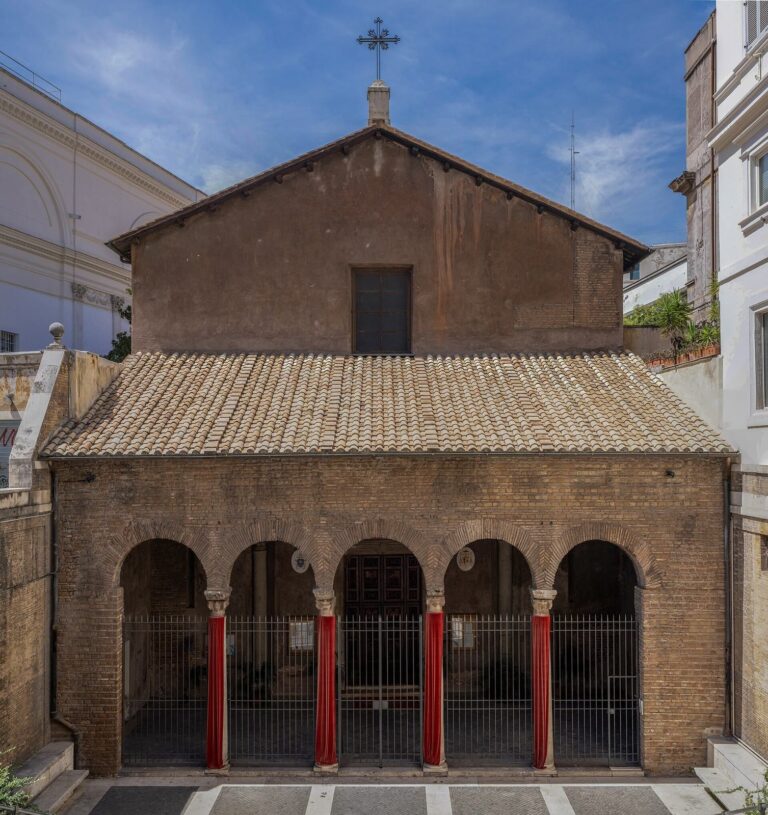
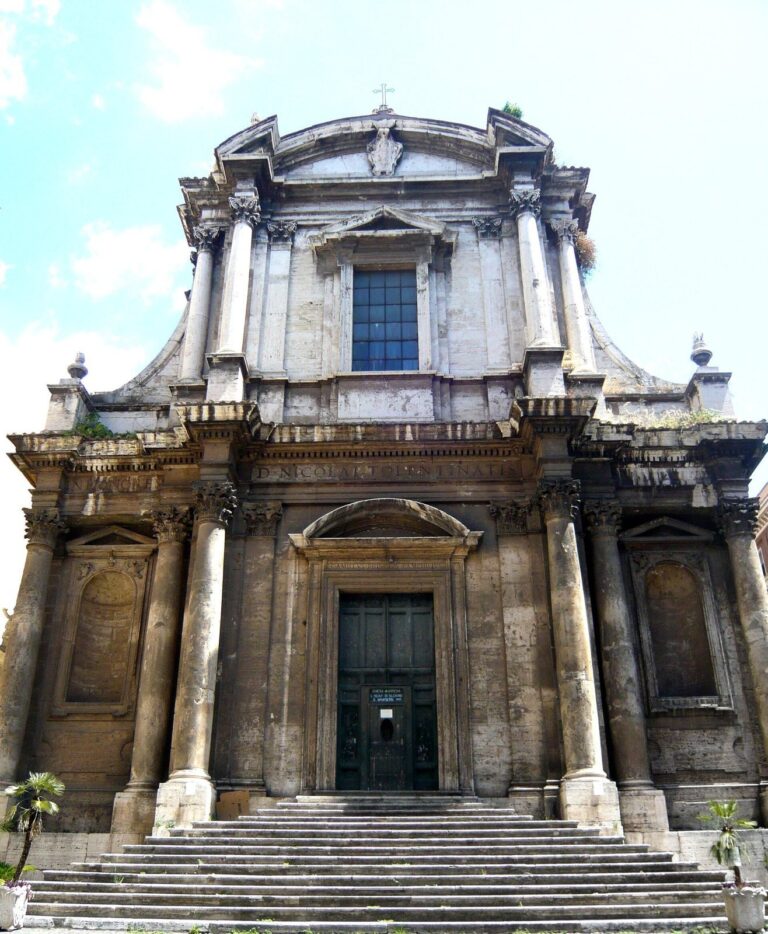
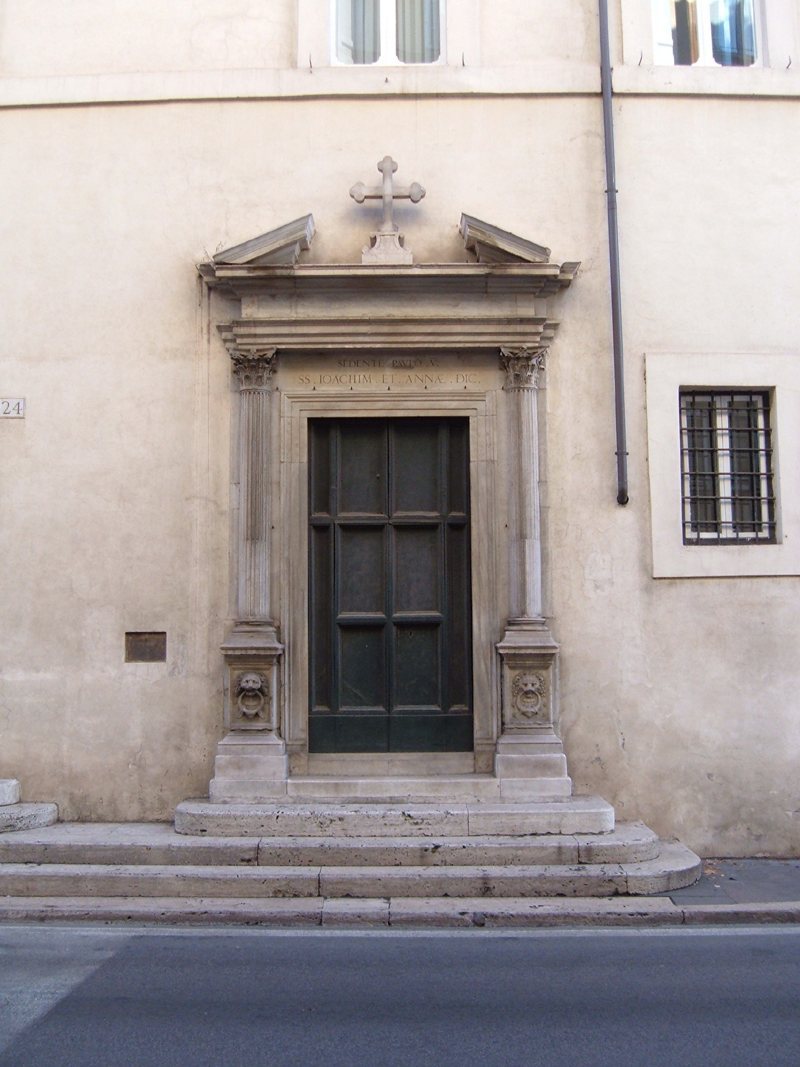
The church stands in Rome’s Rione Monti, beside a building belonging to San Carlo alle Quattro Fontane. Its Baroque exterior has no developed façade, with the entrance portal serving as its principal architectural feature. Corinthian columns flank the portal; their bases are decorated with lion heads, and they support a horizontal entablature and a broken triangular pediment crowned by a cross. An inscription above the entrance recalls the dedication to Joachim and Anne under Pope Paul V. A long passage leads from the portal into the church, whose centralized plan takes the form of a Greek cross, with four arms of equal length. Beyond the entrance are the choir and two side chapels.
Central interior
Dome and central space
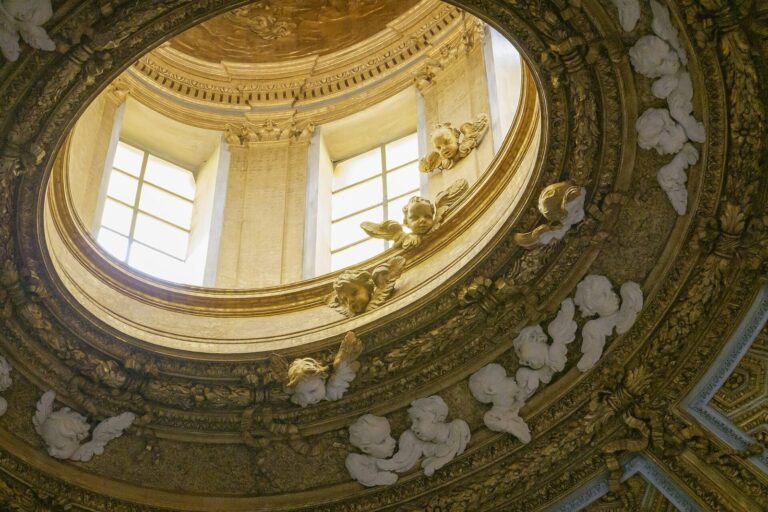
Corinthian pilasters divide the central space, above which rises a dome without an intervening drum. Curved triangular surfaces called pendentives support the dome over the space below. A lantern at its summit bears a relief of the dove of the Holy Spirit. The pendentives have nineteenth-century frescoes of Willibrord, Landoald, Rumold, and Eleutherius, saints associated with Christian missionary traditions in the Low Countries.
Choir and high altar
The choir has a barrel vault, a curved ceiling extending along the space, and a painted false dome. Tuscan pilasters, a plain classical form of wall support, articulate its walls. The high altarpiece depicts the Holy Family with Saints Anne and Joachim. It was made by an unknown artist in the seventeenth century.
Chapels and memorials
Right-hand chapel
The right-hand chapel has an altar framed by twisted columns of the Composite order, which combines features of the Corinthian and Ionic styles. Its altarpiece depicts the Virgin Mary and dates to the church’s foundation period.
Left-hand chapel
The left-hand chapel contains tombs of Belgian Papal Zouaves and an inscription commemorating founders of the Belgian College, including Cardinal Engelbert Sterckx.
Monument to Alfredo De Limminghe
To the left of the high altar stands the tomb monument of Alfredo De Limminghe, a papal infantryman shot dead on 16 April 1861. Pietro Galli made the monument to a design by Giovanni Battista de Rossi. Its projecting relief depicts De Limminghe kneeling before Saint Peter, who receives him with open arms.
Other paintings
Other paintings associated with the church include I. Renier’s depictions of Saint Peter appearing to Saint Amandus and Saint Servatius; Pietro Nelli’s A Holy Monk Comforting a Sick Sister and Two Sisters in Conversation; and Odoardo Vicinelli’s Our Lady of Mount Carmel.