Church of Saints Gervasius and Protasius: Bormio’s Parish and Collegiate Church
Site at a Glance
- Popularity
- Medium
- Country
- Italy
- Primary era
- Early Modern
- Eras represented
- Medieval, Early Modern, Modern
- Civilizations
- Holy Roman Empire
- Site type
- Religious
- Remains
- Church
On this page12 sections
History
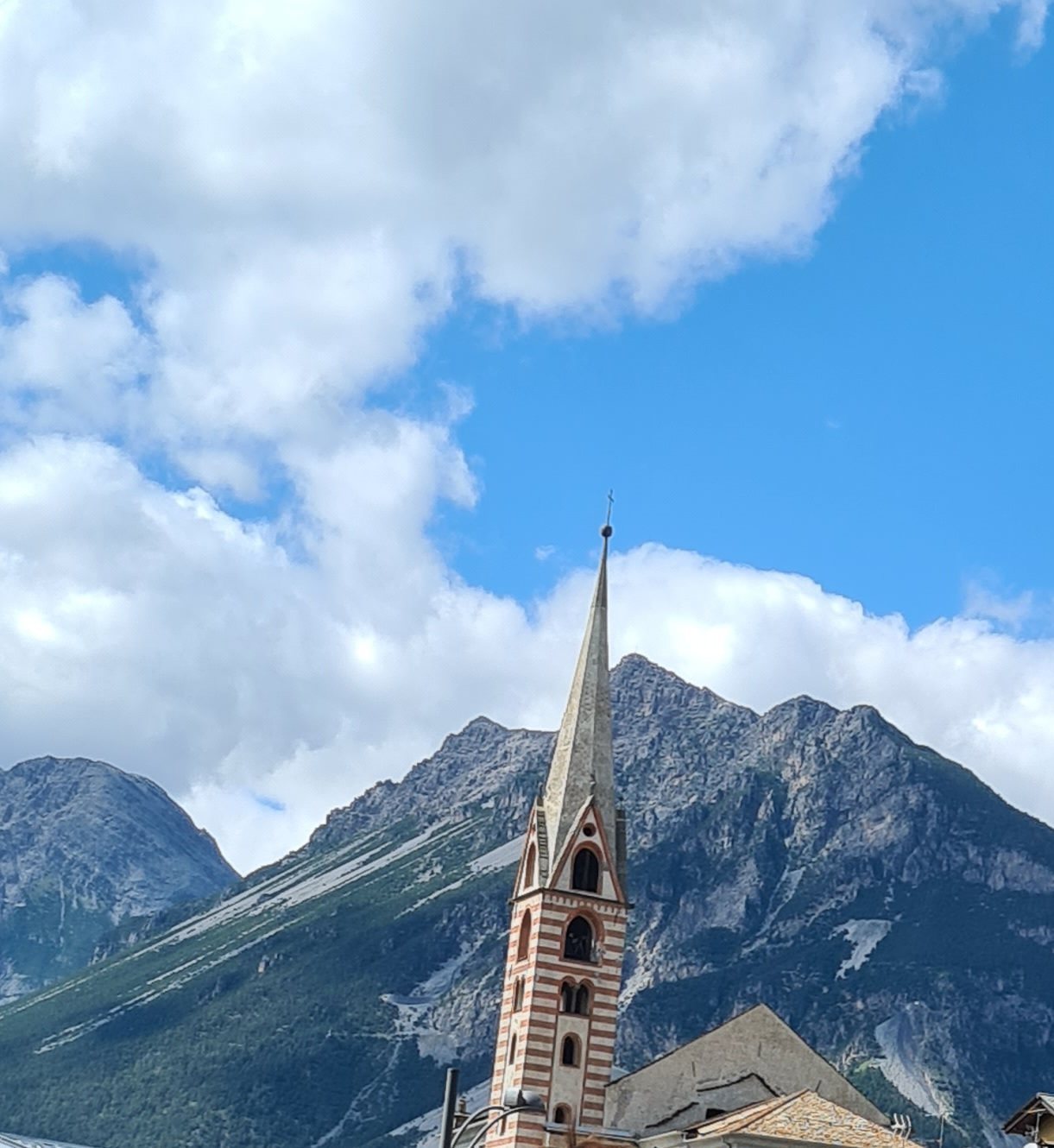
The Church of Saints Gervasius and Protasius is the parish church of Bormio, Italy, and a collegiate church, an institution served by a chapter of clergy. Dedicated to the early Christian martyrs Gervasius and Protasius, it is described as Romanesque, a medieval European style, with Baroque craftsmanship associated with elaborate, dynamic decoration. The present church was built between 1628 and 1641.
Early parish and collegiate chapter
A diploma associated with Charlemagne refers to the church by 803 as a baptistery. It appears again in 824, when Emperor Lothair I confirmed the Diocese of Como’s jurisdiction over Valtellina. The church gained archpriestly status in the 11th century, placing it under an archpriest, a senior priest responsible for a group of parishes.
By the late 13th century, the church’s chapter included the archpriest and five canons, or clergy serving as members of the chapter. Its membership later rose to twelve, but had declined by 1445, when Bishop Gerardo Landriani Capitani made a pastoral visit.
District changes and rebuilding
The church’s historic ecclesiastical district, or pieve, was enlarged in 1551. During the 17th century, this district was reorganized as the Vicariate of Bormio, an administrative grouping of parishes within a diocese. At its establishment, it included Bormio and parishes at Furva, Premadio, Oga, Pedenosso, Semogo, and Livigno, as well as communities at Cepina and Isolaccia.
Swiss troops damaged the earlier church in 1620, and it was almost completely destroyed the following year. The replacement collegiate church was built between 1628 and 1641.
The vicariate in the modern period
In 1816, the Vicariate of Bormio included the parishes of Bormio, Cepina, Isolaccia, Livigno, Oga, Pedenosso, Piatta, Premadio, San Nicolò-Valfurva, Semogo, and Trepalle. Sant’Antonio Morignone joined in 1886, followed by Valdisotto in 1932 and Madonna dei Monti in 1933. A pastoral visit in 1892 counted 2,150 faithful in the pieve and noted four lay associations for religious devotion, dedicated to the Blessed Sacrament, the Most Holy and Immaculate Heart of Mary, the Rosary, and the Sacred Heart of Jesus.
The bell tower was restored in 1927. In the early 20th century, some parishes left the Vicariate of Bormio to form the Vicariate of Livigno; this change was reversed on 20 April 1952. When the Vicariate of Bormio was suppressed in 1968, the church entered the pastoral zone of Alta Valtellina, an administrative grouping of parishes. It returned to the reconstituted Vicariate of Bormio in 2011 and belongs to the Roman Catholic Diocese of Como.
Remains
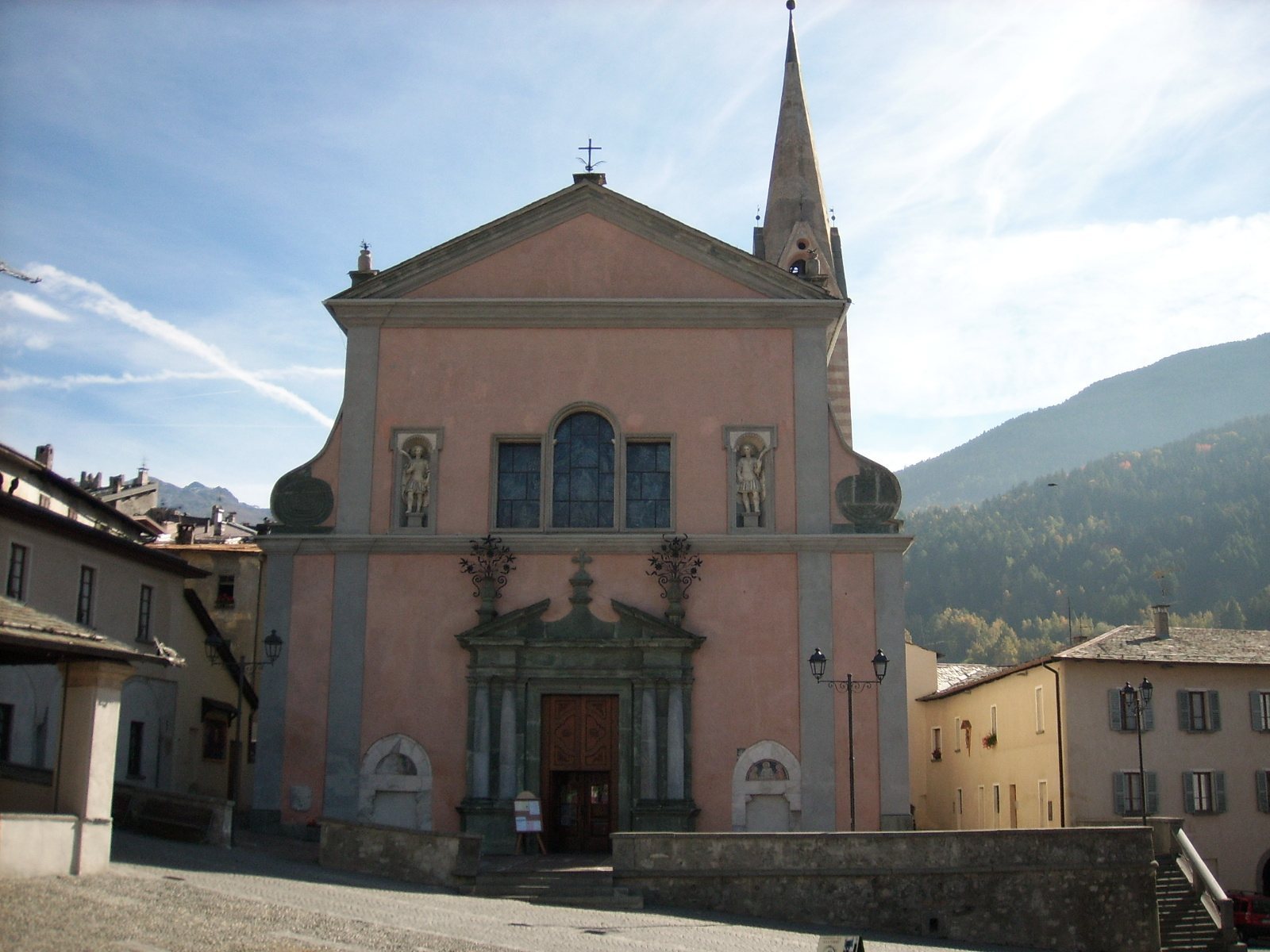
The church faces Piazza Cavour, with a small forecourt bounded by a masonry parapet before its main entrance. Its arrangement links the principal façade with an interior containing a broad apse, the rounded end of the sanctuary, and eight side chapels.
Exterior
Main façade
The façade has two levels separated by a horizontal cornice. In the lower level, pillar-like strips divide the surface into three parts around a large central entrance with a classical-revival design. Above it, the façade ends in a large triangular gable.
Earlier side portals
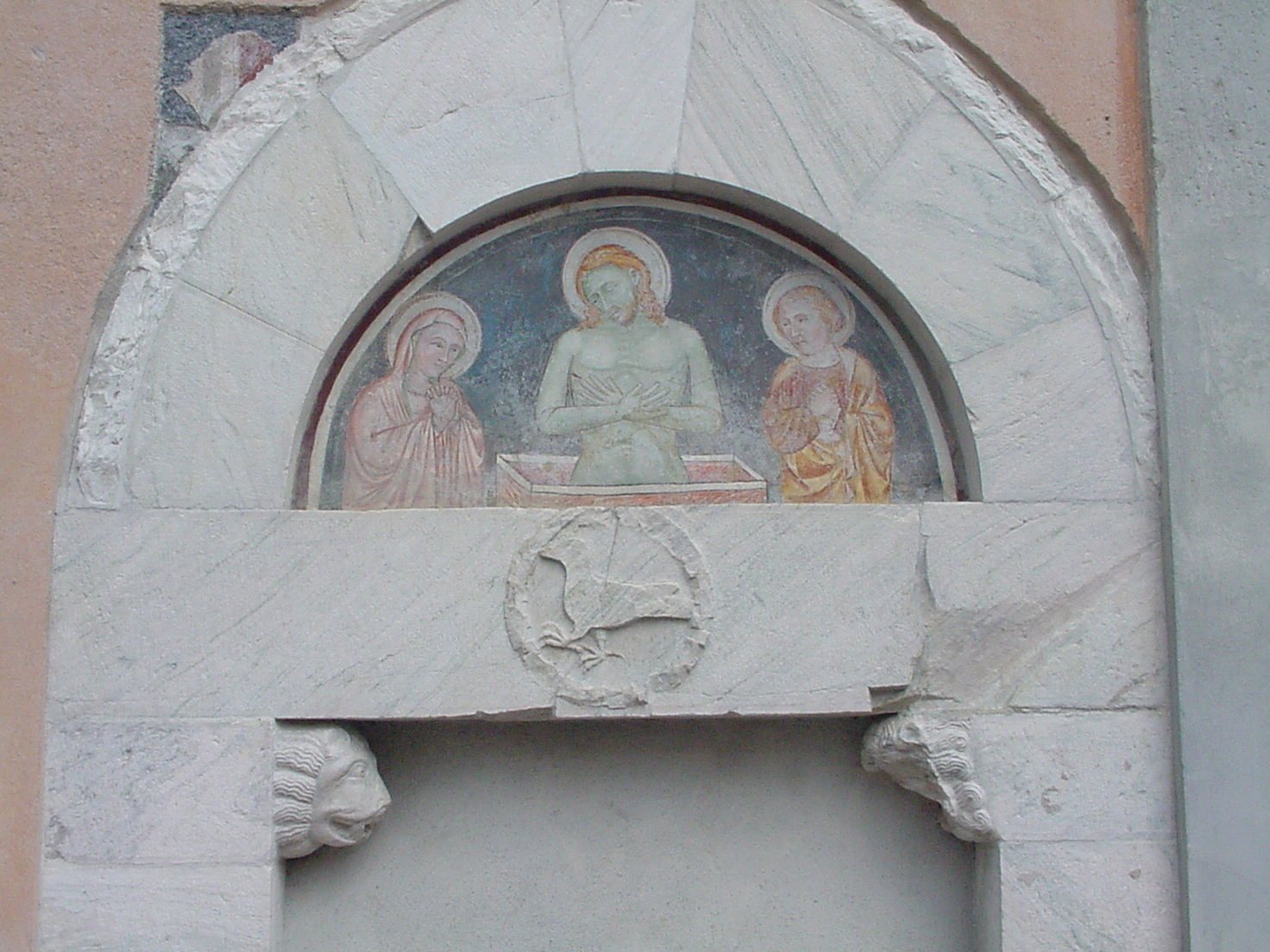
Two white-marble side portals flank the main entrance. They belong to the earlier church and are visible from outside. Their curved upper panels contain 13th-century frescoes, paintings made on plaster, depicting the Virgin Mary with Saint Protasius.
Interior
Chapels and sanctuary
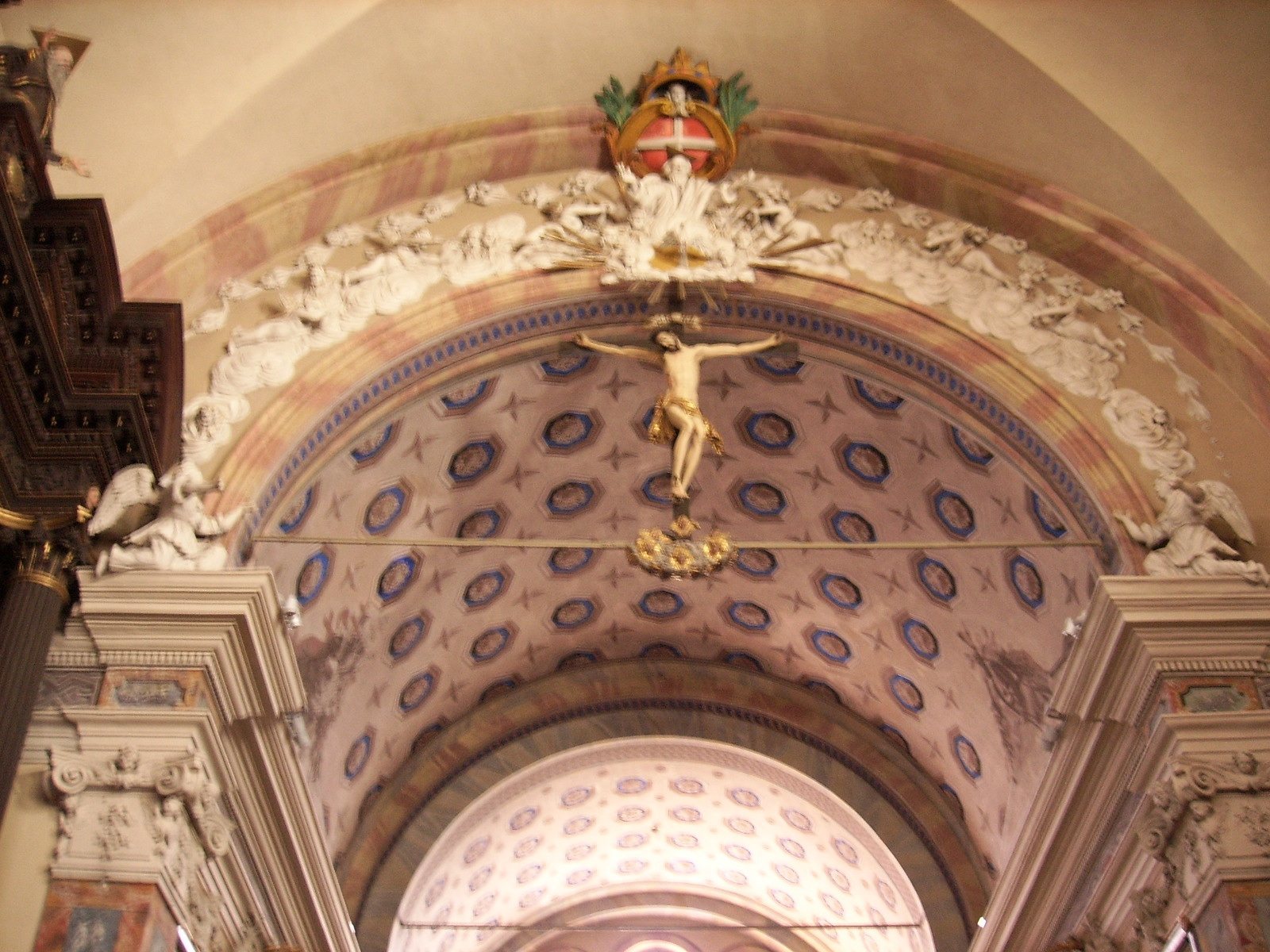
The eight side chapels contain paintings and woodcarvings by local artists. The sanctuary has a barrel vault, a long, curved ceiling, and two paintings by Giuseppe Prina dated 1721: The Martyrdom of Saints Gervasius and Protasius and The Transport of Their Relics.
Organ and liturgical furnishings
Luigi Parietti of Bergamo built the wooden organ in the 19th century. Floral decoration, carvings, and images of Gervasius and Protasius adorn it. A canvas titled The Triumph of Liturgical Music, made between 1666 and 1678 by Carlo Marni with contributions from Paolo Colberg and Baldassarre Rocca, was placed over the organ during Lent, when the instrument was required to remain silent. A wooden ciborium, a furnishing associated with the Eucharist, dates to 1646.
Fresco in the sacristy corridor
A fresco dated 1393 decorates the arch of the corridor connecting the sacristy and rectory. It shows Christ as ruler of all within an almond-shaped frame, surrounded by evangelists, prophets, and apostles, alongside the Madonna nursing the infant Christ. It is considered one of Bormio’s oldest frescoes.