Rock Engraving Park of Grosio: Prehistoric Rock Art and Medieval Castles
Site at a Glance
- Popularity
- Medium
- Country
- Italy
- Primary era
- Iron Age
- Eras represented
- Stone Age, Bronze Age, Iron Age, Medieval, Modern
- Civilizations
- Holy Roman Empire, Italian
- Site type
- Civic
- Remains
- Rock Art
On this page13 sections
History
The Rock Engraving Park of Grosio is an archaeological park in Italy, extending across the municipalities of Grosio and Grosotto in Lombardy. Established in 1978, it was created to protect and study the archaeological, historical, architectural, and landscape heritage of Dosso dei Castelli and Dosso Giroldo. Its creation followed Davide Pace’s discovery of rock engravings in 1966 and the donation of land, buildings, and medieval remains by Margherita Pallavicino Mossi Visconti-Venosta.
Pace found further engravings on Dosso Giroldo in 1967. Researchers mapped and studied the engravings on Rupe Magna from 1991 to 1995. Excavations at Castello Nuovo in the 1990s also revealed evidence of an earlier settlement.
Prehistoric settlement
Finds from Dosso dei Castelli indicate settlement from the Middle Bronze Age through the late Iron Age, including the 1st century BC. They point to distinctive local cultural influences and changing connections with communities in the upper Rhine region of the Grisons and the southern Alpine region of Trentino-Alto Adige.
Medieval castles and changing land use
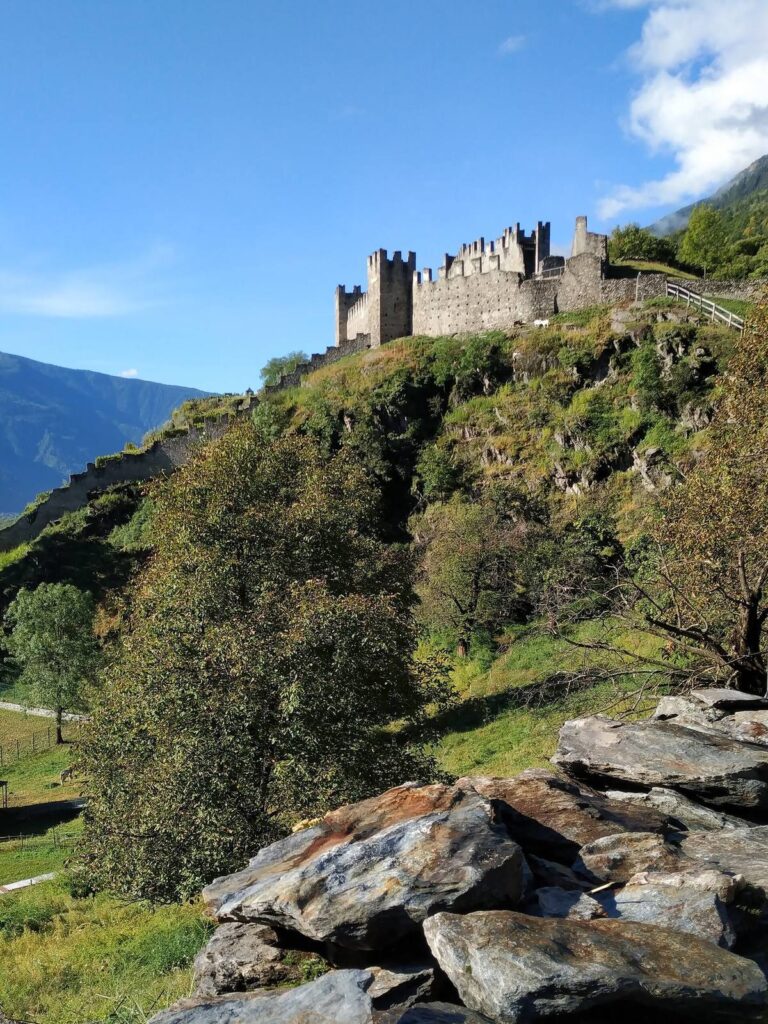
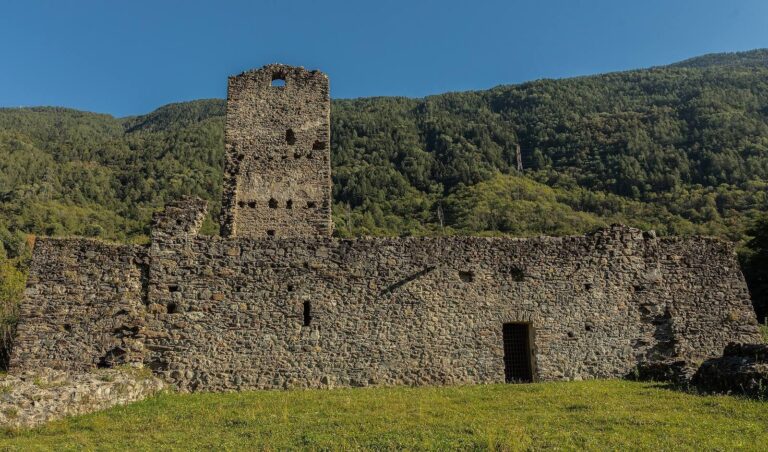
Castello Vecchio, also called the Old Castle or Castle of San Faustino, was built around the late 10th or early 11th century at the behest of the Bishop of Como. A written record from 1150 names it Castrum Groxi. The castle was associated with the Pieve of Mazzo, a territorial church district on which it depended. It represented the bishop’s authority and helped control movement and trade along the Adda valley and access to the Mortirolo Pass. Storing goods and tribute was another function. From about the 12th century, the bishop’s local vassals were the Lords of Matsch, later known in Valtellina as the Venosta family. The castle remained inhabited into the final decades of the 16th century.
Valtellina passed from Como to Milan in 1335. Between 1350 and 1375, the Visconti, the ruling family of Milan, initiated construction of Castello Nuovo to meet the region’s changed strategic and military needs. The castle did not take part directly in fighting, although Milanese troops gathered there in 1376 before marching against Bormio. In 1512, Chiavenna, Valtellina, and Bormio became subject territories of the Three Leagues, a confederation in the Grisons that separated them from Milan. In 1526, the new rulers partly demolished Castello Nuovo, removing its residential block and other important infrastructure to take it out of use and prevent a possible revolt.
Terraces on the hill slopes were developed after the Old Castle was built, probably after 1200. From 2013, the Fondazione Fojanini cleared vegetation and repaired terraces to revive grape cultivation. Five white-grape varieties were planted experimentally in a region then primarily associated with red wine, and wine from the renewed plantings was produced from 2017.
Remains
The park covers 260,000 square metres and includes Dosso dei Castelli, Dosso Giroldo, the two castles, and the surrounding slopes. Its archaeological and built features occupy a landscape shaped by rock, steep ground, and cultivated terraces.
Rupe Magna
Rock surface and imagery
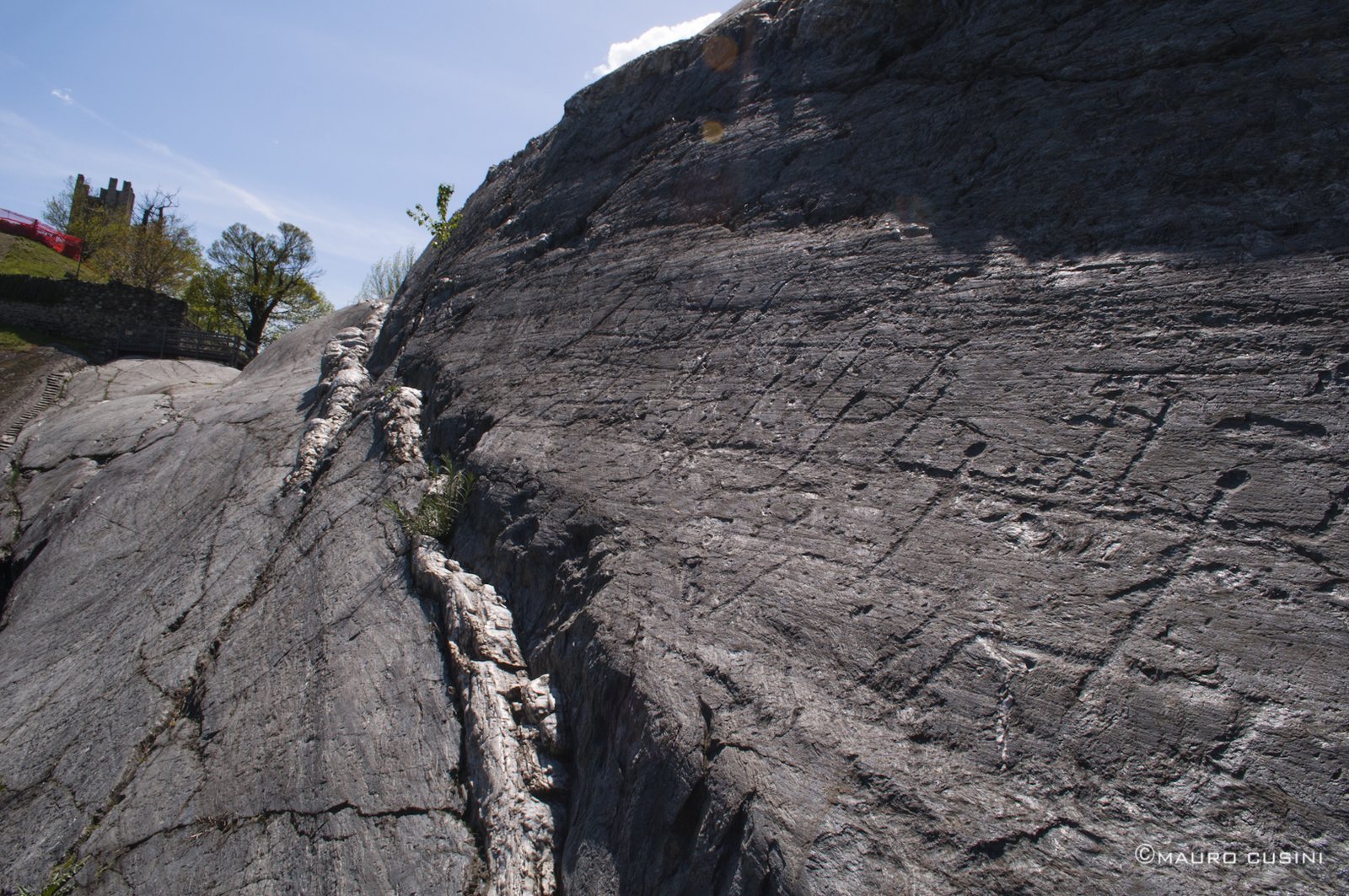
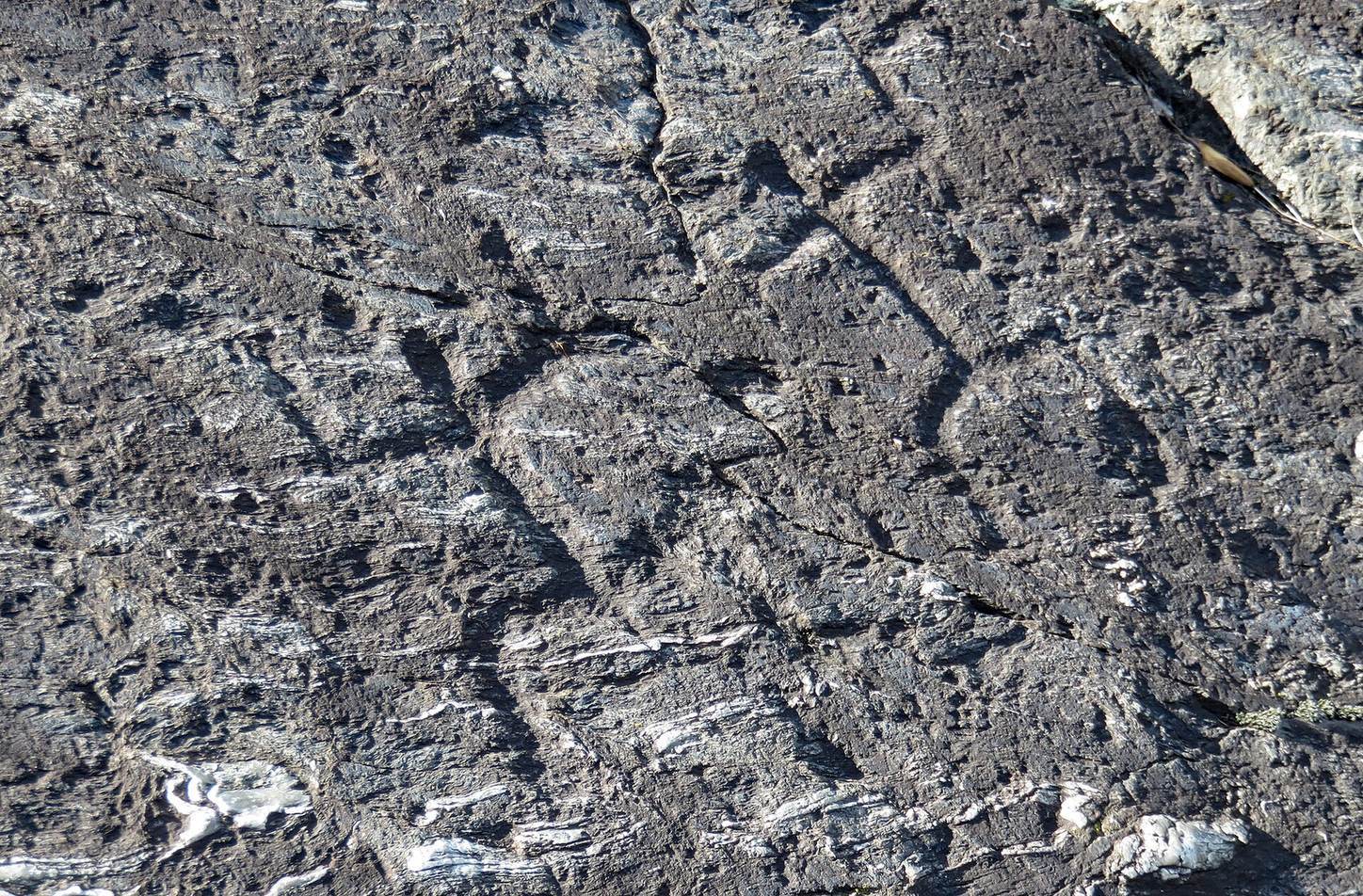
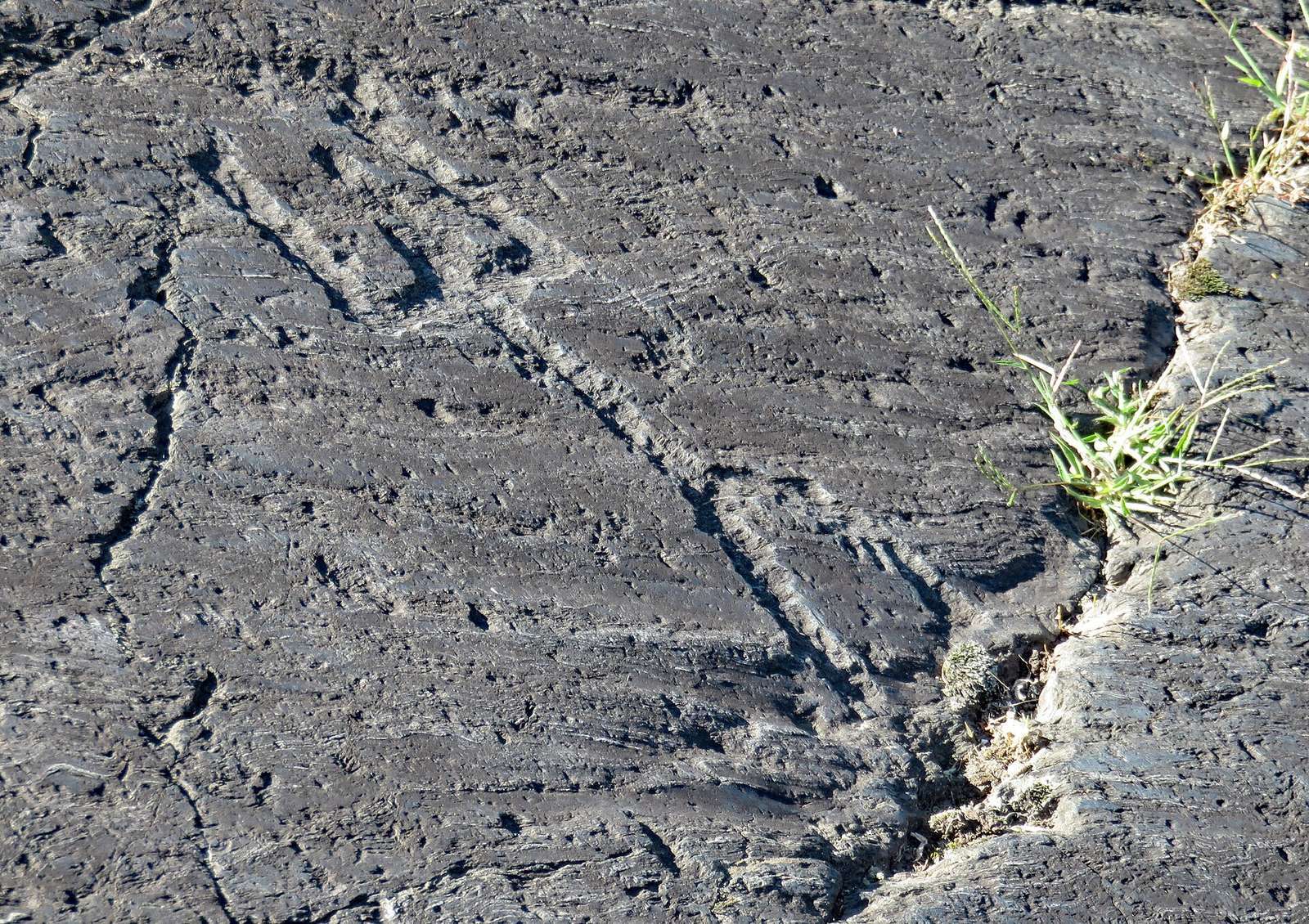
Rupe Magna is an engraved rock about 84 metres long and 35 metres wide, bearing more than 5,000 figures. It is among the largest engraved rocks in the Alpine region. Glacial movement shaped its form and smoothed its surface, which consists of dark-grey phyllite, a fine-grained metamorphic rock, crossed by white quartz veins.
The carvings include human figures, worshippers, armed people, wrestlers, animals, geometric patterns, small cup-shaped hollows known as cup-marks, and other objects. Some of the earliest motifs are concentric arcs, probably dating to the 4th or 3rd millennium BC. Human figures as a group date from the middle of the 2nd millennium to the 6th century BC; most are assigned to the Iron Age and show worshippers with raised arms or armed warriors. Two crosses on the rock provide evidence of Christian religious practice. The range of imagery has been interpreted as offering a glimpse of everyday life in prehistoric Valtellina.
Leaping Worshippers
Three pairs of figures known as the Leaping Worshippers are each about 80 centimetres tall and date to the 12th–10th centuries BC. Their limbs are arranged symmetrically and bent at right angles, creating the appearance of dancing. Objects in their hands have prompted interpretations of either a musical dance or a ritual weapon dance.
Prehistoric settlement remains
Settlement remains have been found on Dosso dei Castelli, including within Castello Nuovo. These finds place evidence of earlier occupation within the same hilltop landscape as the later fortifications.
Castello Vecchio
Hilltop position and construction
The Old Castle occupied the southern end of Dosso dei Castelli and followed the western end of the hilltop. Its position afforded views over the Adda valley and the approach to the Mortirolo Pass, which links Valtellina with Valcamonica and, via the Tonale Pass, Trentino. Parts of the castle rested on exposed bedrock, while other sections were cut directly into the stone.
Chapel of Saints Faustinus and Jovita
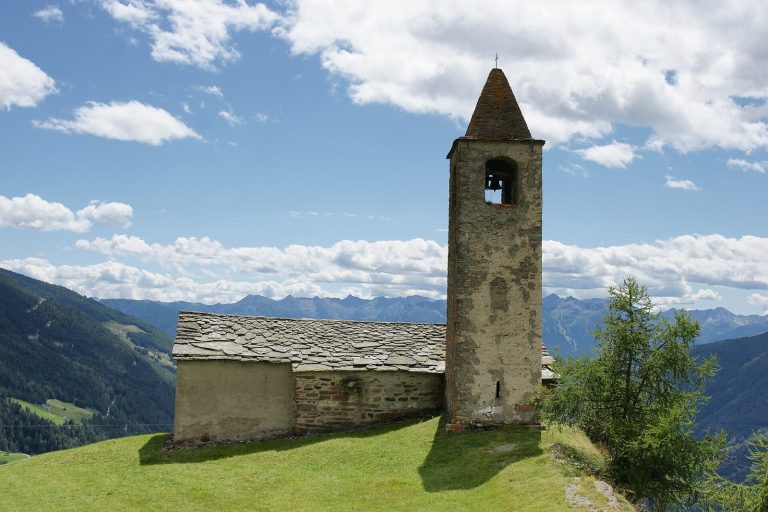
A small hall church dedicated to Saints Faustinus and Jovita stood over a double grave cut into the rock within the castle complex. The chapel’s earliest archaeological phase dates to the 7th–8th century. A Romanesque tower belonged to the chapel, and the church spire was partly restructured in the late 19th century.
Castello Nuovo
The New Castle had two defensive walls and a fortified keep, the principal tower and final point of defence and refuge. Its southern side stood directly against the hill’s steep slope, while a moat formerly protected the northern side.
Terraces and surrounding landscape
The hill slopes bear dry-stone terraces, built by fitting stones together without mortar, and traditionally used for grapevines. Chestnut trees have long characterized the surrounding mountain landscape and provided food and raw materials. Near the pass lies a riverside woodland. Mosses and lichens grow on or near Rupe Magna and are harmful to the preservation of its engravings; grasses, Opuntia succulents, and wild thyme also grow in the area.