Santa Maria in Publicolis: A Baroque Church in Rome
Site at a Glance
- Popularity
- Medium
- Country
- Italy
- Primary era
- Early Modern
- Eras represented
- Medieval, Early Modern, Modern
- Civilizations
- Italian, Papal States
- Site type
- Religious
- Remains
- Church
On this page11 sections
History
Santa Maria in Publicolis is a Roman Catholic church in Rome, Italy, dedicated to the Nativity of the Virgin Mary. Its present building is a 17th-century Baroque church. It is described as the only church in Rome dedicated to this feast and is an annex of Santi Biagio e Carlo ai Catinari within the Diocese of Rome.
Medieval records and the church’s name
A papal document issued under Pope Urban III names the church in 1186 as Santa Maria de Publico and identifies it as affiliated with San Lorenzo in Damaso. A late-12th-century list of Roman churches compiled by Cencio Camerario, a medieval papal official, includes it as entry 208 under the name Sancte Marie in Publico.
The origin of the name Publicolis is uncertain. It may refer to the nearby Porticus Minucia frumentaria, a place associated with distributing Rome’s public grain supply. By the 16th century, the church was called in Publicolis. Its patrons, the Santacroce family, claimed descent from the ancient Roman Valerii Publicola and connected the church’s name with that ancestry. Their tradition associated the consul Publius Valerius Publicola with laws favoring the plebeians in 509 BC.
Santacroce patronage and rebuilding
The Santacroce family restored the church in 1465. After it fell into ruin, it was demolished in 1642 and rebuilt under Cardinal Marcello Santacroce, to a design by Roman Baroque architect Giovanni Antonio de Rossi. Construction was completed in 1643.
Parish and convent church
The church remained a parish until Pope Leo XII’s major reform of 1823, while the Santacroce family continued to maintain it. Antonio Publicola Santacroce, the last male-line member of the family, died without male descendants in 1867.
By 1835, the church had become the principal house of the Missionaries of the Sacred Hearts of Jesus and Mary, a Catholic congregation founded by the priest Gaetano Errico. The congregation was entrusted with the church in 1858. Its members moved into a neighboring convent in 1864, and the convent became the order’s headquarters. Santa Maria in Publicolis now serves as a convent church.
Remains
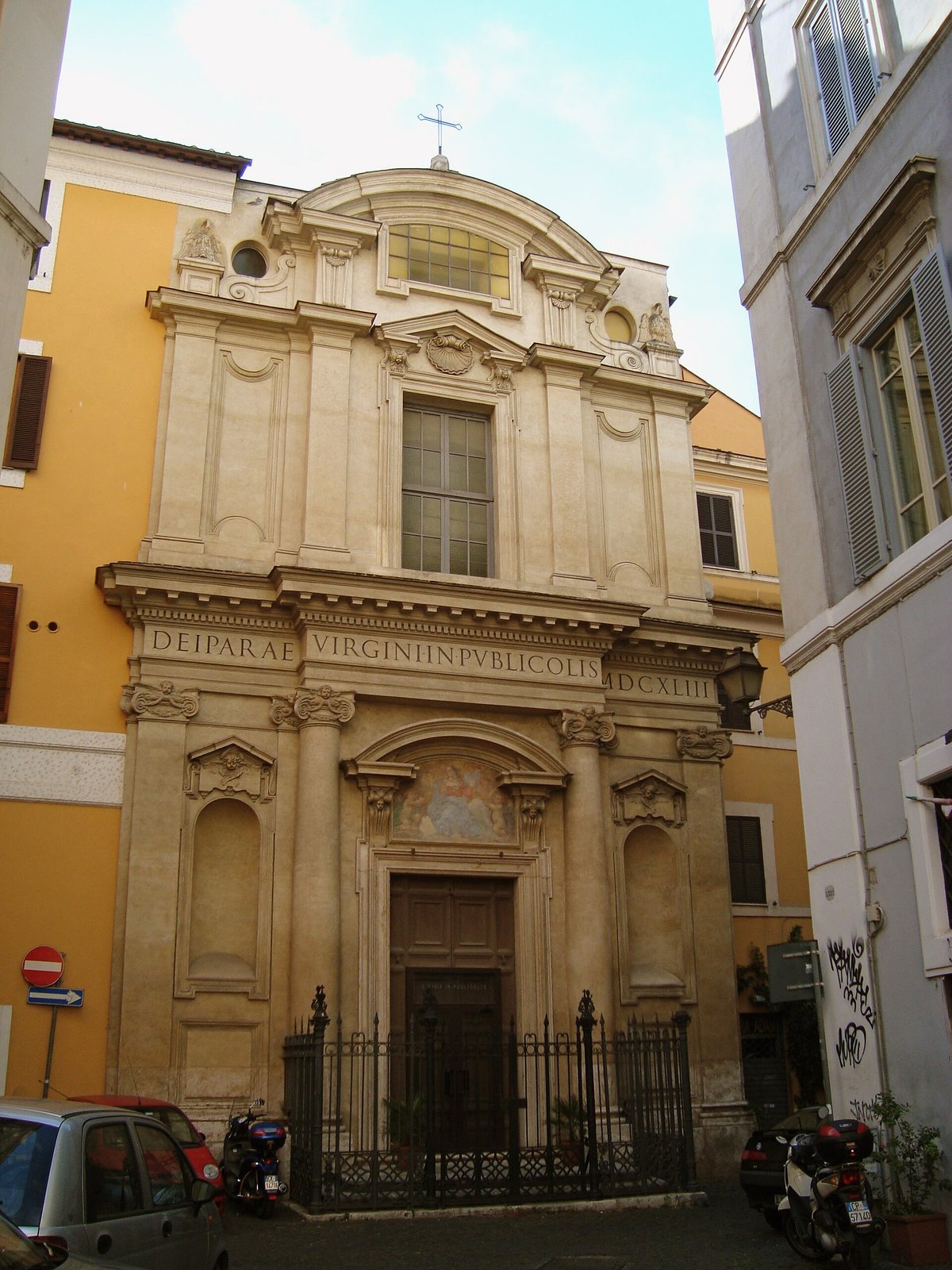
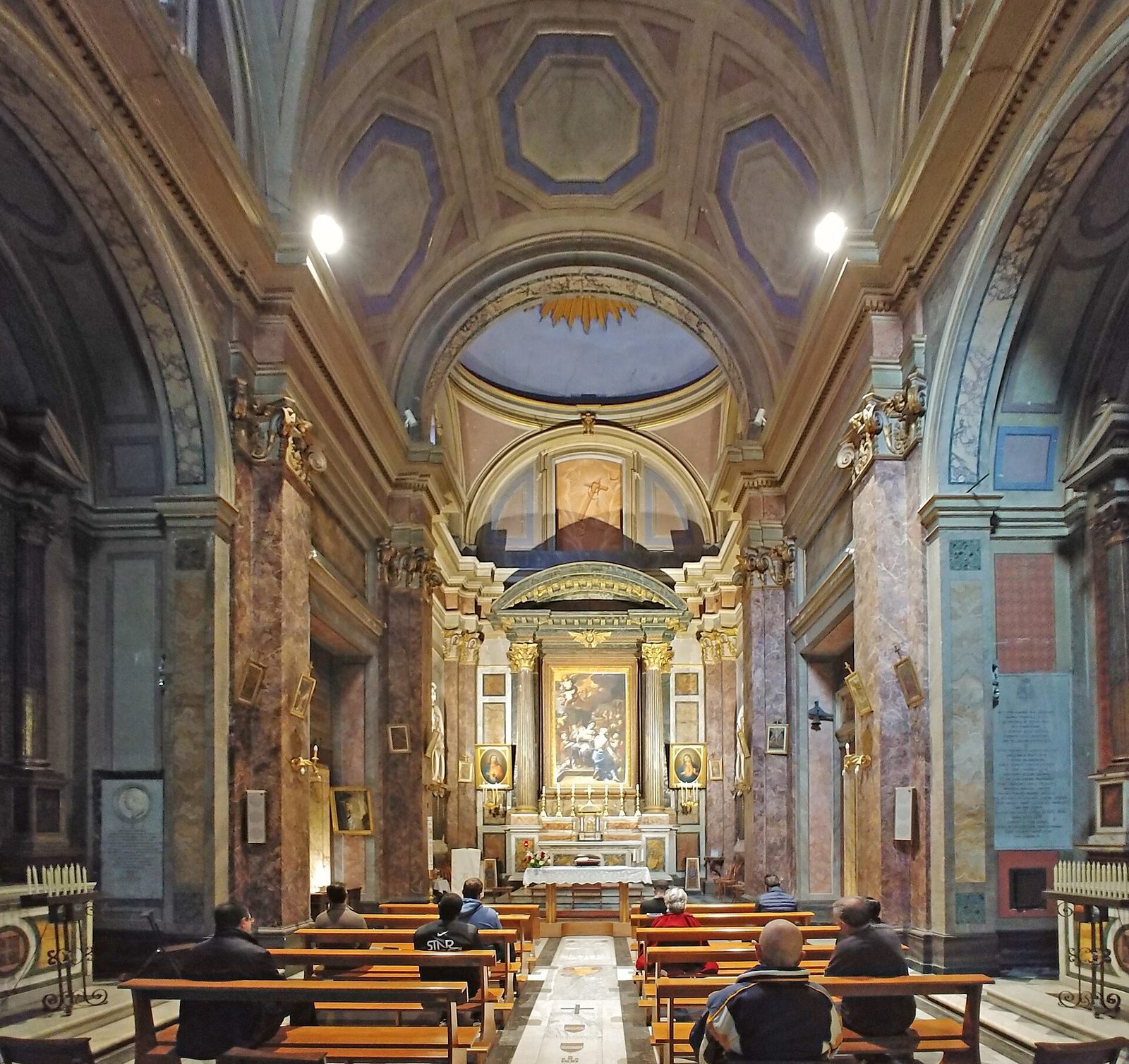
The Baroque church has a two-level façade and a single-nave interior, with two side chapels and a domed sanctuary area at the far end. Its surviving furnishings include paintings, family burials, tomb monuments, and a pipe organ.
Façade
A projecting cornice, or horizontal molding, divides the façade into two levels, each arranged in three vertical sections. The lower level centers on a portal framed by two half-columns in the Ionic classical style. Above the portal is a fresco of the Madonna enthroned among angels, while empty semicircular niches flank the entrance. The upper level has flat pilasters, or column-like strips attached to a wall, in the Tuscan classical style, and a large central window. An arched pediment, the crowning element of the façade, is flanked by sculptures of pelicans wounding their breasts, a symbol of Christ.
Interior
Nave and chapels
The nave, or main body of the church, has a barrel vault, a continuous semicircular ceiling, and two side chapels. In the chapel on the right is Raffaello Vanni’s painting of Saint Helena adoring the Cross. Saint Helena, a Roman empress, is traditionally associated with the discovery of the True Cross. The left-hand chapel contains a painting of Saint Francis of Assisi, founder of the Franciscan movement, by Grimaldi. It is described as a copy after a work by the Italian painter Annibale Carracci.
Apse and high altar
At the end of the nave, a rectangular apse, the church’s terminal recess, is covered by a dome. It is occupied by the presbytery, the area around the main altar. The high altar is made of polychrome marble and includes Vanni’s painting of the Nativity of the Virgin.
Tombs and floor slabs
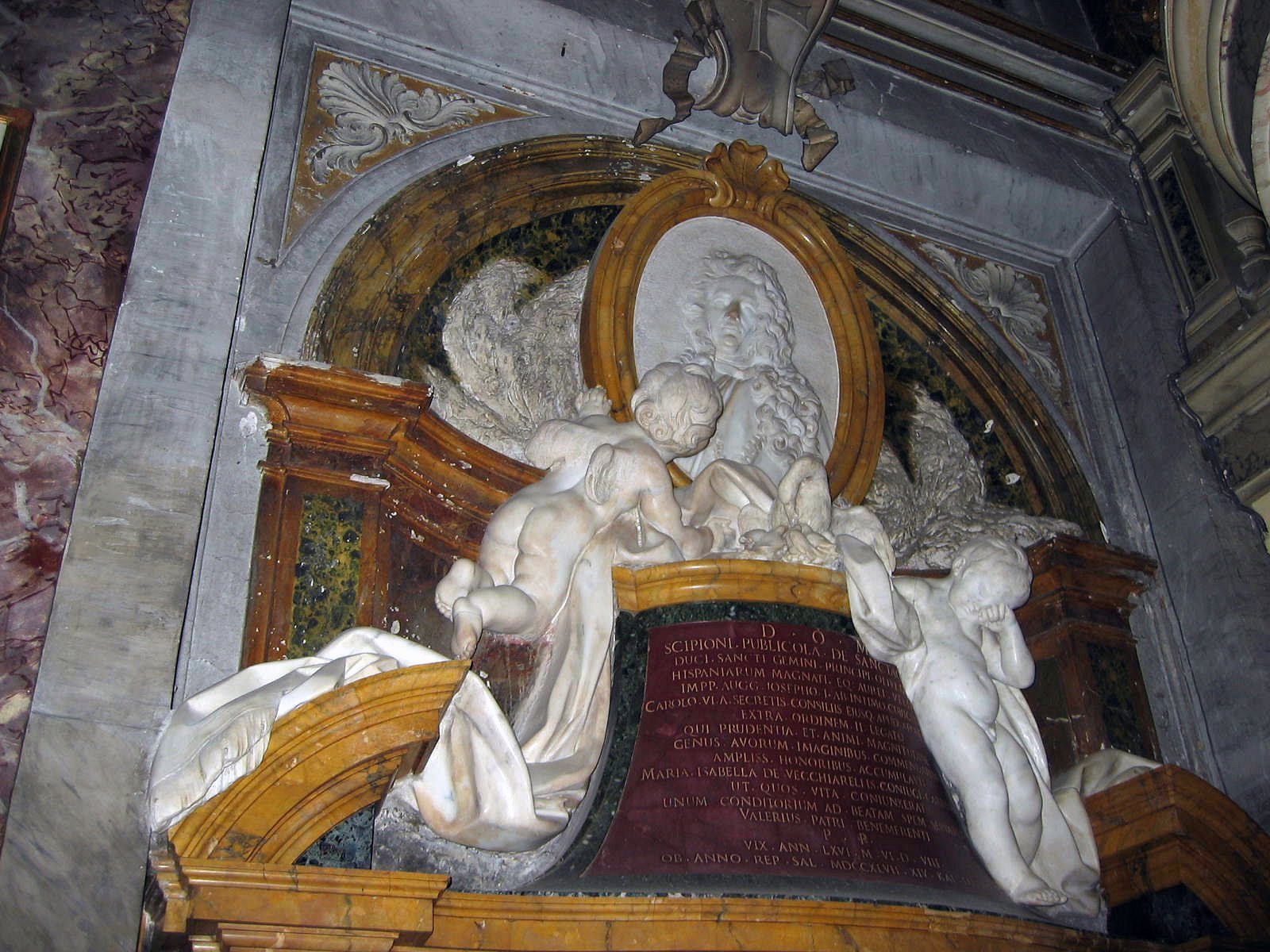
Several 15th- and 16th-century tomb slabs are set into the floor, including one for Alfonso Santacroce. Burials in the church include members of the Santacroce family: Alfonso, Prospero, Antonio, Marcello, Andrea, and Valerio. The church also contains the grave of Ottavia Corsini. A tomb monument for Scipione Publicola Santacroce is attributed to Giovanni Battista Maini, while Antonio Publicola Santacroce’s tomb is attributed to Lorenzo Ottoni.
Choir gallery and organ
The choir gallery, an elevated gallery traditionally used by a choir or organ, occupies the inner façade. It holds the Mascioni pipe organ, opus 307, built in 1912.