Santa Maria in Gruptis: A Medieval Catholic Abbey in Italy


Site at a Glance
- Rating
- 4.9
- Popularity
- Very Low
- Country
- Italy
- Primary era
- Medieval
- Eras represented
- Medieval, Early Modern
- Civilizations
- Kingdom of Naples, Lombard, Spanish
- Site type
- Religious
- Remains
- Fortified Monastery
On this page11 sections
History
Santa Maria in Gruptis, also known as Santa Maria della Grotta, is a former Catholic abbey in Italy, founded by the Lombards, a Germanic people who established the medieval Principality of Benevento in southern Italy. It was established between 940 and 944 in the Camposauro mountains of the province of Benevento and dedicated to the Virgin Mary. The abbey’s position and possessions made it a locally important monastic fief, meaning land or jurisdiction held and administered by a monastery.
Foundation and monastic communities
One of the Lombard princes of Benevento founded the abbey, possibly Atenulf II or Atenulf III. It was initially intended for Benedictine monks, members of a Catholic monastic tradition, and was later occupied successively by the Celestines, the Humiliati, and the Camaldolese. The Camaldolese were a reform branch of the Benedictine tradition.
The earliest surviving written records concerning Santa Maria in Gruptis date from 1164. The abbey held several fiefs and developed a sphere of influence around the castrum of Tocco, Vitulano, and Limata. Its wider connections extended to Benevento, Capua, Telese, Pietramontecorvino, Sant’Agata de’ Goti, Arienzo, Fragneto l’Abate, Guardia Sanframondi, Castelvetere, and Morcone.
Territorial dispute and abandonment
In 1303, the Angevins attempted to incorporate Santa Maria in Gruptis into Santa Maria in Mazzocca, also called Santa Maria del Gualdo, at Foiano di Val Fortore. Local inhabitants opposed the plan in a popular revolt, and the dispute continued until 1326.
In 1660 the abbey was transferred to the Camaldolese. It was abandoned soon afterward following the 1688 earthquake in the Sannio region. Cardinal Vincenzo Maria Orsini, then archbishop of Benevento and later Pope Benedict XIII, deconsecrated the neglected abbey in 1705. Repeated attacks by brigands had also affected the site, whose ruins were later used by them as a refuge. The year 1705 is also given as the date of the abbey’s demolition.
Name, devotion, and documentary heritage
The oldest recorded name was Santa Maria di Monte Drago, referring to the mountain on which the abbey stands. Later forms included Santa Maria di Monte Drocho, Santa Maria in Cripta, Santa Maria de Crypta, and Santa Maria de la Grocta. A fiscal decree of 1545, issued under Abbot Blasio Sellaroli, called it Santa Maria de lo Vallo de Vitulano, or Santa Maria of the Valley of Vitulano.
The name Santa Maria in Gruptis refers to the karst caves around the abbey. These caves supplied the monastic complex through a system for collecting and distributing water. The abbey was dedicated to the Virgin after a Byzantine icon of her was found inside one of the caves.
The abbey’s parchment archive was acquired by antiquarians in the early nineteenth century. In 1882, their heirs donated it to the Neapolitan Society of Homeland History, whose library still preserves it. Academic study developed particularly from the 1960s, after the archive’s earlier dispersal and reordering had resulted in fragmentary study. A partial edition of parchments from the twelfth to the fourteenth centuries and a 2013 edition of 92 eleventh- and twelfth-century parchments added to knowledge of the collection.
The parchments mainly concern sales, acknowledgements of rights, and grants or donations made to the abbey for the salvation of donors’ souls and the remission of sins. They use the terms breve, scriptum, and cartula without strict differentiation, a practice associated with the contemporary Principato Ulteriore. Documents drawn up at Tocco, Vitulano, and Limata use a mixed writing style, combining late Carolingian forms with Gothic influences rather than traditional Beneventan script, the medieval writing tradition associated particularly with southern Italy.
Although the site was geographically considered part of Vitulano in the 2020s, it belongs administratively to Foglianise. Maps up to 1936 and maps reflecting the Second World War period showed it as part of Foglianise. The former abbey now lies within Zone A, an integral-reserve area of the Taburno-Camposauro Regional Park.
Remains
Mountain setting and approach
The former abbey stands at about 607 metres above sea level in the area called Chiaria, against Mount Drago, one of the peaks of the Camposauro massif. It occupies the side of the Funno gorge within the karst gorge of Vallone Secco. The steep position overlooks the valley and lies where two mule tracks once connected the Vitulanese and Telesina valleys. Paths following those ancient routes now provide access on foot.
Vallone Secco and its surroundings form a regionally significant geosite whose primary value is geomorphological, with additional scenic, educational, and excursion-related values. The area of Santa Maria della Grotta provides an observation point over this geological landscape.
Surviving structures
Tower, portal, and enclosing wall
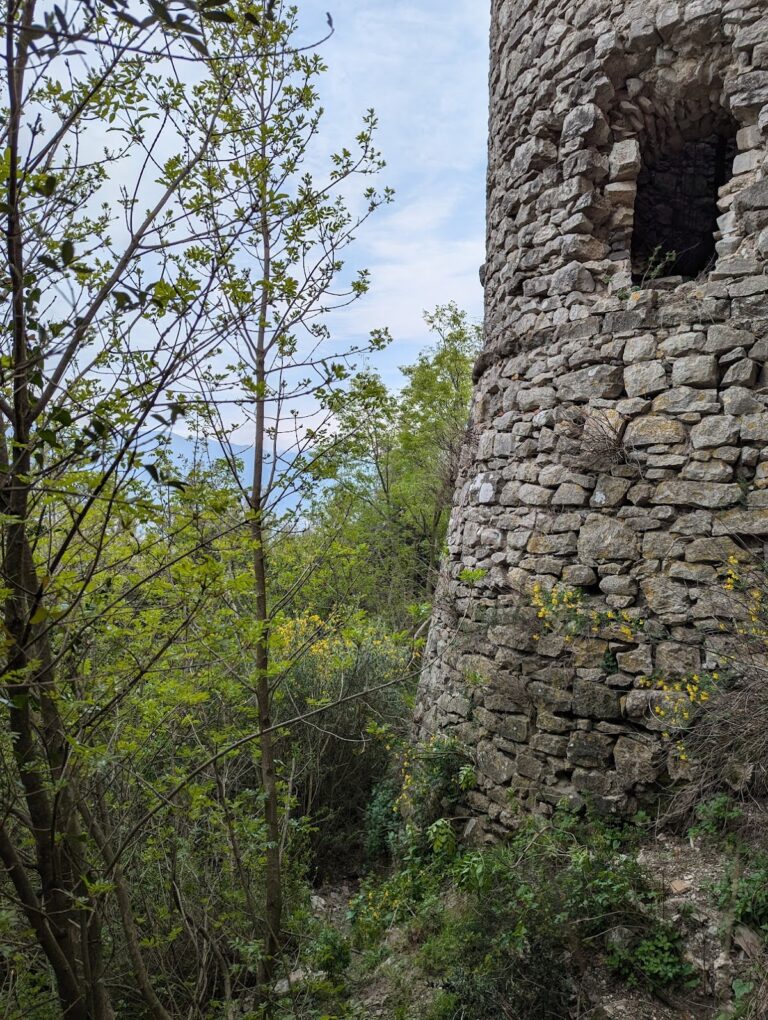
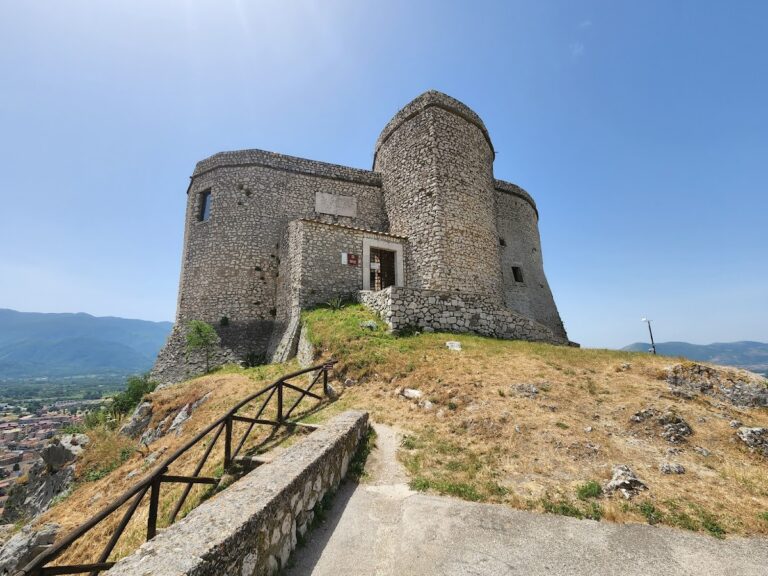
Large portions of the abbey ruins remained intact into the twenty-first century. The visible fabric includes a tower, the entrance portal, and part of the enclosing wall. The wall belongs to a later phase of the complex, while the tower and portal remain identifiable elements of the ruined site.
Monastic residences
The sixteenth-century residences of the monks and the prior can still be identified within the ruins. Their survival preserves part of the residential organization of the later monastic complex.
Church apse
The ancient church was entered from the internal courtyard. Its apse, the usually semicircular or polygonal end of a church behind the main altar, is the surviving portion of the building.
Caves and water system
The surrounding karst caves formed part of the abbey’s water-collection and distribution system. One of these caves was also associated with the discovery of the Byzantine icon of the Virgin that became central to the abbey’s dedication and devotional heritage.