Santa Maria delle Vergini, Macerata: A Catholic Sanctuary to the Virgin Mary
Site at a Glance
- Popularity
- Medium
- Country
- Italy
- Primary era
- Early Modern
- Eras represented
- Early Modern
- Civilizations
- Papal States
- Site type
- Religious
- Remains
- Sanctuary
On this page15 sections
History
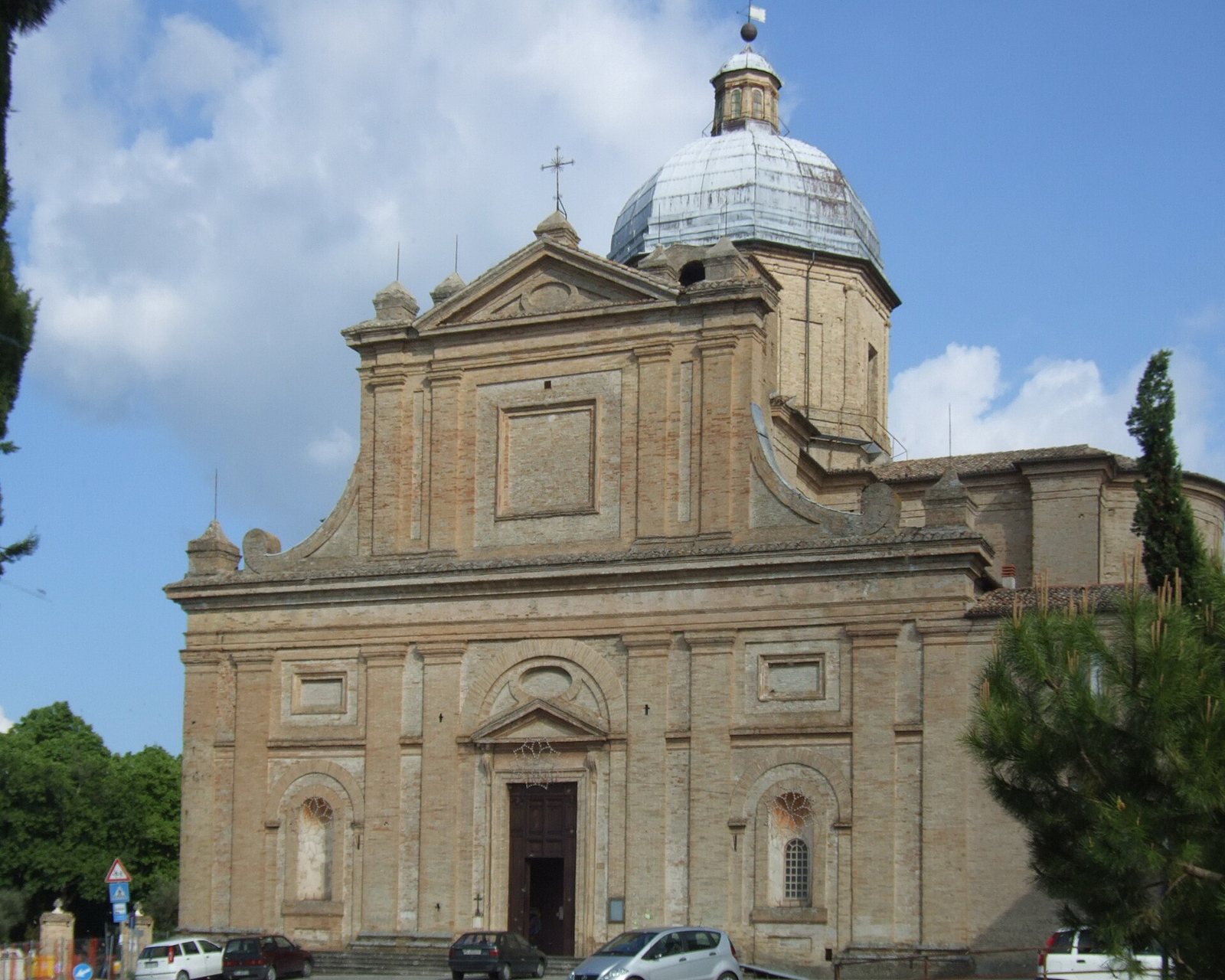
Santa Maria delle Vergini is a Catholic sanctuary dedicated to the Virgin Mary, southeast of Macerata’s historic center and outside the city’s former walls in Italy. Construction began in 1550, and the church was consecrated in 1577. Its architecture and decoration are regarded as among the Marche’s most important sacred projects of the sixteenth and seventeenth centuries, second in importance to Loreto.
The chapel and the Marian tradition
A small chapel dedicated to the Virgin Mary may have stood here around 1335, and it is known to have existed by 1355. By 1510 it had fallen into disrepair. The chapel was then granted to Augustinian friars from the nearby church of Santa Maria della Fonte. In 1547, the friars planned to demolish it and reuse its building materials.
The chapel contained a sacred image painted in 1533 by Lorenzo de Carris, known as Giuda. Local tradition connects the image with miracles and says that, on 10 April 1548, the Virgin appeared to a young girl named Bernardina di Bonino. She was told to warn Macerata’s people that they should repent, fast and pray on a Saturday, and organize a procession of virgins to avert divine anger over scandals in the city. Belief in the apparition and other miracles is said to have persuaded the friars to spare the chapel.
Building and changing custodianship
The community chose to replace the small chapel with a large sanctuary that would protect its sacred image. The first stone was laid on 21 September 1550. The walls were in place by 1553; the pillars were finished in 1561, when work began on the dome. The dome was completed in 1566, and the church was consecrated in 1577 in the presence of Galeazzo Morone, bishop of Macerata and Recanati.
During construction, the sanctuary was entrusted to the Company of Virgins, a lay religious association whose members initially included unmarried young people of both sexes. As the organization later became exclusively female, the church’s designation changed accordingly. The sanctuary was also assigned to the Jesuits, members of the Society of Jesus, who arrived in Macerata in 1562. In 1566 it passed to the Carmelites, a Catholic religious order, specifically their Congregation of Mantua.
The design is attributed to Galasso Alghisi of Carpi, who was called to the Marche in 1550 to direct work at the Basilica of the Holy House of Loreto for five years. The sanctuary’s decorative program has helped inform reconstructions of the earlier decoration at Loreto. A connection between its design and plans by the architect Donato Bramante has been proposed, but remains uncertain. In 1605, the image of the Virgin was transferred from its original shrine within the building site to the eastern apse, after which the shrine was demolished.
Remains
Plan and interior arrangement
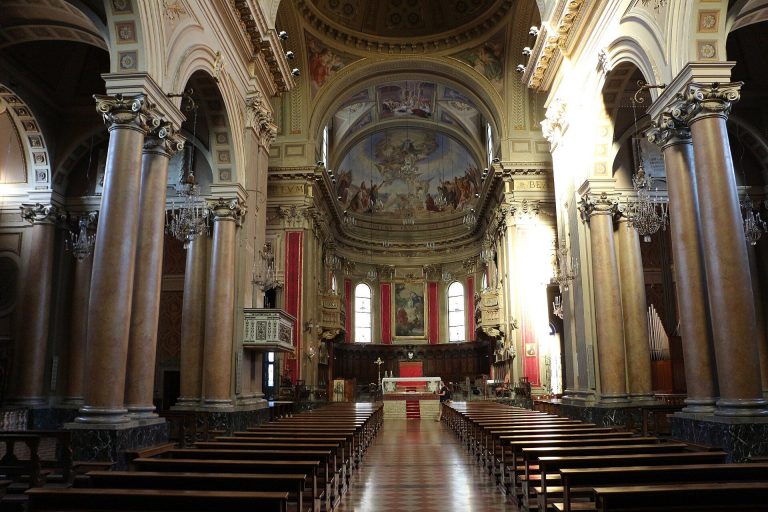
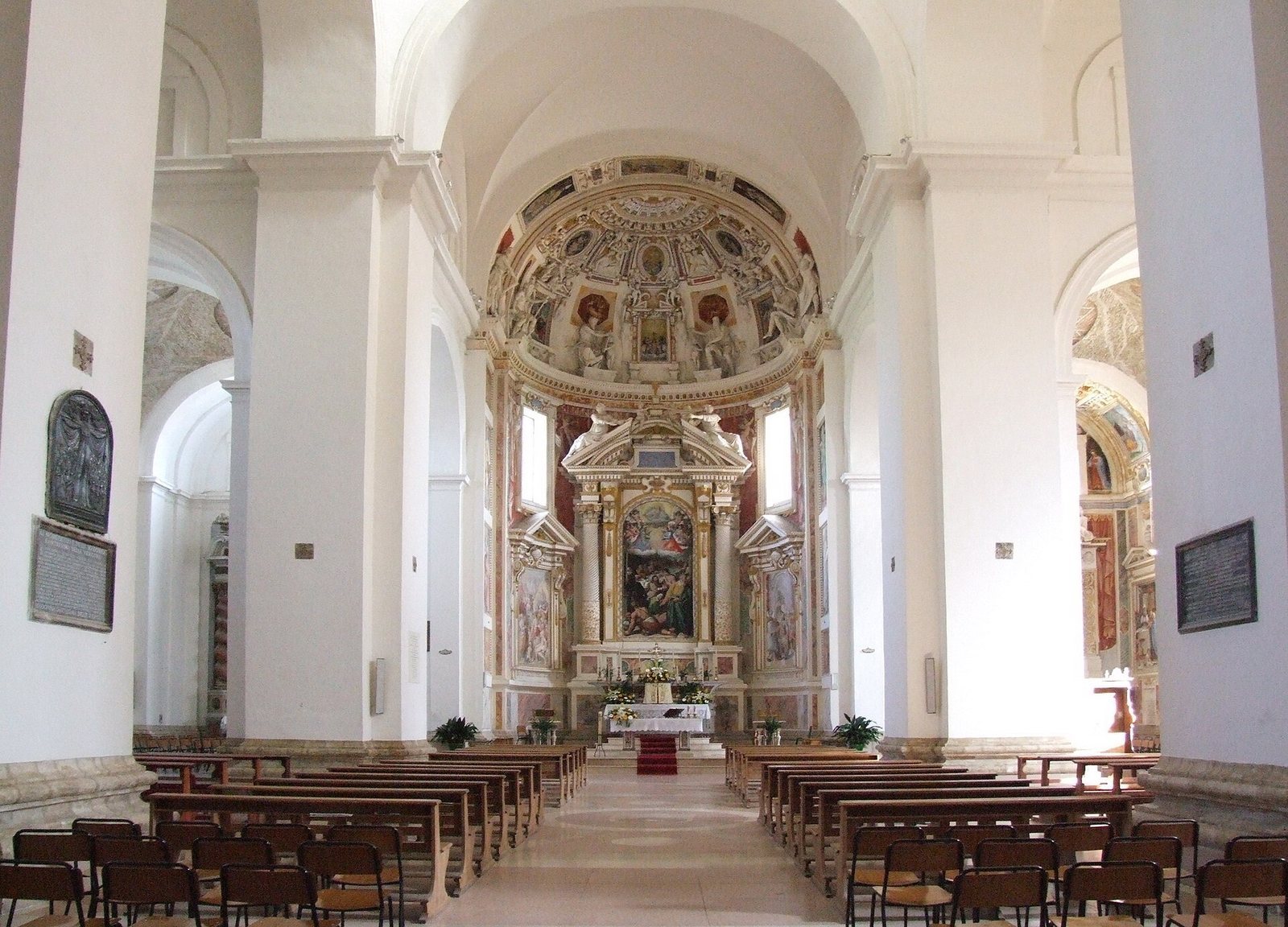
The sanctuary has a Greek-cross plan, with four arms of roughly equal length around a central space. An octagonal dome rises above it on a drum, the upright structure that supports a dome, carried by four massive supports with square bases. Each arm ends in an apse, a projecting semicircular end. Two small rectangular side chapels open from each apse, with ceilings formed by intersecting curved sections.
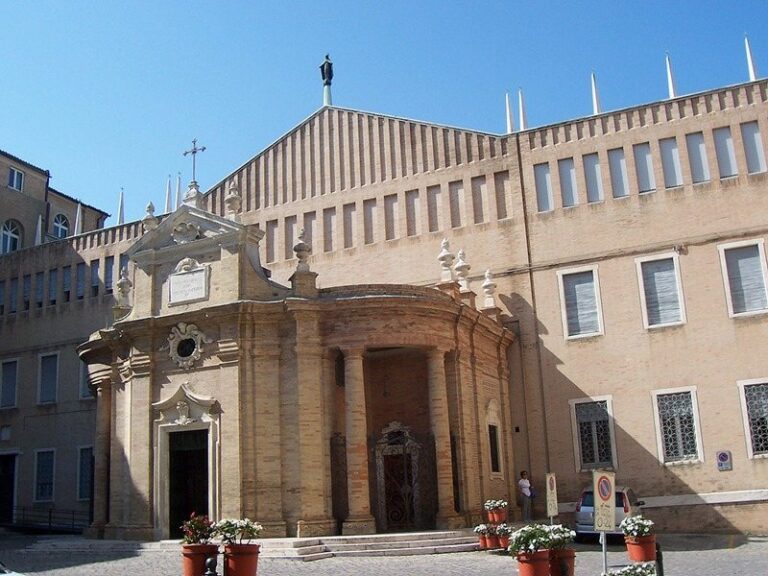
The exterior façade, completed in 1587, is arranged in two horizontal tiers and does not mirror the church’s internal layout. Decoration is restrained across the naves and vaults compared with the richly ornamented chapels. Their connected cycles of images devoted to the Virgin were added mainly from the late sixteenth century through the first half of the seventeenth century, with further work continuing into the eighteenth. Other named chapels include the Baptistery Chapel and chapels dedicated to Saint Philip and Saint Teresa.
Decorated chapels
Mozzi Chapel
Built between 1574 and 1577, the Mozzi Chapel was the sanctuary’s first completed chapel. Alessandro Mozzi, son of the Bergamasque merchant Bartolotto, intended to commission it but died in 1574. His mother, Margherita Marchetti, carried out the plan and entrusted the decoration to Gaspare Gasparrini. The chapel contains Gasparrini’s canvas of the Assumption, which is in poor condition, wall paintings of the Birth of the Virgin and the Presentation of Mary in the Temple, and partly surviving molded plaster ornament.
Albani Chapel
Built between 1579 and 1581 for Cardinal Gian Girolamo Albani, a senior Catholic official who had governed the March of Ancona from 1569 to 1571, the chapel was decorated by Gaspare Gasparrini. Its altar painting shows the Madonna and Child with Saints Jerome and Nicholas of Tolentino. The wall paintings depict the Killing of the False Prophets on the right and the Miracle of Elijah’s Sacrifice on the left. Giuseppe Bastiani was among the artists who worked on the decoration.
Ciccolini Chapel
The Ciccolini family commissioned Giuseppe Bastiani to decorate this chapel in 1593. His altar painting, completed in 1600, depicts the Ecstasy of Saint Francis before the Coronation of the Virgin. Other wall paintings show the Nativity and the Presentation in the Temple, while the underside of the arch carries scenes of the Dream of Saint Joseph and the Massacre of the Innocents. The altar painting is regarded as an example of reformed painting, an approach shaped by Catholic reform that emphasized clarity and devotional purpose. Its restrained ornament and direct, emotionally subtle presentation characterize the work.
Main Chapel or Farmers’ Chapel
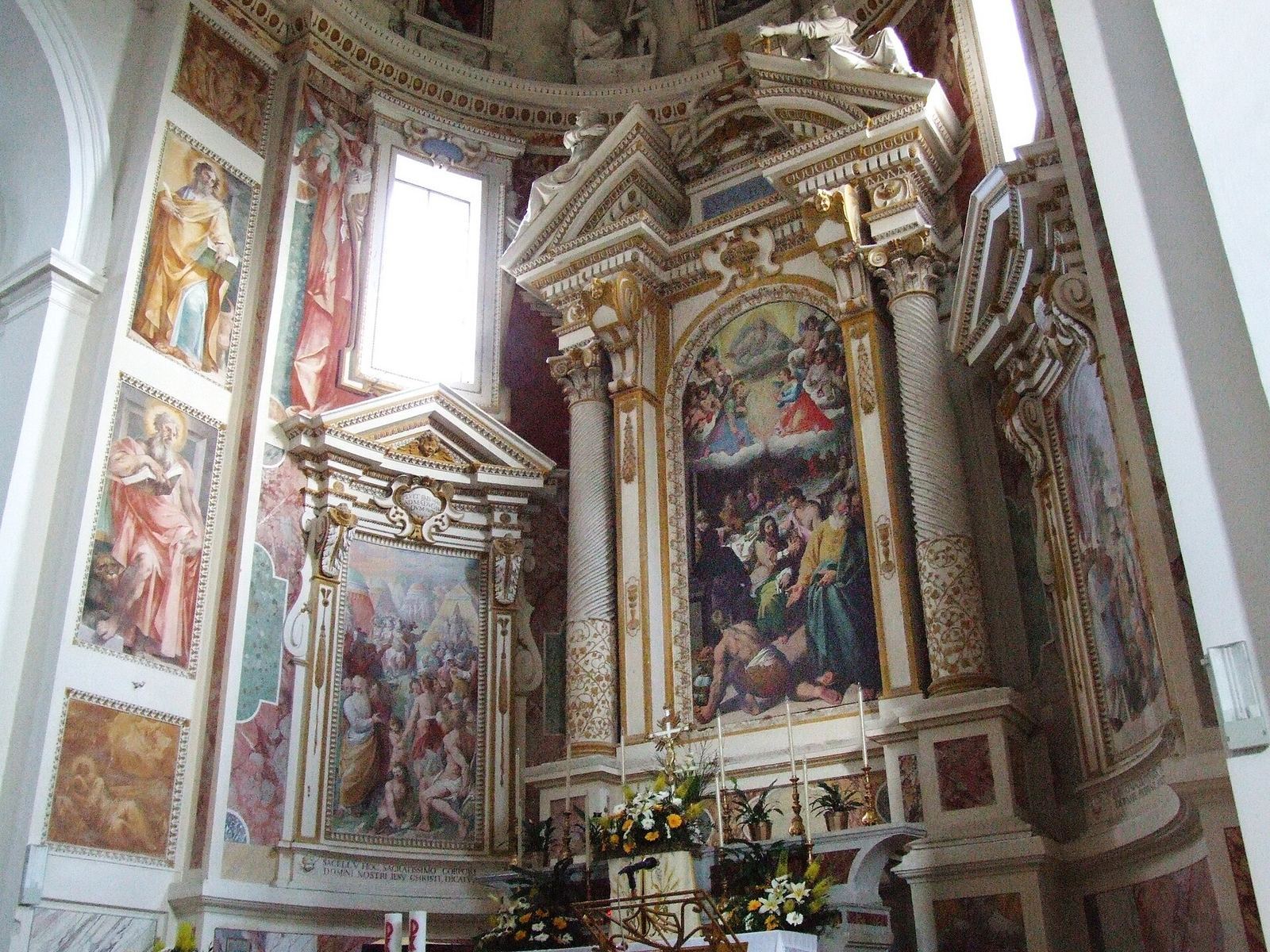
A confraternity, a lay religious association organized around shared devotional or charitable purposes, began decorating this chapel in 1589. Gaspare Gasparrini painted only the half-dome covering the apse before his death in 1590. In 1592, work passed to the brothers Cesare and Vincenzo Conti, painters from Arcevia who had worked on late-sixteenth-century projects in Rome. Their Last Supper altar painting was completed by 1595. Its use of perspective and sculptural treatment of the figures has been linked to the influence of Girolamo Muziano. Wall paintings on either side show the Gathering of Manna and the Meeting of Abraham and Melchizedek.
Ferri Chapel
Decoration began in 1584 to a design by Gaspare Gasparrini, and the chapel retains finely worked molded plaster ornament by Martino Buselli Grisomei. In 1610, Clelia Amici, Ferri’s widow, placed an Adoration of the Magi on the left wall. She had acquired the painting from Tintoretto’s workshop in 1587, but its attribution remains disputed between Jacopo Tintoretto and his son Domenico. A copy of Peter Paul Rubens’s Adoration of the Shepherds hangs on the right wall.
Chapel of the Company of Virgins
This chapel has especially elaborate decoration, including molded plaster, imitation marble and gilding. Its wall painting of the Madonna of Mercy, by Lorenzo de Carris, known as Giuda, is identified as the sacred image associated with the earlier chapel. The work reflects artistic innovations from Raphael’s circle in Rome. Andrea Boscoli painted the half-dome over the apse with Stories of the Virgin. Above it are figures representing virtues, the prophets Isaiah and Jeremiah, children and sibyls, female figures associated with prophecy. Some or all of these upper paintings may be by Boscoli’s pupil Marcello Gobbi.
Bernardino Cesari painted two canvases for the chapel around 1606 and 1607. In the Annunciation on the left wall, the angel is more assured and sinuous than the figure of the Virgin, which has been partly repainted. The angel’s design draws on a drawing by Cesari’s brother. Above the altar, the horizontal-format Rest on the Flight into Egypt may originally have been made as a room painting in Rome, and appears to recall Caravaggio’s treatment of the subject. Giovanni Baglione’s Visitation on the right wall dates to between 1613 and 1618.
Panici Chapel
Decorated around 1595 to 1598 at the request of Cardinal Giangiacomo Panici, the chapel received its altar painting through a commission from his brothers, who inherited his estate. The work shows the Madonna and Child with Saints John, James the Greater and Albert of Trapani, alongside two children of the Panici family. Once attributed to Felice Damiani, it is now assigned to Cesare and Vincenzo Conti. Its devotional and commemorative arrangement uses two tiers of pyramid-shaped groupings, substantial figures, clear light and vivid color.
Pancalducci Chapel
Dedicated to Saint Anne, the chapel was decorated in 1580 and 1581 at the expense of the blacksmith Martino Pancalducci. Its altar painting, signed by the brothers Giovanni Battista and Francesco Ragazzini, depicts the Madonna and Child, Saint Anne, Saint Bernardino, Saint Anthony of Padua, Saint Margaret of Antioch, Saint Andrew Corsini, Saint Julian, and Martino Pancalducci with his wife. Wall paintings depict Saint Mary Magdalene and Saint Elizabeth of Hungary. The Ragazzini brothers, painters from Ravenna associated with Luca Longhi’s circle, worked in the Mannerist style, a late Renaissance approach known for elongated forms and complex compositions.
The hanging crocodile
A stuffed crocodile hangs from a hook on one of the arches in the left nave. Local legend says that in the late sixteenth century a crocodile appeared on the banks of the Chienti River, killed animals and seized a child. The child’s father pursued and killed it with a pitchfork after calling on the Virgin Mary, then had the animal stuffed and hung in the church. The crocodile may instead have been a curiosity brought to Italy from the Holy Land.