Santa Maria del Regno: Royal Chapel and Parish Church in Sardinia


Site at a Glance
- Rating
- 4.7
- Popularity
- Low
- Country
- Italy
- Primary era
- Medieval
- External website
- Open
- Eras represented
- Medieval, Early Modern
- Civilizations
- Crown of Aragon, Spanish
- Site type
- Religious
- Remains
- Church
On this page10 sections
History
Santa Maria del Regno is a Romanesque Catholic church in Ardara, Italy, built in the eleventh century during the period when the town was the capital and residence of the Judicate of Torres. A Judicate was a medieval Sardinian state ruled by a judge whose authority combined political and judicial functions. Built alongside the castle of Ardara, the church served as the palace chapel of the rulers of Torres and remains the town’s parish church within the Diocese of Ozieri.
Foundation and consecration
Construction took place at the direction of Giorgia, a member of the ruling family and sister of Gonnario Comita, judge of Torres and Arborea. Pisan craftsmen built the church within the strong cultural and architectural influence of the maritime Republic of Pisa. Its architect is unknown, but the building has been associated with a single designer working in the Lombard current of the Pisan-Tuscan school. The church was consecrated on 7 May 1107.
Royal chapel of the Judicate
Santa Maria del Regno served both the religious needs of the court and the public expression of the rulers’ authority. Several rulers of Torres took oaths in the church and were buried there. Its role as the palace chapel is also recalled in the Libellus Judicum Turritanorum, a thirteenth-century document written in Logudorese.
In 1238, Adelasia of Torres married Enzo of Swabia in the church. Adelasia was heir to the Judicates of Torres and Gallura, while Enzo was the son of the Hohenstaufen emperor Frederick II and later used the title King of Sardinia. Tradition holds that Adelasia died around 1259 at the castle of Burgos after withdrawing there. Recent research may have identified her tomb at the foot of the high altar.
Name and later history
The name Santa Maria del Regno reflects the church’s former royal connection with the Judicate of Torres. Its nickname, “the Black Cathedral,” refers to the dark, rust-colored stone used in its construction. The building has undergone restoration, during which its large sixteenth-century altarpiece was kept outside the church. The altarpiece has since returned to its original setting.
Remains
Exterior and masonry
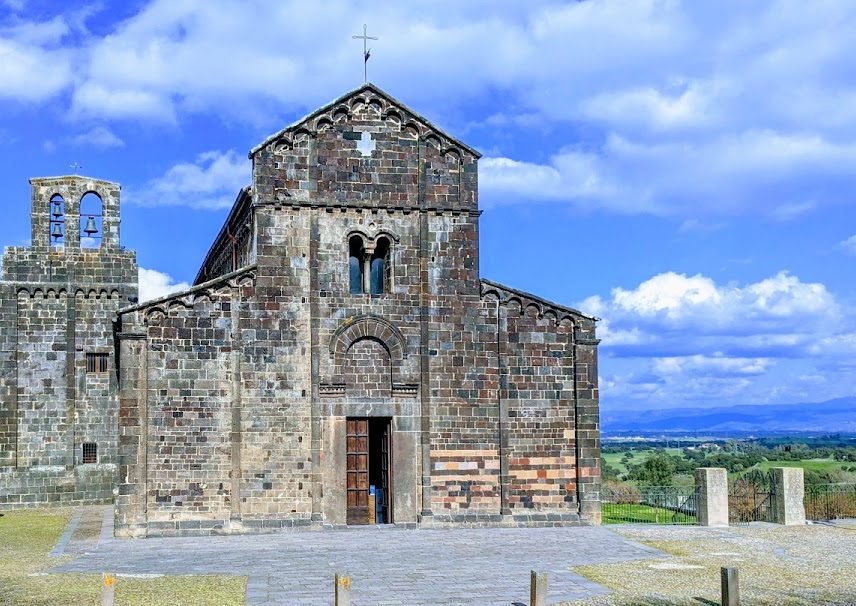
Santa Maria del Regno is built from dark ferruginous trachyte, giving the church a compact and massive appearance. Its predominantly cubic forms create an austere architectural character. The façade is divided into five sections and ends in a stepped gable. At its center, the entrance has a lintel and a semicircular relieving arch, with a double-mullioned window above it. The exterior is enriched by lesenes, Lombard-style blind-arch friezes, and hanging arches resting on strongly projecting corbels. The church largely avoids the colorful maiolica medallions often associated with Lombard architecture.
The structure retains the truncated remains of a square bell tower. Other details reflect Pisan architectural practice, including stone slabs used as abaci, strongly raised semicircular arches above the portals, semicircular windows in the apse, and rectangular nave windows with stepped, splayed reveals.
Interior structure
The interior has a rectangular plan with one nave and two aisles divided by two rows of columns. The columns carry semicircular arches and have carved capitals decorated with floral motifs. Some of these capitals have been compared with examples from Islamic Spain, including the Mosque of Córdoba.
The nave is covered by a wooden truss roof, while the aisles are divided into bays and covered with groin vaults. Their raised crowns and deeply recessed transverse arches express the building’s Lombard architectural character. Thick walls and massive masonry columns compress the interior’s visual and geometric space, and the column shafts are wider than their capitals. Three-part lesenes on the inner faces of the outer walls are especially refined, with the lines of the transverse arches, vault ribs, and blind arcades converging in them.
Altarpieces and interior furnishings
Retablo Maggiore
The semicircular apse is largely concealed by the imposing Retablo Maggiore, or principal altarpiece, behind the high altar. Described as the largest sixteenth-century polyptych in Sardinia, this multi-panel altarpiece measures approximately 10 metres high and 6 metres wide. It contains 31 painted panels separated by carved and gilded wooden elements.
The panels show prophets and saints alongside episodes from the life of the Virgin Mary. At the center, an elaborate niche contains a wooden statue of Our Lady of the Kingdom holding the infant Jesus. The statue wears royal insignia, including a crown and scepter. An inscription on the predella identifies Giovanni Muru as the artist and dates the work to 1515. Another inscription names its commissioner, Joan Cataholo, who was a canon of San Pietro di Sorres in 1489 and archpriest of the cathedral of Sant’Antioco di Bisarcio in 1503.
Pulpit and other works
A smaller altarpiece from the same artistic school is also preserved in the church. Paintings from the seventeenth century attached to the columns depict apostles and other saints. The church also contains a carved wooden pulpit with painted and gilded decoration, regarded as one of the notable works of Sardinian artists of the sixteenth and seventeenth centuries. Its ornament includes handled cups with floral scrolls and a double-headed eagle framing an image of the Madonna, with Byzantine influence.
An inscription commemorating the consecration is probably a thirteenth-century copy of the original text. The church’s design links Pisan models with Lombard principles applied throughout the building, rather than only to its ornament. This architectural approach has been associated with later Sardinian churches, including San Nicola di Trullas, the second building phase of San Pietro and Santa Maria in Bonarcado, and San Nicola in Ottana, as well as with churches at Rigoli near Pisa and Diecimo near Lucca.