Santa Maria Assunta: Roman Catholic Parish Church in Ne, Italy
Site at a Glance
- Popularity
- Very Low
- Country
- Italy
- Primary era
- Early Modern
- Eras represented
- Early Modern, Modern
- Civilizations
- Genoese, Italian
- Site type
- Religious
- Remains
- Church
On this page15 sections
History
Santa Maria Assunta is a Roman Catholic parish church in Ne, Liguria, Italy, and the seat of its parish in the Diocese of Chiavari. It belongs to the Sturla and Graveglia vicariate, a grouping of parishes within the diocese, and is dedicated to the Assumption of Mary, the Catholic belief that Mary was taken bodily into Heaven.
Early church and parish
A religious building stood on the site before AD 1000 and was dedicated to Saint Gottardo. Benedictine monks, followers of the Rule of Saint Benedict, brought devotion to the saint into the Ne valley from the nearby Priory of Sant’Eufemiano at Graveglia, a monastic house.
The dedication later changed to the Assumption of Mary. A deed dated 6 November, written after 1232, names the parish as Santa Maria di Ne. In 1311, the parish became a subsidiary of the pieve of Santo Stefano at Lavagna, a parish church with authority over surrounding churches.
Expansion and changing furnishings
The church retained its early form until about 1626, when population growth led to an enlargement. The choir, which had faced east, was turned around. The number of terracotta altars rose to five around 1735 and to seven by 1746. The church had two bells until 1771.
Nineteenth- and twentieth-century alterations
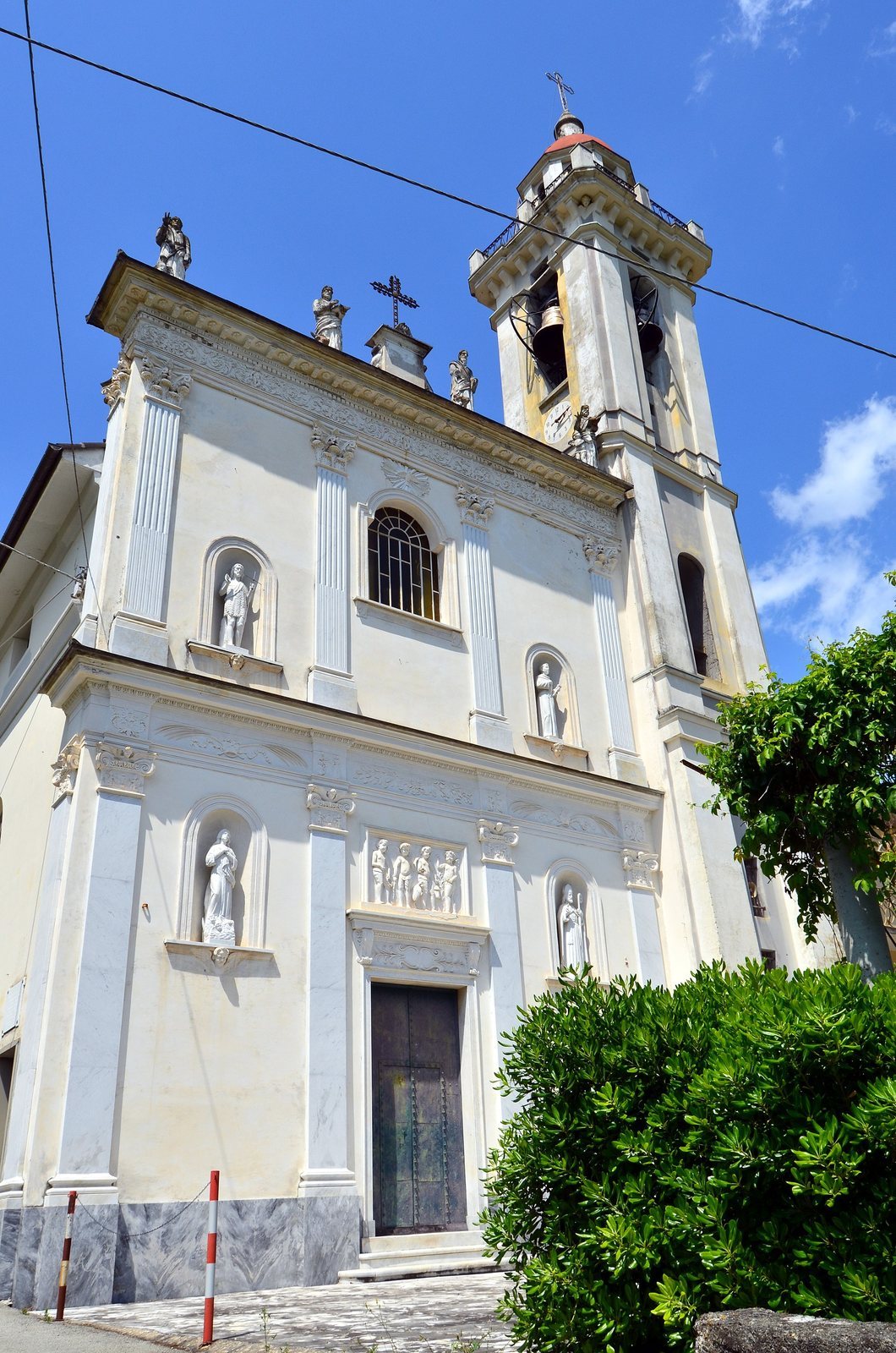
A new façade was built in 1879 and renovated in 1895. In 1878, a sound-amplifying structure was added atop the bell tower to increase the bells’ volume. It was removed in 1929 after defects appeared.
Remains
The church has a single nave, the main body of the building, with terracotta altars and a presbytery, the area around the principal altar. A bell tower about 30 metres high stands between the church and its adjoining rectory. Marble is used for the floors of the church and presbytery.
Exterior
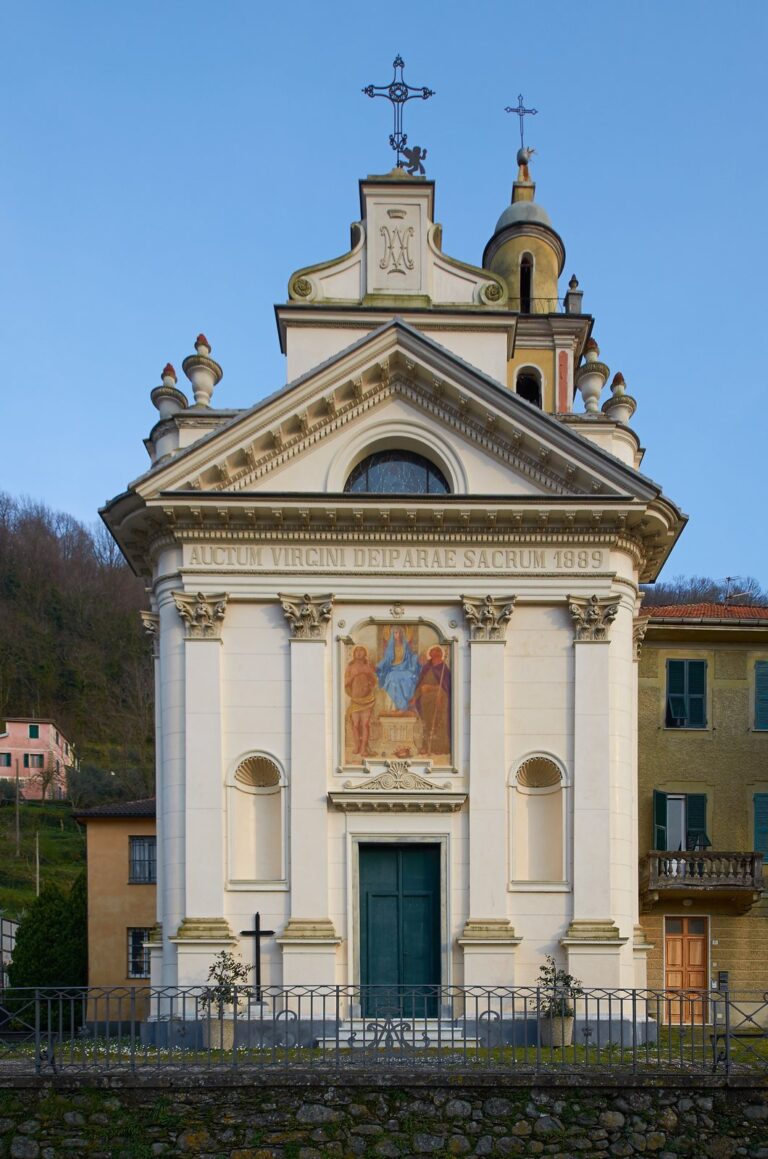
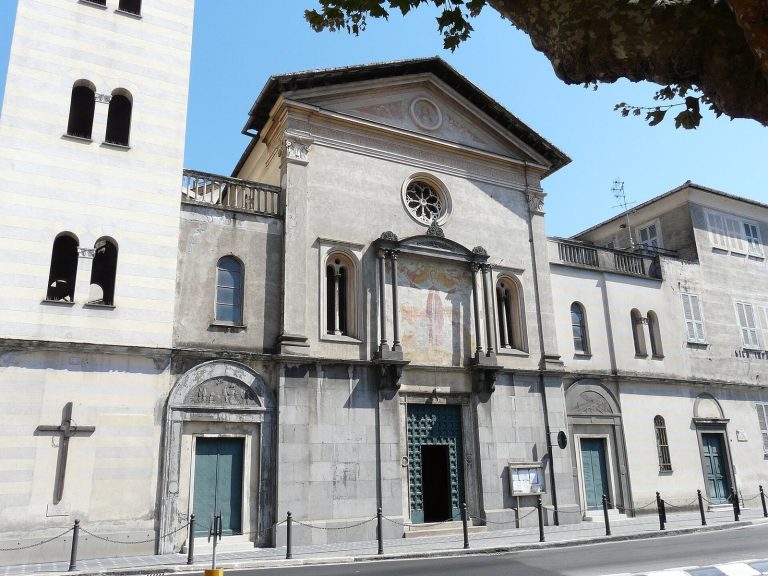
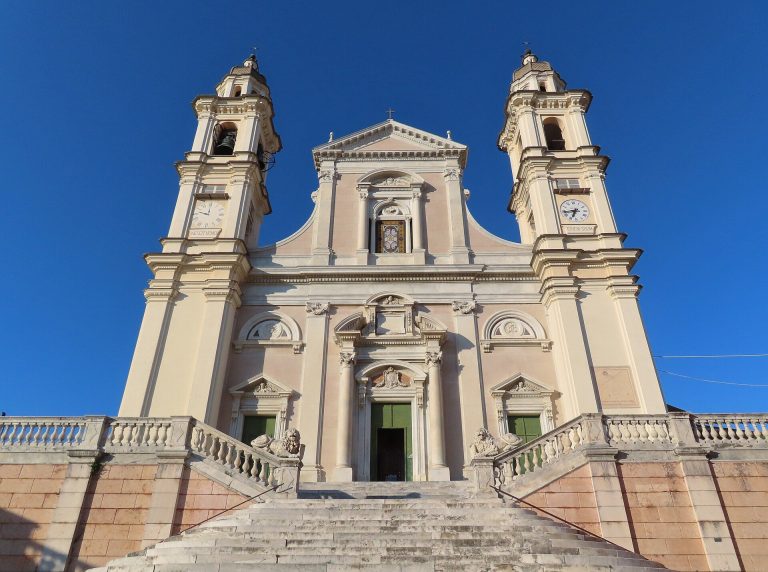
Eight life-size statues decorate the façade. The four Evangelists stand above the roof gutter. Beside the main door, lower niches hold figures of the Assumption of Mary and Saint Gottardo; higher niches beside the large window contain Saint John the Baptist and Saint Anthony of Padua.
Interior decoration and furnishings
Plasterwork, painting, and marble
An inscription dated 1868 names Giovanni Portogallo as the artist responsible for the church’s plasterwork and marble decoration, which appears on the interior walls and side altars. Giuseppe Carossini painted the vault in 1867. Its medallions show the four Evangelists and the Assumption of Mary into Heaven. A white marble baptistry, a place for baptism, is topped by a small dome.
Pulpit and organ
The marble pulpit was carved in 1862 by the Bianchetti brothers of Lavagna and is noted for its elaborate ornament. It resembles pulpits in the churches of San Lorenzo at Cogorno and Sant’Antonino at Breccanecca, the Basilica of San Siro in Genoa, and the shrine of Nostra Signora del Carmine at Lavagna. The Agati firm of Pistoia built the organ in 1885.
Sacristy
The sacristy, a room used to prepare for worship and store liturgical items, contains finely made walnut cabinets brought from the former church of the friars at Recco and the former Church of San Francesco in Chiavari.
Altars and sacred images
Main altar
The main altar is dedicated to the Assumption of Mary into Heaven. It holds a wooden triptych, an artwork made of three panels, created in 1546 by Teramo Piaggio. The central image shows the Virgin Mary with Saint Michael the Archangel and Saint Bernard of Clairvaux. Above it, the crowning section depicts the Ecce Homo, meaning “Behold the Man,” the presentation of Jesus before his crucifixion. The base shows the Last Supper with the twelve apostles.
Altars on the right
On the right, an altar dedicated to Saint Anthony of Padua has an altarpiece, an artwork placed above an altar, and two statues of the saint. Another altar is dedicated to Saint John the Baptist and has a wooden statue. Both that statue and the altar came from the deconsecrated Church of San Francesco in Chiavari. A third altar is dedicated to the Holy Crucifix; by 1835 it was also titled to the Sacred Heart of Jesus.
Altars on the left
The fifth altar is dedicated to Saint Gottardo and holds a wooden statue made in 1875 by the sculptor Antonio Brilla of Savona. The sixth, dedicated to Our Lady of the Rosary, is also called the altar of souls because Masses were offered there for the dead. It contains a wooden image and 15 small panels depicting the Rosary’s Mysteries, meditations on episodes in the lives of Mary and Jesus. The seventh altar is dedicated to Saint Joseph. It was formerly dedicated to Saint Catherine, whose image appeared in a painting that also included Saint Philip Neri and Saint Apollonia.
Presbytery and nave
Niches in the presbytery contain sculptures of the Assumption of Mary into Heaven and the Madonna and Child with Saint Anthony of Padua. Tombs line the nave, including some dating to 1763.