Sant’Andrea (Campi): A Catholic Parish Church in Italy
Site at a Glance
- Popularity
- Very Low
- Country
- Italy
- Primary era
- Medieval
- Eras represented
- Medieval, Early Modern
- Civilizations
- Papal States
- Site type
- Religious
- Remains
- Church
On this page17 sections
History
Origins and parish status
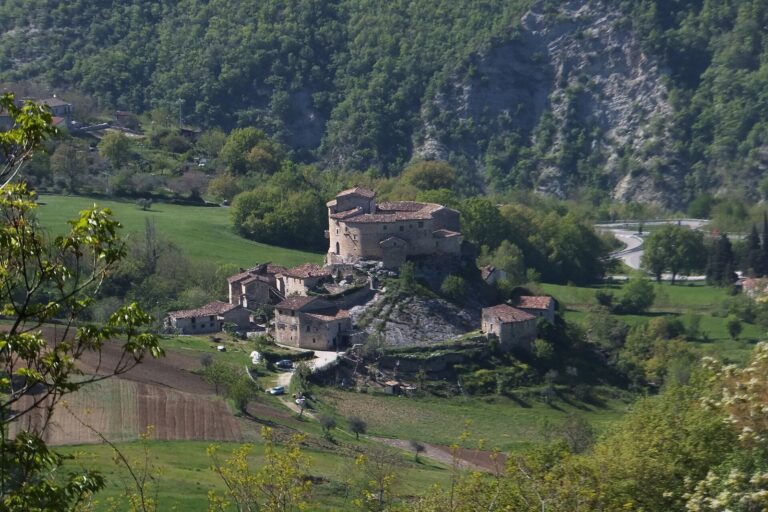
Sant’Andrea (Campi) was a Catholic parish church in Campi, Italy, a hillside castle settlement established in 1288 along the ancient road between Norcia and Visso. Construction began in the fourteenth century and was completed in the sixteenth. The church belonged to the Archdiocese of Spoleto-Norcia.
The community’s corporate body, known as Universitas Campli Castri, financed the fourteenth-century building and retained patronage rights. Sant’Andrea remained under the Abbey of Sant’Eutizio until 1493. Following disputes, it gained the parish standing and privileges previously held by Santa Maria, the abbey’s parish church. The Comunanza di Campi, a local communal institution, appointed the priest, subject to the bishop’s confirmation.
Expansion and worship
As Campi’s population grew, a second interior space was added to the original single-space church, creating a two-nave building. During a pastoral visit in 1712, Bishop Carlo Giaginto Lascaris recorded six altars, providing a dated account of the church’s devotional arrangements.
Later history and the 2016 earthquake
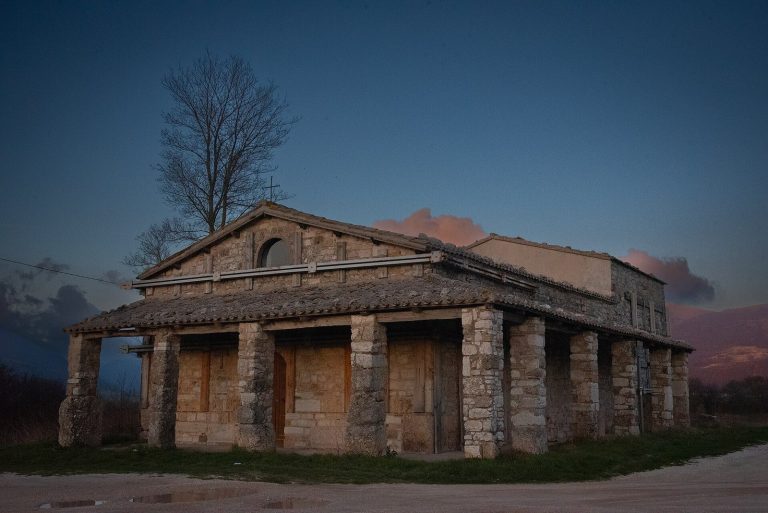
Three valued artworks associated with the church remained there until the late 1960s. By the 1970s they had been moved first to the parish priest’s house and then to the Diocesan Museum in Spoleto. The sixteenth-century portico was restored in March 2009.
The October 2016 earthquake severely damaged Sant’Andrea and brought down the adjoining fourteenth-century southern town gate. Movable cultural objects connected with the church were taken to the Santo Chiodo depot in Spoleto for safekeeping, security, cataloguing, and study.
Remains
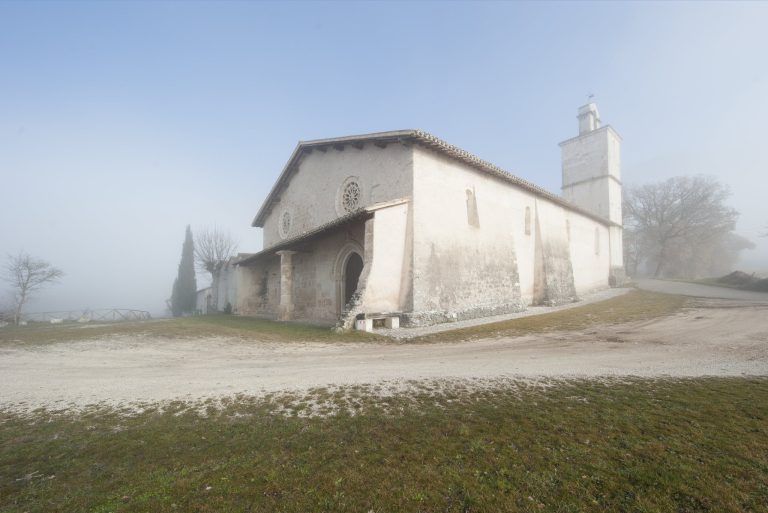
Before the 2016 earthquake, Sant’Andrea had two naves (the main lengthwise spaces of a church), with sail vaults (ceilings formed from curved, sail-like sections) carried by two massive piers. The second nave lay to the right of the original. Rectangular local stones of varied sizes and shades paved the floor.
Exterior and tower
Portico and portals
The projecting sixteenth-century portico had a triangular plan and a row of five arches, with two entrances. Its more ornate left portal belonged to the original construction and had a pointed arch bearing a carved lamb with a cross, associated with the Benedictine order. Carved lions stood above the tops of two side columns. The wooden door leaves were dated 1570. By contrast, the right portal had a plain round arch.
Worn traces of paintings remained beneath the portico roof before the earthquake. One showed an aged Saint Andrew holding the fortress, presenting him as its protector against war, epidemics, fires, and earthquakes. Beneath it was an upside-down funerary inscription from a first-century BCE mausoleum of the Entedia family. Reused as a building block in the fourteenth century, its text asks the protector to secure forgiveness and describes the community offering grateful hearts. A central painting showed the Crucifixion with Campi Castle behind it, while Saint Luke appeared to the right of the second portal.
Façade and fountain
The upper façade had two symmetrical rose windows, one associated with each nave, beneath a gabled roof. A monumental fountain stood within a round arch at the base of a raised, open-sided gallery. The earthquake destroyed the façade and portico.
Bell tower
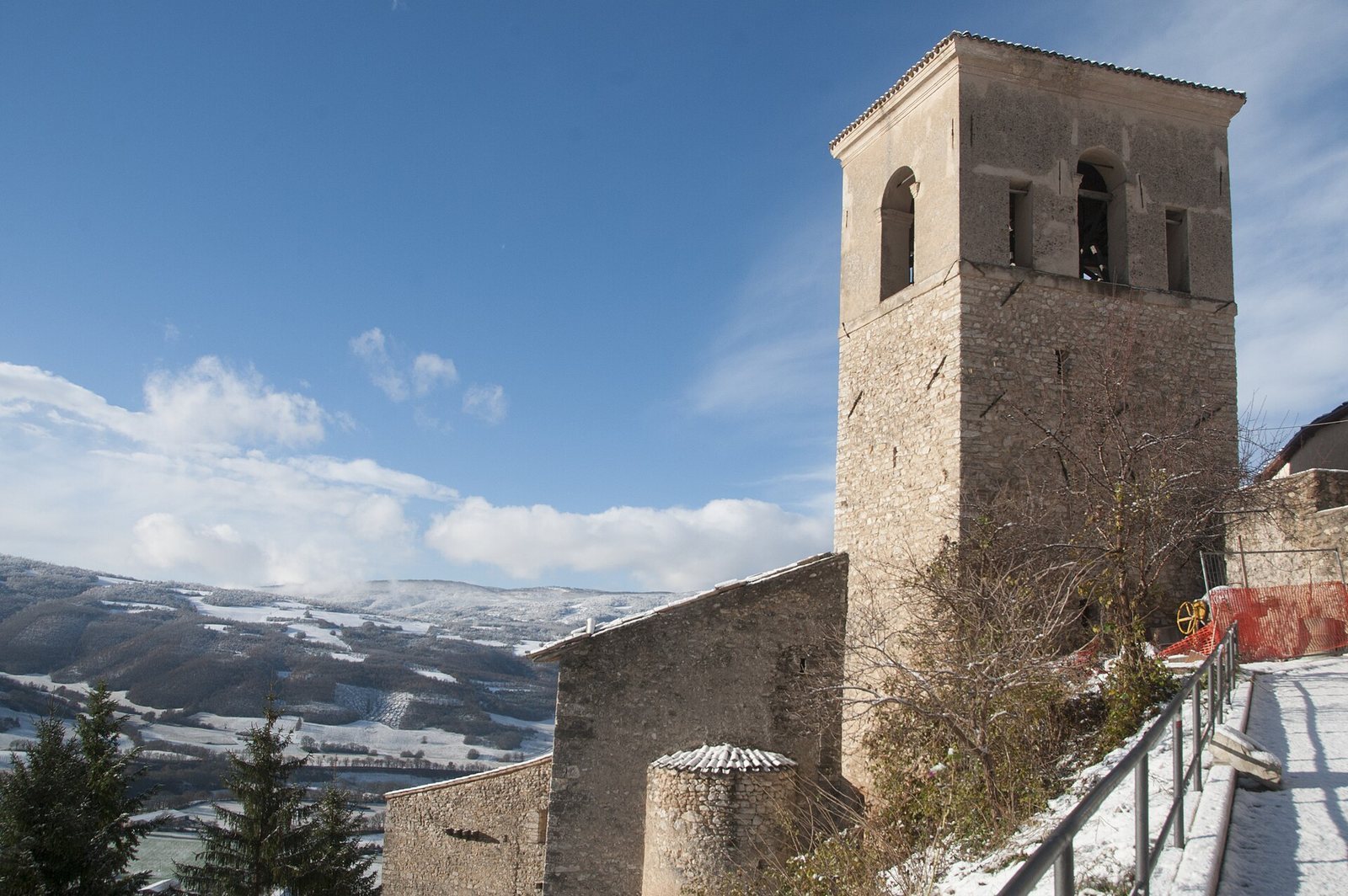
Behind the church, in the apse (the end of a church), stood a massive bell tower with four arched openings, one on each side, and three bells. The tower developed some cracks in the earthquake but appeared to sustain comparatively little damage. About half the church’s roof collapsed, while the surviving section remained against the tower.
Interior and furnishings
Main altar and carved woodwork
At the main altar in the left nave, a large Crucifixion canvas stood within a wooden frame. An elaborate carved wooden partition, dated 1596, separated the altar from the apse, which had long served as a sacristy. Two painted side doors flanked the partition, each topped by a reliquary, a container for sacred relics. On a nearby wall stood a carved and inlaid sixteenth-century pulpit made by the Seneca school of woodworkers in Piedivalle. A nearby altar to the Crucifix held a sixteenth-century wooden statue.
Side altars and devotional images
Near the left-side exit, an altar to Saint Charles Borromeo was commissioned in 1584 by Giuseppe Traversini, a local benefactor. Its niche depicted Benedict of Nursia, associated with the monastic Rule followed by Benedictine communities, Nicholas of Bari, Lucy, and Barbara, both venerated as early Christian martyrs. The Holy Trinity, the Christian belief in one God in three persons, appeared above them. The accompanying descriptions named Nicholas as protector of the poor, Lucy of sight, and Barbara as guardian of heavenly fire and storms. A case against the central pier held a wax image of Mary as Our Lady of Sorrows, dressed in mourning, with a sword in her heart and a lace handkerchief in her hand.
On the right wall, a seventeenth-century altar to Anthony of Padua, a Franciscan friar and preacher, was ornamented with twisted wooden columns. Nearby, the altar of the Madonna of the Rosary held a 1576 painting by Bartolomeo Carducci, a painter, depicting the Christian coalition’s victory over the Ottoman fleet at Lepanto, a major naval battle. At the main altar in the right nave stood a statue of Saint Andrew holding fish from Lake Tiberias.
Music and baptismal furnishings
Between the portals were an organ built in 1787 by organ maker Venanzo Fedeli and a choir gallery, a raised platform for singers and musicians. An oval Renaissance basin for holy water stood below them. Opposite, within a railing, was a sixteenth-century baptismal font with a carved stone lid bearing a scale-like pattern. The earthquake shattered the organ, choir gallery, baptismal font, and altars nearest the portals. Damage gutted the interior to the height of the first central pier.
Artworks associated with the church
Painted cross
A painted cross dated 1241 or 1242 was attributed to Petrus, a painter from Spoleto. It had come from nearby churches and spent several years in the old, now-ruined church of San Biagio. Later kept at Sant’Antonio, it was discovered there in 1927 and studied for its artistic importance.
Polyptych
A polyptych, a multi-panel altarpiece, by Giovanni Sparapane, a painter, dated to the second half of the fifteenth century. Formerly kept in the church of Madonna di Piazza, it depicted John the Baptist, Peter, Andrew, and Benedict. Its central panel was first empty and later held a papier-mâché Madonna and Child.
Wooden statue of Saint Andrew
A 1.40-metre-tall wooden statue showed the seated apostle Andrew raising his right hand in blessing and holding a model of Campi in the other. It was moved to the church of San Salvatore before the three artworks left for the parish priest’s house and the Diocesan Museum.