Santa Maria Antiqua: An Early Christian Church in Rome’s Roman Forum


Site at a Glance
- Rating
- 4.7
- Popularity
- Low
- Country
- Italy
- Primary era
- Classical
- External website
- Open
- Eras represented
- Classical, Medieval
- Civilizations
- Byzantine, Papal States, Roman
- Site type
- Religious
- Remains
- Church
On this page15 sections
History
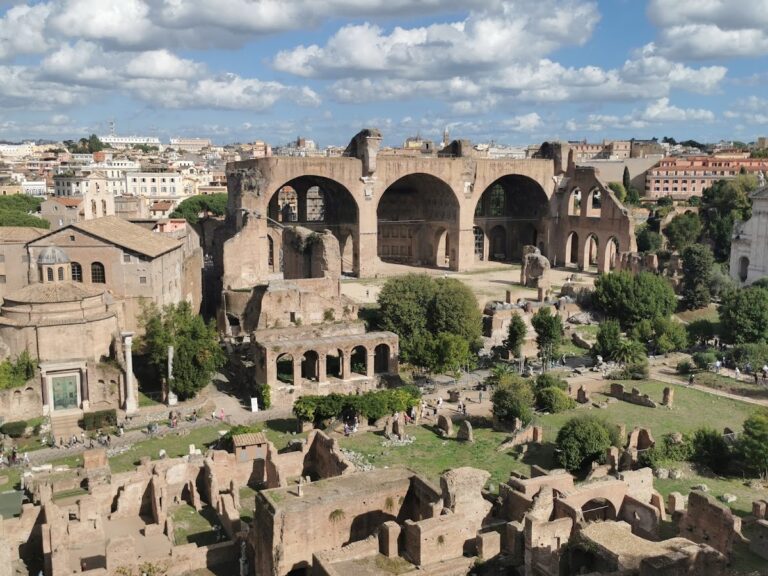
Santa Maria Antiqua is a Catholic Marian church in Rome, Italy, established in the fifth century by adapting a Roman imperial building at the foot of the Palatine Hill. Regarded as the oldest Christian monument in the Roman Forum, it also served for a long period as a monumental entrance to the imperial palaces above it.
Imperial building and Christian conversion
The church occupies a rectangular hall and front portico associated with the reign of Domitian. An earlier interpretation linked the surrounding complex with the Temple of Augustus, while more recent studies identify it with the Domitianic period and understand it as an entrance connecting the imperial palaces with the Forum. The nearby area may also have housed the Praetorian Guard, the elite military force responsible for protecting the Roman emperor.
After the Byzantine capture of Rome in 552, the hall and portico were probably adapted into a Marian palatine chapel. The Byzantine Empire was the eastern Roman Empire, whose political and cultural traditions continued after imperial rule collapsed in the West. Establishing a church in this setting also gave the building a Christianizing function in an area associated with older pagan worship.
A later legend connected the site with Pope Sylvester I and his killing of a dragon. The story has been understood as an allusion to the cult of Vesta, the Roman goddess whose worship was associated with the Forum. Before the later church structures, a Benedictine church called San Salvatore in Lacu occupied the site. Its name referred to the nearby place known as Lago di Gioturna.
Papal patronage and early medieval change
Santa Maria Antiqua was repeatedly repaired and embellished by Popes Martin I, John VII, Zachary, Paul I, and Hadrian I. During the early eighth century, John VII used it as the seat of the bishop of Rome. The church’s changing decoration reflects the succession of political and cultural influences that shaped Rome, including Gothic, Byzantine, Lombard, and Greek artistic traditions.
The earliest surviving decorative phase associated with Martin I dates to 649. It includes images of the Church Fathers, influential early Christian theologians and teachers whose writings shaped Christian doctrine. A Greek inscription refers to the Lateran Council of 649, which condemned Monothelitism, the doctrine that Christ possessed one will. Martin I opposed the doctrine and was later exiled. John VII commissioned Martin’s portrait in the presbytery alongside portraits of other popes, presenting the two popes as expressing solidarity against the Byzantine decision to exile Martin.
John VII ordered extensive repairs and redecorations between 705 and 707, especially in the presbytery, the Chapel of Physicians, and the Oratory of the Forty Martyrs. His program covered earlier paintings with new plaster, a process that removed and damaged some of the older frescoes. The artists combined Hellenistic painting methods with earlier Roman linear conventions. Their work belongs to a period when Byzantine rule and the Greek artistic community on the Palatine strongly influenced Roman religious art.
Paul I’s decoration dates from 757 to 767 and includes the image of Saint Cyrus in the atrium. It was produced after Lombard successes had weakened Byzantine government in Italy and during the period of Byzantine iconoclasm. Iconoclasm was opposition to religious images and, at certain times, the official destruction of them in the Byzantine world. Paul’s paintings mark a reduction in Hellenistic and Byzantine influence and a movement toward a more rigid Roman manner.
Burial, abandonment, and rediscovery
In 847, an earthquake caused parts of the imperial palaces to collapse over Santa Maria Antiqua. The church was partially destroyed and buried, and it suffered further damage during the Norman sack of Rome in 1084. It was abandoned in the ninth century. Pope Leo IV subsequently established Santa Maria Nova nearby, on part of the ruins of the Temple of Venus and Roma and at a site that had contained a chapel commemorating the fall of Simon Magus.
A small church dedicated to Santa Maria Liberatrice was built over the buried remains in the thirteenth century. It was rebuilt in 1617 under the patronage of Cardinal Marcello Lante della Rovere, with Onorio Longhi as architect. Pope Julius III assigned the church in 1550 to the Oblates of Saint Frances of Rome from the nearby Monastery of Tor de’ Specchi. Santa Maria Liberatrice was demolished in 1900 to reveal Santa Maria Antiqua. Its title and images were transferred in 1909 to Maria Liberatrice at Monte Testaccio.
Chance excavations in the eighteenth century and more systematic work in the late nineteenth century revealed the buried church and its wall paintings. The rediscovery transformed the study of early medieval art and clarified the cultural and urban changes that affected the Roman Forum as Antiquity gave way to the Christian period. A conservation program by Italian heritage authorities in partnership with the World Monuments Fund followed decades of restricted access. The monument had been closed to the general public from 1980 until 2016 and appeared on the Fund’s list of endangered buildings in 2004. It reopened in March 2016.
The surviving paintings were created during an intense period of decoration from the sixth through the late eighth or ninth century. Around 250 square metres remain from an estimated original area of about 1,000 square metres. Erosion, destruction, and repeated repainting make the sequence approximate, but the layers preserve a changing movement from pagan mosaics through Hellenistic and Byzantine-influenced painting toward a more linear Roman style.
Remains
Santa Maria Antiqua is a basilical building approximately 30 metres long and 20 metres wide. Its rectangular hall is divided into three aisles, with a small apse formed within the thickness of the rear wall. Two small chapels flank the presbytery, the area around the main altar. A square courtyard extends from the vestibule and contains an impluvium, a shallow basin designed to collect rainwater, dating to the reign of Caligula. Wall niches probably intended for imperial statues and traces of frescoes from the period of Pope Hadrian I survive there, while a ramp on the church’s left side leads toward the Palatine.
Layered wall paintings
The Palimpsest Wall
The Palimpsest Wall in the presbytery preserves at least six successive decorative layers, and some reconstructions identify as many as seven. The earliest two layers, broadly dated from the fourth to the sixth century, contain early pagan or pre-Christian decoration. One includes mortar associated with opus sectile, a technique that uses cut pieces of stone or other hard material to create geometric or figurative surface designs. Another preserves painted plaster with a two-colour border. Later frescoes covered most of these early surfaces, leaving about two percent of the earlier decoration visible.
The third layer, dated approximately from 500 to 550, contains part of the earliest known Roman image of the Virgin as Queen of Heaven, together with the figure known as the Pompeian Angel or Beautiful Angel. The Virgin sits on a throne like a Byzantine empress and holds the Christ Child on her lap. An angel accompanies her, and the original composition probably placed the Virgin between two angels. The surviving figures may belong to one phase or to two separate layers. Their dates have been placed either around 565 to 578 or in the first half of the seventh century. Their bright, impressionistic treatment reflects a strongly Hellenistic character.
Martinian and later presbytery decoration
The fourth and fifth layers, broadly dated from about 570 to 655, show the growing prominence of Hellenistic and Byzantine styles over earlier Roman linear conventions. One layer preserves broad areas of white plaster with traces of colour beside the apse border. Fragmentary figures with yellow haloes surrounded by red and part of a red halo on the apse vault belong to this sequence.
A further layer painted during Martin I’s pontificate may have covered the apse and the side walls of the presbytery. It includes two Church Fathers, possibly Basil and John. The surviving Martinian figures have walking poses, flowing garments marked with highlights, and relatively rigid faces.
The final major layer belongs to John VII. It includes the surviving decoration on the rear apse wall, the upper parts of the apse side walls, and the large lunette above them. Earlier strata appear to have been removed before this work, and Paul I later repainted the apse. John VII’s artists worked from the top downward in the confined interior. Scaffolding holes occur at regular intervals about 9.3 metres above the floor and later at approximately 7.98 metres. Fresh intonaco, the wet finishing layer of plaster used for wall painting, was applied and painted immediately, allowing the pigment to become integrated with the surface.
The John VII paintings show flowing garments, modelled contours, animated expressions, gestures, and turned heads, although the figures remain relatively flat against their backgrounds. Bright white highlights are used extensively. The artists generally kept the backgrounds neutral rather than filling them with villas and columns, while earlier figures often have darkened pupils facing forward and strongly outlined facial features.
Adoration of the Cross
The Adoration of the Cross on the triumphal arch is approximately 2.5 metres high and survives in a very fragmentary state. Christ’s head, abdomen, and left arm remain, together with angels, the haloed head of the Apostle John, and worshippers in differently coloured robes at the foot of a cliff probably representing Golgotha.
Christ has short curly hair, sparse facial hair, wide-open eyes directed forward, and a loincloth rather than the long hair, full beard, and sleeveless tunic often seen in contemporary representations. Close examination of the strongly modelled abdomen supports the identification of a loincloth. This unusual form has been interpreted as possibly influenced by coins issued in Italy after Justinian II reasserted Byzantine control in 705, as well as by Byzantine artists living on the Palatine.
Chapels and distinct painting programs
Chapel of Physicians
The Chapel of Physicians contains fragmentary life-sized images of medical saints. They wear brown tunics, sandals, and long dark hair and beards, with open eyes and arched eyebrows. Scrolls are held in their right hands, while medical or surgical boxes hang from black straps in the other. The figures include Dometius of Persia, Cosmas and Damian, and Nazarius and Celsus.
The chapel’s imagery relates to incubation, a healing practice in which a worshipper slept in a sacred place hoping for a vision from a healing figure or relief from illness. The saints therefore appear within a Christian healing setting that retained the area’s older reputation as a place associated with healing.
Oratory of the Forty Martyrs
The Oratory of the Forty Martyrs forms one of the distinct painted spaces within the church. Its decoration belongs to the successive programs that transformed Santa Maria Antiqua between Late Antiquity and the early medieval period, alongside the paintings in the presbytery and the Chapel of Physicians.
Chapel of Theodotus
The Chapel of Theodotus lies at the rear left of the presbytery. An inscription identifies its patron, Theodotus, as a senior church official who held the offices of primicerius defensor and dispensator of the diaconia of Santa Maria Antiqua. The cycle was completed during the pontificate of Zachary, between 741 and 752, and remains among the church’s most complete and legible groups of paintings.
The chapel preserves a Crucifixion and scenes from the lives of Saint Quiricus and his mother, Saint Julitta. The Crucifixion combines Byzantine frontality, hierarchical scale, and symmetry with direct details. Christ is clothed, and his feet do not overlap. Stakes support the cross, while Mary and John stand on the ground below. The Roman soldiers Longinus, carrying the lance, and another soldier holding a sponge soaked in vinegar also appear. Christ wears a colobium, a simple sleeveless tunic associated with some early Christian representations and with early monastic dress.
The walls retain mortar from Late Antique opus sectile decoration. Higher on the walls and across the vault are white plaster and traces of red decoration probably dating from the Domitianic period, linking the chapel’s Christian paintings with the earlier imperial building.
Atrium fresco of Saint Cyrus
The atrium contains a relatively well-preserved fresco of Saint Cyrus, also identified as Saint Abbakyros. Painted under Paul I, it uses hard, rigid brushwork. The saint has asymmetrical eyes, arched eyebrows, a wrinkled forehead, and a beard, while the hair, beard, eyelashes, and mouth receive little modelling or highlighting.
Inscriptions and artistic sequence
The inscriptions associated with the church are in Greek for Martin I, in both Greek and Latin for John VII, and in Latin for Paul I. Together with the paintings of the Virgin and Child, popes, Church Fathers, saints, martyrs, angels, and medical saints, they reveal the changing communities and artistic preferences that shaped the building.
The layered surfaces, plaster fragments, inscriptions, and contrasting techniques make Santa Maria Antiqua an unusually complete record of late antique and early medieval Roman and Byzantine wall painting. They preserve the physical results of repeated decoration, changing religious priorities, and the movement between Hellenistic, Byzantine, and Roman artistic languages.
Nearby sites