Santa Margherita Vergine e Martire: A Medieval Church in Maddaloni, Italy


Site at a Glance
- Rating
- 4.6
- Popularity
- Very Low
- Country
- Italy
- Primary era
- Medieval
- External website
- Open
- Eras represented
- Medieval, Early Modern, Modern
- Civilizations
- Kingdom of Naples
- Site type
- Religious
- Remains
- Church
On this page14 sections
History
Medieval origins
Santa Margherita Vergine e Martire is a medieval Roman Catholic church in Maddaloni, Italy, dedicated to Saint Margaret of Antioch in Pisidia and belonging to the Diocese of Caserta. Its origins are unknown, but a 1323 reference to a street named after the saint indicates that the church was already in existence. The first direct citation dates from 1327, in records of payments made by churches in the Diocese of Caserta to the pope.
The church’s masonry is generally considered to preserve its original medieval structure. Restoration after the 1980 earthquake revealed and emphasized Gothic elements that support a fourteenth-century construction date. Further restoration work in 1983 uncovered another blocked pointed-arch single-lancet window, providing additional evidence of the medieval building.
Ecclesiastical use and later transformation
Santa Margherita Vergine e Martire was incorporated into the Chapter in 1509. From 1620 onward, it appeared regularly in the pastoral visitations of the Diocese of Caserta, inspections carried out by diocesan authorities to review the condition and administration of churches.
A radical eighteenth-century restoration changed the church’s internal arrangement by reversing its orientation. The high altar was moved from the east to the west, while the nave received a reed-framework vault. The walls, vault, and altars were also renewed with stucco decoration. The bell tower belongs to the same broad period, probably having been built around the middle of the eighteenth century.
The church in Maddaloni
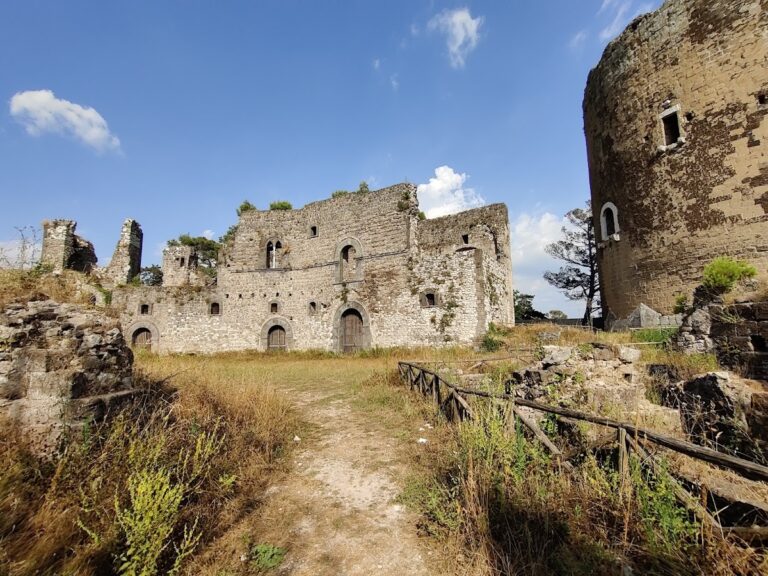
The church stands in the historic Formali district, whose name derives from the Carmignano aqueduct. Built from 1628, the aqueduct passed through Maddaloni and supplied, among other features, the fountains of the Carafa ducal palace. The district lies at the foot and partly on the eastern slopes of the hill occupied by Maddaloni Castle, whose surviving features include a Norman keep and two isolated towers.
Artistic history
The chapel of Saint Leonard preserves frescoes dated by painted inscriptions to 1408 and 1409. The decoration has been associated with more than one artistic hand. The vault and left wall have been linked with Nicola da Caserta, while the chapel’s wider fresco cycle is attributed to an anonymous painter conventionally known as the Master of the Crucifixion of Santa Margherita of Maddaloni. This name derives from the Crucifixion regarded as especially important for recognizing the painter’s style.
The surviving artworks form only part of the works recorded in the church around 1860. Among them is a painting of Saint Margaret with the dragon, traditionally associated with the saint’s story and said to have come from the former church of San Pietro. It is attributed to Pompeo Landulfo.
Remains
Exterior and plan
The church has an elongated rectangular plan, with its longer elevation running along the street. The only unobstructed short elevation is undecorated. Since the eighteenth-century restoration, the left side wall has served as the principal facade, giving the building an unusual exterior arrangement shaped by its altered orientation.
Portals and facade painting
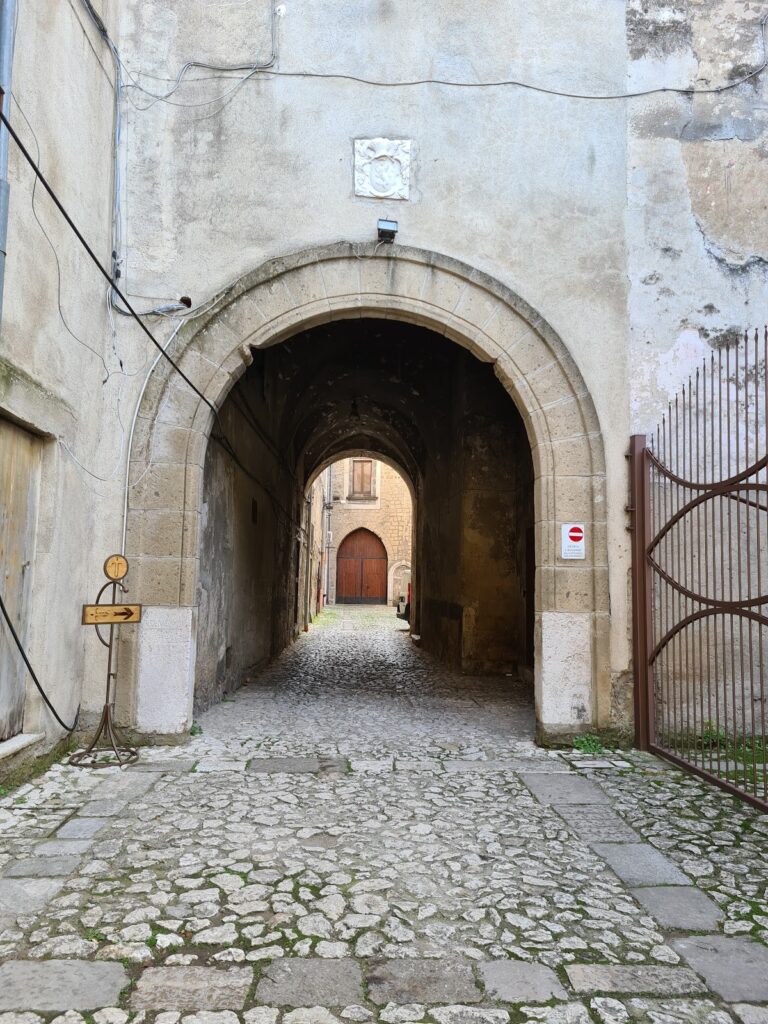
The facade contains three portals. Near the western corner, where the masonry appears to incorporate reused elements, is a round-arched portal made of tuff. Beside it is a blocked pointed-arch portal with a lowered-arch lintel, also built entirely of tuff. The current entrance is rectangular, framed in stone, and set beneath a lowered arch. Above it is a triangular pediment in a nineteenth-century Neoclassical design.
A lunette above the facade arch contains a fresco probably painted around 1730 to 1740. It shows the Madonna and Child with Saint Margaret and Saint John the Baptist.
Bell tower
The bell tower stands immediately to the right of the present entrance. It has four levels: a blind first level, two middle levels opened by round arches, and an upper level carrying a spire covered with majolica tiles. Its form places it in the eighteenth century, probably near the middle of that period.
Nave and side spaces
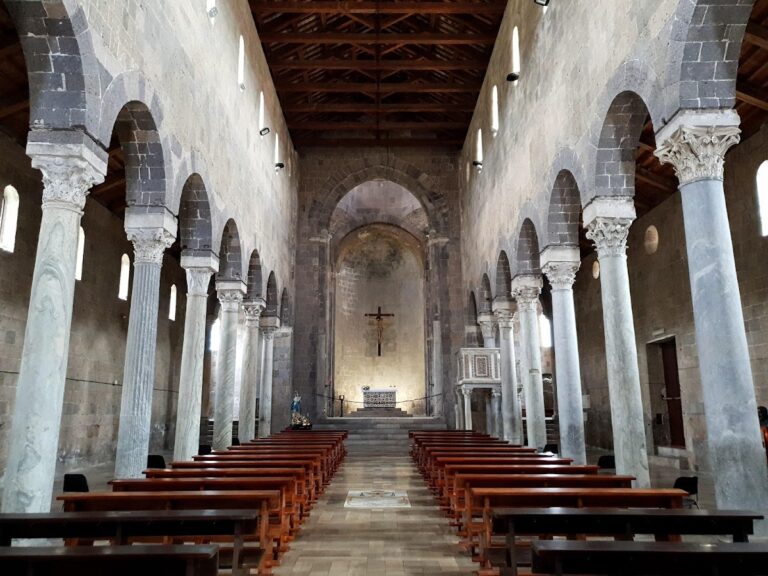
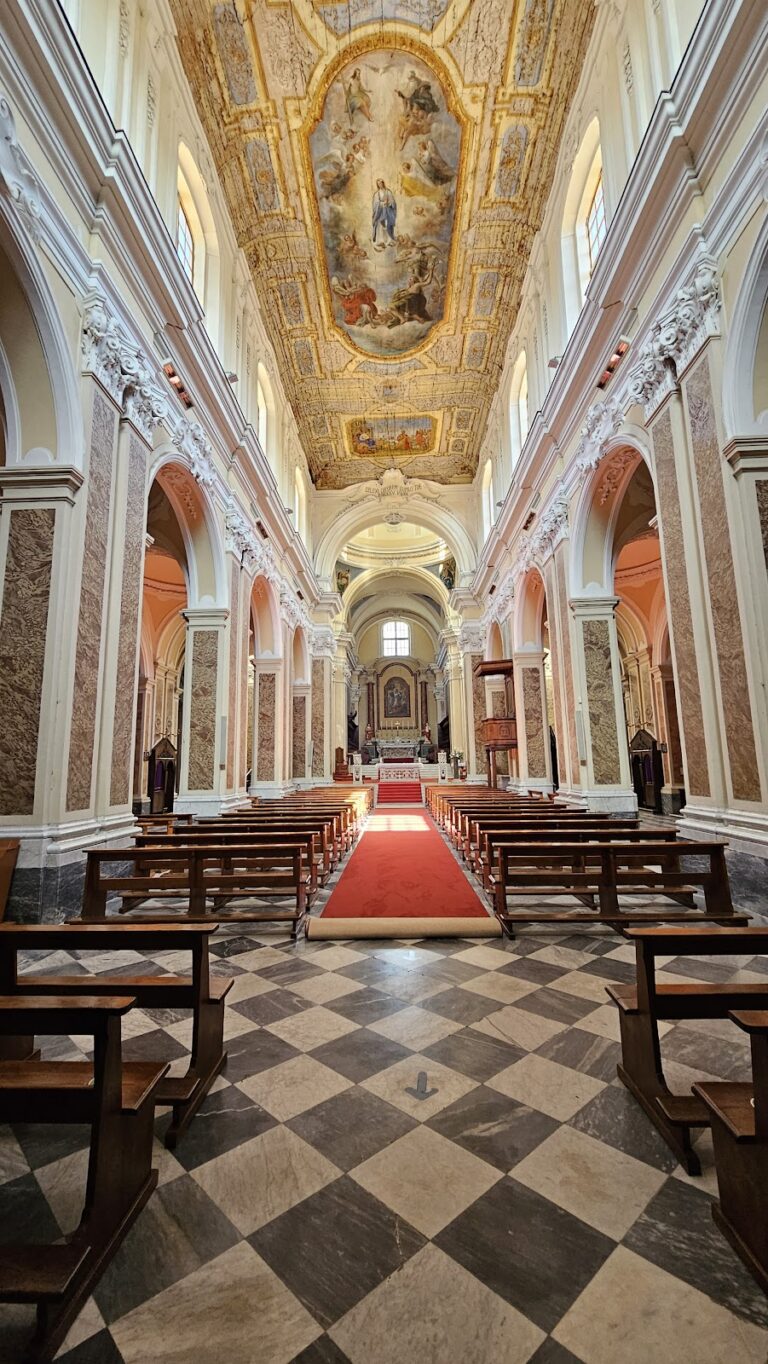
The interior consists of a single nave covered by a lowered vault. On the left, lowered blind arches define the entrance area and the altars. On the right, open lowered arches lead into a space resembling a side aisle, originally arranged as chapels that may have been interconnected. White stucco covers the walls and vaults.
Paintings on the nave walls
Near the entrance on the left wall is a Baroque painting of Saint Joseph in a contemporary frame. Farther along stands a large wooden, partly gilded frame containing the Madonna of the Rosary with saints and the souls in Purgatory. Salvatore Airola and Camilla di Errico commissioned the painting, which is dated 1648 and was made by Giovan Angelo Patenostro, a painter from Pontelandolfo.
The central Rosary image is surrounded by fifteen small panels representing the Mysteries of the Rosary. Beneath it, a predella, the lower section of an altarpiece, shows the preaching of Saint Dominic. On the present rear wall of the high altar hangs the painting of Saint Margaret with the dragon. An eighteenth-century painting of Saint John the Baptist is located on the right wall of the high altar.
Chapel of Saint Leonard
To the right of the present entrance, the Gothic chapel of Saint Leonard opens onto the nave through a large pointed triumphal arch. Saint Leonard was a medieval Christian saint traditionally associated with prisoners and captives. The chapel has a groin vault, a vaulted ceiling formed by intersecting curved surfaces, whose Gothic arches create ribs. Its vault webs carry frescoes of the four Evangelists and the four principal Doctors of the Church, authoritative Christian theologians formally recognized within the Catholic tradition.
Rear-wall frescoes
The rear wall centers on Christ Pantocrator, a representation of Christ as the all-ruling sovereign, enclosed within a mandorla, the almond-shaped halo surrounding a sacred figure. The image separates the two parts of an Annunciation. A large Crucifixion is painted below it. Masello Guerra commissioned these frescoes, and he appears at the feet of the Archangel Gabriel holding an inscribed scroll bearing his name and the date.
A parchment displayed in the chapel’s upper-left area identifies its dedication to Saint Leonard. The corbels supporting the vault were restored and signed by Nicola da Caserta. The frescoes on the vault and walls have also been connected with his activity, although the wider decoration is assigned to the anonymous Master of the Crucifixion of Santa Margherita of Maddaloni.
Side-wall paintings
On the left wall, a painted panel depicts Pope Eugene IV between two cardinals. The painted parchments held by the figures record indulgences granted to the chapel. Beneath the panel is a small niche whose rear wall carries a fresco of a Mass. The subject remains uncertain and debated. Saint Lawrence appears on the niche’s left side wall, while Saint Leonard is shown on the right.
The chapel’s right wall preserves a fragmentary fourteenth-century Crucifixion. The Virgin Mary stands on the left and Saint John the Evangelist on the right, framing the central scene within the surviving portion of the painting.