Santa Margherita: A Parish Church in Colorno, Italy
Site at a Glance
- Popularity
- Low
- Country
- Italy
- Primary era
- Medieval
- Eras represented
- Medieval, Early Modern, Modern
- Civilizations
- Duchy of Milan, Duchy of Parma and Piacenza, Habsburg, Holy Roman Empire, Italian, Papal States
- Site type
- Religious
- Remains
- Church
On this page23 sections
History
Santa Margherita, also known as the Duomo di Colorno, is a Roman Catholic church in Colorno, Italy, dedicated to Margaret of Antioch. Its foundation date is uncertain, but it is generally placed in the second half of the fifteenth century, probably by 1454. Another view associates the beginning of construction with interior work recorded in 1512. The church was complete when Pompeo Musacchi, bishop of Parma, consecrated it on 27 May 1525.
Foundation and parish status
In 1479 Santa Margherita received the parish jurisdictional rights previously held either by the destroyed church of Saint John the Baptist, east of the settlement, or by Santo Stefano, a church established by the fourteenth century. The exact predecessor is uncertain. In 1582 Santa Margherita became Colorno’s parish church, while Santo Stefano took a subsidiary role.
The original building followed a late-Gothic design inspired by the much larger San Francesco del Prato in Parma. A bell tower was erected in 1573, the same year that work was carried out in the apse.
Seventeenth- and eighteenth-century changes
Spanish troops looted the church in 1637 during their opposition to Odoardo I Farnese, duke of Parma, and caused extensive damage. An earthquake on 10 April 1653 brought down one of the pinnacles on the façade. Work begun in 1660 included a chapel for the Blessed Sacrament, completed in 1666. In 1662 the interior was whitewashed ahead of a visit by Duke Ranuccio II Farnese and his wife, Margherita Violante of Savoy. The coating covered frescoes from the sixteenth century. On 1 December 1664, Bishop Carlo Nembrini established a collegiate church, a church served by a chapter of clergy.
In 1734 the church was occupied and looted during the Battle of Colorno, a conflict between Austrian forces and French and Sardinian forces. A chapel dedicated to Saint Anthony of Padua followed in 1737. In 1760 a raised seating gallery for Duke Filippo of Bourbon was installed in the sanctuary. Work in 1777–78 concealed the timber roof trusses beneath reedwork vaults, restored the apse and added an organ gallery.
Nineteenth-century rebuilding
An earthquake damaged the church in 1832. Major neoclassical renovation began the following year under the direction of provost Isacco Deval, with designs by Giuseppe Tebaldi, the architect Casa and the collaboration of Nicola Bettoli. The church closed for worship on 27 May 1834, and services moved to the ducal chapel of San Liborio during the works.
The renovation altered the façade, created side entrances and enclosed the Corinthian columns within massive piers. It also replaced the terracotta floor, redecorated the interior and established the first eight side chapels. The planned work on the apse could not be completed because funds ran short, despite donations that included support from Duchess Maria Luigia. The project was completed and the church reopened on 1 December 1844.
Further alterations included new side altars in 1862, a replacement organ in 1892, apse frescoes in 1898, a new main altar in 1904, roof work in 1905 and interior restoration in 1909. Bishop Evasio Colli granted the church the honorary title of cathedral on 30 September 1945. This title did not make it the seat of a bishop.
Recent restoration
New floors were laid inside and outside between 1962 and 1968, the arrangement of interior paintings was revised in 1995, and the apse was restored in 2005–06. Earthquakes on 25 and 27 January 2012 damaged the church, prompting its closure for consolidation and restoration.
Remains
The church has a Latin-cross plan, meaning that its central arm is longer than its cross arms. Three aisles lead toward the sanctuary, with five side chapels along each side and two further chapels beside the sanctuary. The entrance faces west and the apse, the curved or polygonal end of the church, faces east. Brick is the principal exterior facing, while the interior combines the older late-Gothic structure with later chapels, furnishings and artworks.
Exterior and overall form
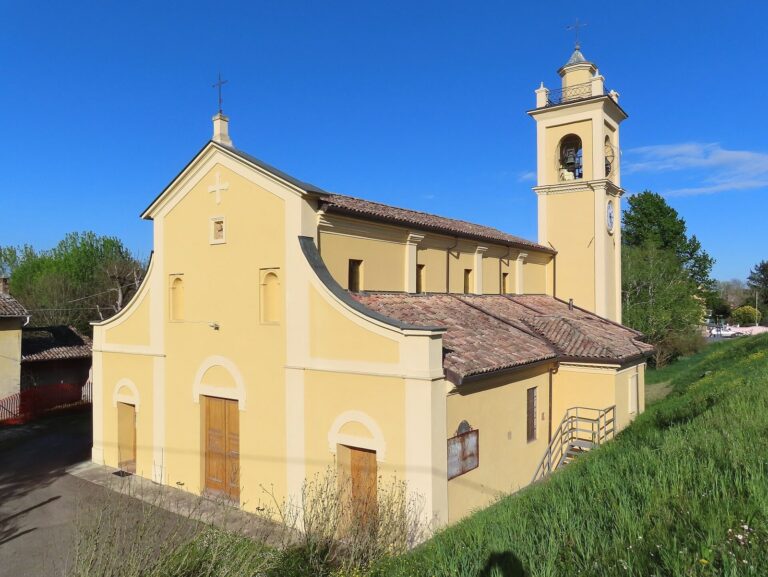
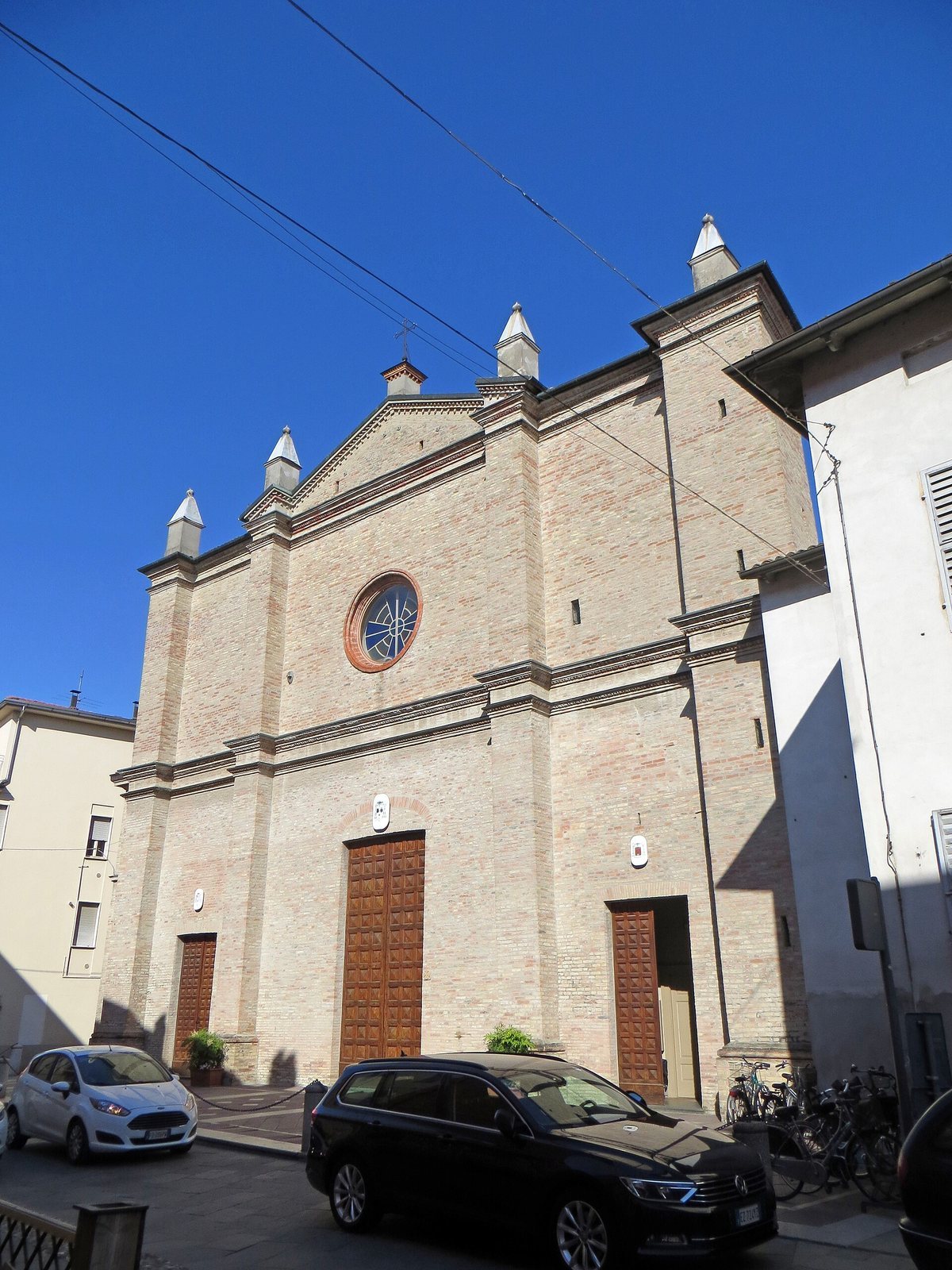
The symmetrical brick façade is divided into four vertical sections by pilasters, flat strips that resemble shallow columns. A projecting horizontal band separates its two levels. The main doorway sits below a large rose window framed in terracotta, with a smaller portal on either side. Above the cornice, a broad triangular pediment has a dentilled edge dating to the fifteenth century and a metal cross at its peak. Four pyramidal pinnacles stand beside the buttresses. Chapels added in the seventeenth and eighteenth centuries project from the sides of the building.
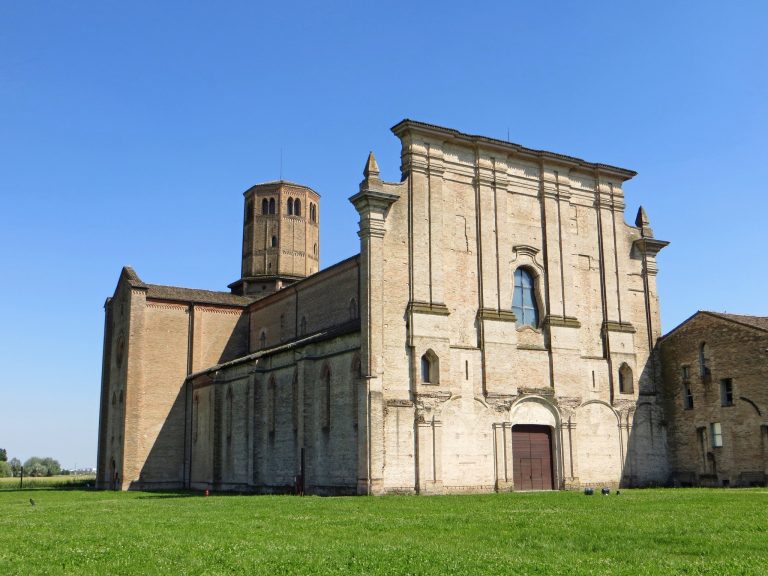
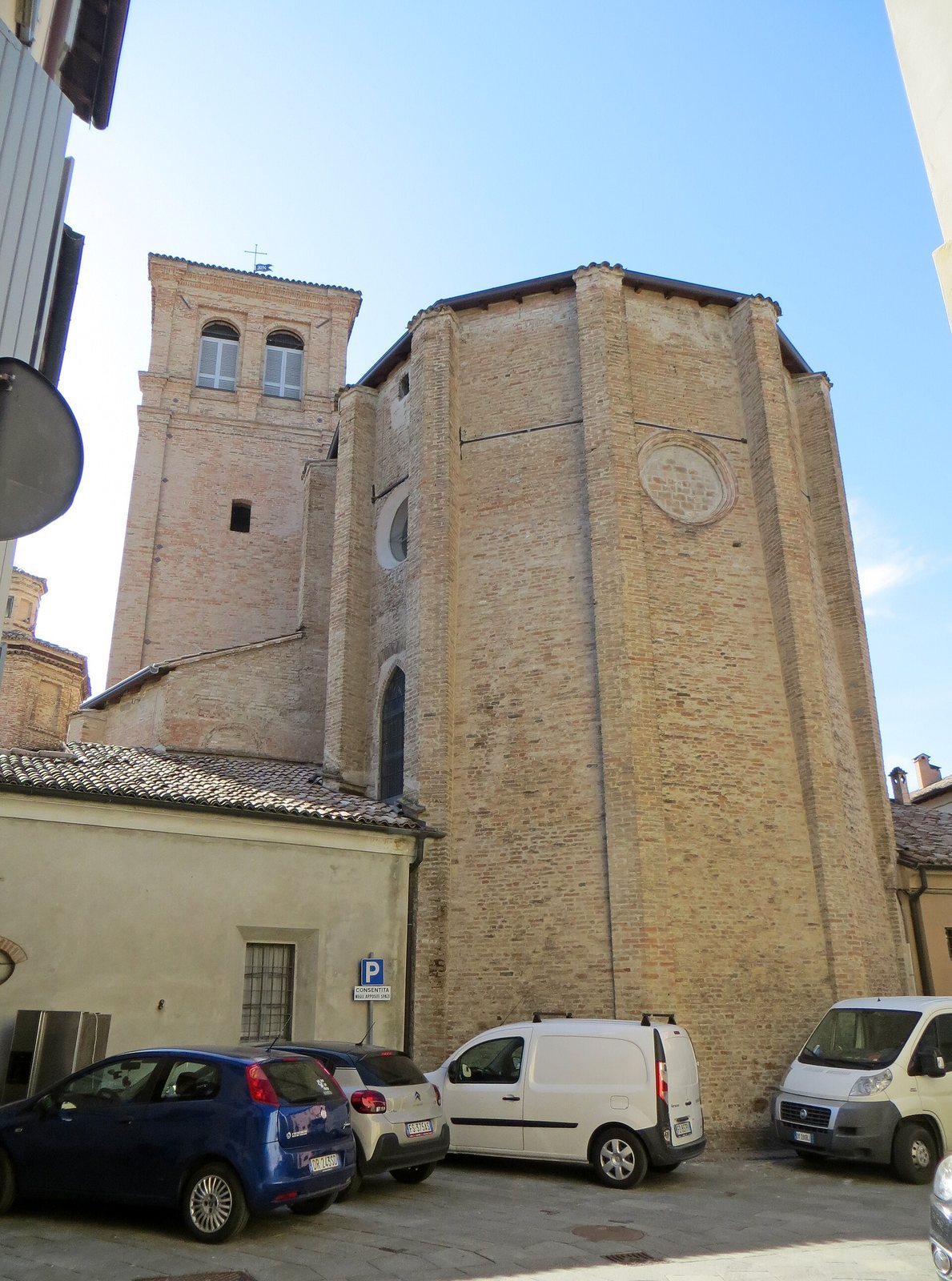
At the rear on the right rises the sixteenth-century bell tower. Each of its four faces at bell level has a pair of round-arched openings, each opening containing a single aperture. The original late-Gothic apse survives at the east end. Pilasters divide its exterior, where pointed-arch windows on the sides are topped by circular windows.
Nave and entrance end
Central nave
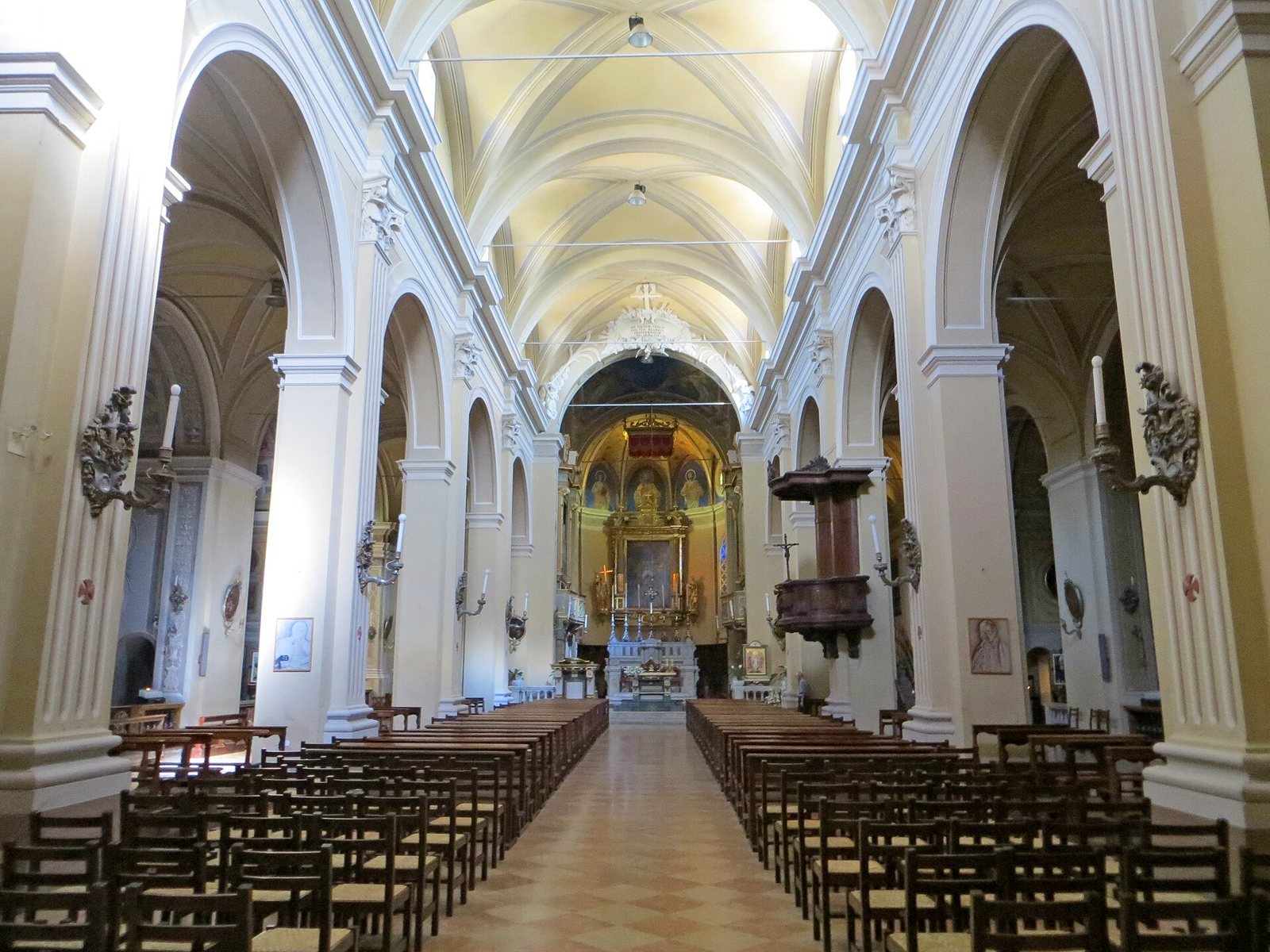
Five plastered ribbed vaults cover the central nave. Five broad round arches on each side open into the aisles. Massive piers, faced with Corinthian pilasters, support a projecting cornice around the interior. Almost all the piers in the central nave carry eighteenth-century Baroque candle stands.
Entrance wall and furnishings
Three paintings hang on the interior face of the entrance wall. Clemente Ruta painted Saint Remigius Baptizing Clovis around 1720. A painting of the Madonna and Child with Saints John the Baptist, Apollonia, Lucy, and Agatha probably dates to around 1560 and is attributed to Alessandro Mazzola Bedoli. Saint Francis Receiving the Stigmata, dated to 1612, is attributed by most critics to Lionello Spada and by others to Sisto Badalocchio. Nearby is a marble monument to Pier Luigi Belloni, who worked to promote the education of young people. Tommaso Bandini made the monument in the Purist style in 1840; it was transferred from Colorno’s cemetery in 1889.
An eighteenth-century carved wooden pulpit projects from the fourth pier on the right. Designed by Antonio Brianti, it bears the Dominican arms and was originally made for Parma’s destroyed church of San Pietro Martire. The aisles also contain the Stations of the Cross made by Cristoforo Carra in 1756.
Side chapels
Chapels on the right
The first apsidal space on the right contains a wooden pulpit made in 1859 and transferred from the church of San Tiburzio in Parma. In the second chapel, dedicated to Saints Claudius and Charles Borromeo, an altar painting shows the Madonna and Child with those saints. It dates from between the late seventeenth and the first half of the eighteenth century and may come from the school of Mauro Oddi.
The third chapel is dedicated to the Immaculate Virgin. Clemente Ruta’s paintings of the Visitation and the Nativity, made around 1720, flank its central altar. The paintings were first made for side chapels in the oratory of the Santissima Annunziata at Vedole and were later replaced there. The fourth chapel, dedicated to the Madonna of Suffrage and Saint Lucy, has an altar painting by Francesco Rivara from 1862, showing the Madonna and Child with Saints Rose, Apollonia, Agatha and Lucy. Two nineteenth-century oval paintings of Saint Henry I and Saint Anne hang beside it.
Chapel of the Blessed Sacrament
The large fifth chapel has a Greek-cross plan, with four arms of similar length. Paired Corinthian pilasters on four corner piers support curved pendentives, which bridge the space to a dome. Leonardo and Domenico Reti covered the chapel with stucco decoration. Large sculptures of the Four Evangelists occupy the pendentives, while high reliefs of the Virtues alternate with putti and garlands along the entablature. Angels bearing symbols of the Passion crown the four windows in the drum, the structure beneath the dome. Eight pilasters rise along the dome and narrow toward its centre, where their capitals frame an image of the Dove of the Holy Spirit.
A marble altar at the back of the chapel was probably designed by Ennemond Alexandre Petitot and made by Domenico Della Meschina around 1780. Its tabernacle has a bronze door embossed with Christ carrying the cross, perhaps by Laurent Guyard. Above it, a late-seventeenth-century altarpiece frames Giovanni Venanzi’s 1668 painting of the Last Supper between Corinthian columns and a tall, curved pediment decorated with putti, garlands and the emblem of the Blessed Sacrament. Large windows flank the altar above late-eighteenth-century confessionals. Nearby are broken pediments with sculpted vases and angels, niches containing statues of boys, probably added in the nineteenth century, and eight candle stands from the same century.
Chapel of the Cross
The chapel at the rear on the right is dedicated to the Cross. Its eighteenth-century altar has a scagliola frontal, a polished plaster surface made to imitate marble. A painting of the Assumption, perhaps by Francesco Rivara around the mid-nineteenth century, hangs to one side. Another large painting, from the second half of the seventeenth century, shows the Madonna and Child with Saints Anthony of Padua and Dominic presenting the city of Colorno.
Chapels on the left
The first apsidal chapel on the left serves as the baptistery. An eighteenth-century wrought-iron screen encloses a nineteenth-century font of red Verona marble. Giovanni Alessandri’s 1836 fresco of the Baptism of Jesus covers the curved rear wall. The second chapel is dedicated to Saint Roch and has an altar crowned by Alessandro Mazzola Bedoli’s 1568 painting Saint Roch Discovered by the People of Piacenza.
The third chapel, dedicated to Saint Joseph, contains a painting of the Marriage of the Virgin, probably from the second half of the seventeenth century. Four oval paintings hang in pairs beside it. They depict Saint Anthony the Abbot, painted around 1800 by Antonio Bresciani; Saint George, painted by Ilario Spolverini in the early eighteenth century; and Saint Martin and Saint Maurus the Abbot, both by unidentified artists. The fourth chapel, dedicated to All Saints, has an altar painting of the Madonna surrounded by saints, made after 1637, with four smaller oil paintings of saints at its sides.
Chapel of Saint Anthony of Padua
The large fifth chapel on the left follows the Greek-cross plan of the Blessed Sacrament chapel. Its corner piers, paired Corinthian pilasters, pendentives and dome are frescoed. The neoclassical marble altar dates to around 1820; above it stands an eighteenth-century tabernacle with a carved wooden door showing the Lamb of God. Two Ionic columns support the altarpiece’s tall entablature and triangular pediment. Giovan Battista Borghesi painted its image of the Madonna and Child with Saints Anthony of Padua, Vincent Ferrer and Andrew Avellino in 1818.
Chapel of Our Lady of Sorrows
The chapel at the rear on the left has a nineteenth-century neoclassical altar with a scagliola frontal. Its eighteenth-century wooden altarpiece is richly carved, with scrolls at the sides, two putti above and a triangular pediment. A small painted curtain by Francesco Rivara, made between 1860 and 1870, shows angels with the monogram of Christ and conceals a niche. Inside is an eighteenth-century painted wooden statue of Our Lady of Sorrows, possibly by Giuseppe Sbravati. Traces of sixteenth-century frescoes remain behind the altarpiece, and a nineteenth-century painting of Our Lady of Sorrows with angels hangs on the adjacent wall.
Sanctuary and apse
Presbytery
The raised presbytery, the sanctuary around the main altar, is reached beneath a stucco-decorated triumphal arch and a marble balustrade designed by Rolando Levacher in 1904. Paolo Baratta painted angels in tempera on its sail vault under Cecrope Barilli’s direction. A gilded wooden canopy from the late eighteenth century hangs at the centre of the ceiling. The presbytery contains a wooden altar table painted to resemble marble, made around 1750 for the destroyed oratory of the Piazzi family, and the marble main altar designed by Levacher in 1904.
On the left stands a wooden gallery made in 1760 for Duke Filippo of Bourbon. Marc Vibert carved it, perhaps following a design by Petitot. Pilasters divide it into three sections, each with a large arched panel and garland decoration; two putti in the central panel hold the duke’s coat of arms. A contemporary chair stands in front. The organ gallery above contains Gaetano Cavalli’s 1892 instrument, which replaced an earlier organ transferred to the parish church of San Giovanni Battista in Gainago.
Apse and main altarpiece
The polygonal apse retains much of its late-Gothic form. Slender pilasters divide the walls, and two large pointed-arch windows pierce its sides. Above them, frescoed pointed arches support a segmented vault. The two-tier wooden choir may date to around 1650; scrolls and Ionic columns were added in the following century.
Giovanni Prevedini made the monumental carved and gilded altarpiece in 1575. Its scroll-decorated crest, brackets, paired columns with composite capitals, entablature and broken curved pediment frame a large painting of the Martyrdom of Saint Margaret. Most critics attribute the painting to Francesco Cairo and date it after 1637; others attribute it to Veronese. The altarpiece also conceals fragments of sixteenth-century frescoes. Gilded wooden statues of Faith and Charity flank it. They were probably made by Giuseppe Sbravati in 1777 for the main altar of the ducal chapel of San Liborio, which was later dismantled.
Sacristy and rectory
Sacristy
The sacristy rooms adjoin the presbytery and the chapel of the Cross. Their furnishings include an inlaid cabinet from the second half of the eighteenth century and two carved processional thrones made by Ignazio Verstrackt in 1788. The rooms also hold three eighteenth-century brocade chasubles and a seventeenth-century set of three silk vestments, along with two old chalices, one silver and one copper and silver. Other objects include a late-eighteenth-century silver vessel used to display the consecrated host and two Empire-style silver hanging lamps made by Luigi Natale Vernazzi in the early nineteenth century.
Rectory
The rectory contains a large painting of the Massacre of the Innocents. Most critics attribute it to Ilario Spolverini and date it to the early eighteenth century; others assign it to Mattia Preti in the seventeenth century. It originally hung in the baptistery and was removed in 1836 when that chapel was reorganized.