Church of the Dormition in Yepifan: A Monastery and Parish Church
Site at a Glance
- Popularity
- Very Low
- Country
- Russia
- Primary era
- Early Modern
- Eras represented
- Early Modern, Modern
- Civilizations
- Russian
- Site type
- Religious
- Remains
- Church
On this page13 sections
History
The Church of the Dormition in Yepifan, Russia, is a stone Russian Orthodox church dedicated to the Dormition, the Christian observance of the Virgin Mary’s death and assumption. Built for the Dormition Monastery, its construction probably began in the late seventeenth century, followed by substantial rebuilding in the early eighteenth. Its provincial Russian architecture bridges pre-Petrine traditions and early Baroque forms.
Hill traditions and the monastery
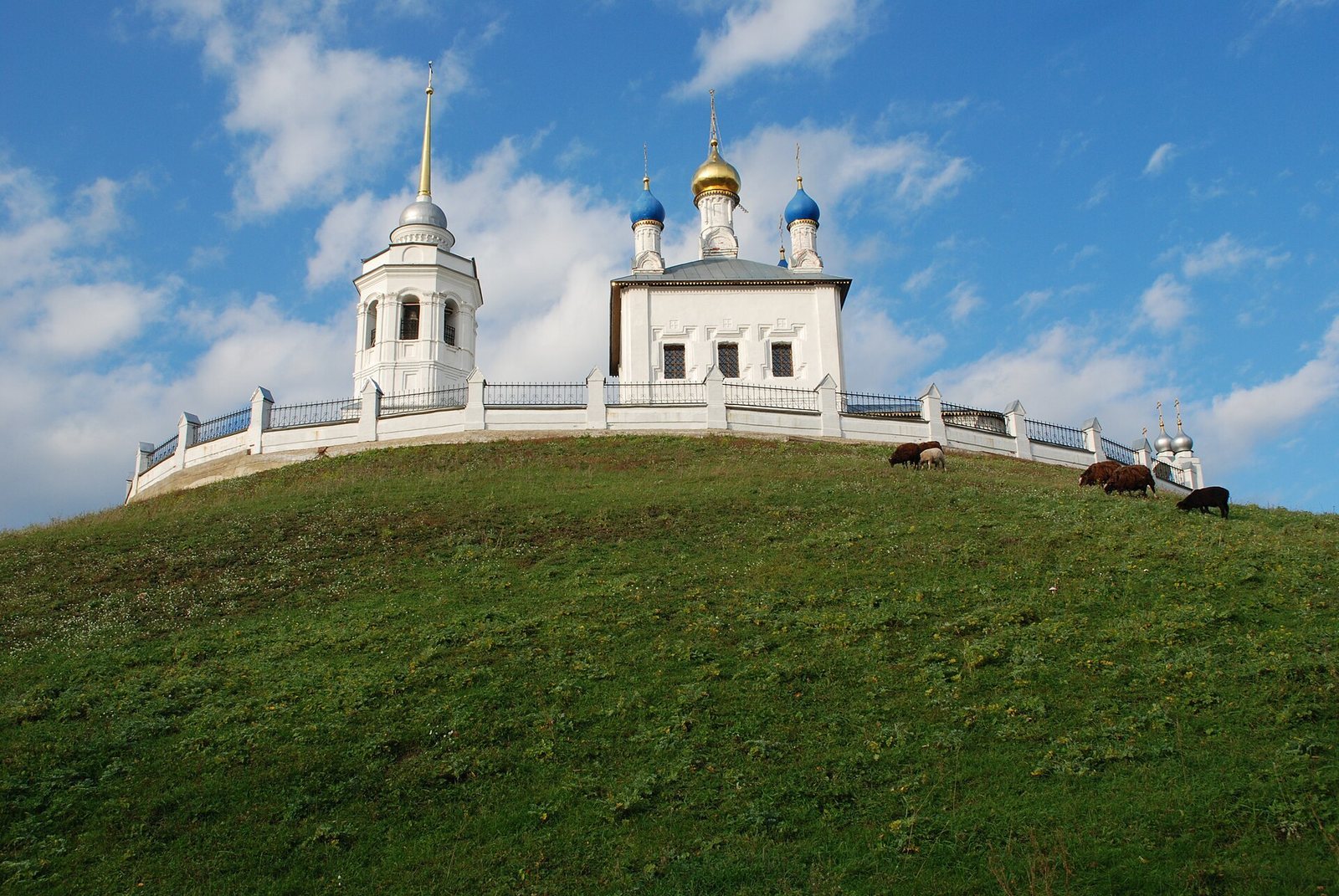
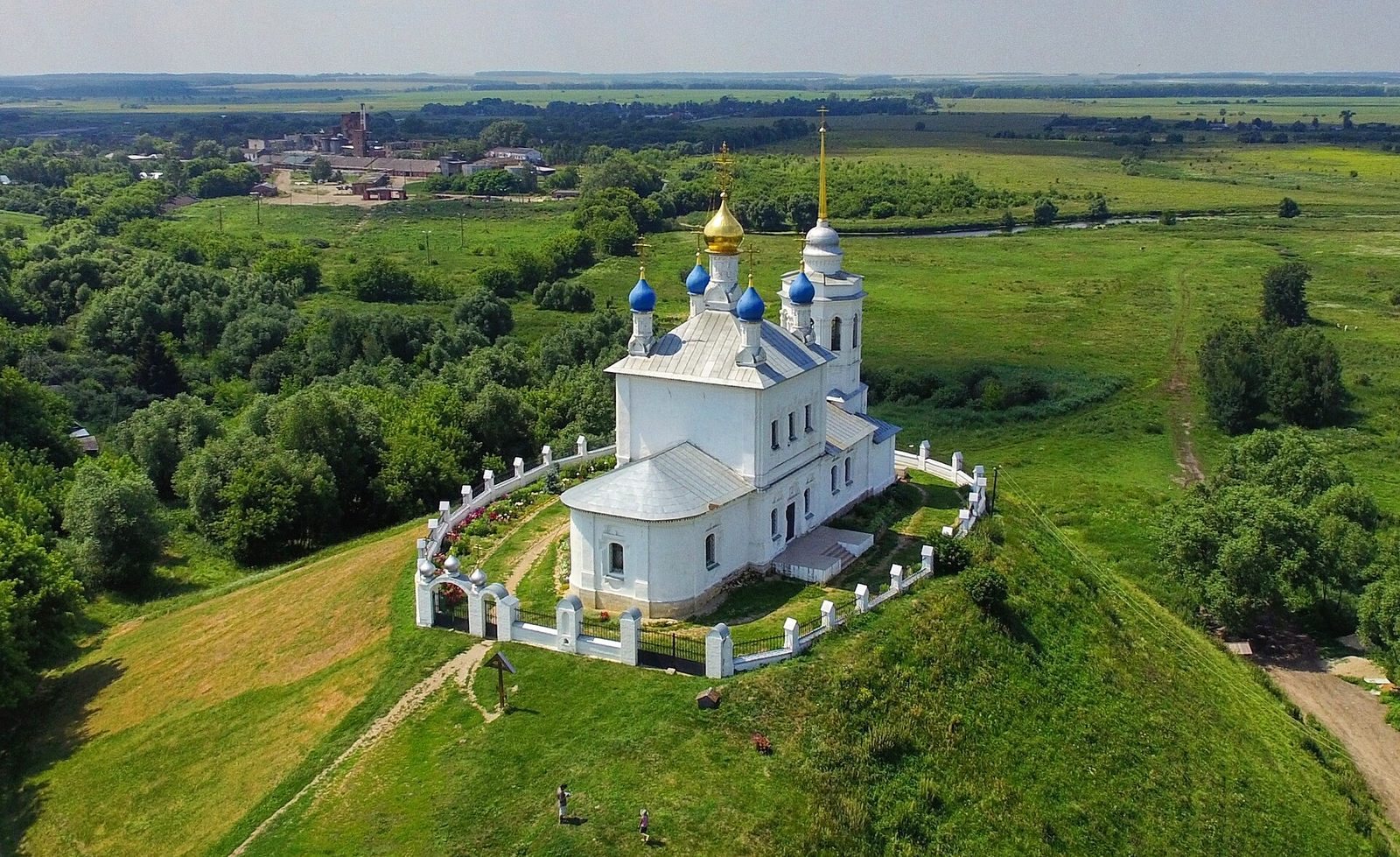
The church stands on Fedosino Hillfort, a hill associated with several stories about the area’s name. One tradition tells of a monk from Little Russia, a historical name for parts of present-day Ukraine, who founded a small monastery on the Don and named it for his teacher, Theodosius of the Caves. Theodosius was an eleventh-century monk and an early leader of the Kyiv Pechersk Lavra. Another tradition connects the hill to warriors killed at the Battle of Kulikovo in 1380, later an important symbol of resistance to Mongol-Tatar power. The hill itself is naturally formed.
A separate tale recounts how an abbot of a Dormition monastery sent his monks to join Dmitry Donskoy’s forces before Kulikovo, while he stayed behind to pray. When Lithuanian ruler Jogaila arrived with his troops, the abbot said that neither Moscow nor Tatar forces were there and hosted the visitors for three days. After hearing of the Russian victory, Jogaila understood why the abbot had welcomed him and ordered the abbot’s beheading. The tale became another explanation for the hill’s name and, later, the town’s.
The monastery is known from 1628, while a Crimean Tatar raid in 1609 had left its community on the hill desolate. An elder and his followers revived it in the mid-seventeenth century. Its estate covered 180 cheti, a traditional Russian measure of land, near Bolokhnino and Zaikino, about 25 versts, a traditional measure of distance, from Yepifan. In 1670–1671, the western part of Yepifan district, including the monastery’s estate, became part of the newly formed Bogoroditsk district.
A stone church was probably erected on the monastery grounds in the late seventeenth century and substantially rebuilt in the early eighteenth, although its precise construction date is unsettled. A Gospel records its donation in 1753 to the monastery’s Tikhvin chapel in Yepifan. In 1724, after the monastery lost land and other property, it was attached to Paroyskaya Hermitage, a small monastic community in Tambov Governorate. An inventory from 1763–1764 counted six monks, including three who were priests, and four lay assistants under Abbot Gerasim. As Catherine II’s government transferred church lands out of ecclesiastical control and reduced the number of monasteries, this small, poorly resourced community was abolished. Its church became a parish church.
Parish life and repairs
In 1780 the congregation included members of a military invalids’ unit and a fire brigade, along with civil officials. Sections of Korableinaya settlement joined the parish in 1782 and Rozhdestvenskaya settlement in 1797; Konnaia settlement and Endovishche were added later. The parish’s town residents then numbered 187 men and 224 women. By 1829 it comprised 56 households and 333 men and 303 women. About half of its members were town residents, including nobles, officials, retired military personnel, and townspeople; the rest lived in nearby settlements. It was the town’s smallest and poorest parish, and its modest income barely met the cost of candles, incense, and church utensils.
Donations helped maintain and improve the church through the nineteenth century. A major refurbishment took place in 1835, and a stone enclosure was built around the church in 1850. From 1894 to 1918, the churchwarden organized further donations and contributed more than 2,900 rubles to church needs, while personally paying for heating and lighting. In 1914, a Tula merchant’s bequest funded repairs to the exterior.
Closure and restoration
The church closed in 1932 and was first used to store grain. During the Second World War it housed a local-history museum. The museum closed in 1958, two years after Yepifan district was abolished. The disused building deteriorated, and vandalism over the next two decades left the architectural monument in ruins.
After Patriarch Alexy II, head of the Russian Orthodox Church from 1990 to 2008, visited in 2003, he blessed restoration work. A women’s monastic community was established, affiliated with the Trinity-Sergius Lavra. Restoration began in June. On 27 August, an archimandrite held a minor consecration of the altar, followed the next day by a liturgy for the Dormition.
Work continued through 2007. The altar of the Tikhvin side chapel was consecrated on 21 September, and the main altar on 14 October. A new enclosure was installed in 2008. In 2020, management passed to the Anosino Stavropegic Women’s Monastery of Saints Boris and Gleb, a monastery directly under patriarchal authority, and the church became its dependent church. It is active as an Orthodox church and is a federal-level cultural heritage monument of the Russian Federation.
Remains
The stone church occupies the former monastery grounds on Fedosino Hillfort. Its provincial Russian design, associated with the transition from pre-Petrine traditions to early Baroque, is also classified as Petrine Baroque, an early Russian Baroque style linked to the period of Peter the Great. The building has a main chapel and a side chapel, with interior paintings, icon screens, and a bell tower forming its principal architectural and decorative features.
Chapels and interior
Main chapel
The main chapel is dedicated to the Dormition. Its frescoes depict episodes from the Virgin Mary’s life. Paintings in the western part of the church show Rus’ gaining independence from Mongol-Tatar rule, including Sergius of Radonezh blessing Dmitry Donskoy, the Battle of Kulikovo, and the burial of fallen soldiers. Other imagery reflects the tradition that warriors killed at Kulikovo were buried beneath the hill.
Tikhvin side chapel
The side chapel is dedicated to the Tikhvin Icon of the Mother of God. A carved icon screen was installed there in 1811. The chapel’s altar section was restored in 2003.
Icon screens and devotional images
A five-tier iconostasis, an icon-covered screen separating the sanctuary from the main body of the church, stands inside. Its icons follow the painting traditions of the Trinity-Sergius Lavra school. The church’s worn icon screen was renewed in 1873.
Before 1918, the interior also held several icons in gilded cases, including images of Theodosius of Chernigov, the Dormition, and the Tikhvin Icon of the Mother of God. The image of Theodosius, a seventeenth-century Orthodox bishop and saint, was given by the churchwarden and was among the parish’s most venerated icons. Donations organized between 1894 and 1918 also provided five new bells and several of these devotional images.
Exterior and bells
Walls and roof
In 1835 the church was plastered throughout, repainted, and given a sheet-iron roof. These works formed part of the major refurbishment carried out that year.
Domes and bell tower
The domes were renewed and topped with gold crosses in 2004. The bell tower has a gilded spire. In 2006 it received seven bells, including one cast in Voronezh that weighs 1,200 kilograms, and six smaller bells.
Enclosure
A stone enclosure built around the church in 1850 was damaged by vandalism. The replacement, installed in 2008, combines wrought iron with stone pillars.