Santa Francesca Romana: A Roman Catholic Church beside the Roman Forum


Site at a Glance
- Rating
- 4.8
- Popularity
- Very Low
- Country
- Italy
- Primary era
- Medieval
- Eras represented
- Classical, Medieval, Early Modern
- Civilizations
- Papal States, Roman
- Site type
- Religious
- Remains
- Church
On this page18 sections
History
Santa Francesca Romana is a Catholic church and minor basilica in Rome, Italy, beside the Roman Forum. Founded broadly between the eighth and tenth centuries, it developed from an earlier Christian oratory in the portico of the ancient Temple of Venus and Roma. The church is a titular church of the Diocese of Rome, meaning that it is assigned to a cardinal as a symbolic ecclesiastical seat, and it is also a rectoral church of the parish of San Marco Evangelista al Campidoglio.
From Santa Maria Nova to a medieval church
A small oratory was probably established in the mid-eighth century during the pontificate of Pope Paul I. The site was traditionally associated with Saint Peter’s confrontation with Simon Magus, a figure portrayed in early Christian tradition as a magician and rival of the apostles. According to the legend, Simon tried to prove his powers by levitating, but Peter’s prayer caused him to fall to his death. Two basalt stones believed to bear the impressions of Peter’s knees were incorporated into the south-transept wall.
By the tenth century, the church was known as Santa Maria Nova, or New Saint Mary. The name distinguished it from Santa Maria Antiqua, the older Marian church in the Roman Forum. When Santa Maria Antiqua fell into ruin, its title, responsibilities, relics, and sacred objects were transferred to the newer church under Popes Leo IV and Gregory V. The earlier oratory was rebuilt or expanded into a church between approximately 847 and 996. During Gregory V’s pontificate, relics of several martyrs were brought from suburban catacombs.
Around 1140, the complex was entrusted to the Canons Regular of the Congregation of Saint Frigidian of Lucca. They remained there until 1352, when administration passed to the Olivetans, the Benedictine Congregation of Monte Oliveto, a reform branch of the Benedictine tradition founded in Italy. Medieval rebuilding added the apse and bell tower, and the church was reconsecrated in 1161, although the exact sequence of the works is uncertain.
Saint Frances of Rome and papal associations
During the sixteenth century, the church was rededicated to Frances of Rome, also known as Francesca Buzzi. She was a Roman aristocrat, mystic, and founder of the Oblates of Mount Olivet, a Benedictine-associated religious community. Her canonization in 1608 or 1609 led to further rebuilding, and her relics were transferred to the church. The new dedication to Saint Frances replaced the earlier dedication to the Virgin Mary.
Pope Gregory XI, who brought the papacy back to Rome from Avignon, was buried in the church. His tomb was later reconstructed, and a monument commemorates his return to Rome on 17 January 1377. The church’s former deaconry was suppressed on 8 August 1661. Pope Leo XIII reestablished Santa Maria Nova as a cardinal-priest titular church on 17 March 1887, and its formal titular name remains Sancta Mariae Novae.
Early modern renewal and later changes
Carlo Lambardi directed a major renewal of the church’s interior from 1595 and designed the present facade, porch, and portal, completed in 1614 and 1615. The work was financed by Cardinal Paolo Emilio Sfondrati, the nephew of Pope Gregory XIV. A wooden ceiling was added during this period.
During the French occupation of 1798, a bronze sculpture of Saint Frances and the angel was removed and destroyed. After Rome became the capital of the Kingdom of Italy in 1870, the state expropriated church property, including the adjoining Olivetan monastery. The monastery was formally suppressed in 1873, leaving the monks only a small part of the historic complex. In the early twentieth century, the archaeologist Giacomo Boni established the Antiquarium Forense in part of the former monastic premises to display finds from excavations in the Roman Forum.
Santa Francesca Romana is also associated with a legend that an angel illuminated Frances’s way with a lamp during her night journeys. This tradition made her the patron saint of car drivers, and automobiles traditionally gather for a blessing on her feast day, 9 March. The church also provided the design precedent for a replica facade at the Church of Holy Cross College in Clonliffe, Dublin, designed by James Joseph McCarthy.
Remains
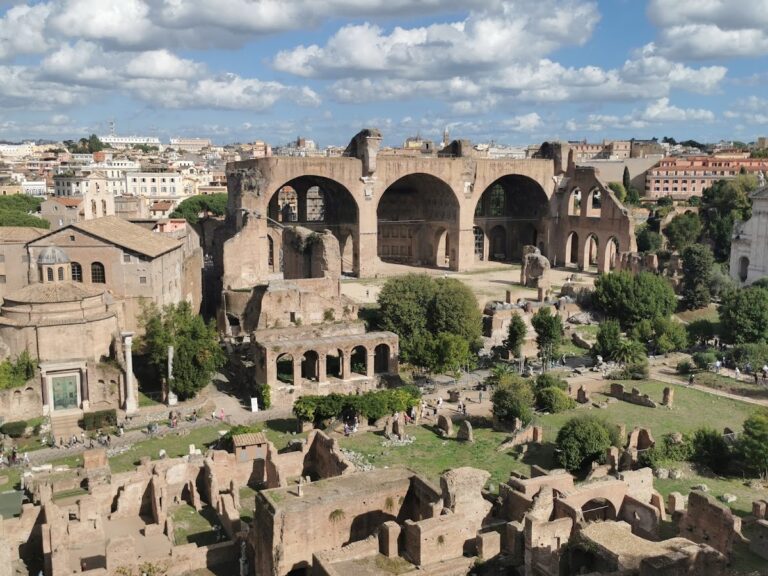
Santa Francesca Romana occupies the western entrance area of the former Temple of Venus and Roma. Its present nave follows the area of the earlier oratory, while the medieval apse and bell tower stand at the eastern end of the temple’s portico and entrance stairs. The church is a Romanesque building with a single nave and side chapels. Behind the apse and tower are remnants of the former monastery, including two small courtyards. The temple’s surviving outer columns flank these monastic structures and continue westward toward the Colosseum.
Church fabric and medieval remains
Facade and bell tower
The present travertine facade, porch, and portal were designed and built by Carlo Lambardi in 1614 and 1615. Beside the church, near the main altar, stands a tall Romanesque bell tower constructed of brick. Five stories rise above the roofline, each separated by a projecting cornice.
Nave and choir enclosure
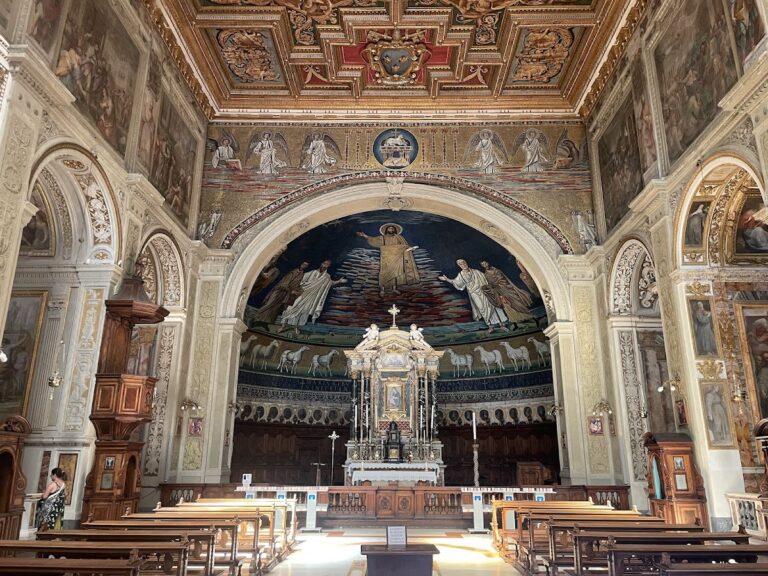
The nave preserves the rectangular schola cantorum, a designated choir enclosure or singing area, from the earlier church. Its decoration uses Cosmatesque work, a medieval Roman technique that arranges cut and colored marble and stone in geometric patterns. Fragments of a Cosmatesque pavement dated to 1216 survive in the floor, although most of the pavement was relaid in 1953 with three-colored marble.
Apse mosaics
The apse contains a Byzantine-style mosaic of the Virgin and Child with the apostles James, John, Peter, and Andrew. Medieval mosaics also survive on the triumphal arch.
Chapels and paintings
Crucifixion and Benedict chapels
The chapel of the Crucifixion contains an anonymous Calvary altarpiece, with paintings by Giuseppe Maria Crespi on the side walls. The chapel of Saint Benedict has a 1937 altarpiece by Augusto Orlandi showing Saint Benedict with Emperor Henry and Saint Francesca Romana. Its side-wall paintings depict Bernard Tolomei teaching and performing an exorcism.
Nativity and Saint Gregory chapels
The Nativity chapel contains a copy of a work by Carlo Maratta, with side paintings attributed to Domenico Maria Canuti. The chapel of Pope Saint Gregory the Great contains an image by Angelo Caroselli.
Other side chapels
The side chapels are dedicated to the Crucifixion, Saint Benedict, Saint Francesca Romana, the Nativity, Pope Saint Gregory the Great, Our Lady of Sorrows, and Saint Bernard Tolomei. The chapel of Saint Francesca Romana was renovated in 1729. An image of Saint Emidius now occupies the altar in the chapel of Our Lady of Sorrows, whose former marble Pietà was sold and is now in Germany.
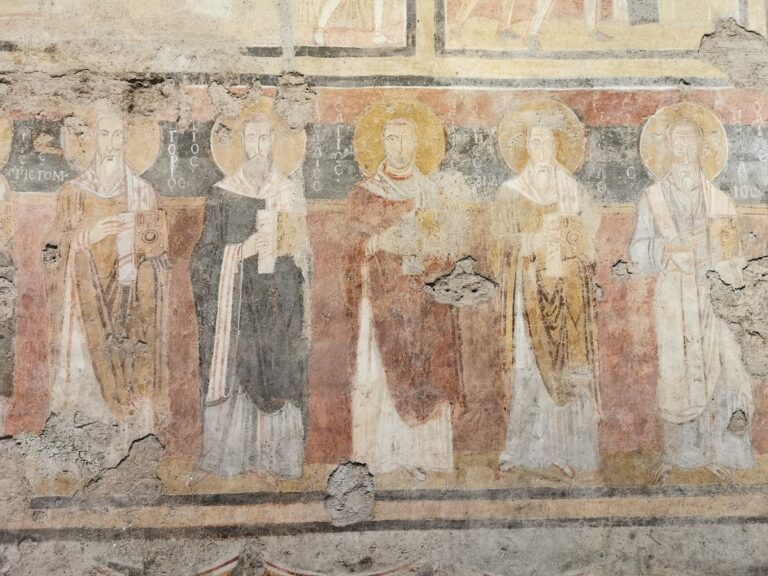
The chapel of Saint Bernard Tolomei contains an altarpiece by Giuseppe Pirovani showing the saint on his deathbed during the plague in Siena. Other paintings in the church and sacristy include works by Pietro Tedeschi, Padre Pozzi, Pierre Subleyras, Giacinto Brandi, and other artists. The first chapel on the right contains a badly damaged vault fresco of the Doctors of the Church, Christian theologians and teachers recognized for the authority of their doctrine and writings, attributed to Melozzo da Forlì.
Images, relics, and memorials
Sacristy icons
The sacristy houses the Madonna Glykophilousa, or Our Lady of Tenderness, an icon probably dating from the early fifth century and possibly associated with the Italo-Cretan school. It was transferred from Santa Maria Antiqua. A twelfth-century image of the Madonna and Child had previously been painted over it, and the older image was carefully detached from the panel in 1950.
The main altar contains a twelfth-century image of the Virgin Hodegetria, or She Who Shows the Way. This traditional icon type shows the Virgin indicating Christ as the path to salvation. The image is attributed to the Tuscan school and was also transferred from Santa Maria Antiqua. The sacristy additionally contains Giacinto Brandi’s Trinity with Blessed Bernard Tolomei and Angels, made between 1665 and 1670, and Pierre Subleyras’s eighteenth-century painting The Miracle of Saint Benedict.
Gregory XI’s tomb
The tomb of Pope Gregory XI stands in the south transept. Reconstructed to a design by Pietro Paolo Olivieri, it is signed and dated 1584. Its central relief shows Gregory XI’s return from Avignon to Rome within an architectural frame.
Confessio and relics of Saint Frances
Below the altar is the confessio, a protected devotional space associated with a saint’s relics. Gian Lorenzo Bernini designed it between 1638 and 1649. Curved side stairs, a railing, and a balustrade enclose the area, which contains a sculptural group of Saint Frances and an angel. Saint Francesca Romana’s relics were placed beneath the altar in a decorated sarcophagus in 1649, after being opened on 2 April 1638.
Bernini’s original sculpture was removed during the French occupation in 1798 and is lost. Giosuè Meli’s replacement marble sculpture was installed in 1866. A jasper-clad confessional designed by Bernini survives in the central nave.
Other memorials
The painter Gentile da Fabriano was buried in the church in 1427. A memorial plaque commemorating the burial was installed on the nave floor during the 1950s. Inscriptions concerning the church’s history were collected and published by Vincenzo Forcella.