Santa Croce in Fossabanda: A Medieval Church and Monastery in Pisa
Site at a Glance
- Rating
- 4.6
- Popularity
- Very Low
- Country
- Italy
- Primary era
- Medieval
- Eras represented
- Medieval
- Civilizations
- Republic of Florence, Republic of Pisa
- Site type
- Religious
- Remains
- Monastery
On this page9 sections
History
Santa Croce in Fossabanda is a Roman Catholic church and former monastery in Pisa, Italy, built in the medieval period for Dominican nuns and dedicated to the Holy Cross. It stands in the Piagge area of northeastern Pisa, in the place known as Fossabanda, whose name appears in property-sale documents from 1034 and 1111. The name referred to a drainage ditch in marshy ground bordering land associated with a person named Bando.
Dominican Foundation
A Dominican convent existed at the site by 1233. In 1251, Augustinian nuns who followed the Dominican rule took possession of it. They were known as the Sisters of the Most Holy Savior. The church and convent were built for this community, with work beginning in 1322 and the complex completed in 1325. The project was attributed to Bartolomeo del Cantone, a member of a prominent Pisan family and a lecturer at the Pisan convent of Santa Caterina d’Alessandria.
The convent’s position outside Pisa’s walls soon created practical difficulties. In 1331, the nuns asked Archbishop Simone Saltarelli to move them to the Benedictine church of San Silvestro inside the city because the isolated complex was considered inadequately protected. Around twenty nuns remained at Santa Croce, which thereafter served for retreats centered on meditation and prayer.
Chiara Gambacorti entered Santa Croce in 1378 at the encouragement of Catherine of Siena, a fourteenth-century Dominican tertiary. Chiara stayed for only a few years. In 1382, she moved to the new convent of San Domenico, founded for her by her father, Piero Gambacorti, the political lord of Pisa.
Franciscan Reorganization
The complex was extensively reorganized during the fifteenth century after it passed to the Franciscans. In 1426, Santa Croce was described as completely abandoned. Pietro Neretti, a Florentine patrician, acquired the property and donated it in 1427 to the Franciscan friars of the Observance. The Observance was a reform movement within the Franciscan order that emphasized stricter discipline and poverty. Santa Croce became the sixteenth Tuscan convent transferred to this branch.
In 1497, the monastery hosted Charles VIII of France during negotiations with the Pisan government about assistance against Florence. Bandino Bandini, a Florentine condottiero, was buried at Santa Croce in 1512. A condottiero was a military commander who led a contracted company of soldiers in late medieval and Renaissance Italy. Bandini’s tomb, made by the circle of the sculptor Pietro Aprile, included a reclining statue of the deceased on an urn. The monument was later moved to the cloister of the Conventual Franciscans of San Francesco in Pisa.
The church was solemnly dedicated to the Holy Cross on 1 June 1572. During the eighteenth century, the convent housed a prestigious General Study of Theology, one of the most important institutions of its kind in Tuscany alongside those of Lucca and Siena. A valuable wooden choir was installed in 1715 and completed in 1806.
Suppressions and Civic Use
Napoleonic suppressions closed the monastery and expelled its friars in 1810. The community returned after Napoleon’s fall, but the friars were expelled again in 1866 under suppression laws enacted by the newly established Italian state. The convent archive and many paintings were dispersed during these changes.
After the state expropriated the property, it transferred the convent to the Municipality of Pisa on 16 June 1875 for 19,483.88 lire. The building was converted into a lazaretto, an institution used to isolate people during epidemics, including the cholera outbreaks that frequently affected the city. The Franciscans purchased only part of the former orchard from the municipality, for 1,205 lire, and built a new convent there. The religious community still resides in that newer building, while the historic church and convent remain municipal property. The former convent is currently used as a student residence of the Sant’Anna School of Advanced Studies.
Remains
Church and Cloister
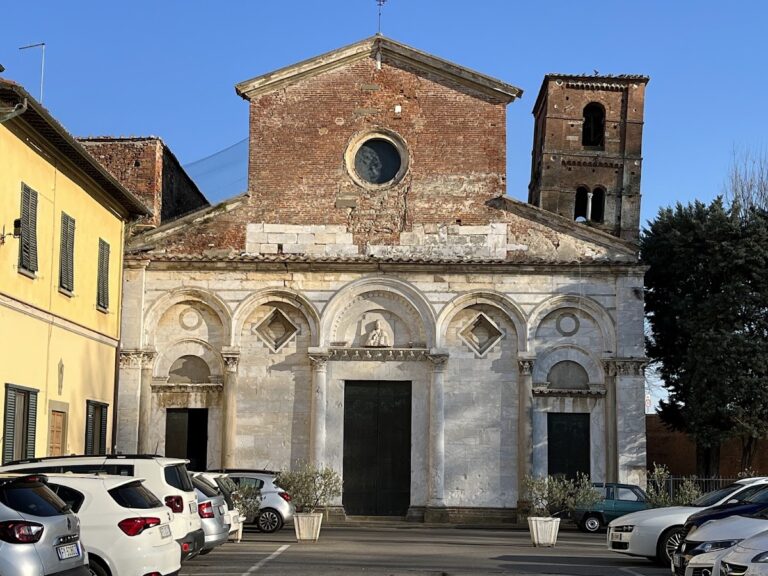
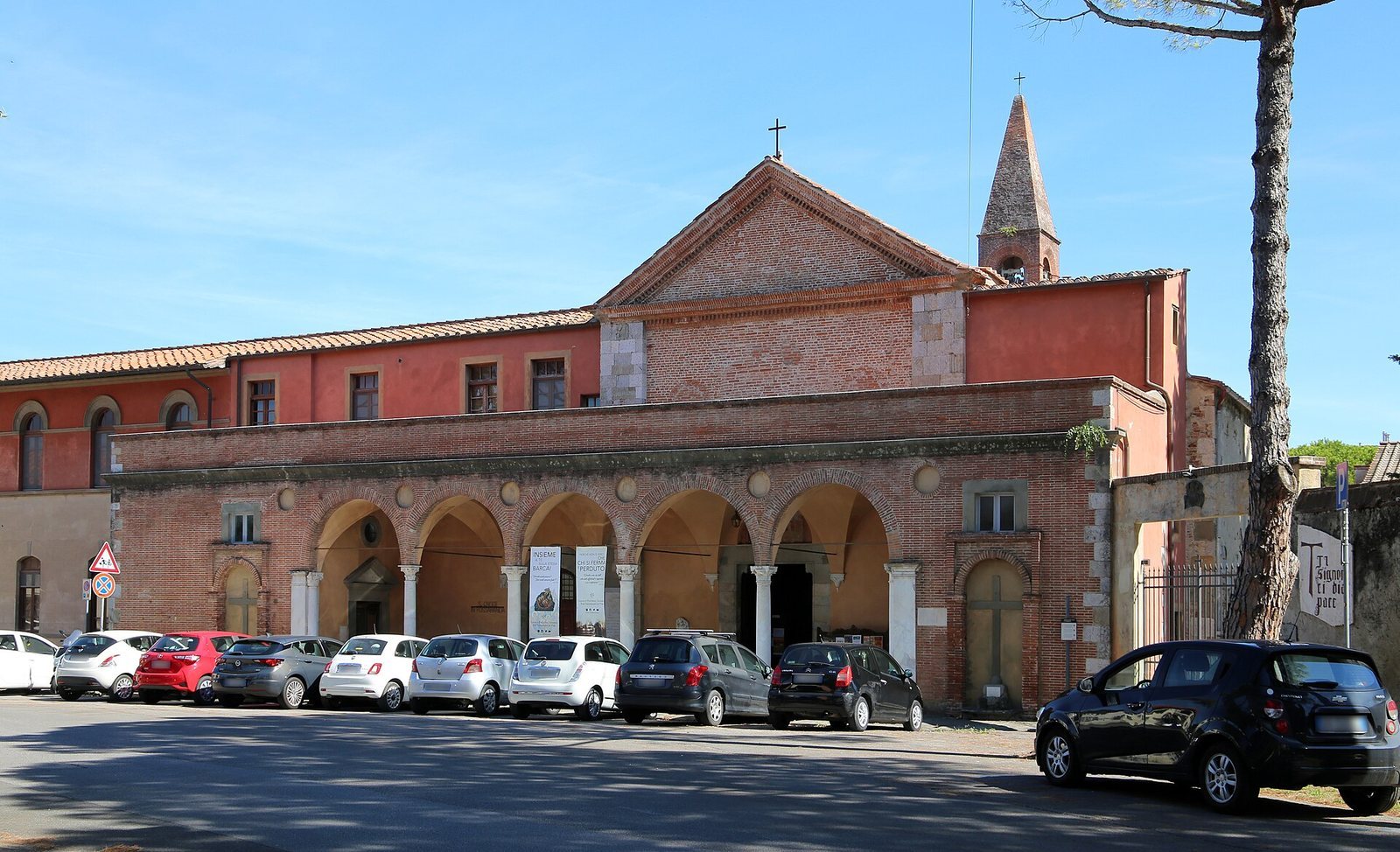
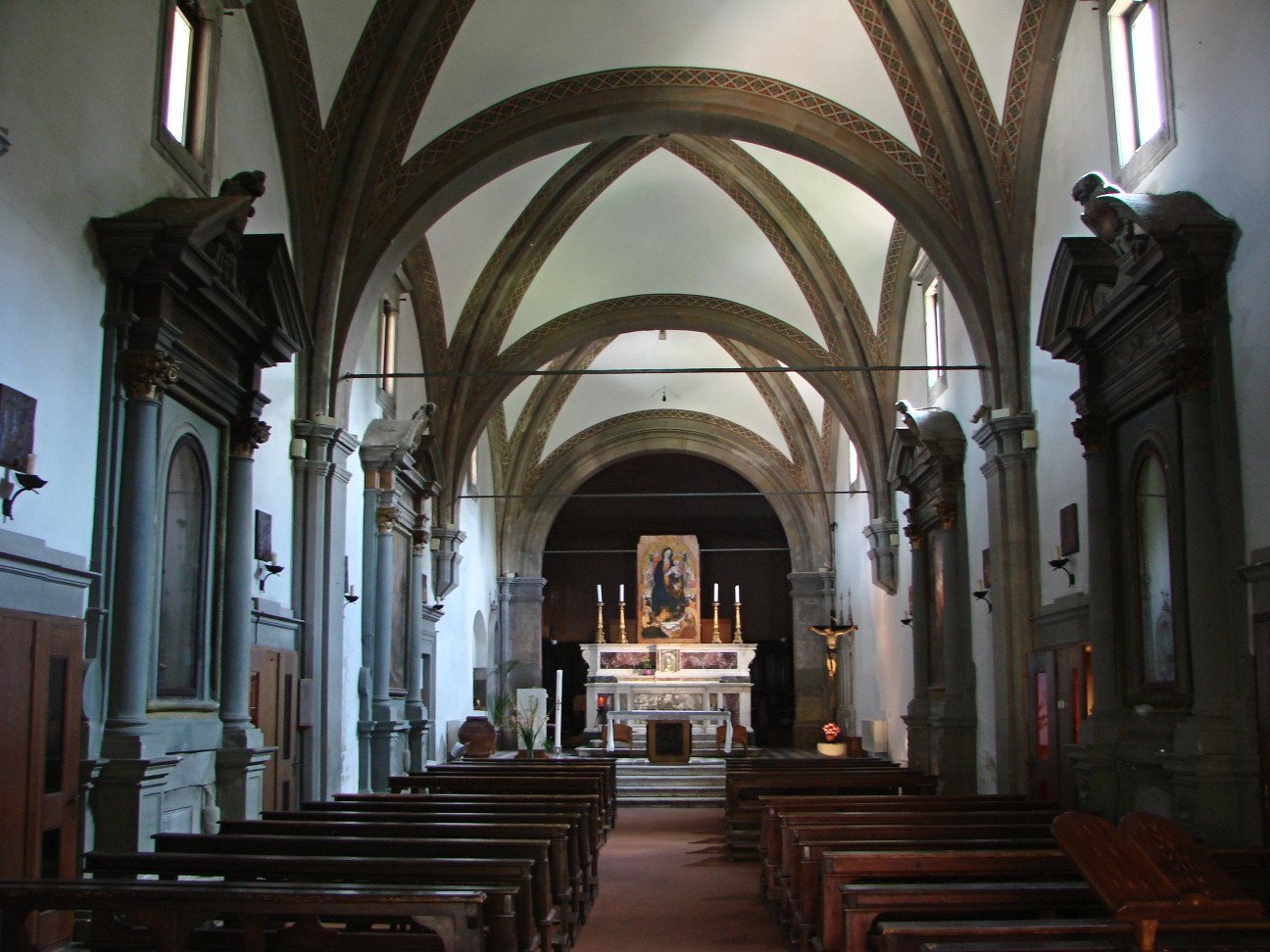
Santa Croce has a facade with a portico, a single nave, and a deep presbytery, the part of the church containing the principal altar and traditionally reserved for the clergy. The church is also described as having a narthex, an entrance hall or porch before the nave. The Franciscan rebuilding added the facade portico and established the cloister, a covered walkway surrounding an open courtyard. The cloister is porticoed on all four sides, and its lunettes retain traces of fifteenth- and sixteenth-century frescoes.
Side Chapel
A single side chapel stands on the right near the entrance. It preserves a signed panel by the Portuguese painter Álvaro Pires de Évora, showing the enthroned Madonna and Child among eight musician angels. The work dates to around 1430 and reflects the influence of Gentile da Fabriano, particularly in the use of gold and lacquers for decorative and naturalistic effects. Its central section is separated from the lateral panels, which are now in the Lindenau Museum in Altenburg.
Nave Altars
The side altars in the nave contain paintings from the seventeenth century and later. They include Jacopo Vignali’s Saint Francis and a Boy to Whom an Angel Points to the Madonna and Child, painted in 1649; Paolo Guidotti’s Blessed Salvatore da Orta, the Franciscan, Healing the Sick and Infirm, made after 1606; and Francesco Curradi’s Pardon of Assisi, made after 1627.
Crucifix and Former Altarpieces
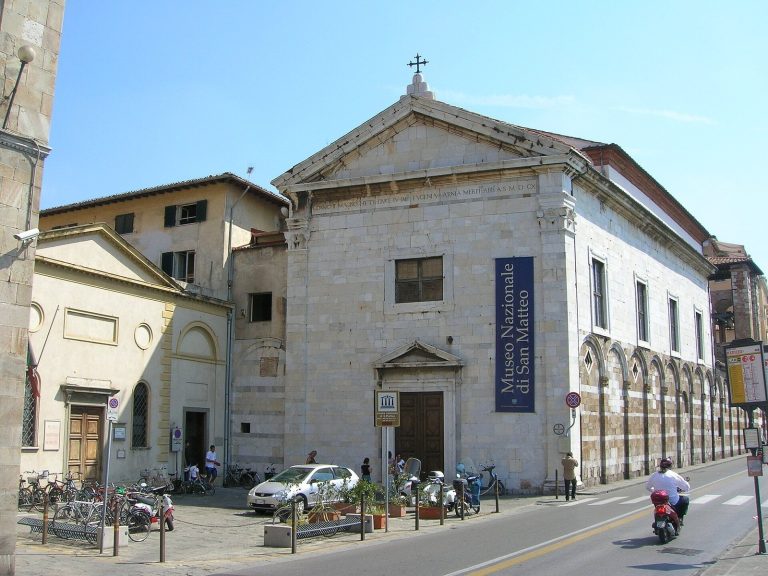
The church preserves a late-fifteenth-century wooden crucifix with movable limbs, a feature associated with theatrical forms of late-medieval religious devotion. Other works connected with Santa Croce are held elsewhere. Zanobi Machiavelli’s painting of the Madonna and Child with Saints Anthony Abbot, Pope Gregory, John the Baptist, and Francis of Assisi is now in the Museo di San Matteo. His Coronation of the Virgin, dated 1474, is in the Museum of Dijon after being looted by Napoleonic troops in 1810. A chapel formerly contained an altarpiece depicting Saint John the Baptist by Clemente Bocciardi.