Santa Croce e San Bonaventura alla Pilotta: A Roman Catholic Church in Rome
Site at a Glance
- Popularity
- Medium
- Country
- Italy
- Primary era
- Early Modern
- Eras represented
- Medieval, Early Modern
- Civilizations
- Papal States
- Site type
- Religious
- Remains
- Church
On this page17 sections
History
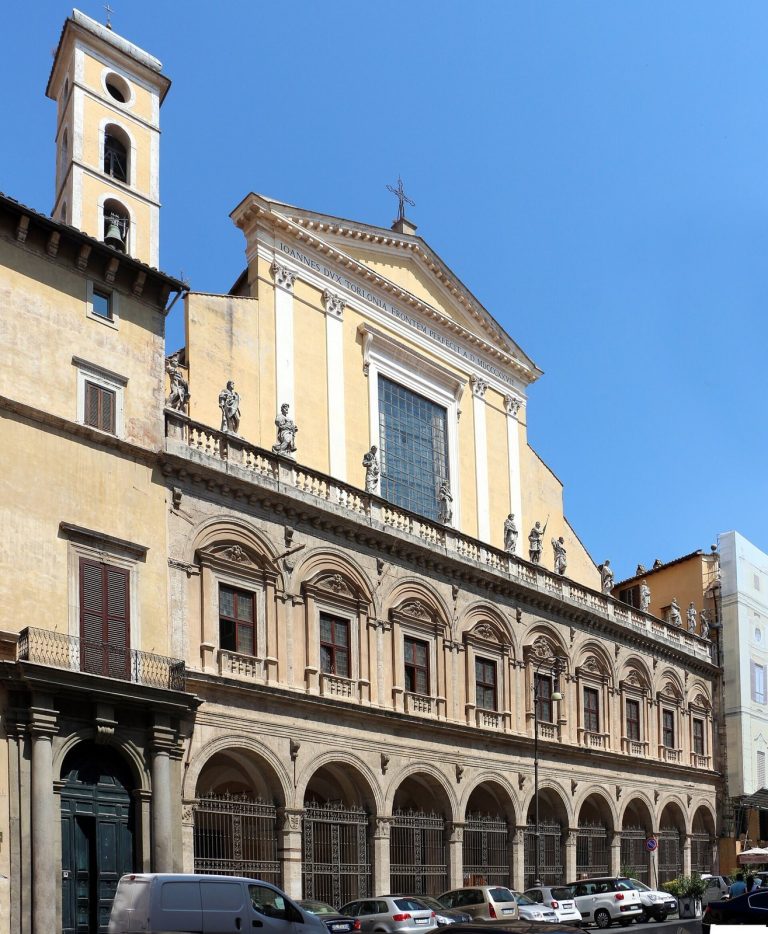
Santa Croce e San Bonaventura alla Pilotta is a Roman Catholic church on Via dei Lucchesi in Rome’s Trevi district, Italy. Its present building belongs to the late seventeenth century. The church belongs to the parish of Santi XII Apostoli and serves Rome’s Lucchese community. It was once that community’s national church and is now its regional church.
Medieval origins
The church stands on the site of a predecessor dedicated to Saint Nicholas, known as San Nicola in Porcis. This earlier church is dated to the ninth century, and a larger building was erected over it in the thirteenth century. It first appears in a written record in 1192. The origin of the name in Porcis is uncertain. It may refer to a Porzia family, or, more probably, to the nearby ancient Forum Suarium, a swine market, through a Latin word associated with pigs.
Capuchin period
In 1536, Bishop Ludovico de Torres granted the medieval church to Capuchin friars following the intervention of the Colonna, an influential Roman noble family. The Capuchins are a reform branch of the Franciscan order. At the initiative of Pope Gregory XIII, their convent was expanded and the church rebuilt. It was dedicated to Saint Bonaventure in 1575 and consecrated by Bishop Bartolomeo Doria on 12 March 1580. Saint Felix of Cantalice, a Capuchin friar, spent an extended period at the convent.
The Lucchese community and the present church
When the Capuchins moved to a new convent near Piazza Barberini in 1631, Pope Urban VIII assigned the church to Rome’s Lucchese community by a decree dated 22 May. The community, made up mainly of merchants, added the dedication to the Holy Cross, reflecting its devotion to Lucca’s Volto Santo, a wooden crucifix venerated in the city’s cathedral.
The medieval building was demolished in 1685, and Lucchese residents commissioned a replacement, constructed between 1692 and 1696. Mattia de Rossi directed the work and is credited with the design; Filippo Gherardi has also been tentatively associated with it.
Restoration and later use
The church underwent restoration in the nineteenth century, including partial rebuilding in 1863. The architect Virginio Vespignani is associated with this work. The church is attached to the headquarters of the Society of Mary Reparatrix, a Catholic women’s religious congregation, and preserves the relics of Blessed Mary of Jesus, who founded the congregation.
Remains
The church has a single nave, the main hall of the building, with three chapels along each side. A recessed square choir, the area reserved for clergy, lies beneath a shallow dome. Steps connect a small forecourt with the entrance. Inside, the chapels, decorated walls, wooden ceiling, and altar furnishings form the principal features.
Facade
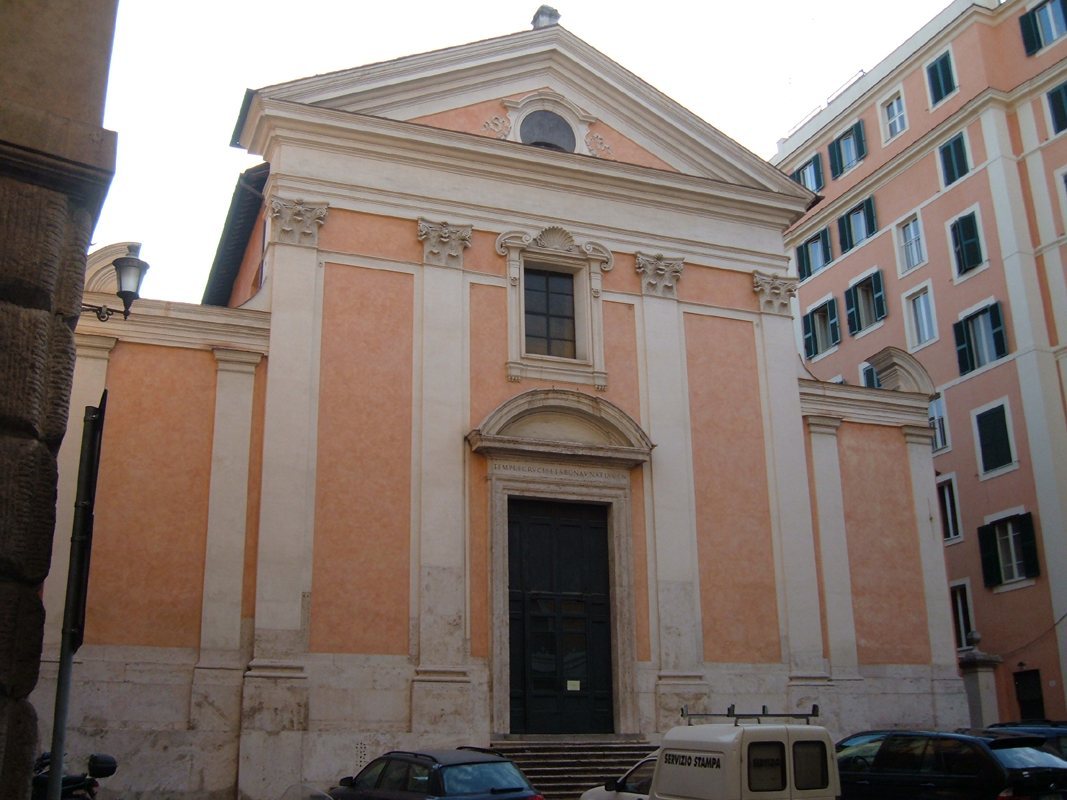
The facade has a central section divided into three vertical parts, flanked by recessed side sections. Corinthian pilasters, shallow columns projecting from a wall, articulate the center; simpler Tuscan pilasters frame the sides. Above the entrance doorway, an inscription sits beneath a slightly projecting, curved pediment. A rectangular window with shell ornament is set above it. The plain horizontal upper band supports a triangular pediment pierced by a decorated round window, while quarter-circle scroll forms crown the outer ends of the facade.
Medieval remains
Remains of San Nicola can be seen in the church crypt. Its apse is also visible in the courtyard of Palazzo San Felice on Via della Dataria. A nearby convent chapel may incorporate substantial remains of the medieval church.
Interior
Pilasters divide the nave walls between the chapels. Their shafts bear garlands and foliage, and rectangular windows pierce the upper walls. Marble details and gilded ornament enrich the interior. The flat wooden ceiling, painted and gilded and attributed to de Rossi, was complete apart from its paintings in 1673. Giovanni Coli and Filippo Gherardi made four ceiling scenes between 1673 and 1677. They show Heraclius, the Byzantine emperor, returning the True Cross to Jerusalem, and angels carrying Veronica’s Veil, a cloth believed to have received the image of Christ’s face; the Volto Santo; and objects associated with Christ’s suffering and crucifixion. Two stucco statues on the inner entrance wall portray Frediano and Paolino, bishops of Lucca venerated as saints.
Side chapels
Saint Zita Chapel
Attributed to de Rossi, the chapel dedicated to Saint Zita, a medieval saint associated with Lucca, has rich marble decoration and a curved ceiling with an upper lantern opening. Two marble child figures by Lorenzo Ottoni decorate the chapel. Lazzaro Baldi painted its altarpiece, which depicts Zita, and is also credited with the chapel’s wall paintings.
Castagnari Chapel
Frediano Castagnari commissioned this chapel, and Simone Costanzi is credited as its architect. It is dedicated to the Holy Trinity and was originally dedicated to the Immaculate Conception, the Catholic belief that Mary was preserved from original sin from the moment of her conception. Its slightly oval dome was shaped to fit the space. Biagio Puccini’s altarpiece depicts the Immaculate Conception. Wall paintings by Domenico Muratori and Francesco del Tintore show a miracle of Saint Lorenzo Giustiniani, a fifteenth-century Italian bishop, and Saint Frediano diverting the Serchio River.
Archangel Raphael Chapel
An oil painting of the Archangel Raphael by Agostino Tofanelli commemorates the artist’s young son Raffaele. The chapel’s decoration is largely illusionistic, mostly in shades of grey, and even the altar is painted.
Pierleoni Chapel
Opposite the Saint Zita Chapel, the Pierleoni Chapel is dedicated to the Crucified Christ. Illusionistic paintings on its curved ceiling imitate three-dimensional forms. An eighteenth-century wooden crucifix stands on the altar. The side walls carry paintings of Christ presented to the crowd and the Crowning with Thorns, alongside Passion scenes attributed to Coli and Gherardi.
Queen of Heaven Chapel
This chapel contains a seventeenth-century image of the Coronation of Mary and a painting of the Madonna in adoration, surrounded by the twelve apostles. Four tomb monuments commemorate Filippo Buonamico, who died in 1781; Lorenzo Prospero Bottino, who died in 1818; Stefano Tofanelli, who died in 1812; and Alessandro Gaetano Buttaonio, who died in 1816. Stefano’s portrait on his monument was made by his brother Agostino Tofanelli.
Saint Bonaventure Chapel
Formerly dedicated to the Assumption of Mary, this chapel was rebuilt and embellished by Pompeo Pierleoni. Its altarpiece shows the Assumption with Saints Francis of Assisi and Jerome, and may come from the school of Domenichino. Wall paintings depict Saint Margaret of Cortona and Saint Catherine of Siena, medieval Italian saints.
Altar and entrance features
The high-altar painting represents the Volto Santo, and a painting of the Madonna of Lucca is in the presbytery, the area around the main altar. Two seventeenth-century basins for holy water remain in the church. At the entrance are tomb monuments for Fantinello de Fantinelli, who died in 1719, and Fabio Guinigi, who died in 1691. A plaque and bust there also commemorate de Fantinelli, founder of the Saint Zita Chapel.