Santi Apostoli: A Roman Basilica and Church of the Twelve Apostles


Site at a Glance
- Rating
- 4.9
- Popularity
- Very Low
- Country
- Italy
- Primary era
- Early Modern
- External website
- Open
- Eras represented
- Medieval, Early Modern, Modern
- Civilizations
- Byzantine, Papal States
- Site type
- Religious
- Remains
- Basilica
On this page15 sections
History
Santi Apostoli is a Roman Catholic parish church and minor basilica in Rome, Italy, dedicated to the Twelve Apostles. Standing in the Trevi district beside Palazzo Colonna, it occupies a site associated with a church founded under Pope Pelagius I around 560, during the late antique period. The basilica is also a titular church, a church assigned to a cardinal priest as the symbolic seat of his Roman title, a station church for particular liturgical observances, and a Conventual Franciscan church administered by the Order of Friars Minor Conventual.
Early Christian Foundation
A predecessor basilica had been built near Trajan’s Forum under Pope Julius I in the mid-fourth century. By 499 it was recorded as titulus apostolorum, a title indicating its status as a recognized Roman church. The present institution traces its foundation to the church established on the current site by Pelagius I around 560.
The foundation was traditionally understood as an act of thanksgiving for the Gothic defeat at the Battle of Taginae in 552. That battle formed part of the Gothic wars in Italy, which culminated in the Ostrogothic defeat associated with the Byzantine general Narses. Narses was also said to have contributed to the construction. Pope John III dedicated the church around 570 to Saints James the Less and Philip.
The sixth-century building had three aisles and three apses, with a mosaic in the central apse. In a letter to Charlemagne written in the late eighth century, Pope Hadrian I described the church as richly decorated with mosaics. An atrium may also have stood before it, and possible remains of that structure lie beneath the present piazza.
Medieval Development
The church was restored by Pope Stephen VI in the ninth century. During this period, relics were moved from exposed suburban churches and catacombs into churches within Rome’s walls. Santi Apostoli consequently received relics associated with Saints Eugenia, Claudia, Chrysanthus, and Daria, together with those attributed to James and Philip.
The church was originally known as Saints Philip and James because their purported relics were preserved there. During the fifteenth or sixteenth century, its dedication was extended to all Twelve Apostles: Peter, Andrew, James the Greater, John, Philip, Bartholomew, Thomas, Matthew, Simon the Zealot, James the Less, Jude Thaddeus, and Matthias.
An earthquake seriously damaged the church in 1348. Reconstruction began in 1417 on the orders of Pope Martin V. The Conventual Franciscans assumed responsibility during the fifteenth century and later returned to exclusive care of the basilica in 1745, after an intervening period of diocesan administration.
Renaissance and Baroque Rebuilding
Pope Sixtus IV commissioned a major renovation in the late fifteenth century, carried out by Baccio Pontelli. The portico was altered around 1665 by Carlo Rainaldi, who closed its upper arches, inserted Baroque windows, and added statues of Christ and the Apostles to the balustrade.
Pope Clement XI initiated an almost complete rebuilding in 1702. Francesco Fontana planned and began the work, and Carlo Fontana continued it after Francesco’s death in 1708. The reconstruction was completed in 1714. Apart from the portico and the confessio, a recessed area providing access to a saint’s tomb or relics, beneath the high altar, the earlier building was demolished and reconstructed. The number of side chapels along the nave was reduced from twelve to six, while the separate Bessarion Chapel survived behind the Odescalchi Chapel.
The rebuilding also changed the presentation of an important Renaissance artwork. Melozzo da Forlì’s apse fresco of the Ascension of Christ was removed in 1711 when the choir was enlarged. The fresco was cut into sections. The central figure of Christ went to the Quirinal Palace, other fragments went to the sacristy of Saint Peter’s, and further fragments and preparatory designs entered the Vatican collections.
Restoration and Continuing Religious Role
The basilica was restored in 1827, when Giuseppe Valadier designed and completed the facade above the portico. In 1873, the ancient crypt was excavated and redecorated to resemble an early Christian catacomb. The original crypt altar and the relics attributed to Saints Philip and James were found in place.
An international research team examined the relics scientifically in 2020. The material attributed to Philip was too contaminated for reliable dating. The femur attributed to James the Less was identified as belonging to another person, who lived approximately 160 to 240 years later than James.
Santi Apostoli has remained a parish church and a Roman titular church, Titulus XII Apostolorum. Angelo Scola has held its titular cardinalate since 2003. The basilica is also a station church on the Friday of the first week of Lent and on the Thursday after Easter. The General Curia of the Conventual Franciscans occupies the adjacent building.
Burials and Historical Associations
The basilica has long been associated with the Colonna family and contains burials or memorials connected with the papacy, the College of Cardinals, the Stuart family, and the arts. Cardinal Bessarion served as its titular priest before his burial there. Pope Clement XIV, Cardinals Pietro Riario, Raffaele Riario, and Agostino Casaroli, and the composer Girolamo Frescobaldi were also buried in the church.
Michelangelo was temporarily buried at Santi Apostoli in 1564 before his remains were secretly transferred to Santa Croce in Florence. James Francis Edward Stuart used the church as his parish church while living at nearby Palazzo Muti and prayed there regularly. After his death in 1766, his body lay in state at Santi Apostoli before he was buried with his wife in Saint Peter’s Basilica.
Remains
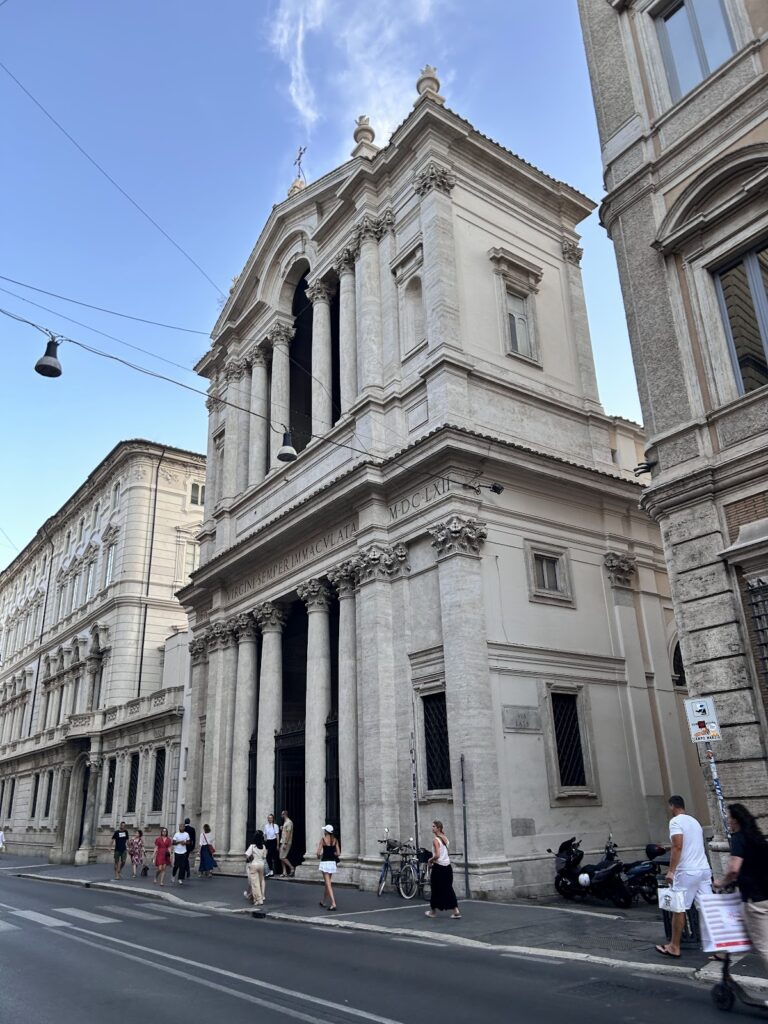
Santi Apostoli is a Baroque basilica arranged around a broad, short central nave, two side aisles, a raised choir, and a portico facing Piazza dei Santi Apostoli. The entrance loggia is set at an angle to the church’s main axis, so that the left exterior wall is longer than the right. The church has three aisles, a central nave divided into three bays, and a long presbytery ending in a three-sided apse. The nave is 63 metres long and is lit by three large windows on each side.
Portico and Facade
The lower facade is dominated by a portico with nine large open arches. Its visible supports are octagonal, while the archivolts have triple ribbing. Behind these applied supports, square piers carry the actual vaults. The upper arcade was later filled with windows, and the balustrade carries statues of Christ and the Apostles.
Several older works are incorporated into the portico. A second-century Roman marble relief of an eagle within an oak wreath was found near Trajan’s Forum. Beneath it stands a stone lion made by Pietro Vassalletto in the twelfth century. Two further twelfth-century red-marble lions flank the main portal. They formerly supported the pilasters of the entrance doors, and the column bases remain visible on their backs.
At the left end wall of the portico is the monument to the Venetian engraver Giovanni Volpato, made by Antonio Canova in 1807. Its principal relief shows a mourning woman before a bust of Volpato. Above the portico, Valadier’s 1827 facade uses restrained pilaster decoration.
Nave, Presbytery, and Decoration
Heavy piers with paired pilasters open into high arcades. The central nave is covered by a barrel vault pierced by windows above the surrounding cornice. The side chapels have lanterns over their domed vaults, bringing lateral light into the aisles. Frescoes, white-and-gold stucco, and extensive gilding create the interior’s richly ornamented surface.
Giovanni Battista Gaulli, known as Baciccio, painted the 1707 vault fresco of the Triumph of the Franciscan Order. On the apse ceiling, Giovanni Odazzi painted the Fall of Lucifer and his Angels. Later frescoes of the Evangelists were added in the apse, while Sebastiano Ricci painted the Ascension on the sacristy ceiling in 1701.
The eighteenth-century high altar stands against the apse wall. Its large altarpiece, made by Domenico Maria Muratori around 1704, depicts the martyrdoms of Saints Philip and James the Less. Measuring approximately 14 by 6.5 metres, it is described as probably the largest canvas or panel painting in Rome. A baldachin, or canopy over an altar, with four porphyry columns formerly stood above the altar.
The pulpit was made by Sebastiano Cipriani in 1736. The nave floor is formed of black and white marble installed in the late nineteenth century. The large Chapel of the Crucifixion, designed as a miniature basilica, stands to the right of the apse, while the sacristy is positioned to its left. The organ, built by Mascioni in 1925 and enlarged in 1955, has 46 stops, three manuals, pedals, electric action, and two sections. Its manual divisions are behind the high altar, and the pedal stops occupy a lateral case.
Chapels Along the Aisles
Right Aisle Chapels
The first chapel on the right is dedicated to Saint Bonaventure. Its altar contains a fifteenth-century Madonna and Child by Antoniazzo Romano. Niccolò Lapiccola painted the larger altarpiece, which shows the Virgin with Saint Bonaventure and Blessed Andrew Conti.
The second right-hand chapel is dedicated to the Immaculate Conception. Luigi Gabet created it in 1858 after the earlier Baroque Chapel of Saint Cyprian was removed, and Corrado Giaquinto made its altar. The chapel contains Maria Clementina Sobieska’s tomb monument by Filippo della Valle. She was buried in Saint Peter’s Basilica, and her heart is also commemorated at Santi Apostoli.
The Odescalchi Chapel, the third on the right, was rebuilt by Ludovico Rusconi Sassi under the patronage of Baldassarre Erba Odescalchi and completed in 1722. Its floor is a polychrome marble mosaic bearing the arms of Pope Innocent XI. Benedetto Luti painted the altarpiece of Saint Anthony of Padua, and Giuseppe Nicola Nasini decorated the vault.
Bessarion Chapel
Behind the Odescalchi Chapel is the funerary Chapel of Cardinal Bessarion. Conceived in the mid-fifteenth century and completed and decorated during the second half of that century, it retains Renaissance frescoes attributed to Antoniazzo Romano with assistance from Melozzo da Forlì. The scenes include Bishop Aubert of Avranches at Mont-Saint-Michel, the apparition of Saint Michael as a bull at Siponto, and a choir of angels. Much of the apse decoration has been lost.
The chapel was later abandoned, and its frescoes were whitewashed in 1723 when the Odescalchi Chapel was built. It was rediscovered during restoration work near Palazzo Colonna in 1959 and restored between 1989 and 2005. An opening at the rear reveals a porphyry urn traditionally believed to contain the relics of Saints Eugenia and Claudia, transferred from the catacombs in the ninth century.
Left Aisle Chapels
The first chapel on the left is dedicated to Our Lady of Sorrows. Francesco Manno painted its 1807 altarpiece, the Descent from the Cross. The second is dedicated to Saint Joseph of Cupertino and contains Giuseppe Cades’s 1777 altarpiece, which depicts the saint levitating.
The Saint Joseph chapel also contains two ribbed Corinthian columns made from verde antico, an ancient green decorative stone formed from breccia with green serpentinite fragments. They are regarded as the largest known examples of this stone type. The third chapel on the left is dedicated to Saint Francis of Assisi and contains Giuseppe Bartolomeo Chiari’s painting of Saint Francis in ecstasy.
Crypt and Relic Shrine
Two stairways descend to the confessio, which connects the high altar with the crypt and relic shrine. Beneath the high altar, the relics attributed to Saints Philip and James are kept in a red-and-green marble reliquary placed in a deep, barrel-vaulted niche at the end of the crypt.
The earlier altar that held the relics remains visible and is decorated with an ancient relief. The crypt walls carry reproductions of catacomb paintings. Together, the altar, niche, reliquary, and stairways preserve the physical arrangement created for access to the apostolic relics.
Tombs and Memorials
At the end of the left aisle, near the sacristy door, stands the Neoclassical tomb of Pope Clement XIV. Antonio Canova made it between 1783 and 1787 as his first major work in Rome. The monument shows the seated pope blessing from a granite pedestal above a classical sarcophagus supported on lions’ feet, with allegorical figures of Temperance and Clemency.
Near the choir on the left side of the nave is the tomb monument of Cardinal Pietro Riario, associated with Andrea Bregno, Mino da Fiesole, and Giovanni Dalmata. On the right side is the tomb of Cardinal Raffaele Riario, traditionally attributed to a design by Michelangelo. The church also contains a Madonna by Mino da Fiesole.
Cardinal Bessarion’s tomb is now in the cloister. Its bilingual Latin and Greek inscription identifies him as Bishop of Tusculum, a cardinal of the Roman Church, and Patriarch of Constantinople, and states that he prepared the tomb during his lifetime. A separate inscription from 1682 inside the church praises his contributions to the Catholic and Orthodox churches, to Santi Apostoli, and to the Conventual Franciscans. It bears a relief portrait of Bessarion and is often mistaken for his actual tomb.
The former tomb of Michelangelo is preserved as a memorial in the cloister. It depicts the artist reclining on a couch before a small table and two erotes. An inscription records his initial burial at Santi Apostoli and the later transfer of his remains to Florence.
Nearby sites