Galleria Sciarra: A Liberty Covered Passage in Rome


Site at a Glance
- Rating
- 4.6
- Popularity
- Low
- Country
- Italy
- Primary era
- Modern
- Eras represented
- Modern
- Civilizations
- Italian
- Site type
- Civic
- Remains
- Cryptoporticus
On this page10 sections
History
Galleria Sciarra is a covered passage in Rome, Italy, created between 1885 and 1888 in the Liberty style, the Italian form of Art Nouveau, during the modernization of the capital’s historic center. It was built as an appendage to Palazzo Sciarra Colonna di Carbognano and connected different parts of the property.
From the ancient portico to the noble palace
In antiquity, the area contained the Porticus Vipsania, a roofed colonnaded walkway built by Vipsania Polla, the sister of Marcus Vipsanius Agrippa. Agrippa was a prominent Roman statesman and general whose villa stood nearby. The district remained continuously built up, later accommodating civic and religious buildings, patrician residences, and noble homes.
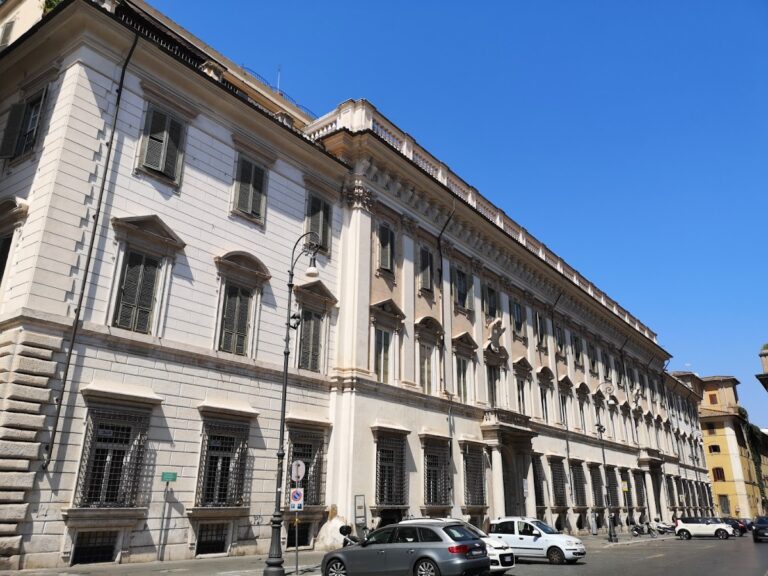
Palazzo Sciarra Colonna di Carbognano, the larger complex to which the gallery belongs, was constructed between the late sixteenth and early seventeenth centuries as a richly appointed noble residence. Galleria Sciarra occupies the central section of a broader architectural complex extending from the Banco di Roma to the Teatro Quirino on Via delle Vergini.
Creation during Rome’s modernization
The present gallery was formed as a courtyard at the end of the palace during the rebuilding and modernization of central Rome after the capital of the Kingdom of Italy moved from Florence to Rome. The Kingdom of Italy, established in 1861, was the Italian state that preceded the republic created in 1946. This period brought population growth, new commercial activity, greater demand for housing, and prestigious building projects for the expanding bureaucracy.
Prince Maffeo Barberini Colonna di Sciarra, the eighth Prince of Carbognano, commissioned the gallery to link spaces within his property. He was a deputy in the Kingdom of Italy and an entrepreneur in publishing. The new passage housed the editorial offices of the daily newspaper La Tribuna, followed by those of the literary magazine Cronaca Bizantina, directed by the poet, novelist, journalist, and political figure Gabriele D’Annunzio.
Galleria Sciarra was inaugurated in 1888. It continues to serve as office space and as a covered pedestrian passage through a private courtyard that is open to the public during office hours. At the end of the 1970s, a safety restoration emptied the interior and rebuilt the building in reinforced concrete while preserving its painted decoration and iron structures.
Remains
Galleria Sciarra occupies a quadrangular plan between Via Marco Minghetti and Piazza dell’Oratorio in Rome’s Trevi district. Four floors surround a central courtyard-like space, which is covered by an iron-and-glass vault. The surviving framework and painted surfaces combine modern nineteenth-century materials with decorative references to the ancient past.
Passage and structural framework
Iron-and-glass vault
The central passage is enclosed by a vault made of iron and glass. Cast-iron columns mark the entrances, reflecting the architect Giulio De Angelis’s interest in cast iron and the influence of English Liberty architecture. The iron framework survived the late-1970s reconstruction, when the interior was rebuilt in reinforced concrete.
Central courtyard space
The gallery is organized around a central courtyard-like area divided by rich architectural framing. Its position within the larger palace complex makes it a connecting passage between spaces belonging to the property, while its present use combines offices with a covered pedestrian route.
Painted and modeled decoration
Glorification of Woman
Giuseppe Cellini painted the central decoration in 1888, with its iconographic program developed in collaboration with the writer Giulio Salvatori. Executed in encaustic painting, a technique that binds pigments with heated wax, the Liberty scheme is organized around the theme “Glorification of Woman.” Female figures represent Modesty, Sobriety, Strength, Humility, Prudence, Patience, Benevolence, Ladyhood, Fidelity, Amiability, Mercy, and Justice.
The figures are presented as graceful and elegant tributes to Carolina Colonna Sciarra, the mother of Prince Maffeo. Her initials, “CSS,” appear on shields in the entrance bays. Terracotta elements introduce references to ancient Etruscan, Roman, and Greek art within the modern decorative program.
Scenes of bourgeois life
A second decorative narrative portrays scenes from contemporary bourgeois life. The activities include gardening, a domestic meal, musical practice, charitable work, personal grooming, and polite conversation. The belief that the man shown in the final scene is Gabriele D’Annunzio remains a legend.
The combination of painted ornament, terracotta classical references, and an iron framework makes Galleria Sciarra one of Rome’s few examples of Liberty architecture. Its decorative surfaces and structural ironwork remain from the nineteenth-century design despite the later reconstruction of the building.
Nearby sites