Balnuaran of Clava: A Prehistoric Cairn Complex in Scotland
Site at a Glance
- Popularity
- Low
- Country
- United Kingdom
- Primary era
- Bronze Age
- Eras represented
- Stone Age, Bronze Age, Modern
- Civilizations
- British
- Site type
- Burial
- Remains
- Necropolis
On this page9 sections
History
Neolithic and Bronze Age use
Balnuaran of Clava is a prehistoric burial complex in Strathnairn, Scotland, United Kingdom, built by prehistoric communities around 2300–2000 BC. Its construction fell at the transition from the Late Neolithic, the later Stone Age farming period, to the Early Bronze Age, when bronze was used for tools and other objects. The stone burial mounds, or cairns, replaced an earlier settled and farmed landscape.
The cairns were used for a relatively short period and held only a few burials, perhaps just one. After this first phase, they were closed. About a thousand years later, people used them for burials again and built additional burial monuments nearby. The distinctive cairn form at Balnuaran gave its name to the Clava Cairns, a type found only in northeastern Scotland, south and west of the Moray Firth.
Investigation and protection
The cairns were examined in the 19th century. Bones may have been recovered from the northeastern cairn in 1828. An excavation of the southwestern cairn in 1858 yielded fragments from two urns and a small quantity of cremated bone.
In 1870–71, the landowner enclosed four of the best-preserved cairns with a wall and cut back vegetation. Stones from the cairns may also have been used in the wall. Because people then believed the site was associated with Druids, religious specialists in ancient Celtic societies, trees were planted to create what was called a Druid grove. The site became a Scheduled Monument, a legally protected archaeological or historic place in the United Kingdom, on 18 August 1882. It is now cared for by Historic Environment Scotland, Scotland’s public body for the historic environment.
The Office of Works repaired the cairns in the early 1930s, when fallen stones lay around them. Archaeologist Kathleen Kennedy led partial excavations at the same time. Their results remained unpublished and were rediscovered in the late 1980s. In the 1950s, archaeologist Stuart Piggott directed excavations that produced few new findings, though work in the central cairn’s chamber revealed evidence of fire and cremated bone. From 1994 to 1997, Richard Bradley of the University of Reading led further excavation and fieldwork, including detailed recording of the best-preserved cairns above ground.
Remains
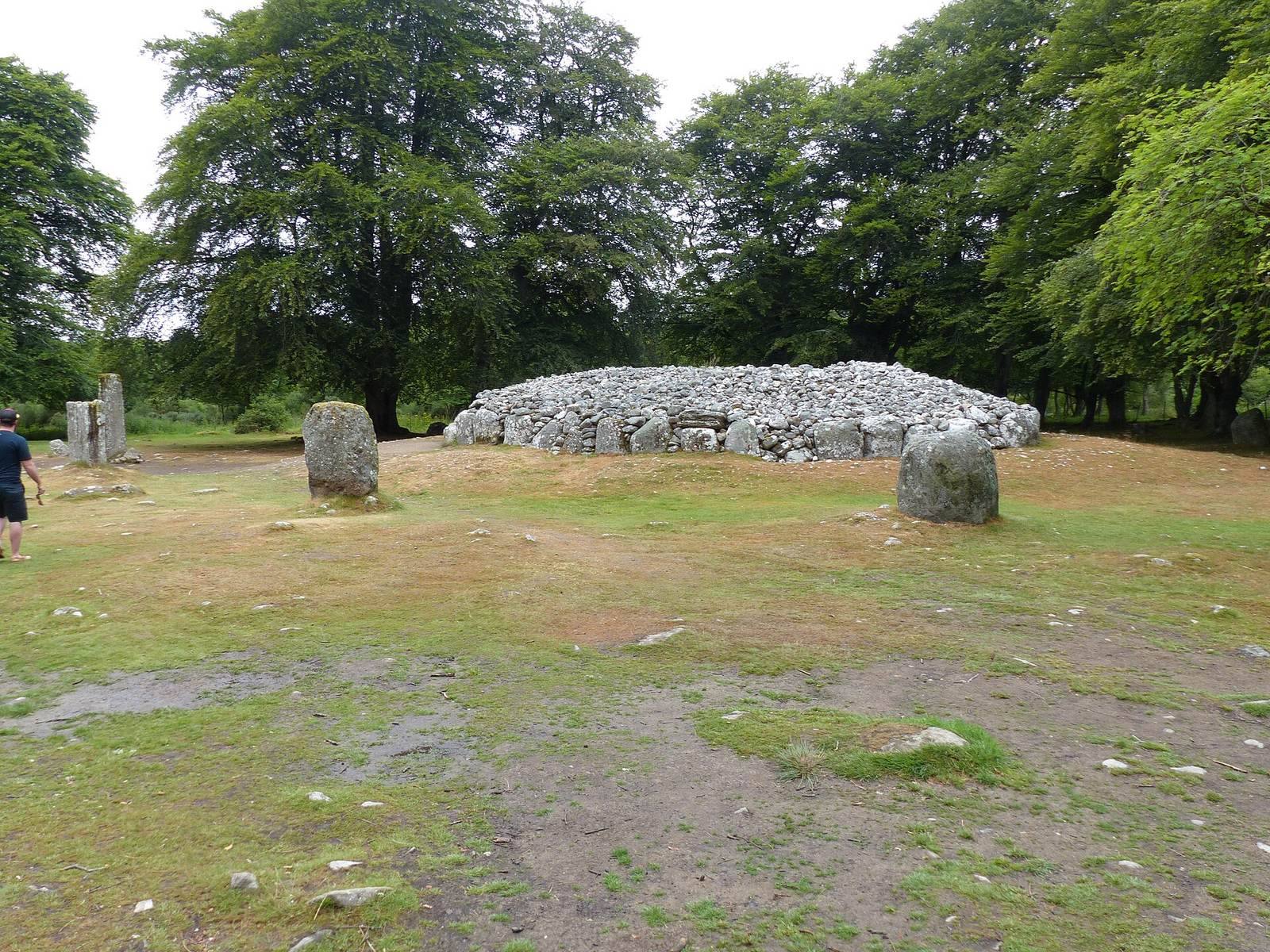
Three principal cairns stand in a slightly irregular line from northeast to southwest, each within a stone circle. A smaller burial mound lies between the middle and southwestern cairns. The principal cairns have roughly circular mounds on rubble platforms, which support their outer edge stones. The stones rise in height toward the southwest, an arrangement also followed by stones within the chambers. The two passage graves had roofs made by laying successive courses of stone inward. The builders used red sandstone, red conglomerate, pink pegmatite, pale granite, gneiss and mica schist, as well as a few black stones. Arranged by size and colour, the stones created areas that would have appeared wholly red or white.
The principal cairns
Northeastern cairn
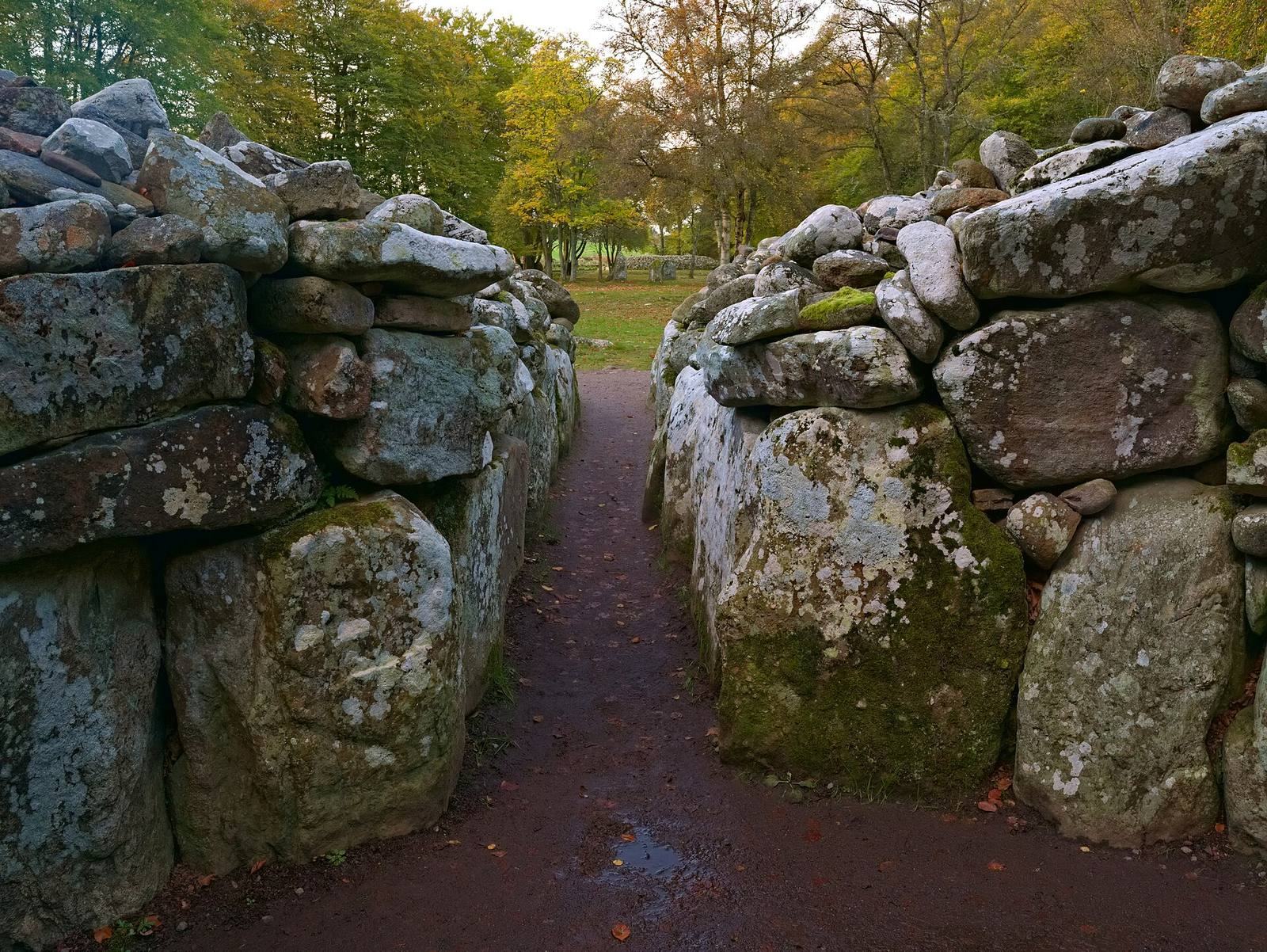
This passage grave has a mound nearly 10 feet (about 3 m) high and 55 feet (about 16.8 m) across. Its low entrance passage aligns with the winter solstice: the setting sun on that day reaches the inner chamber. The chamber is 12–13 feet (about 3.7–4 m) in diameter and is formed by edge stones 2.5–3.9 feet (about 0.8–1.2 m) high. Around the mound, stones 1.6–3 feet (about 49–91 cm) tall form its outer edge; one bears cup marks, small cup-shaped hollows carved into stone.
An irregular circle of eleven stones surrounds the cairn, set 24–37 feet (about 7.3–11.3 m) beyond its outer edge. The circle’s diameter ranges from 110 to 177 feet (about 33.5–54 m). Its irregular outline may reflect the resetting of three fallen stones in the 19th century.
Middle cairn
The middle monument is a ring cairn, with a central chamber enclosed by a ring of stones. The chamber measures 18–21 feet (about 5.5–6.4 m) across, and the mound is 52–60 feet (about 15.8–18.3 m) across and up to 4 feet (about 1.2 m) high. Some of its outer stones bear cup marks. A prominent surviving outer stone is a stump 4.3 feet (about 1.3 m) high. Repairs in the 1930s cleared rubble that had filled the chamber after its use as a grave ended.
Nine large upright stones form the surrounding circle, which is 100 feet (about 30.5 m) in diameter. The stones are 21–25 feet (about 6.4–7.6 m) high, with the tallest to the southwest. Stone embankments 6–8 feet (about 1.8–2.4 m) wide connect the cairn to four of the circle’s stones.
Southwestern cairn
About 80 feet from the middle cairn, this passage grave measures 52.6 feet (about 16 m) across. Its passage begins on the southwest side, runs 19.9 feet (a little over 6 m), and is 2 feet (about 0.6 m) wide. Like the passage of the northeastern cairn, it aligns with the winter solstice. The slightly irregular inner chamber is 11.6–13 feet across, with edge stones reaching 6.9 feet (about 2.1 m) in height. Some chamber stones bear cup marks, as does one of the surrounding circle’s stones.
Ten large upright stones form the circle, standing 24–28 feet (about 7.3–8.5 m) from the cairn’s edge. Three stones that had fallen were raised again in 1876. Two others were moved during construction of the present access road and no longer occupy their original positions.
Smaller kerb cairn
This badly damaged burial mound, probably built around 1000 BC, is bordered by a ring of fifteen stones. Its red and white stones include one with cup-and-ring marks, a cup-shaped hollow surrounded by one or more carved rings.