Sant’Andrea degli Scozzesi: Rome’s Former Scottish National Church
Site at a Glance
- Rating
- 4
- Popularity
- Very Low
- Country
- Italy
- Primary era
- Early Modern
- Eras represented
- Early Modern
- Civilizations
- Papal States
- Site type
- Religious
- Remains
- Church
On this page13 sections
History
Sant’Andrea degli Scozzesi is a former Scottish national church on Via delle Quattro Fontane in Rome, Italy, established by Pope Clement VIII in 1592. Its present Baroque character reflects a major rebuilding in 1645–46. The church served Scottish Catholics in exile and functioned as the chapel of their seminary.
Foundation and Scottish institutions
An earlier plan for a Scottish national church under Pope Gregory XIII, funded by Mary, Queen of Scots, was never carried out. After Pope Sixtus V assigned Sant’Andrea delle Fratte to the Minim friars, a Catholic religious order, in 1585, the Scottish community needed a new church. Clement VIII established Sant’Andrea degli Scozzesi in 1592 and dedicated it to Saints Andrew and Margaret, Scotland’s patron saints.
The church served Scottish Catholics living in exile, particularly men preparing for the priesthood. A Scottish college and a hospital for pilgrims were established nearby; the college’s foundation is dated 5 December 1600. In 1604 the institutions moved to Via Felice, now Via delle Quattro Fontane. Pope Paul V entrusted the church and college to the Jesuits, members of the Society of Jesus, in 1615. The church was almost entirely rebuilt in 1645–46 and thereafter dedicated to Saint Andrew alone.
The exiled Catholic Stuarts, a royal dynasty, settled in Rome in 1717 under the leadership of James Francis Edward Stuart. The son of the deposed James II and a claimant to the British thrones, James attended a Mass celebrated by Pope Clement XI on 10 June.
Administration and nineteenth-century changes
The suppression of the Jesuits in 1773 ended their administration of the church and college, which passed to secular clergy, or priests outside a religious order. During the French occupation of Rome, both institutions were abandoned in 1798 and reopened in 1802. Scottish secular priests took charge in 1820, when educational and religious activity at the college also resumed.
During the Scots’ absence, a Roman confraternity, a lay religious association, occupied the church and refused to leave. It vacated in September 1847 after the college petitioned Pope Pius IX. Following renovation, the church formally reopened on Saint Andrew’s Day that year, with a high Mass sung by John Henry Newman, an English theologian who had become a Catholic priest.
Alessandro Mantovani redecorated the church in the mid-19th century. Architect Luigi Poletti worked on the church in 1864 and reconstructed the adjacent college in 1869.
Deconsecration and later use
The college moved to new premises on Via Cassia in the early 1960s. The church was deconsecrated in 1962, and the church and college were acquired by a bank, which restored the church during that decade. Cardinal Vicar Camillo Ruini issued the formal decree of deconsecration on 1 June 2004. Some of the church’s artworks were transferred to the new college on Via Cassia that year.
In 2016 the church was owned by the NCTM law firm, which restored it and converted its interior into a conference hall while retaining its Baroque decoration. Saint Andrew continues to be commemorated ceremonially on 30 November.
Remains
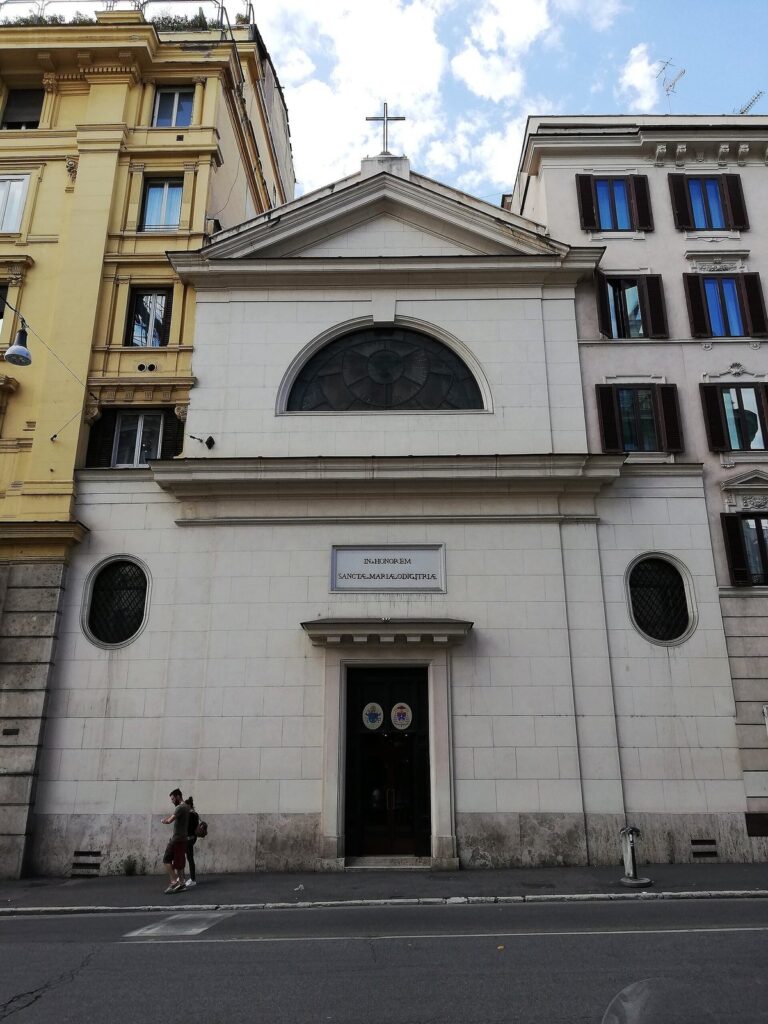
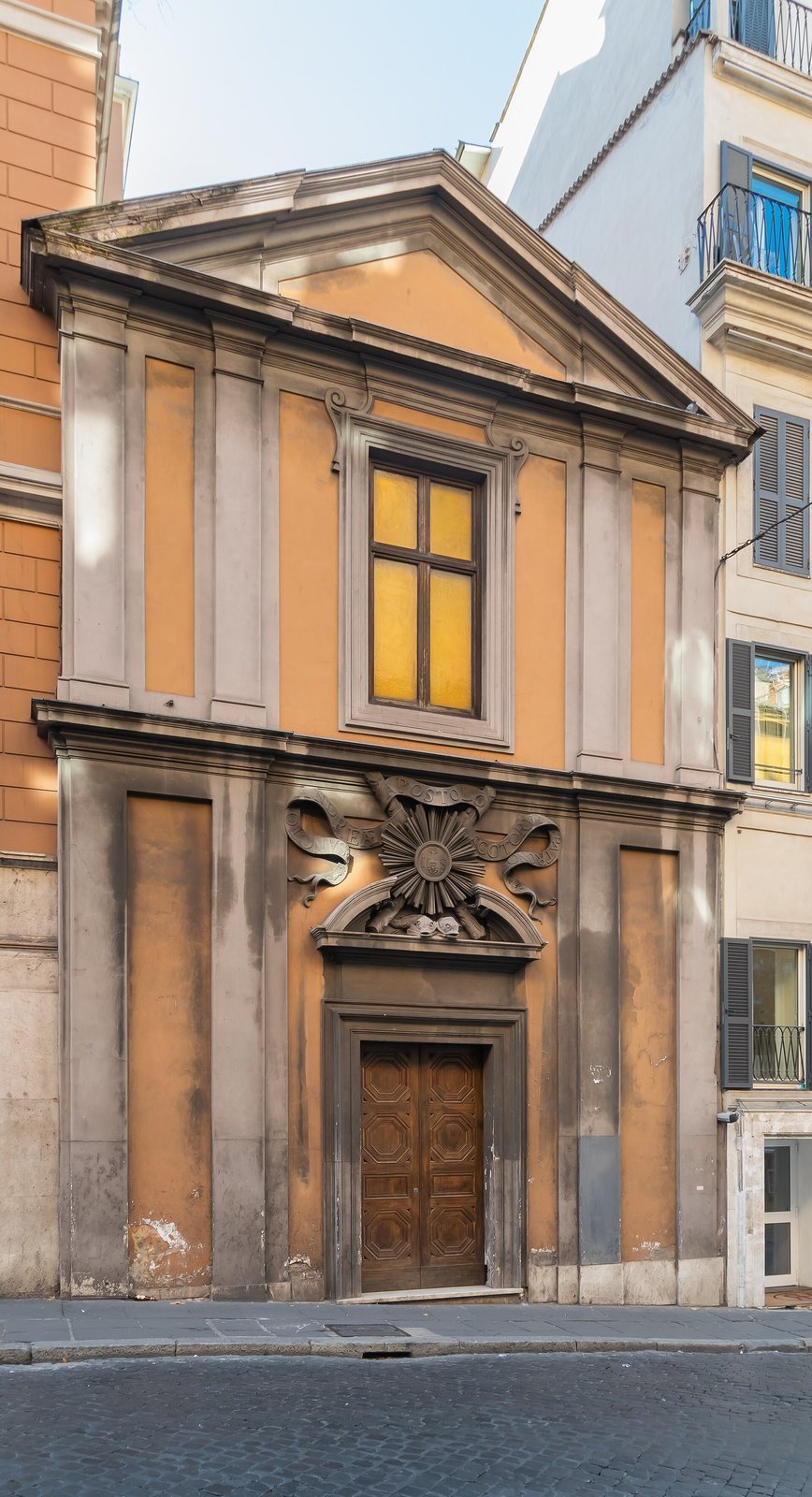
Hemmed in by neighboring buildings, the church lies about 50 metres south of Piazza Barberini. Its rectangular plan contains a single aisle-free space beneath a barrel vault, a continuous arched ceiling. The two-storey Baroque façade and the decorated interior preserve the building’s distinctive architectural character.
Architecture and interior
Façade
The entrance portal sits beneath a broken, curved-topped pediment. Two fish in its central field refer to Saint Andrew’s former occupation as a fisherman. Above them are an X-shaped cross associated with the saint and an IHS monogram, a symbol for Jesus’ name, set within radiating decoration. A twisting band bears the Latin inscription Sancto Andreae Apostolo Scotorum Patrono, meaning “To Saint Andrew the Apostle, patron of the Scots.” The upper storey has a rectangular window framed by shallow attached columns and is capped by a triangular pediment.
Interior
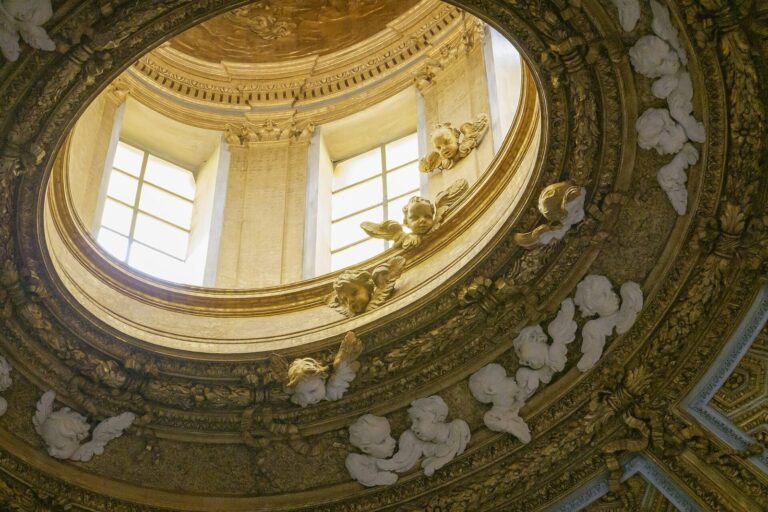
Shallow attached columns and rounded wall niches articulate the interior, whose decoration includes restrained gray-painted work and stucco. The former high altar stood in a simple rectangular choir, separated from the main body of the church by pillars. Two side altars were also part of the earlier arrangement; they were removed in 1924, while their paintings remained in place at that time.
Paintings and memorials
Ceiling and altar paintings
A ceiling fresco by Guillaume Courtois depicts the Glory of Saint Andrew. In the area around the high altar, white and gilded stucco frames a fresco of the Trinity with the dead Christ and angels; curved panels above the altar show the Virgin Mary and the Angel of the Annunciation. The 18th-century high-altar painting by Scottish artist Gavin Hamilton portrays the Martyrdom of Saint Andrew.
Other paintings
Paintings formerly associated with the church include Alexander Maximilian Seitz’s Enthroned Madonna and Child with Saints Columba and Ninian, and a series of portraits of saintly bishops and Scottish saints attributed to George Jamesone. Other works include Saint Margaret praying before the Trinity as the Battle of Alnwick rages, and a Virgin Mary with Saints Ignatius and Francis Xavier by Nicolas de Bar. The former side altars had 19th-century paintings by Jacob Nicolay: Saint Margaret in Ecstasy and a Madonna and Child with Saints.
Memorials
A white-marble monument to John Stewart is set into the right wall just inside the main entrance. Other memorials commemorate Alexander Sloane, who died in 1802; Alexander Grant, who died in 1878 and is honored by a memorial for someone buried elsewhere; and Peter Grant, William Leslie, and Thomas Forbes, whose memorial stones bear the dates 1784, 1707, and 1711 respectively.
Former Scottish seminary
The façade of the adjoining former seminary retains Scotland’s coat of arms and motto, along with busts of notable Scottish Catholics.