Palazzo Bellini delle Stelle: A Florentine Residence and Sculptors’ Workshop
Site at a Glance
- Rating
- 4
- Popularity
- Very Low
- Country
- Italy
- Primary era
- Medieval
- Eras represented
- Medieval, Early Modern, Modern
- Civilizations
- Grand Duchy of Tuscany, Republic of Florence
- Site type
- Domestic
- Remains
- Elite Residence
On this page11 sections
History
Palazzo Bellini delle Stelle is a residence in Borgo Pinti, Florence, Italy, probably built in the late fifteenth century. It became the home and workshop of Giambologna, then a workplace for generations of sculptors serving the Medici court.
From institutional property to Giambologna’s workshop
The building belonged to the Hospital of the Innocents, a Florentine foundling institution, during the sixteenth century. The surrounding neighborhood attracted artists in part because the Academy of the Arts of Drawing, an institution for visual arts, was based nearby at the Basilica of the Santissima Annunziata, beside the Chapel of San Luca.
In 1587, Giambologna, a Flemish-born sculptor who became a leading figure in late Renaissance sculpture in Italy, bought the residential part of the palazzo for 1,800 scudi, a historical Italian currency. He spent a further 600 scudi on substantial works. A claim that a grand duke had given him the property has been rejected. Giambologna lived there and used its extensive ground-floor rooms, which reached as far as Via di Mezzo, for workshops, a foundry, and a school. The space accommodated marble, statues, models, and equipment for casting large metal works, as well as pupils from several countries. The Flemish sculptor Pietro Francavilla was regarded as his foremost pupil.
Works made in the workshops included equestrian statues of Cosimo I and Ferdinando I for Florence. A statue of Henry IV, king of France, was sent to Paris and destroyed in 1793 during the French Revolution, a period of political upheaval in France. A statue of Philip III, king of Spain, dated 1616, survives in Madrid’s Plaza Mayor.
The Tacca and Foggini workshops
Giambologna died in the palazzo in 1608. His great-grandson later sold the property to Cosimo II de’ Medici, who gave Pietro Tacca the right to use it and benefit from it without owning it, in accordance with Giambologna’s will. In 1640, Grand Duke Ferdinando II granted the property to Tacca’s son, Ferdinando. The workshops produced the fountains of the Sea Monsters and statues for Livorno’s Monument to the Four Moors.
In 1661, Ferdinando II acquired the workshop section, and the complex served as both home and workplace for court sculptors, with large workshops and a foundry. A few years after Ferdinando Tacca’s death, Cosimo III assigned the building to Giovanni Battista Foggini, a Baroque sculptor and architect. Foggini used it only as a workshop until his death in 1725; his home was elsewhere. Matteo Rosselli, Lorenzo Lippi, Jacopo Ligozzi, Stefano della Bella, and Francesco Janssens were also associated with temporary residence or workshop activity in the building.
Later ownership and restoration
In 1785, Pietro Leopoldo of Lorraine transferred the property to the Petresi family. It passed to the Quaratesi family in 1816, then to the Bellini delle Stelle family in 1837. That year, architect Luigi Casamorata modernized the palazzo and gave it the character of a grand residence.
By the 1970s, the building was in very poor condition, but it was later restored with support from the heritage authority. For many years, painter Franco Mello worked in the former stables and other ground-floor rooms, including one that had housed a furnace. The building now houses the Mello Foundation.
Remains
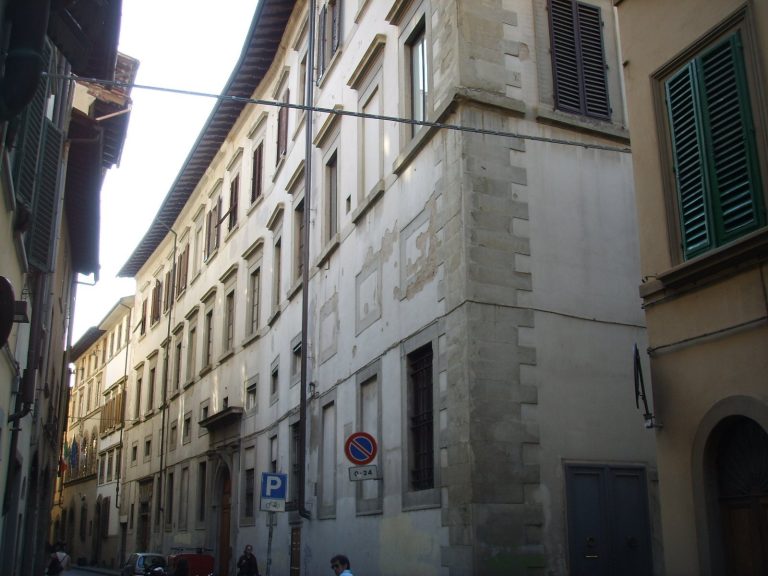
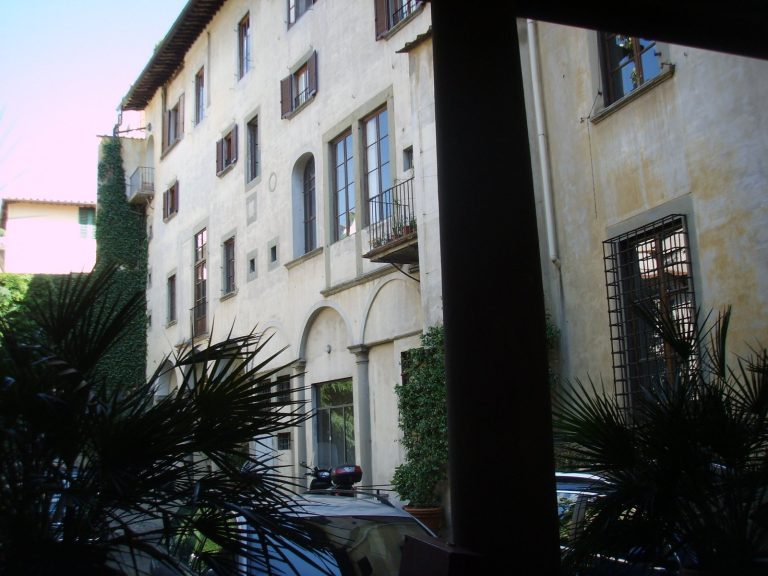
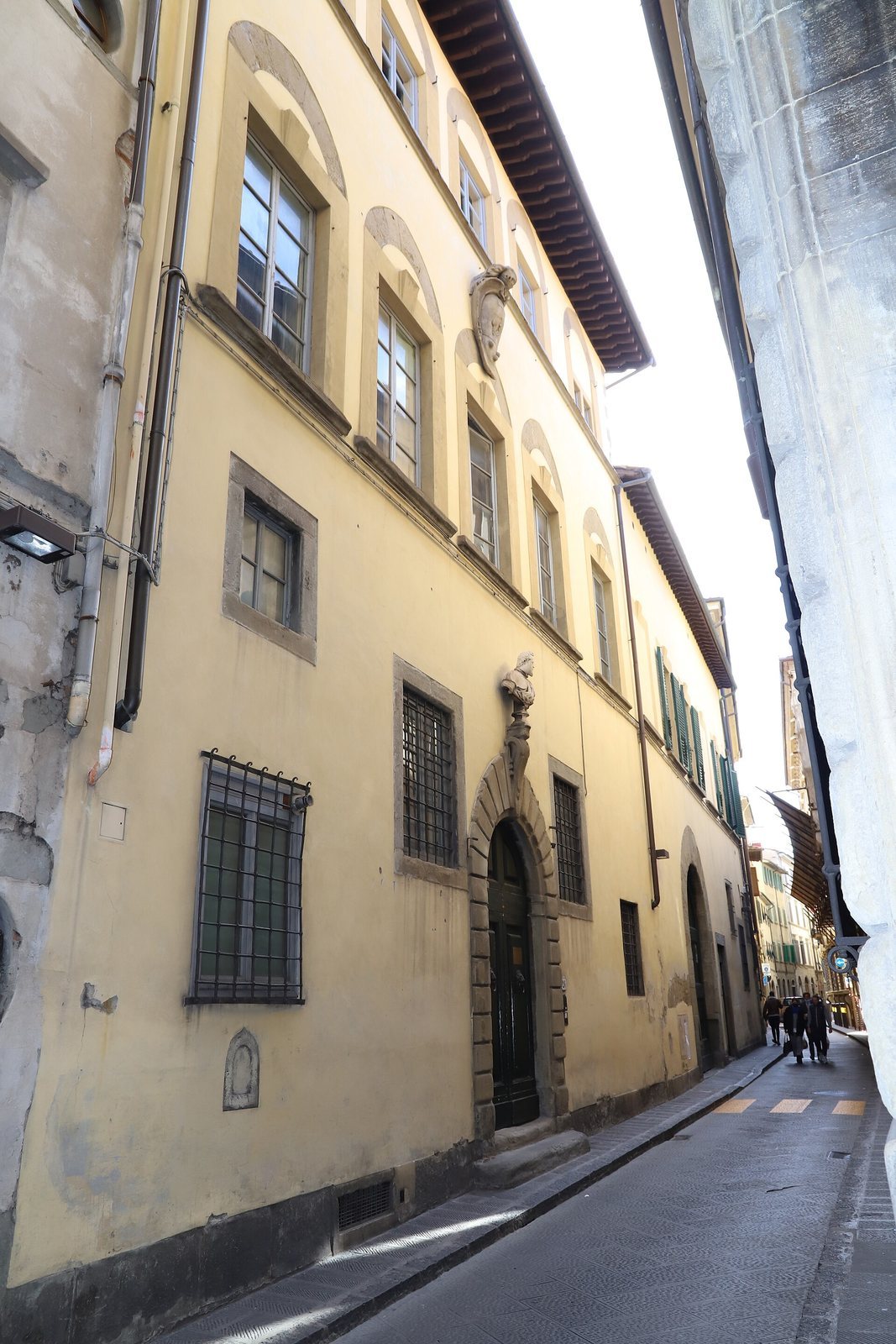
The three-story complex combines a residential block with an adjoining former workshop block. Its main façade along Borgo Pinti presents a unified appearance, although some windows overlap older ones. This arrangement has been attributed to Ferdinando Tacca through comparison with Palazzo Corsini al Parione.
Building layout and façades
Residential block
The main residential block has a restrained, elegant façade arranged in five vertical divisions. Its windows were originally topped with stone arches. Above the entrance is a bust of Ferdinando I de’ Medici by Giambologna, dated 1603. A shield above the first-floor windows bears arms granted to Giambologna by a grand duke: a cross, a lion’s paw, and three Medici balls.
Former workshop block
The adjoining block, raised during the time of Pietro and Ferdinando Tacca, retains five windows and a large carriage doorway. The doorway came from Palazzo Vecchio, where it had been dismantled during work in the late sixteenth century, and was adapted for use here. An artist’s workshop remains in the former workshop area.
Interior features and inscriptions
Atrium
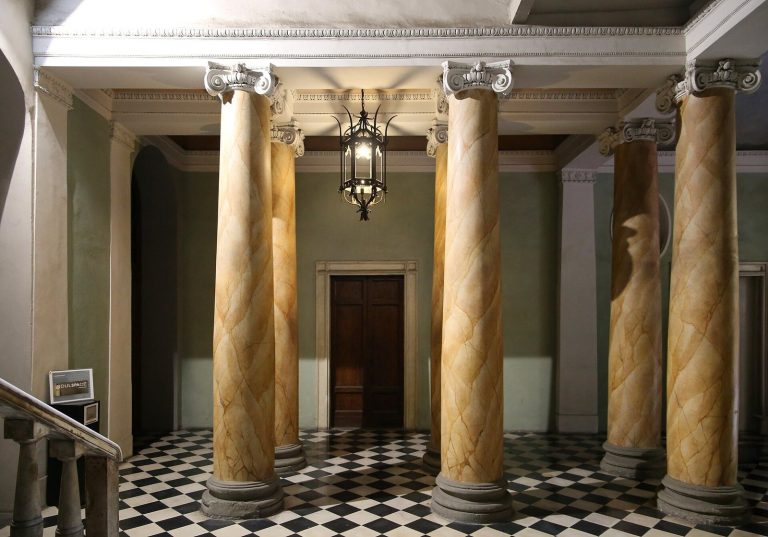
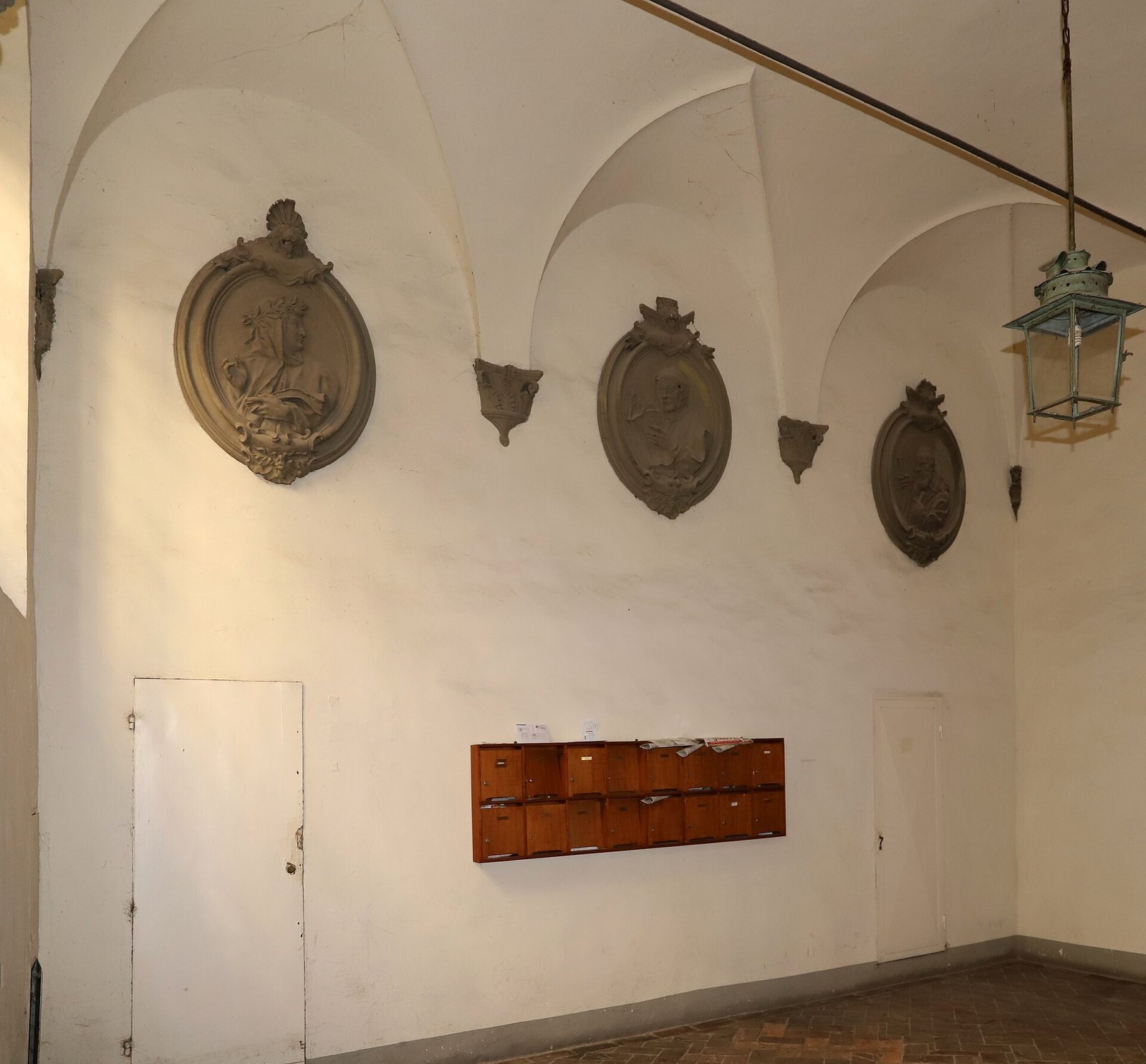
The atrium contains a series of roundels depicting notable Florentines, including Michelangelo, the medieval poet Dante, and the Renaissance architect Brunelleschi. A stone bust of Cosimo III de’ Medici is also displayed there.
Inscriptions
A lintel inscription in the residential building and former workshops says that Giambologna, honored by Grand Duke Ferdinando, erected the equestrian statue of Cosimo I. An inscription on the opposite side states that Giambologna made large bronze and marble statues for the first three grand dukes of Tuscany and lived and rested in the building. Another inscription, once on an interior window facing the small garden, identified him as “John of Bologna, the Belgian”; it is now unreadable.