Sant’Agostino: A Roman Catholic Church in Siena
Site at a Glance
- Popularity
- Medium
- Country
- Italy
- Primary era
- Medieval
- Eras represented
- Medieval, Early Modern, Modern
- Civilizations
- Grand Duchy of Tuscany, Republic of Siena
- Site type
- Religious
- Remains
- Church
On this page22 sections
History
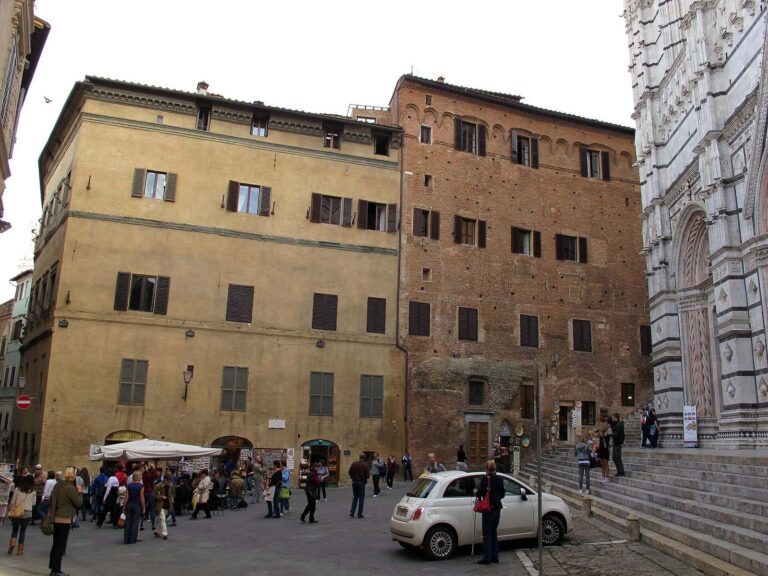
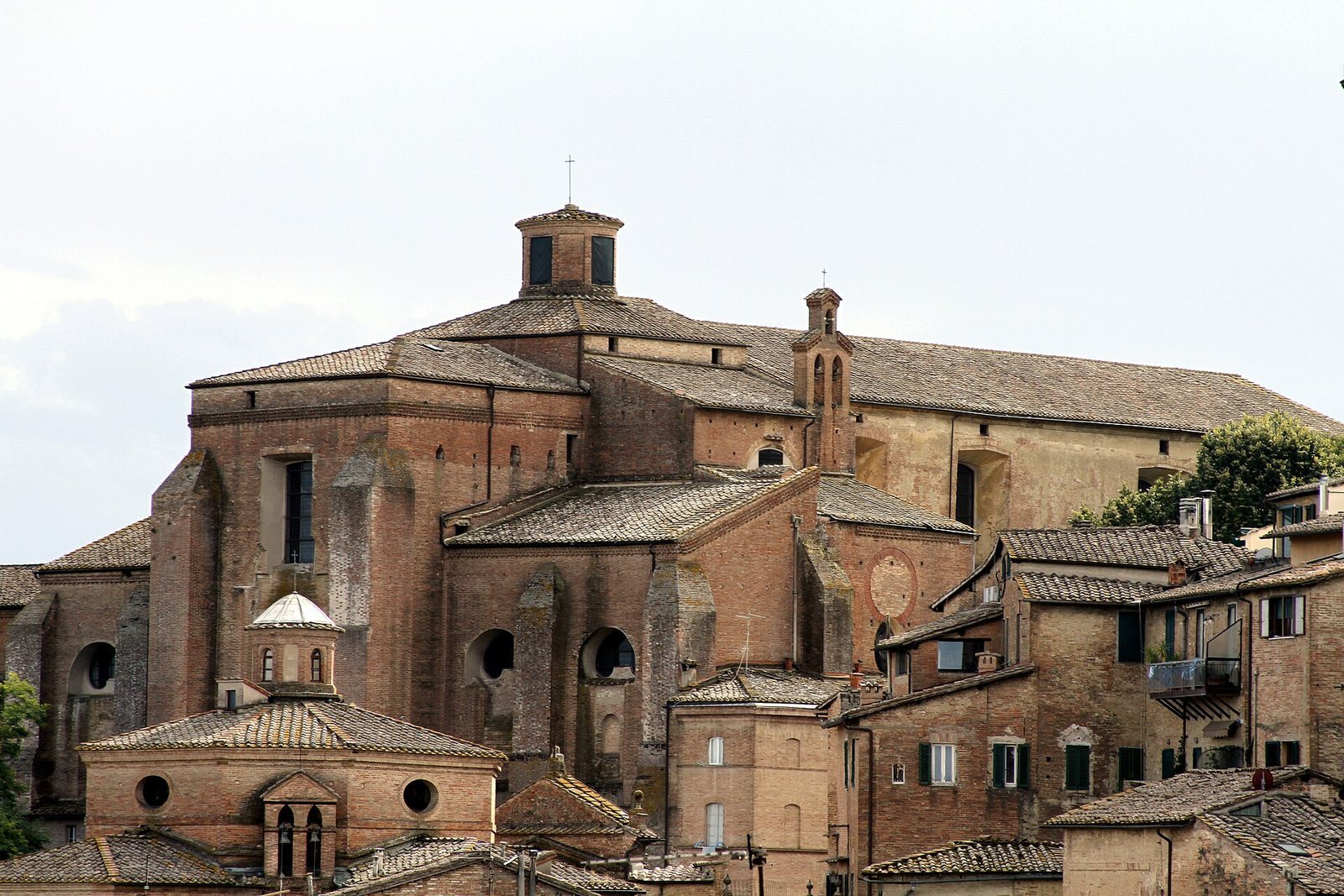
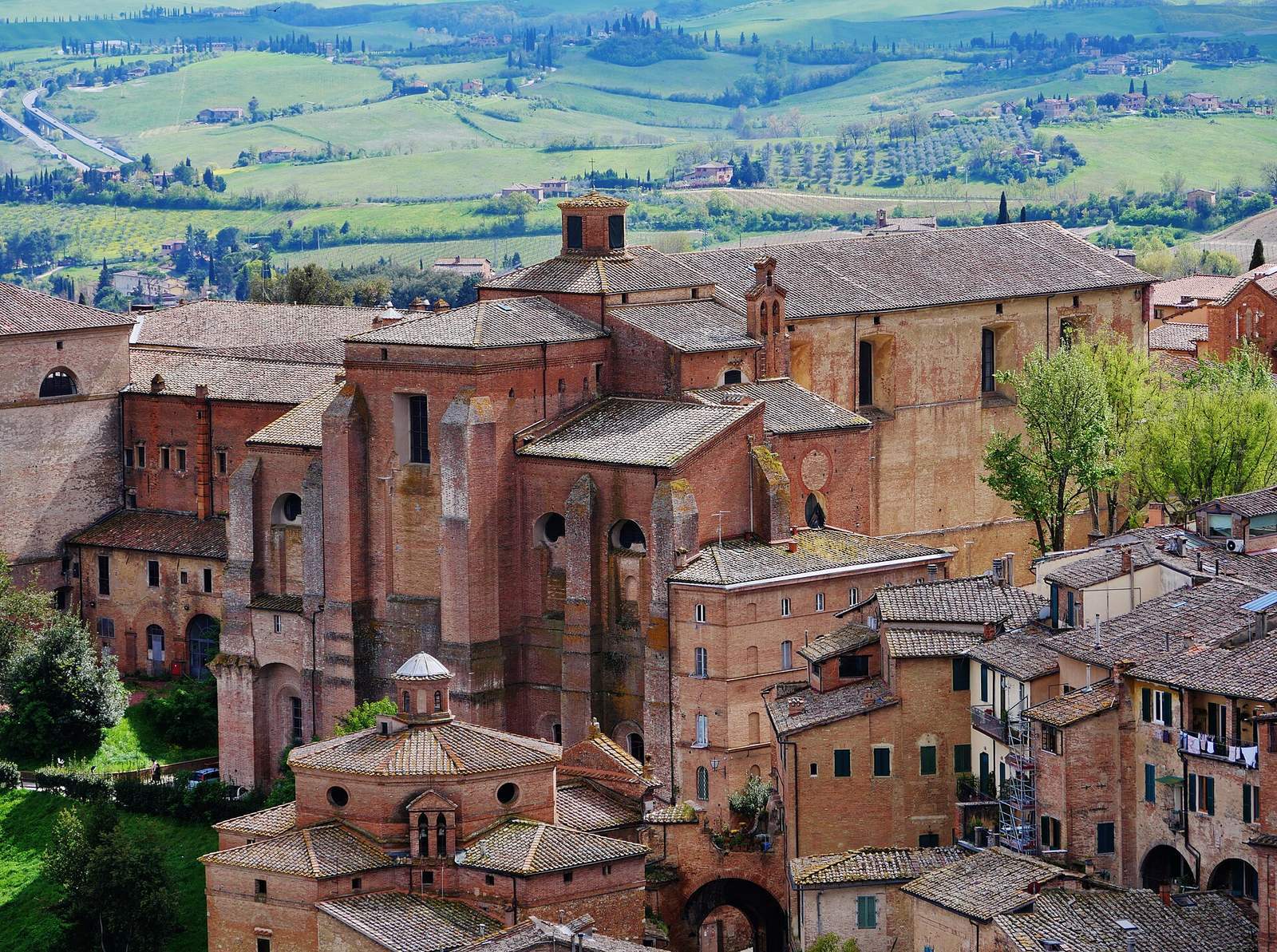
Sant’Agostino is a Roman Catholic church in Siena, Italy, dedicated to Augustine of Hippo, a Christian theologian and bishop of the fourth and fifth centuries. The church belongs to the Archdiocese of Siena-Colle di Val d’Elsa-Montalcino and stands at Prato Sant’Agostino, in the Terzo di Città, one of Siena’s three historic districts, and the Contrada Tartuca, a historic neighborhood community. Augustinian monks, members of a Catholic religious order following a rule associated with Augustine, began building the church and convent in 1258. Its overall style is Gothic, with later Baroque alterations and an eighteenth-century neoclassical interior.
Foundation and medieval development
An earlier church, Sant’Agata, stood on the site. In 1259 the Augustinians acquired neighboring land and laid a foundation stone for their new complex; Sant’Agata was incorporated into the church in 1283. Siena provided much of the funding and building materials, while private gifts generally helped the monks extend their landholdings. Sant’Agostino was originally outside the city walls, close to Porta all’Arco on Poggio Sant’Agata. Siena’s 1325 extension of the walls to Porta Tufi brought the church within the city.
Building continued into the fourteenth century. A bell tower is mentioned in 1303, and work on the church was still in progress in 1309. The dormitory was enlarged from 1322 through at least 1337. The plague of 1348 interrupted construction for almost 80 years, with work taking up again in the 1420s. Around 1397-98, a storm brought down the bell tower and the still-unfinished roof.
Augustine Novello, a thirteenth-century Augustinian friar later venerated as a blessed, was buried on the grounds in 1309. His remains were transferred in 1977 to the Cathedral of San Nicola di Bari in Termini Imerese. Pope Gregory XII stayed at Sant’Agostino in 1408, and the Renaissance sculptor Jacopo della Quercia was buried in the first cloister in 1438.
Siege, restoration, and parish changes
During Florence’s siege of Siena in 1553-55, the church housed German mercenaries and suffered substantial damage. Restoration and enlargement followed between 1579 and 1598, including the completion of the upper dormitory. The church was consecrated on 22 October 1635, with Grand Duke Ferdinando II de’ Medici present.
A major fire damaged the building in 1747. The architect Luigi Vanvitelli directed restoration from 1747 to 1755, with Giuseppe and Sebastiano di Giorgio Minacci also involved. Disagreement about the roof led to additional repairs that continued through 1760. In 1785, the neighboring parish of San Salvatore was united with Sant’Agostino, which took on its parish title.
The lower church beneath the transept had served the Confraternity of the Holy Cross, a religious association founded at Sant’Agata in 1213, and its oratory. That use ended with secularization in 1785. French troops later occupied the rooms; in 1872 they became a gymnasium used by sections of Mens Sana Basket Siena. Since 1971, the space has housed one of the University of Siena’s main refectories.
Suppression, earthquake, and later use
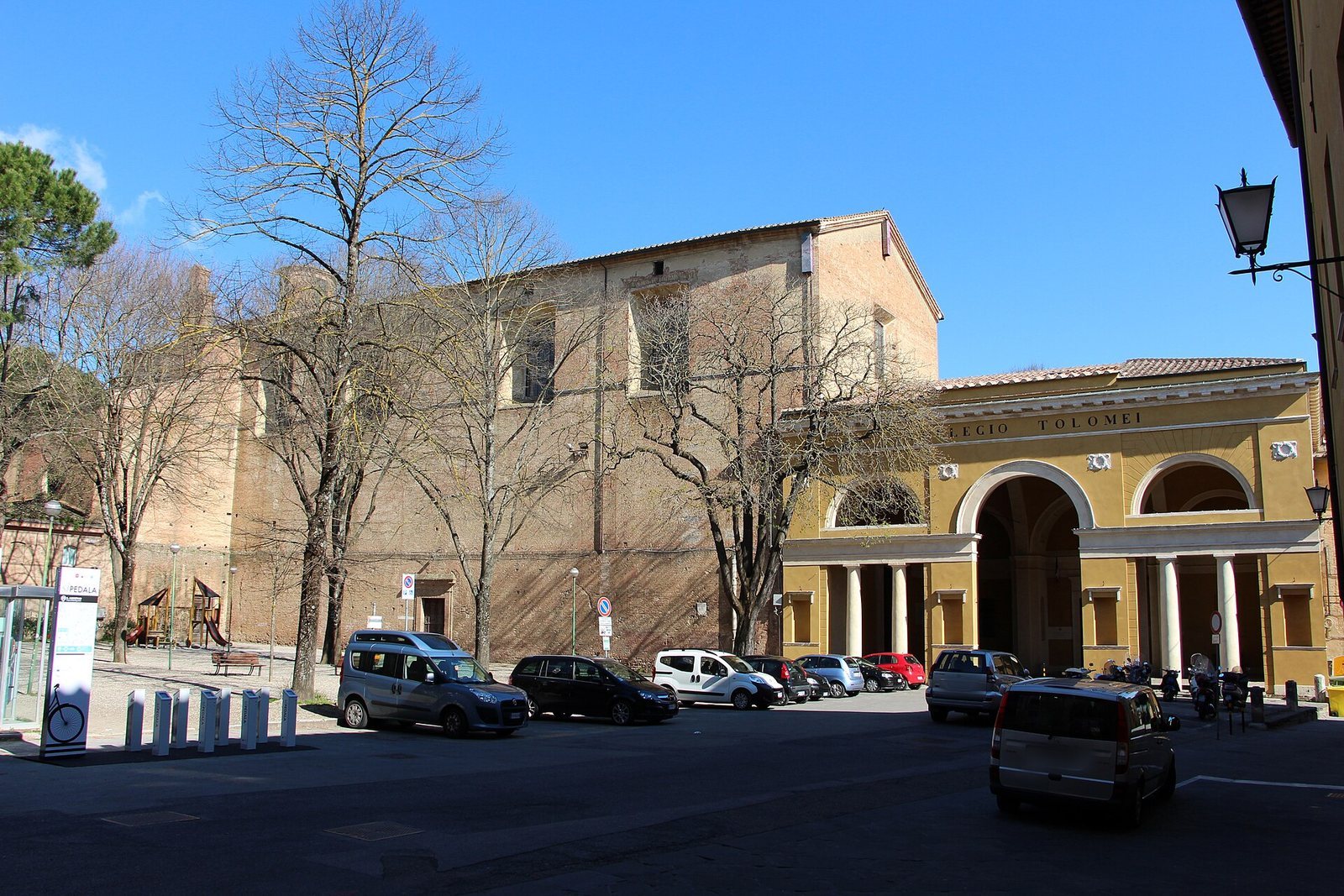
During the Napoleonic-era suppression of religious orders in the early nineteenth century, the Augustinians had to leave their convent, which was assigned to Collegio Tolomei. The monks returned a few years later to serve the parish, but could not move back into the convent and lived in a small nearby house. Collegio Tolomei, an educational institution previously based in Palazzo Piccolomini from 1681, acquired the convent grounds in 1816.
An earthquake in 1798 collapsed the sacristy’s vaults and those of the Piccolomini Chapel, and badly damaged the bell tower. Agostino Fantastici directed restoration from 1816 to 1820. The 40-metre tower was removed, and a three-bay loggia was added in front of the church. The Augustinians eventually left the complex, and the Diocese of Siena took responsibility for the church.
In 1944, amid the danger of bombing during the Second World War, the painting by Sodoma in the Piccolomini Chapel was moved for protection. The chapel’s Piccolomini altar was shifted to the opposite side, uncovering a fresco by Ambrogio Lorenzetti that it had concealed.
Remains
Building and plan
Complex and exterior
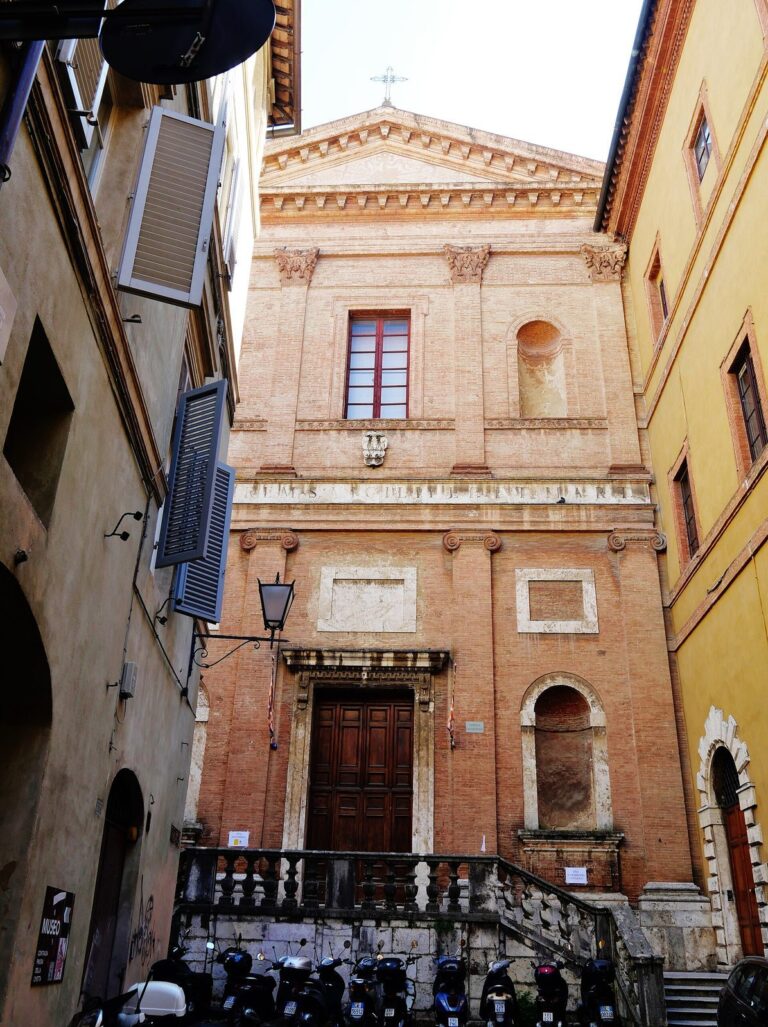
The surviving complex comprises the church, convent, dormitory, and sacristy. The church’s plain brick facade is screened by a neoclassical, colonnaded loggia designed by Agostino Fantastici and built in 1818-19. The loggia leads toward the former convent. The church’s fifteenth-century alterations are most evident on its exterior.
Church plan
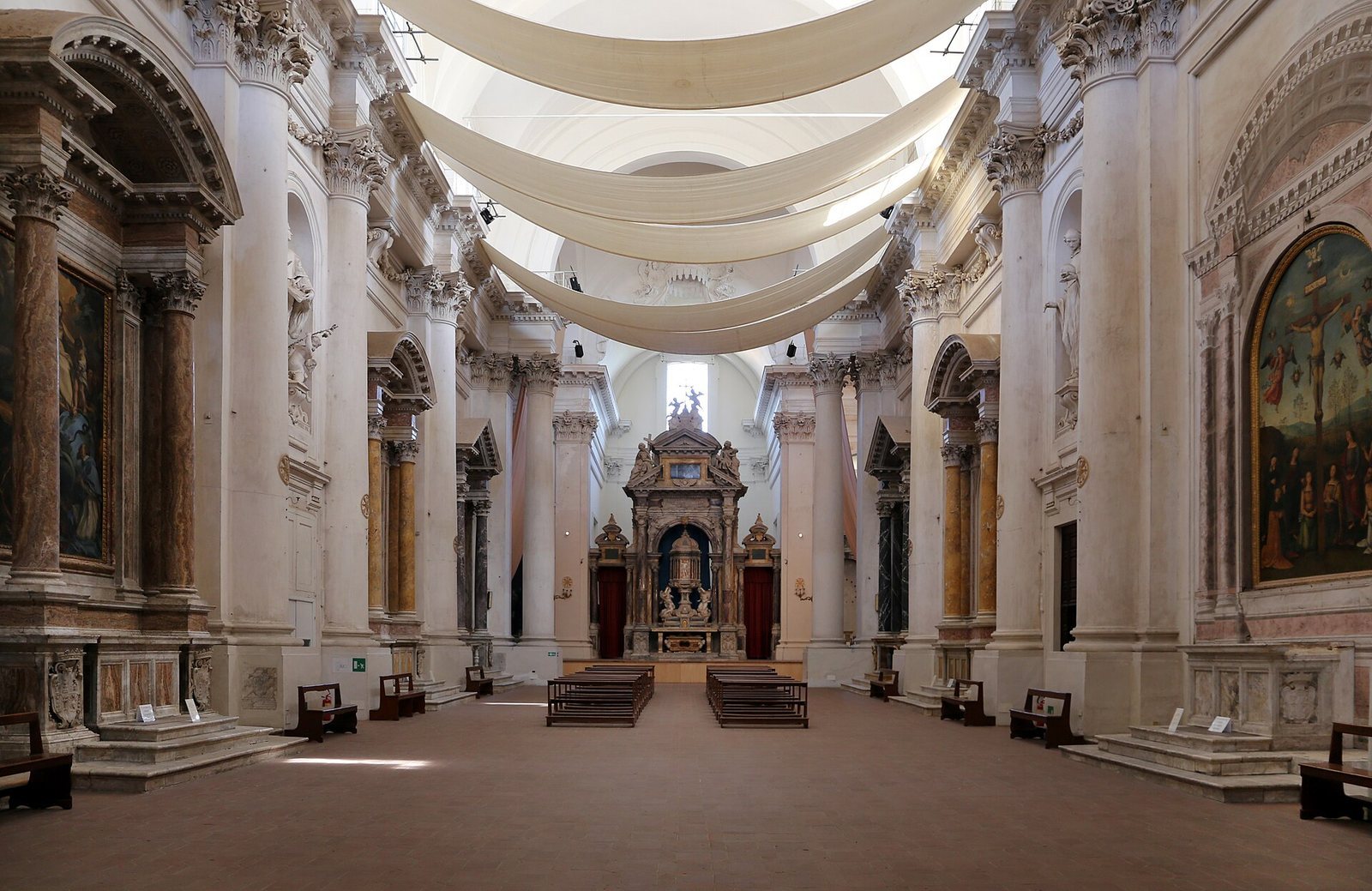
The church has a Latin-cross plan, with a long nave crossed by a projecting transept, four side chapels, and a deep presbytery, the area around the main altar. The nave measures 43 by 16.5 metres and rises 22.5 metres. It contains eight altars, four along each side. Cross vaults cover the nave, and semicolumns divide its walls into broader altar spaces and narrower niches. Stucco statues by Giuseppe Mazzuoli and Giuseppe Silini occupy the niches, and further stucco statues stand in the transept. Monumental altars of polychrome marble, dating from the late sixteenth and early seventeenth centuries, remain among the church’s furnishings.
Nave furnishings
Right-hand altars
The first altar on the right, in the Rocchi Chapel, holds Astolfo Petrazzi’s Last Communion of Saint Jerome, signed and dated 1631. The second, in the Chigi Chapel, contains Perugino’s Crucifixion, commissioned by Mariano Chigi in 1502 and painted in 1506-07. It is Perugino’s only painting in Siena. Its original predella, the panel or panels beneath an altarpiece, is now divided between the Metropolitan Museum of Art in New York and the Art Institute of Chicago.
Another right-side altar has a large wooden altarpiece by Giuseppe and Sebastiano Minacci, measuring 930 by 576 centimetres and dating to about 1750-55. An altar designed by Flaminio del Turco holds a painting of Christ meeting his mother on the way to Calvary. Alessandro Casolani began the work, and Ventura Salimbeni completed and signed it in 1612.
Left-hand altars
The left-hand altars hold Giovanni Francesco Romanelli’s Adoration of the Shepherds, dating to about 1640, and a late seventeenth-century altarpiece by Carlo Maratta showing the Madonna with Saints Francis de Sales and Thomas of Villanova. They also contain Francesco Vanni’s Baptism of Constantine (1586-87) and Pietro Sorri’s Trinity and Saints (1600). Scipione Bargagli commissioned Sorri’s painting, which depicts Saints Ansanus, John the Baptist, Augustine, Jerome, Catherine, and Peter.
Choir and organ
The organ stands on the choir loft above the entrance. Giuseppe Piffero built it between 1522 and 1526, and an unidentified maker completed it between 1533 and 1538. Its double case combines a Baroque front, probably dating to about 1770, with a rear case following Renaissance proportions. Francesco Zanin restored the rear in 1987. The organ has entirely mechanical action, five stops, one manual, and a pedalboard coupled to the keyboard.
Presbytery and transepts
Presbytery
Flaminio del Turco made the main altar and its polychrome-marble tabernacle in the early seventeenth century. Above the altar, a temple-shaped ciborium, a canopy over an altar, includes a relief of the risen Christ and two adoring angels, works by members of the Mazzuoli family.
Transepts
The left transept contains Tommaso Redi’s 1631 funerary monument to Agostino Chigi, formerly rector of the Hospital of Santa Maria della Scala. Nearby is a polychrome wooden statue of Saint Nicholas of Tolentino from the late fifteenth century, attributed to an artist in the circle of Giacomo Cozzarelli. In the right transept, Raffaello Vanni’s Death of Saint Thomas of Villanova and Glory of Saint Thomas of Villanova, both dated 1664, accompany Giovanni Antonio Mazzuoli’s funerary monument to Count Orso d’Elci.
Chapels
Piccolomini Chapel
The Piccolomini Chapel occupies a former chapter house, the meeting room of a religious community, built in 1322-28. Archbishop Ascanio I Piccolomini turned it into a private chapel during his tenure from 1588 to 1597, and its polychrome-marble altar was erected in 1596. The altar incorporates Sodoma’s Adoration of the Magi, an oil painting on wood made around 1530-31 for Giovanni and Arduino Arduini. The work measures 328 by 203 centimetres.
The chapel also contains Astolfo Petrazzi’s Saint Lucy, dating to about 1640, and his Miracle of Saint Eligius; Giovan Paolo Pisani’s Dead Christ (about 1610); and a painting of Christ and Saint Catherine attributed to Simondio Salimbeni. Matteo di Giovanni’s Massacre of the Innocents (1482), painted in tempera on wood, is also here. In the room before the chapel stands Giovanni Dupré’s marble monument to Pope Pius II, made in 1850. Across the chapel, a lunette, a semicircular area of a wall, contains Lorenzetti’s Maestà, an image of the Virgin Mary enthroned, dated 1337-38 and the oldest artwork preserved in the church.
Bichi Chapel
The outer right-hand Bichi Chapel contains Luca Signorelli’s frescoes of the Tiburtine and Erythraean Sibyls, female prophets in classical and later Christian tradition, dating to about 1490, as well as a fresco of the crucified Christ attributed to him. Monochrome frescoes of the Birth of the Virgin and the Nativity of Jesus were made by Francesco di Giorgio Martini and his workshop, possibly with Pietro degli Orioli, between 1487 and 1494. They measure 449 by 530 centimetres and 451 by 532 centimetres respectively. The chapel also has a tin-glazed ceramic-tile floor made by Pietro and Niccolò Mazzaburroni in 1488, and Niccolò Franchini’s Saint Christopher (1755). The fifteenth-century frescoes were brought back to light during a later intervention.
Other chapels
The inner right-hand chapel contains an image of the Madonna della Cintura, associated with Augustinian devotion to Mary and the girdle. Sebastiano Conca’s 1763 painting of the Madonna appearing to Saint Joseph Calasanz is in the inner left-hand Chapel of Saint Rita. In the outer left-hand Chapel of Saint John are Rutilio Manetti’s Saint Anthony Tempted by the Devil, an oil on canvas dating to about 1630 and measuring 221 by 141 centimetres; Bartolomeo Neroni’s painted cenotaph, a memorial for someone buried elsewhere, from the second half of the sixteenth century; and Stefano Volpi’s Baptism of Christ (1626). Domenico Cafaggi, also known as Capo, carried out work in the Lucarini Chapel in 1605-06. The chapel formerly associated with the bell tower contains frescoes by Biagio di Goro Ghezzi, made between 1355 and 1365, depicting Christ blessing, Saint Catherine of Alexandria, and Saint Lawrence.
Sacristy and lower church
Sacristy and adjoining chapel
The sacristy contains Pietro Ciapettini’s Death of Saint William, dating to about 1800; Bernardino Mei’s oil painting Miracle of Saint Stephen (1654); The Redeemer Appears to Saint Augustine by Rutilio and Domenico Manetti (about 1639); and a Holy Family by G. Battista Giustammiani, also known as Il Francesino. The adjoining sacristy chapel has fourteenth-century frescoes, some attributed to Paolo di Giovanni Fei.
Lower church
A lower church lies beneath the transept as part of the complex. Its rooms have been adapted to successive uses, including their present university refectory function.