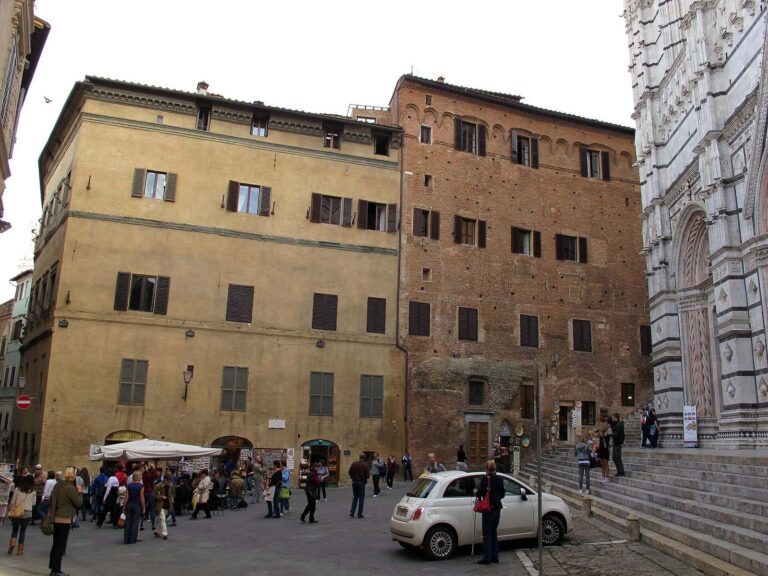
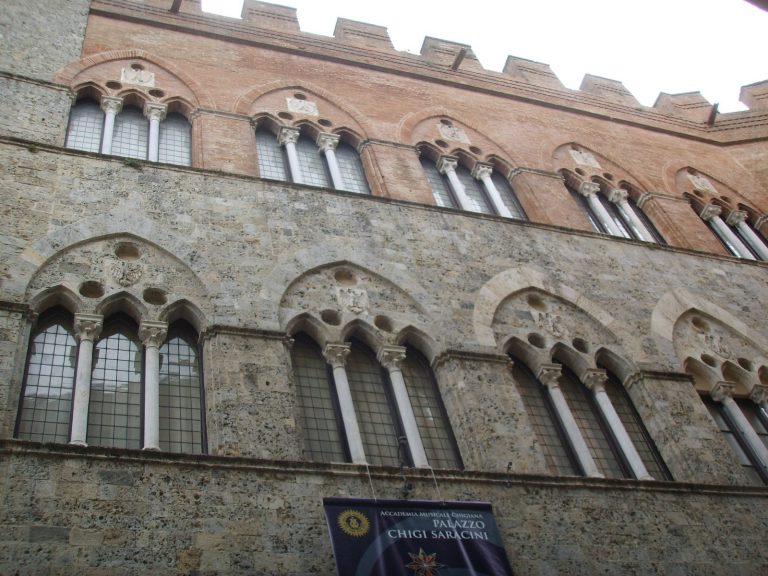
San Vigilio: A Roman Catholic Church and University Chapel in Italy
Site at a Glance
- Popularity
- Low
- Country
- Italy
- Primary era
- Early Modern
- Eras represented
- Early Modern
- Civilizations
- Duchy of Florence, Grand Duchy of Tuscany, Holy Roman Empire
- Site type
- Religious
- Remains
- Church
On this page20 sections
History
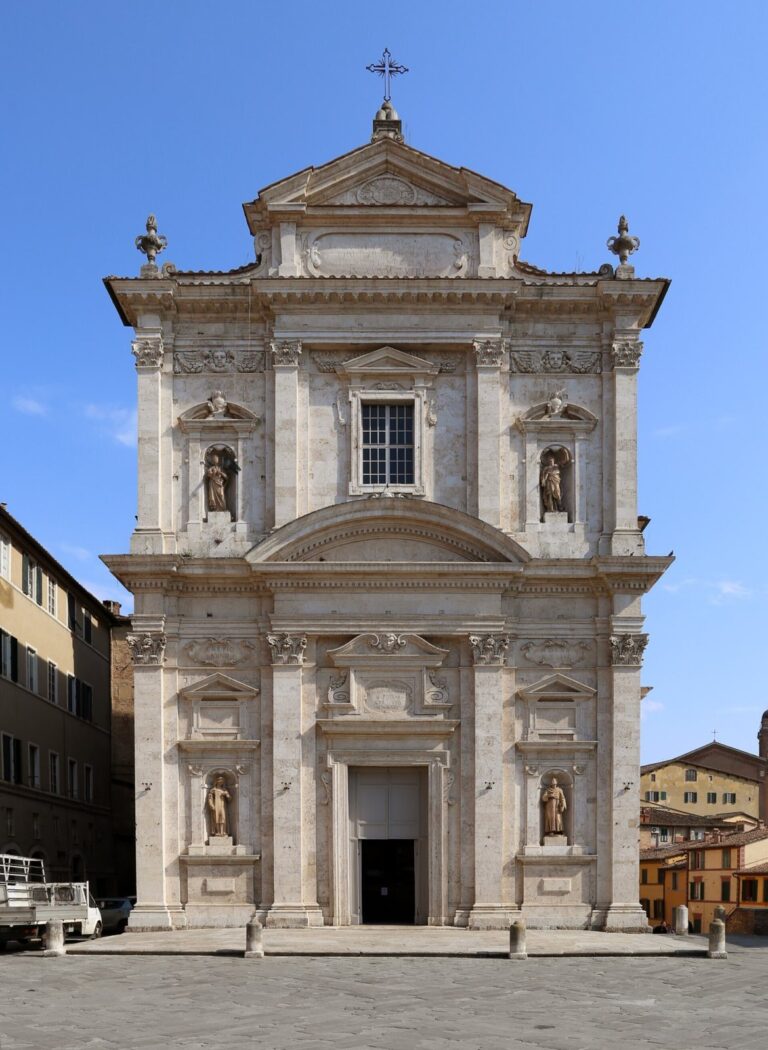
San Vigilio is a Roman Catholic church in Italy, founded by the Ugurgieri family in the eleventh century as a parish church and dedicated to Saint Vigilius of Trent, a bishop and martyr. Its architectural character combines Renaissance art, associated with a European cultural movement that flourished from the fourteenth to the sixteenth centuries, and Baroque art, a later style that flourished from the late sixteenth through the eighteenth centuries.
Foundation and monastic history
In 1131, the Ugurgieri family gave the church to the Camaldolese, a Catholic monastic congregation in the Benedictine tradition. They remained until 1420, when they were expelled. The church, convent, and ecclesiastical benefice then passed to prominent citizens of Siena. A building within the church-and-convent complex burned in 1153 and had been rebuilt by 1231.
Jesuit and Vallombrosan phases
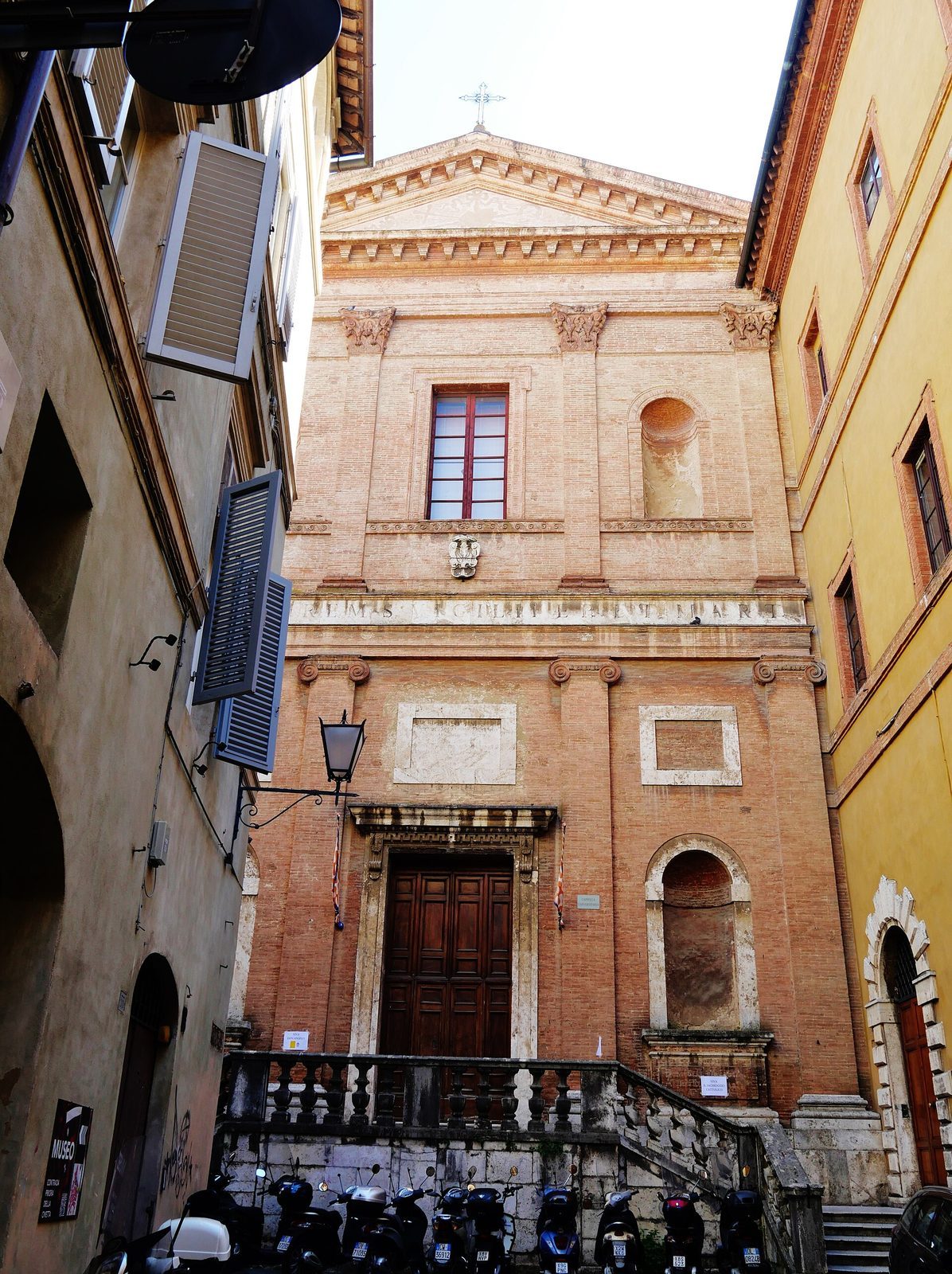
The church passed to the Jesuits, a Catholic religious order, in 1556 and ceased to serve as a parish. They began rebuilding in 1561, work that substantially shaped the building’s present character. After the Jesuits were suppressed in 1759, the Vallombrosans, another Benedictine monastic congregation, took over the complex. They had the façade rebuilt to a design by Antonio Matteucci.
University use and the chapel
During the Napoleonic government of Tuscany, the Vallombrosans were dispossessed. In 1816, Grand Duke Ferdinand III established the University of Siena in the adjoining palace. The church became the property of the archdiocese and was served by the lay Confraternity of the Most Holy Sacrament, which no longer exists.
On 26 August 1991, Archbishop Gaetano Bonicelli established the University Chapel of Siena at San Vigilio to provide pastoral care for Italian and international students. The church continues as the university chapel and has a community of the Daughters of the Church, a Catholic religious congregation. It belongs to the Archdiocese of Siena-Colle di Val d’Elsa-Montalcino, while the former monastery’s rooms now house the University of Siena’s central offices.
Remains
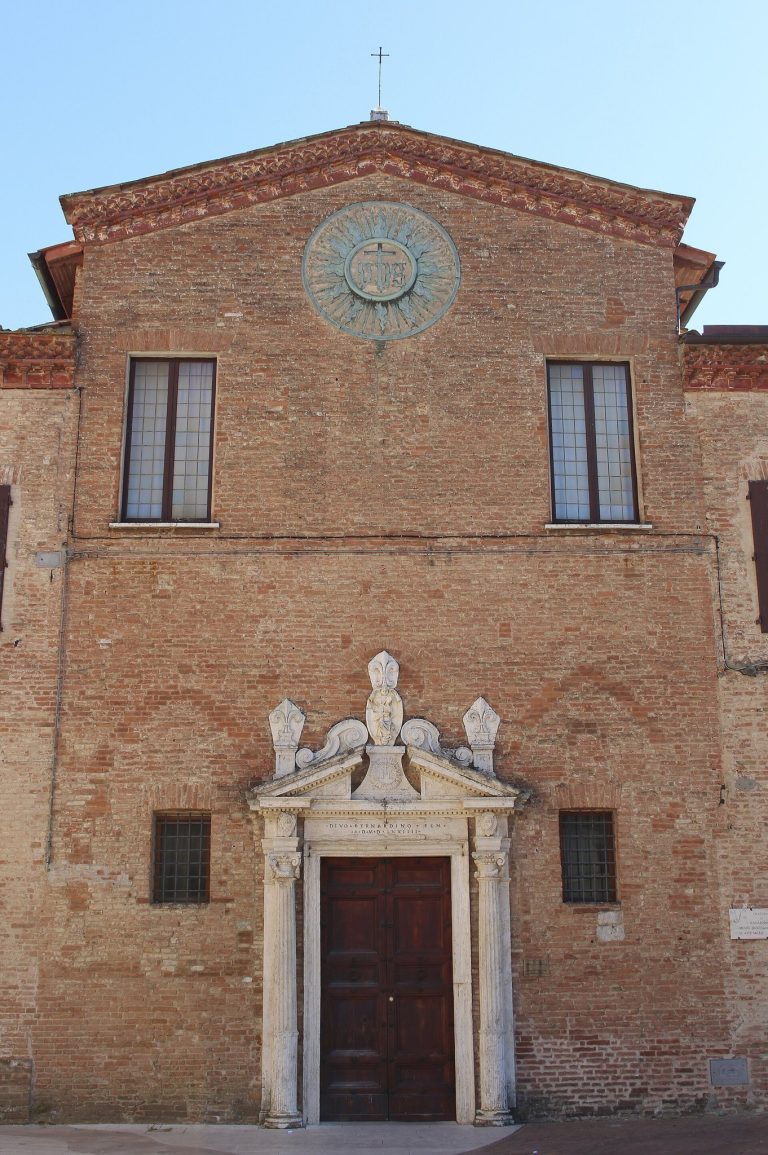
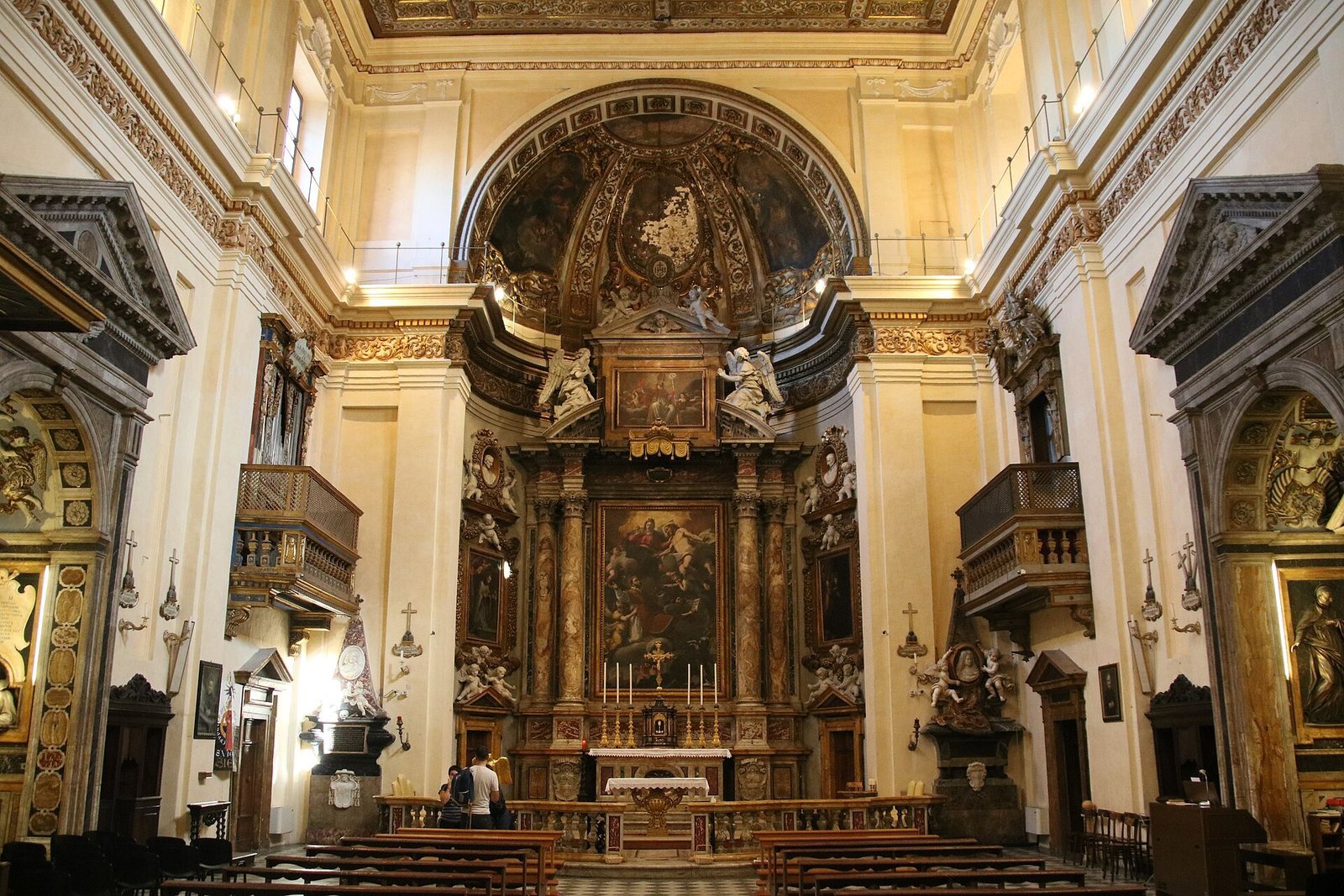
The church has a brick exterior with a restrained classical appearance. Inside, painted ceiling compartments, richly decorated marble altars, chapels, sculpture, and organs form a varied ensemble.
Ceiling and main altar
Painted ceiling
Sienese painter Raffaello Vanni divided the ceiling into fifteen large painted compartments showing the Last Judgment. Carved cornices and richly gilded rosettes frame the scenes.
Main altar
The brothers Marcello and Lattanzio Biringucci commissioned the main altar. Its altarpiece, Mattia Preti’s Glory of Saint Ignatius, is flanked by paintings of Saint Stanislaus Kostka and Saint Louis Gonzaga by Francesco Vanni. Bartolomeo Mazzuoli provided gilded sculptural decoration, while Annibale Mazzuoli painted three frescoes above the altar niche. Montorselli painted the figure of Saint Vigilius of Trent on the pediment.
An elaborate canopy-like structure, or ciborium, over the altar is decorated with hardstones and gilt-bronze plaques. Beneath the altar table are relics of numerous martyrs, believed to have been brought from Japan by the Jesuits. Near the sacristy stands a marble tomb monument to Marcello Biringucci, carved by Bartolomeo Mazzuoli in 1745.
Other bronze sculpture
Rocco Tamburani made bronze figures in high relief, with the forms projecting strongly from their backgrounds, of Saint Ignatius of Loyola and Blessed Giovanni Colombini. A large bronze crucifix by Ferdinando Tacca dates to 1644.
Side altars and chapels
Altar of the Most Holy Name of Jesus
Beneath the sacristy, the marble altar of the Most Holy Name of Jesus was carved by Alessandro Redi and Dionisio Mazzuoli. Its gilt-bronze Name of Jesus and raised figures of Saint Ignatius, Blessed Giovanni Colombini, and Saint Bernardino were made in Rome to designs attributed to Gian Lorenzo Bernini. Cardinal Flaminio del Taja commissioned the work. A relic identified as that of Saint Flaminio is set into the altar, and its placement there is attributed to Taja.
Altar of Saint Francis Xavier
This marble altar has an altarpiece by Francesco Vanni and side paintings of the saint’s miracles by Volterrano, also known as Baldassare Franceschini. The altar table is shaped like a monument and contains a martyr’s relic.
Altar of Our Lady of Loreto
A statue of the Virgin and Child, described as miraculous, stands within a gilded wooden ornament and a gilded-bronze frame that supports glass. An urn beneath the altar contains martyrs’ relics. Francesco Vanni painted the side panels, which depict the Assumption of the Virgin and the traditional transfer of the house associated with Mary from Nazareth to Loreto.
Altar of Saint Anne
The altar has a painting of Saint Anne by Romanelli. Its side paintings, showing episodes from the Virgin Mary’s life, are attributed to Montorselli. Beneath the altar table, an urn lined with crimson velvet and silk holds a relic of Saint Felix the Martyr.
Altar of Saint Torello
Gambacciani painted the altarpiece and side panels, the latter showing episodes from Saint Torello’s life. An urn beneath the altar contains a martyr’s relic, and Romanelli painted the pediment.
De Vecchi family chapel
The De Vecchi chapel is the third chapel on the left. Its crucifix was cast by Pietro Tacca and is traditionally attributed instead to Alessandro Algardi. Marble busts of Pietro De Vecchi and his wife, Giulia Verdelli, were made by Giuseppe Mazzuoli. An urn beneath the altar holds relics of Saint Fortunatus. The chapel also contains a marble monument to Jesuit Antonio Rospigliosi, a nephew of Pope Clement IX, made by Giovanni Antonio Mazzuoli in 1658.
Chapel of Saint Francis Borgia
Dionisio Montorselli painted the chapel of Saint Francis Borgia.
Organs and sacristy
Pipe organs
Giovanni Battista Ramai built the pipe organ in 1799. It stands on a choir loft along the nave’s left wall, near the rear wall, and has mechanical connections between its keys and pipes. Its fourteen stops select sets of pipes; it has one hand keyboard and a foot-operated pedal keyboard. Across the nave is a matching choir loft with a wooden organ case. A second instrument, a compact positive organ designed to stand in a room, sits on the nave floor. Built by Steinmann in the second half of the twentieth century, it has nine stops and one manual.
Sacristy
The adjoining sacristy consists of two large rooms. One is furnished with benches and choir stalls faced with walnut veneer. Several frescoes are also present.