Sant’Agnese Church: An Augustinian Gothic Church in Lodi
Site at a Glance
- Rating
- 4.3
- Popularity
- Very Low
- Country
- Italy
- Primary era
- Medieval
- Eras represented
- Medieval, Early Modern
- Civilizations
- Holy Roman Empire
- Site type
- Religious
- Remains
- Church
On this page11 sections
History
Sant’Agnese Church is a Catholic church of the Roman rite in Lodi, Italy, dedicated to Saint Agnes and built within an Augustinian monastery. Construction began in 1351, during the development of Lombard Gothic architecture, and the church was substantially expanded in 1393 after the Augustinian Bonifacio Bottigella became Bishop of Lodi. Bottigella administered the diocese until 1404, a period that shaped the church’s connection with the Augustinian community and the city’s religious life.
The Augustinian foundation
The Augustinians are a Catholic religious order whose spiritual tradition follows the rule associated with Saint Augustine. Their community at Sant’Agnese maintained the church as part of a monastery, linking worship with an order especially associated with learning and close ties to the papacy. The building’s Gothic form belongs to the period of its medieval foundation and expansion.
Suppression and later use
The Augustinian order was suppressed on 23 June 1798 by decree of the Cisalpine Republic, a French-supported republic in northern Italy that carried out political and religious reforms between 1797 and 1802. Following the suppression, Sant’Agnese became a subsidiary church of San Lorenzo.
The Galliani commission
In 1518, Nicola Galliani commissioned a major altarpiece after his election as prior of the Augustinian Conventuals of Sant’Agnese. Albertino Piazza completed the work in 1520, connecting the church’s Augustinian identity with Renaissance painting and with the office held by its commissioning prior.
Remains
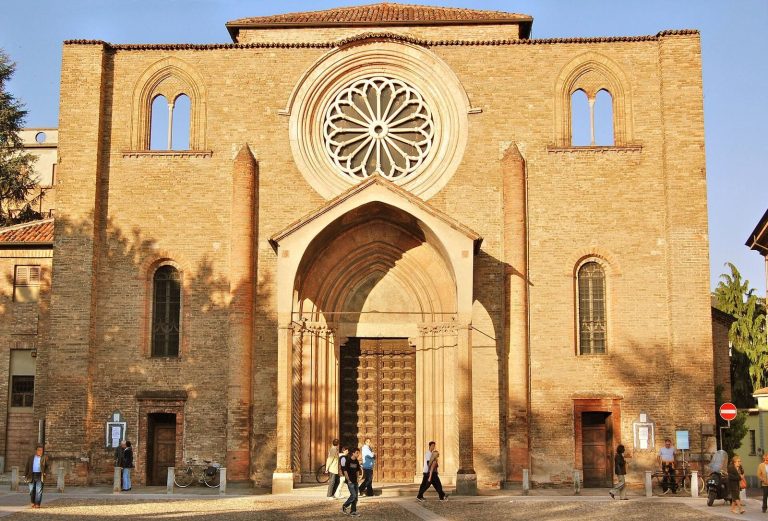
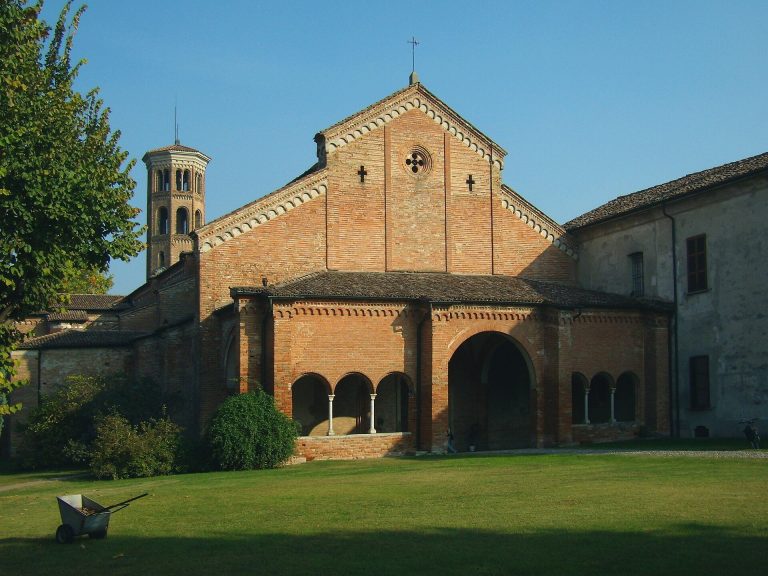
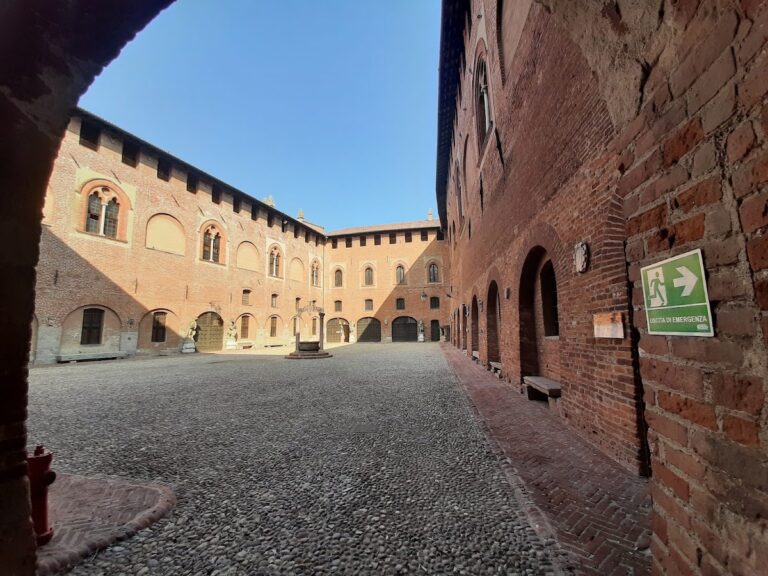
Sant’Agnese stands along a narrow street in Lodi’s historic centre. Its Gothic exterior leads to a hall church, a design in which the side aisles rise to approximately the same height as the central nave, creating a unified interior space. The polygonal apse and the two-tiered bell tower are visible from the cloister. The tower contains three bells tuned to B-flat major, cast by the Barigozzi brothers of Milan in their distinctive “ultralight” form.
Facade and bell tower
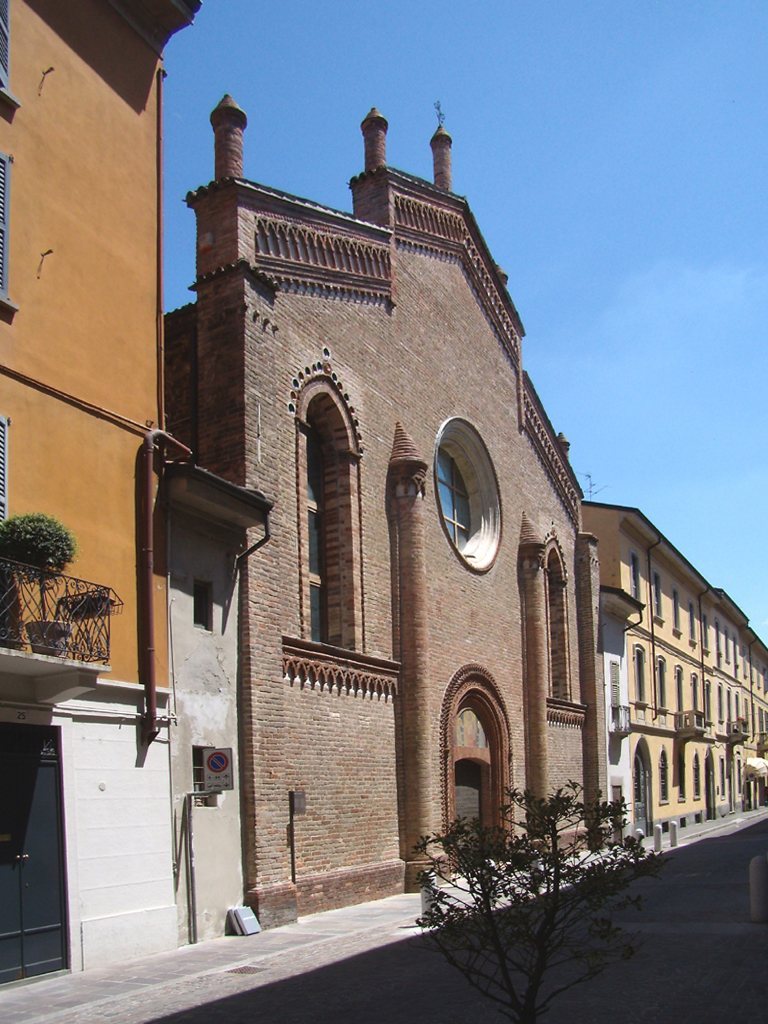
The facade is contemporary with that of San Lorenzo and shares several of its characteristics. It is also described as resembling the facade of Lodi Cathedral. Strong vertical lines, two pointed-arch lancet windows, and a stringcourse of interlaced arches organize its front. A staggered cornice and pointed pinnacles, or acroteria, rise along the pediment. The entrance lunette, a semicircular field above the doorway, contains a fresco of Saint Agnes remade in the late nineteenth century.
Interior structure
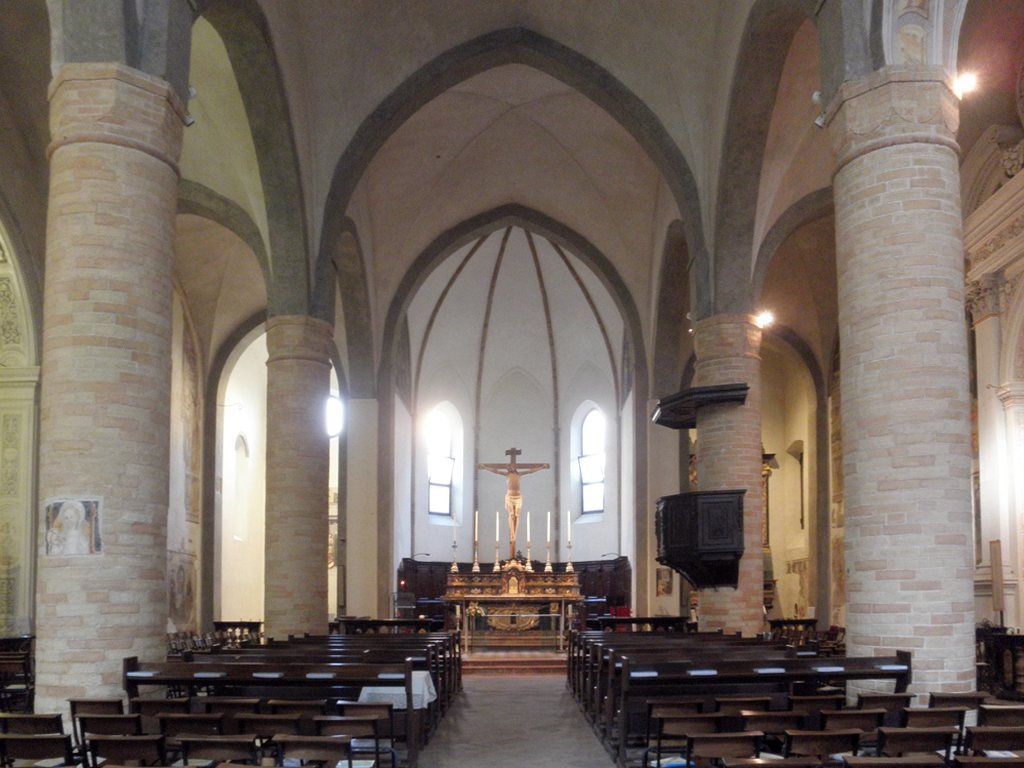
The interior has three aisles of equal height. Cylindrical brick pillars support groin vaults, which are formed by the crossing of two barrel vaults. The principal structure remains almost completely intact, preserving the spatial arrangement of the medieval church.
Painted and sculpted furnishings
The Galliani Polyptych
The first chapel on the right contains the Galliani Polyptych, a polyptych being an altarpiece made from several painted or sculpted panels. Painted by Albertino Piazza in 1520, the large oil painting on wood measures 420 by 280 centimetres. It was originally intended for the high altar before being moved to its present chapel.
The uppermost section, or tympanum, presents the Holy Spirit as a white dove surrounded by rays of light. Beneath it, the central lunette shows God the Father blessing, flanked by the angel of the Annunciation and the Virgin Annunciate. The upper register includes Saint Catherine of Alexandria with the attributes of martyrdom, Saint Monica in Augustinian clothing with a crucifix and a bag of books, and the enthroned Virgin holding the Christ Child. The child blesses Nicola Galliani, the commissioning prior. Saint Clare of Montefalco appears at the right in Augustinian dress with a lily and a flaming heart, beside Saint Agnes with the palm of martyrdom and her traditional lamb.
The lower register shows Saint Bassianus in episcopal dress and Saint Nicholas of Tolentino in Augustinian clothing. Nicholas holds a lily and crucifix beside an open book bearing the words, “I have kept my father’s precepts and despised all worldly adornment.” At the centre, Saint Augustine is enthroned with an open book displaying the evangelical rule, “Above all, dearest brothers, let God be loved, then one’s neighbor.” He is shown crushing three heretics identified as Donatists, Manichaeans, and Pelagians. The right side contains a bishop, probably Saint Albert Quadrelli, co-patron of the Diocese of Lodi, and the Augustinian saint John Bono. The predella, the narrow section along the base, depicts Christ among the twelve apostles.
Other devotional artworks
A terracotta bas-relief triptych on the right-aisle wall depicts Christ of Pity between Saints Christopher and Martin and a donor. A fifteenth-century wooden crucifix stands at the centre of the apse. Above the choir, two seventeenth-century frescoes in the lunettes show Saint Augustine preaching and Saint Augustine dying.
The chapel to the left of the high altar contains a fresco of the Virgin and Child between Saint Augustine and Saint Catherine of Siena. The painting was first attributed to Bergognone and later to Matteo della Chiesa, a painter from Pavia who also worked at the Incoronata in Lodi.
Organ
The organ above the entrance portal was built in 1834 by Carlo Bossi, an organ builder from Bergamo. Its position over the portal forms part of the church’s later musical and architectural furnishings.