San Stanislao Kostka: A Jesuit Church and Parish in Palermo
Site at a Glance
- Popularity
- Low
- Country
- Italy
- Primary era
- Early Modern
- Eras represented
- Early Modern
- Civilizations
- Habsburg, Kingdom of Sicily, Spanish
- Site type
- Religious
- Remains
- Church
On this page15 sections
History
San Stanislao Kostka, also called the Church of the Madonna del Lume, is a Roman Catholic church in Palermo, Italy. It began as a chapel for a Jesuit novitiate, designed by Natale Masuccio and founded on 15 August 1591. The Jesuits, members of the Society of Jesus, used a novitiate as a house for candidates’ initial religious formation. There, young men studied theology, classical subjects, science, and philosophy before taking the Jesuits’ fourth vow, a special promise of obedience to the pope in matters of mission. The novitiate was the city’s largest Jesuit building.
The chapel and its development
The church was consecrated in 1699 by Asdrubale Termini, bishop of Syracuse. Work on its facade and interior was still under way in 1704, with Giuseppe Diamante involved in the project. A Confraternity of the Madonna del Lume, an Italian devotional title meaning “Our Lady of Light,” was established at the novitiate in 1736.
Between 1763 and 1765, the interior received a new decorative scheme. Stucco work took the place of Andrea Palma’s earlier frescoes, which featured architectural elements, as well as ornaments by Diamante.
Suppression, destruction, and parish status
In 1767, the Society of Jesus was suppressed and its members expelled. The former novitiate buildings were turned into barracks for Bourbon troops. After the order was restored on 30 July 1814 by Pope Pius VII, the Jesuits recovered the church, but not the wider complex. During the Sicilian uprising of 1848, the former novitiate and barracks were attacked and destroyed. San Stanislao Kostka became a parish in 1953.
Remains
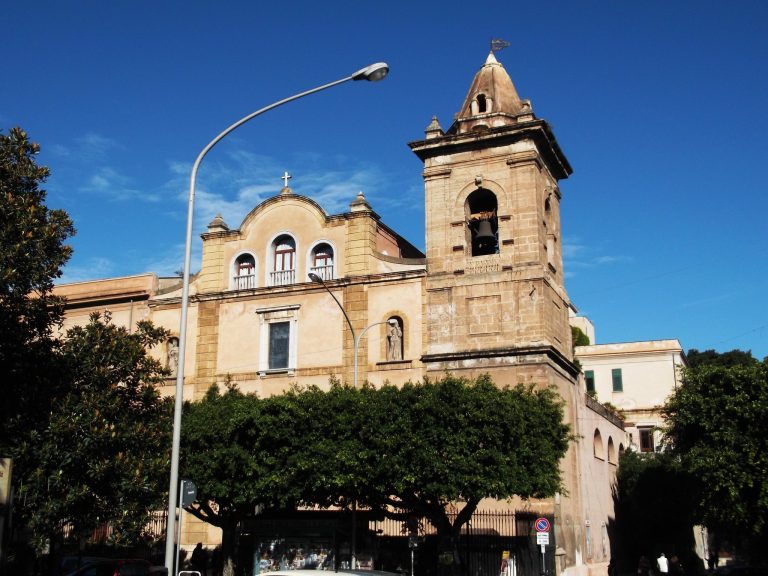
The church stands in Palermo’s historic center, in the Capo quarter of the Monte di Pietà district, near Porta Guccia and the Bastione d’Aragona and behind the present-day Palace of Justice. Its Baroque and Rococo interior is organized around a single nave with three chapels on each side and a high-altar area.
Facade
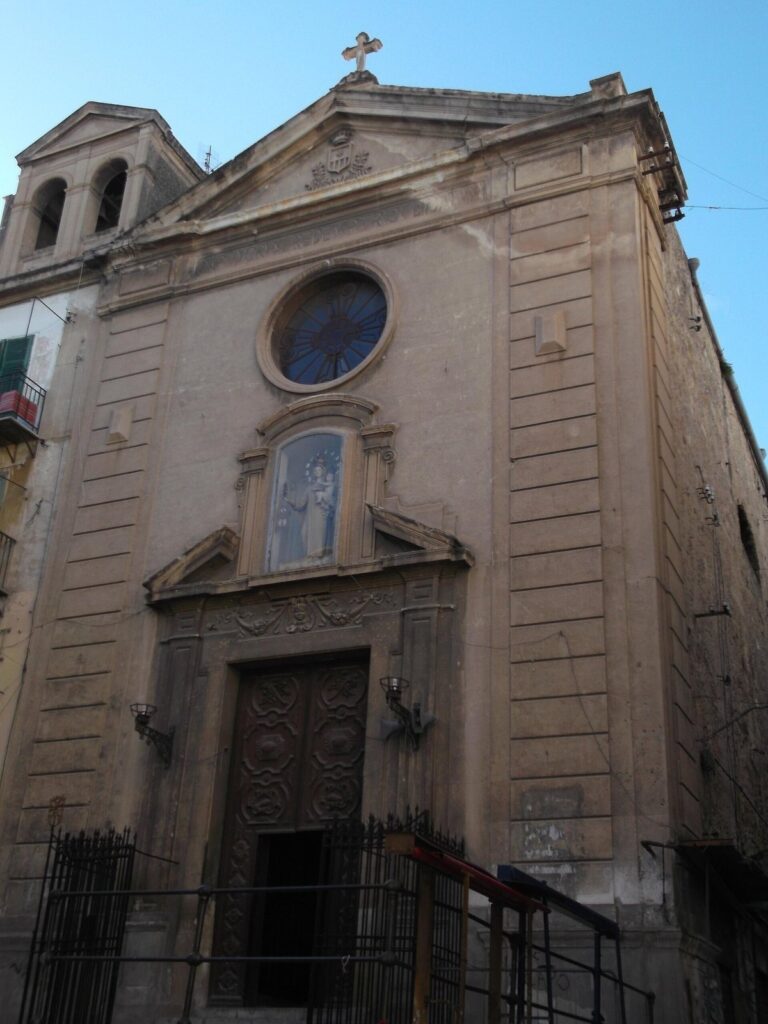
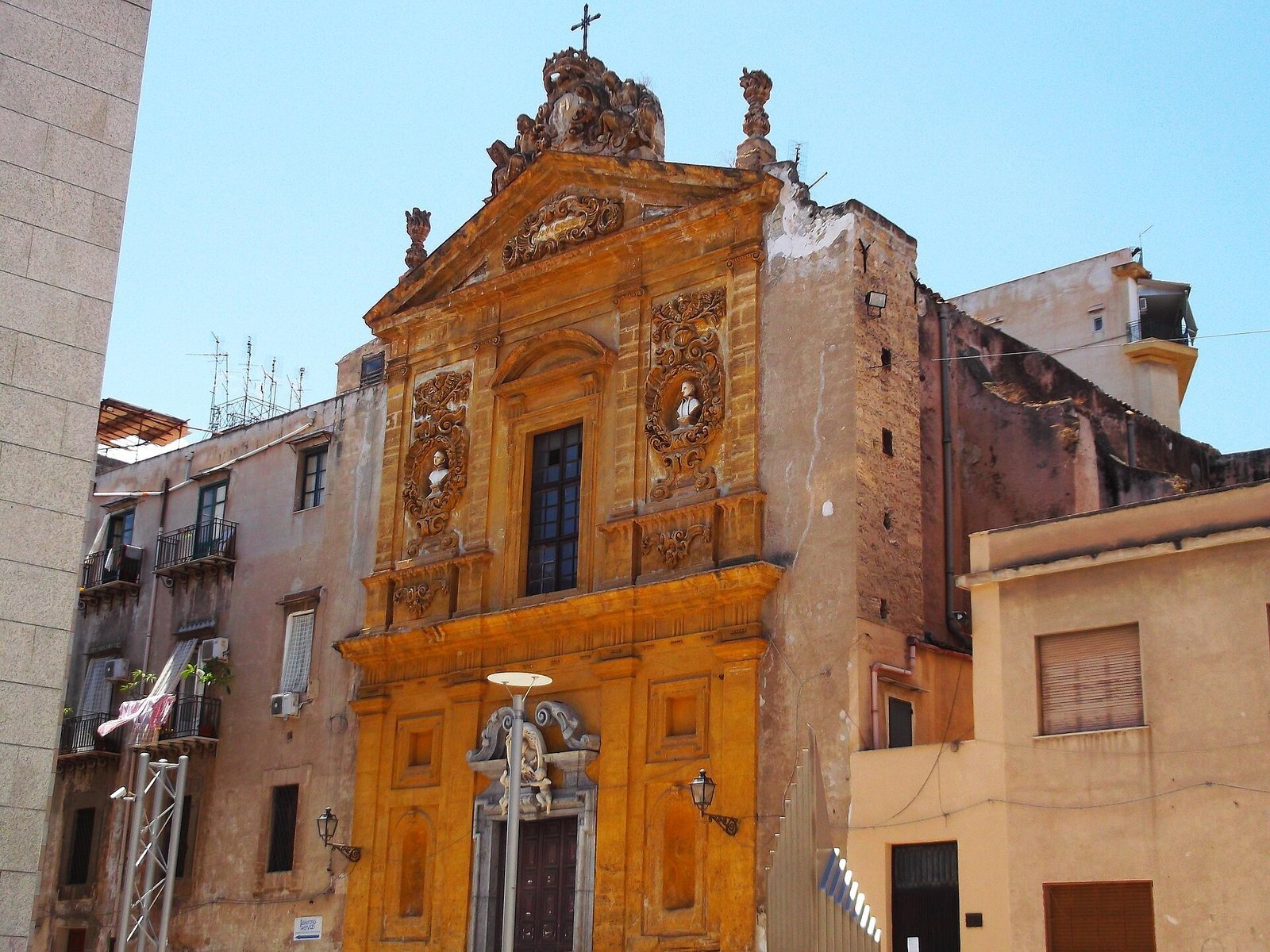
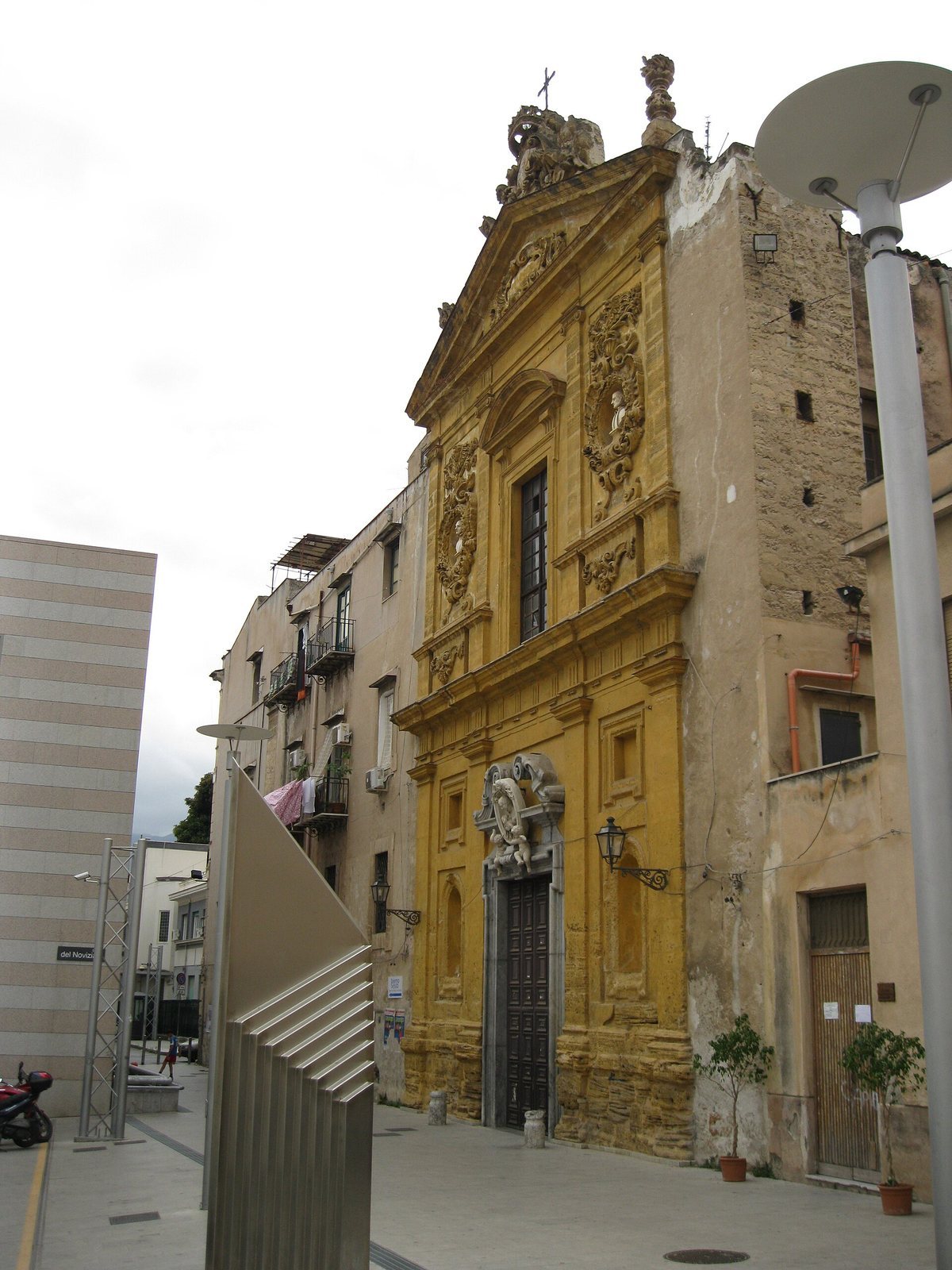
The cut-stone facade is divided into two levels by a horizontal cornice. Four pilasters, shallow supports attached to the wall, frame niches, square recesses, and a broad central window. Busts of Jesuit saints appear in frames across the front. Above the entrance, angels hold a medallion of Saint Stanislaus Kostka, sculpted by Giacomo Pennino in 1725. A triangular pediment, a sculptural group, a crown, and a cross shape the upper outline; the roofline also bears the Jesuit coat of arms, flanked by stone urns with flames.
Nave and presbytery
Nave
The single nave is covered by a barrel vault, a continuous arched ceiling. Its stucco decoration, made by Gaspare Firriolo and Vittorio Perez in 1763, includes symbols of the Eucharist, the Christian sacrament of communion, and the Ark of the Covenant, a sacred chest described in the Hebrew Bible.
High altar and presbytery
The high-altar chapel was once covered in sheets of silver. In the presbytery, the area around the main altar, Bartolomeo Sanseverino’s stucco work on the vault includes a radiating pattern, a chalice, and figures representing Charity and Hospitality. The wider decoration incorporates God the Father with symbols of the Evangelists, the Lamb of God, symbols of the Eucharist, and four medallions of Old Testament prophets and priests. Shells, stars, garlands, palms, interlacing patterns, and symbols of the priesthood complete the ornament. Around 1770, Gaetano Mercurio painted a Last Supper in the central wall frame, with female allegorical figures in frames to either side.
Side chapels
First chapel on the right
The altar has twisted columns and stucco ornament and was probably designed by Paolo Amato. A statue of Mary as the Immaculate Conception, reflecting the Catholic teaching that she was preserved from original sin from conception, stands in a niche between figures representing Virginity and Fortitude. Giuseppe Palumbo made the statue in 1686. Antonio Grano’s wall paintings are badly damaged. Other stucco details include candelabra patterns on the pilasters, crouching children on the cornices, and God the Father on the pediment, in the manner of Giacomo Serpotta’s school.
Second chapel on the right
Dedicated to Saint Stanislaus, this chapel has a wooden altar with stucco patterned to resemble marble. A case below it holds a two-colour marble statue of the saint by Giacomo Pennino, made in 1729. The chapel also contains a painting of the Virgin with Saint Stanislaus and stucco scenes from the saint’s life on its side walls.
Third chapel on the right
The chapel of Saint Francis Xavier has an altar of mixed marbles with twisted columns, made by Francesco Scuto in 1666 and later worked on by Vincenzo D’Aurelio and Paolo and Gerardo Castelli. Antonio Grano painted its frescoes. The chapel now houses a processional float, a platform carrying a sacred image in a procession, of the Madonna del Lume, made by Francesco Pisciotta in 1905.
First chapel on the left
The chapel of the Holy Crucifix centers on a wooden cross set against an elaborately decorated wall shrine for relics. At its foot are stucco figures of the Virgin Mary and Saint John the Evangelist, made by Giuseppe Palumbo in 1686 along with the chapel’s decoration. Two grieving angels stand on projecting ledges of the pediment. A wooden-and-glass case at the foot of the cross contains the skull of Saint Clement the Martyr. In 1687, Antonio Grano painted the walls and vault with scenes of the Lamentation over the Dead Christ, the Ascent to Calvary, and the Trinity with the Dead Christ.
Second chapel on the left
The chapel dedicated to the Madonna del Lume includes an entrance to the sacristy. Above the opening is a copy of the small oval painting of the Madonna. On either side, large stucco panels by Bartolomeo Sanseverino show Saint Rosalia being led by angels to the cave at Quisquina and carving an inscription there. The left wall contains the tomb of Ottavio and Lorenzo Lombardi.
Third chapel on the left
The chapel of Saint Ignatius has an altar of mixed marbles with twisted columns and caryatids, sculpted figures serving as supports. Paolo Amato designed the altar, which Francesco and Gerardo Scuto made. Its altarpiece shows Saint Ignatius of Loyola with Saint Aloysius Gonzaga and Saint Stanislaus Kostka. Two marble high-reliefs depict Ignatius in a cave and the Trinity appearing to him. Giovanni Battista Ragusa, Baldassare Pampillonia, Giovan Battista Ferrera, and Pietro Nucifora also contributed to the chapel.