San Samuele: A Historic Roman Catholic Church in Venice


Site at a Glance
- Rating
- 4.7
- Popularity
- Very Low
- Country
- Italy
- Primary era
- Early Modern
- External website
- Open
- Eras represented
- Medieval, Early Modern, Modern
- Civilizations
- Italian, Venetian
- Site type
- Religious
- Remains
- Church
On this page14 sections
History
San Samuele is a Roman Catholic rectorial church in Venice, Italy, founded around 1000 by the Boldù and Soranzo families. A rectorial church is administered by a rector. The parish was first recorded in 1090, when its priest was Pietro Regini. The church stands in Venice’s San Marco district and is administered within the Patriarchate of Venice, the Latin Church, and the parish of Santo Stefano Protomartire.
Foundation and changing dedication
The original church was dedicated to the Apostle Matthew. Fires in the early and later twelfth century led to successive rebuilding. After the first reconstruction, the building’s orientation was probably turned by 90 degrees. In 1161, the church was recorded under the combined dedication of Saint Matthew and Saint Samuel, a name that remained in use into the sixteenth century. After the later fire, the dedication changed to Samuel the Prophet, a biblical figure of the Old Testament.
The dedication gives San Samuele an unusual place among Roman Catholic churches, since relatively few are dedicated to an Old Testament figure. Relics traditionally attributed to Samuel are believed to be preserved in the church and helped shape its religious identity.
Rebuilding and parish reorganization
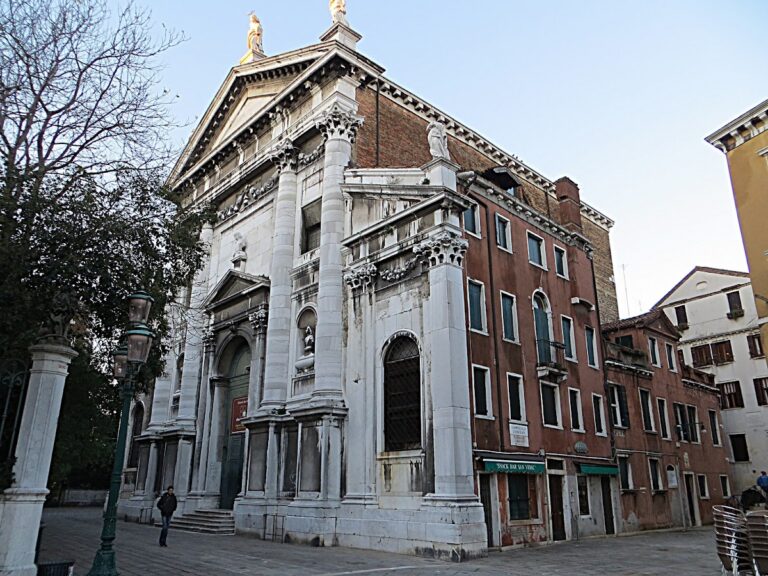
San Samuele was almost entirely rebuilt in 1685. The reconstruction retained the original portico and the Gothic apse, linking the later building with elements of its medieval predecessor. The facade was rebuilt again in 1952. During the same work, the architect Ferdinand Forlati restored the earlier reconstructed portico and opened the upper-level loggia.
Napoleonic decrees issued in the Kingdom of Italy in 1805 and 1807 brought the suppression and reorganization of Venetian parishes. In 1807, San Samuele’s parish was united with Santo Stefano Protomartire, and the church became a filial church of the newly formed parish. A filial church is a dependent church attached to a larger parish.
Conservation and cultural associations
Conservation work in 1882 revealed fifteenth-century frescoes beneath plaster. They were restored in 1946 and again in 2000. Work on the walls and vaults of the apse began in 1999. The frescoes are by an unknown artist and have traditionally been linked with the Paduan or Bolognese school.
The nearby Teatro San Samuele took its name from the church. Giacomo Casanova’s mother, the actress Giovanna Maria Farussi, and his presumed father, the dancer and actor Gaetano Giuseppe Casanova, married at San Samuele on 17 February 1724. Casanova, an eighteenth-century Venetian adventurer, writer, and cleric in training, was born nearby in Calle Malipiero and baptized in the church on 5 May 1725.
Casanova later played in the orchestra of the Teatro San Samuele, which subsequently functioned as a school. While briefly pursuing a clerical career, he preached in San Samuele in 1740 and 1741. His second sermon ended in a moral scandal and brought his priestly career to an end. By 2019, the church had been desacralized and was being used for cultural events.
Remains
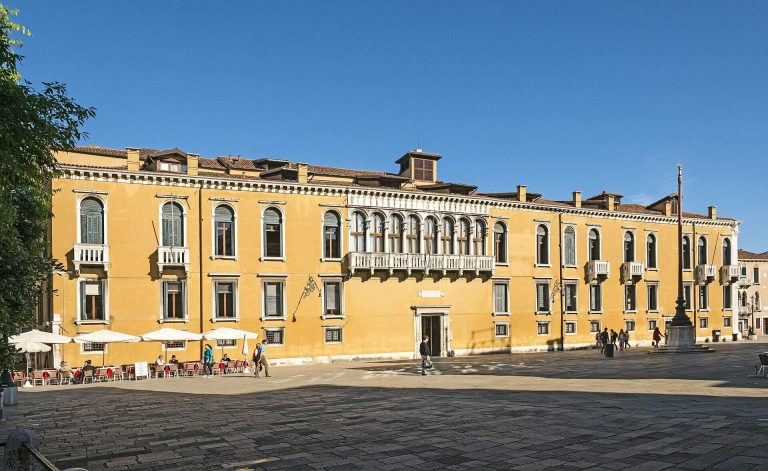
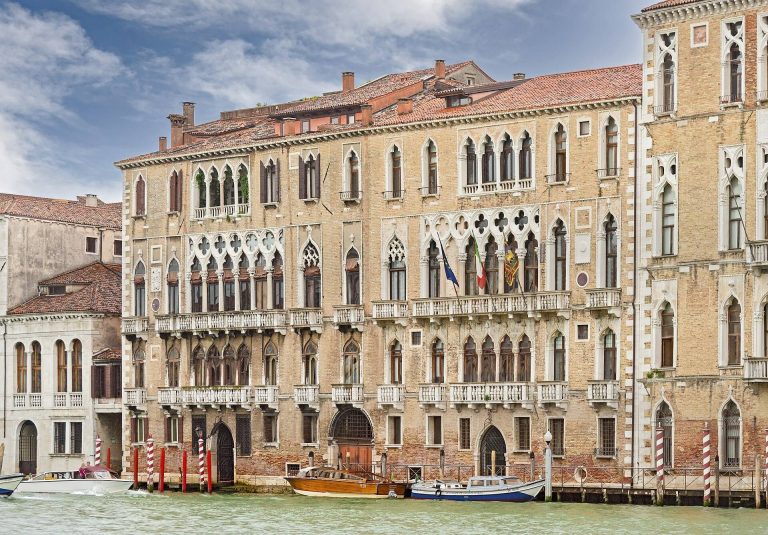
San Samuele occupies Campo San Samuele, which opens toward the Grand Canal. Calle delle Carrozze and Salizzada Malipiero run parallel along the church’s sides. Residential buildings partly screen the facade and campanile, while houses enclose the apses. The church has direct access to the Grand Canal, from which its facade is visible. Its surviving structure combines a three-aisled plan, a medieval apse and bell tower, and substantial seventeenth-century rebuilding.
Exterior and medieval fabric
Facade and portico
The plain facade has a large thermal window in its upper section. A thermal window is a broad, semicircular-headed opening derived from Roman architectural forms. Small stone pedestals carrying four crosses crown the facade, while large thermal windows also pierce the side walls. The original portico survives in reconstructed form. In 1952, its upper loggia was created by opening the masonry with round-arched arcades. The loggia is not publicly accessible.
Campanile
The Romanesque campanile, or bell tower, rises approximately 28 metres and was built of Istrian stone in the twelfth century. It is among Venice’s oldest bell towers. A pyramidal roof covered with lead tiles caps the tower, whose bells are operated manually. The campanile was restored in 1984.
Adjoining house
A house directly adjoining the campanile was built and decorated with frescoes in 1915 by the painter Augusto Sezanne.
Interior and artworks
Plan and vaulting
The interior is divided by columns of Istrian stone and arranged in three aisles. The nave and aisles extend through four bays. The right aisle was substantially widened during the seventeenth-century rebuilding, giving the interior an asymmetrical form. The side aisles end in straight walls, while the Gothic presbytery ends in a polygonal apse. A barrel vault covers the central nave.
Painted decoration
The pendentive panels carry oil paintings of saints by Antonio Zanchi, Giustino Menescardi, Gaspare Diziani, Fabio Canal, and Gregorio Lazzarini. Nicolò Bambini designed the central lunette. Four nearly identical altars, each with an altarpiece, are also preserved.
Presbytery and apse frescoes
The fifteenth-century fresco cycle in the presbytery and apse presents Christ, the four Evangelists, Augustine, Ambrose, Jerome, Gregory, and eight Sibyls. The four Western Church Fathers were influential early Christian theologians whose writings shaped Western Christian doctrine. Sibyls were female prophetic figures associated with the ancient Greek and Roman world, and Christian interpretation treated some of their sayings as predictions of events in Christ’s life.
The vault is divided into four sections, each containing one of the Church Fathers in a roundel. Inscriptions, foliage, and putti carrying the instruments of the Passion surround the figures. Above the high altar, frescoes between the ribs of the cupola depict Christ and the Evangelists Matthew, Mark, Luke, and John. The cycle has traditionally been attributed to the Paduan or Bolognese school.
Altars and sacred images
The high altar contains a crucifix dated to approximately 1350 to 1355, or broadly to the fourteenth century, and attributed to Paolo Veneziano, a leading Venetian painter of that period. It also contains the cult image known as the Vergine Ortocosta, brought to Venice in 1541 and traditionally venerated by Byzantine emperors.
Above the altar at the end of a side aisle is a Byzantine icon of the Virgin and Child from the thirteenth century. Its Byzantine covering dates from the fourteenth century. Excavations in 2000 also revealed a sarcophagus against the right rear wall.