San Vidal, Venice: A Former Church and Baroque Concert Hall


Site at a Glance
- Rating
- 4.7
- Popularity
- Medium
- Country
- Italy
- Primary era
- Early Modern
- External website
- Open
- Eras represented
- Medieval, Early Modern
- Civilizations
- Venetian
- Site type
- Religious
- Remains
- Church
On this page12 sections
History
San Vidal, Venice, is a former Roman Catholic church in Italy, founded in 1084 and rebuilt in the late seventeenth century with a Palladian facade. Dedicated to Saint Vitalis of Milan, an early Christian martyr, it stands in the San Marco district and was administered within the Patriarchate of Venice.
Foundation and medieval rebuilding
Older Venetian chronicles place the church’s foundation in either 699 or 917, but the better-supported date is 1084, during the dogeship of Vitale Falier, the elected head of the Venetian Republic. The parish appears to have been established at the same time. A fire destroyed the building in 1105, after which it was rebuilt in stone. Renovation followed toward the end of the twelfth century, and an earthquake damaged the church again in 1347.
The rebuilding of 1696–1700
A new rebuilding campaign began in 1696. It was first planned as a monumental memorial to Francesco Morosini, the Venetian doge from 1688 to 1694 and a prominent naval commander. Morosini’s victory over the Ottoman Empire in the Morean War, a late-seventeenth-century conflict over the Peloponnese, provided the original commemorative purpose.
Antonio Gaspari prepared several designs influenced by Sant’Andrea al Quirinale in Rome, but Morosini’s heirs abandoned the project. After the patrons changed, Andrea Tirali erected the present church body between 1696 and 1700. The facade followed in 1734–1737 through the patronage of Carlo Contarini, a doge of Venice identified as an heir of the Morosini family. Sculpted portraits of Contarini and his wife, Paolina Loredan, appear on the facade, alongside a bust of the parish priest Teodoro Tessari, whose efforts helped bring about the rebuilding.
Secular use and later conservation
In 1810, under the Napoleonic Kingdom of Italy, the San Vitale parish was incorporated into that of Santo Stefano protomartire, or Saint Stephen the Protomartyr. San Vidal then became a subsidiary church, subordinate to the principal parish, and was later deconsecrated, formally losing its status as a place of worship.
After deconsecration, the building served for many years as the seat of the Union of Catholic Italian Artists. Its sacristy was used for exhibitions of modern and contemporary art. San Vidal is now a concert and event hall for classical and Baroque music, associated with Chorus Venezia and the chamber ensemble Interpreti Veneziani. Conservation work took place in 1902–1903 and again in 2000. Tradition also holds that the Venetian composer Baldassarre Galuppi was buried there, although his funeral was held at the nearby church of Santo Stefano.
Remains
San Vidal stands at one end of Campo Santo Stefano beside Rio di San Vidal and near the Ponte dell’Accademia. The approach passes through the campiello San Vidal toward the bridge and the Grand Canal. Built principally of brick and marble, the church presents a symmetrical classical facade whose three-part composition suggests three aisles, although the interior has a single nave. The apparent side sections of the exterior contain residential rooms, whose historic rents provided parish priests with income for construction.
Facade and bell tower
Palladian facade
Designed by Andrea Tirali, the facade follows a Palladian scheme, a classical architectural approach associated with symmetry, formal orders, and pediments. Two pairs of columns rise from high bases and support a triangular pediment crowned with statues. Sculpted portraits of Carlo Contarini and Paolina Loredan, together with the bust of Teodoro Tessari, connect the facade to the eighteenth-century rebuilding campaign.
Campanile
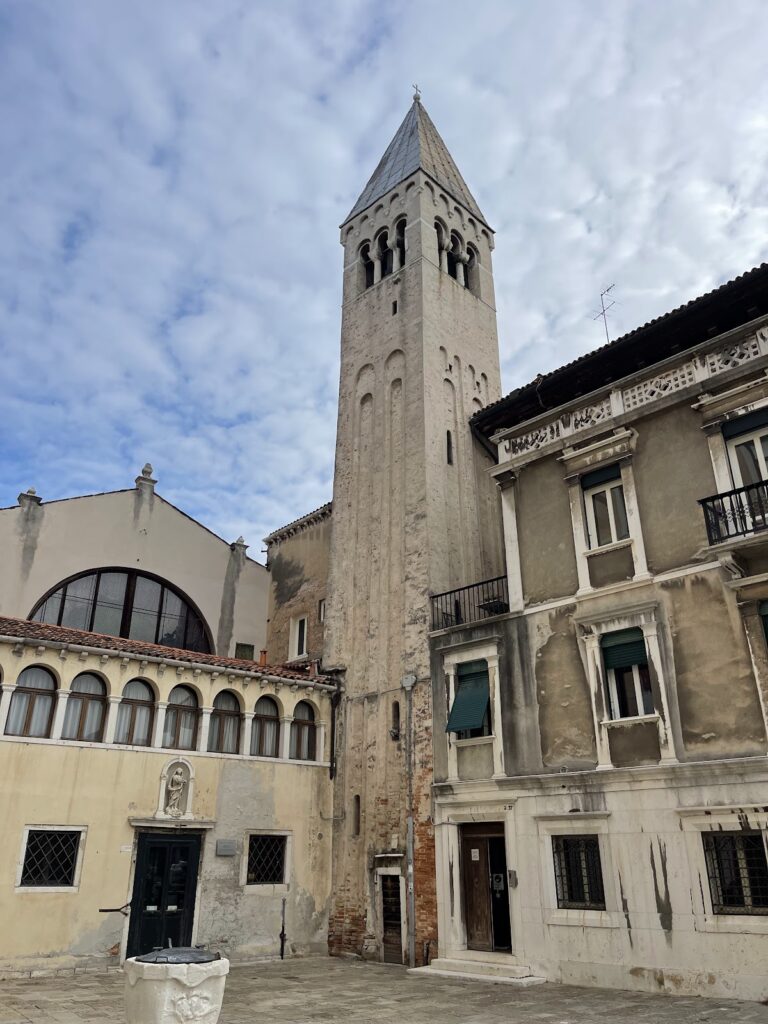
The 29-metre campanile, or bell tower, formed part of the original 1084 design. It was rebuilt after the fire of 1105 and restored or rebuilt again after the earthquake of 1347 and in 1680. Above a ground-level side door, the tower incorporates a fragment of a probably twelfth-century cornice and a fifteenth-century stone relief whose subject is not consistently identified. A white-stone Roman inscription, placed at the base in the sixteenth century, is also part of the tower.
Interior and artworks
Nave and main altar
The interior has a single nave beneath a vaulted ceiling, with three secondary altars on each side. The principal altar stands separately at the centre of the presbytery. Marble statues by Antonio Gai flank it, representing Faith and Fortitude.
The principal altarpiece is Vittore Carpaccio’s Saint Vitalis on Horseback, also known as The Glory of Saint Vitalis or the San Vidal Altarpiece, painted in 1514. Saint Vitalis appears on a white horse, accompanied by four saints beside him and four more shown above in balconies. The figures include Saint Valeria, Saint George, Saint James, Saint John the Baptist, Saint Peter, and Saint Andrew.
Side altars
The left side contains Sebastiano Ricci’s Immaculate Conception; Giulia Lama’s Christ Crucified with the Apostles; and a painting of Saint Sebastian and Saint Roch associated with the school of Giovanni Battista Piazzetta and attributed to Angelo Trevisan. The work by Lama is flanked by eighteenth-century sculptures of Patriarch Simeon and Saint Joseph attributed to Antonio Tarsia.
On the right are Giovanni Antonio Pellegrini’s The Trinity with Saints Peter and Francis of Paola, sculptures by Antonio Tarsia representing the Annunciation, Saint Dominic, and Saint Rose, and Giovanni Battista Piazzetta’s 1730 altarpiece of the Archangel Raphael, Saint Louis IX, and Saint Anthony of Padua. Saint Louis IX was a thirteenth-century king of France, while Saint Anthony was a thirteenth-century Franciscan preacher and theologian.
Sacristy and organ
The sacristy contains Gregorio Lazzarini’s The Death of Saint Ursicinus, an eighteenth-century Venetian-school painting of the martyrdom of Saint Vitalis, and a collection of eighteenth-century paintings. A Bazzani organ built in 1833 is installed on the interior wall of the facade.