San Rocco: A Baroque Catholic Church in Turin
Site at a Glance
- Country
- Italy
- Primary era
- Early Modern
- Eras represented
- Early Modern, Modern
- Civilizations
- Duchy of Savoy, Italian, Kingdom of Sardinia
- Site type
- Religious
- Remains
- Church
On this page12 sections
History
San Rocco is a Baroque Catholic church dedicated to St Roch in Turin, Italy. Its larger church, begun in 1667, developed from the work of a religious association formed to serve the parish and bury abandoned dead. Baroque was a European style known for elaborate decoration and dramatic forms. St Roch was traditionally invoked for protection against plague.
Early devotion and the first church
Devotion to St Roch was widespread in Turin from the start of the sixteenth century. A chapel near the fountains of Santa Barbara was cared for by a penitential confraternity, a lay religious brotherhood whose members undertook acts of penance. When signs of a new plague appeared in 1598, 35 members left the Confraternity of the Holy Cross and founded the Confraternity of St Roch, Death and Prayer. Archbishop Carlo Broglia approved the new association by decree on 7 September. Its members worshipped in the Chapel of Our Lady of Graces, within the parish church of St Gregory, and made burying abandoned bodies their chief duty.
When the chapel proved too small, the confraternity arranged with its owner, Francesco Broglia, to expand it. The chapel and church were demolished, and a replacement building was completed in 1617. In 1620, members travelled to Arles to obtain a relic of St Roch. Maria Cristina, the Savoy regent Christine of France, later gave a crystal urn for the relic, which was placed beneath the altar table.
Parish restoration and the larger church
Disputes between the confraternity and local clergy led to a change in 1662. The government suppressed the parish of St Gregory, transferred its endowment to the Fathers of the Mission, Catholic priests belonging to the Congregation of the Mission, and divided its jurisdiction among nearby parishes. The confraternity agreed to restore the parish endowment, securing the parish’s reinstatement and its own right of patronage. It then planned one larger church to replace the two small churches. Work began in 1667, after the confraternity purchased a house from Count Vittorio Baratta and other nearby properties.
Emilio Palliano, a theologian and lawyer, became the church’s first parish priest on 9 June 1671. By the early eighteenth century, the church had largely assumed its present form. A new altar to the Madonna was made in 1717, the bell tower was raised in 1725, and the choir received its definitive arrangement between 1772 and 1774.
Later changes and damage
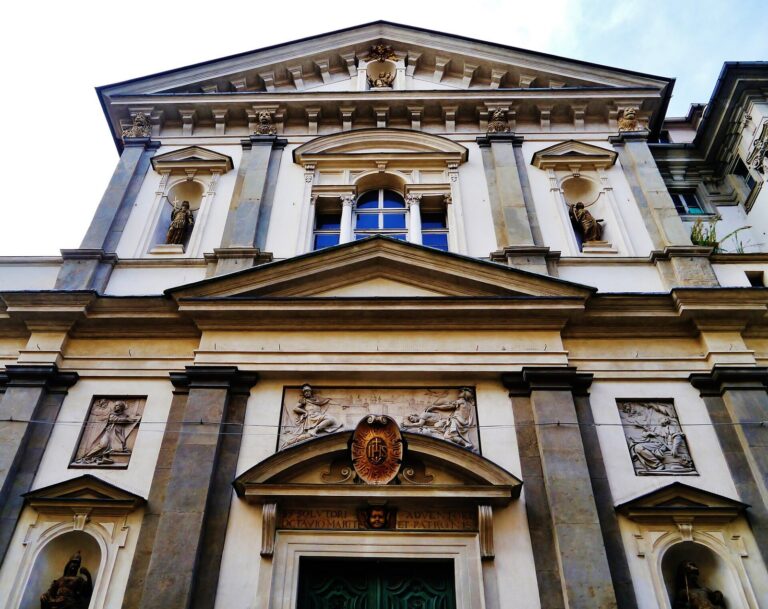
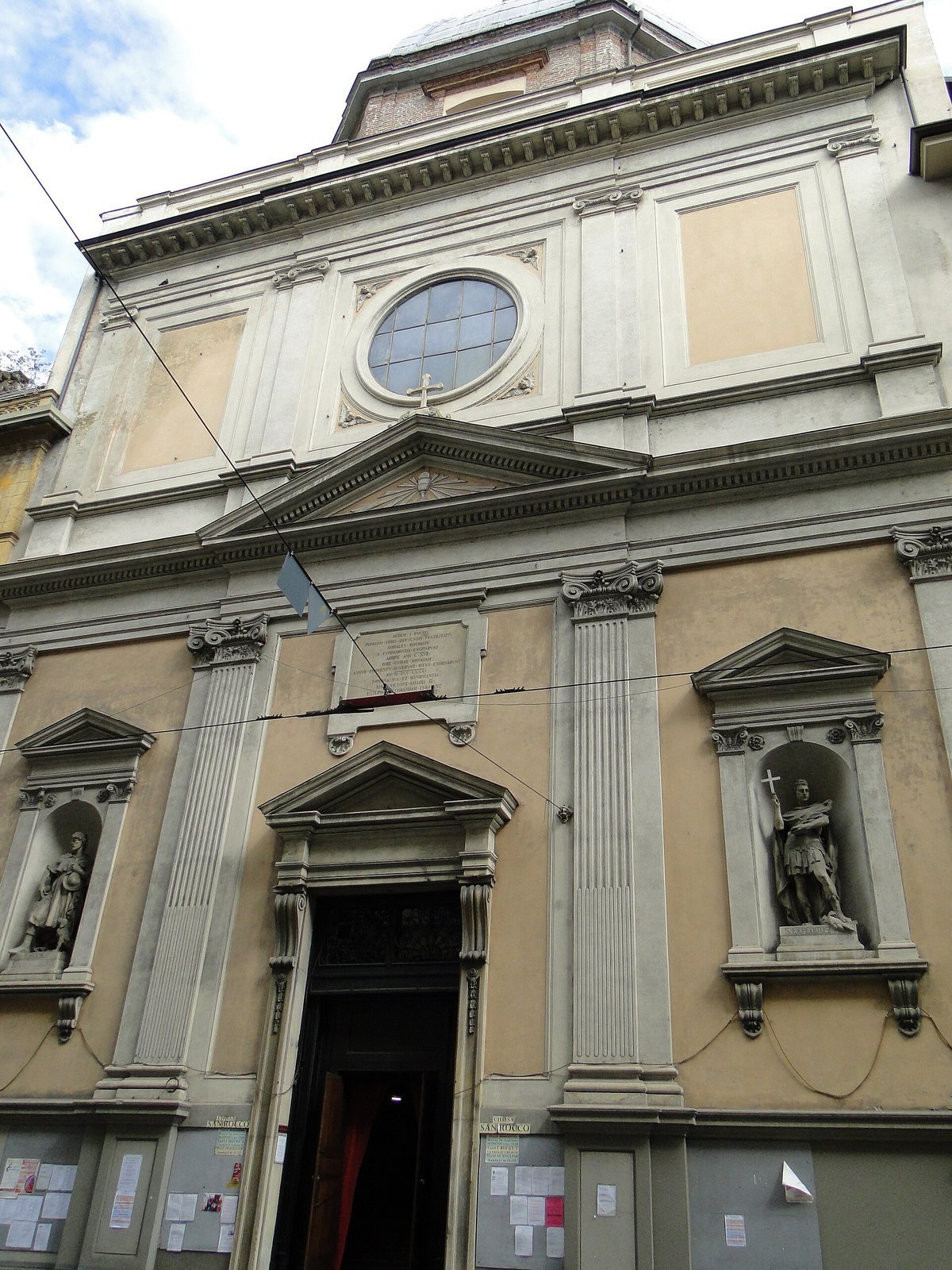
Work on the façade was promised in 1690 but delayed by lack of funds. It was completed in 1780 with help from Victor Amadeus III, a ruler of the House of Savoy. That year, a façade designed by Pietro Tommaso Beria was erected. In 1755, a marble replacement was designed for the former wooden high altar. The church also underwent extensive decorative work in 1830.
The confraternity established a Pious Burial Society, whose principal task was burying abandoned corpses. Among those buried by the society was a young Parisian seamstress who died by suicide for love; her body was recovered from the Po and placed in the underground chapel. Many affluent bourgeois and merchant families from the neighborhood were also buried at the parish, which became one of Turin’s oldest.
When Via San Francesco d’Assisi was widened in 1885, part of the church had to be surrendered for the road. The city paid for its demolition and for a replacement façade, completed in 1890. Air raids during the Second World War severely damaged the church, especially in the attack of 13 July 1943; the damage was later repaired. San Rocco belongs to the Archdiocese of Turin.
Remains
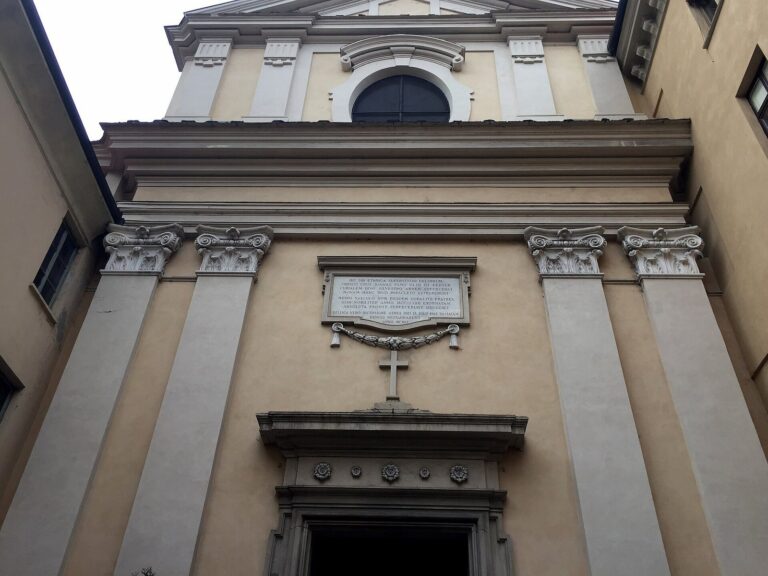
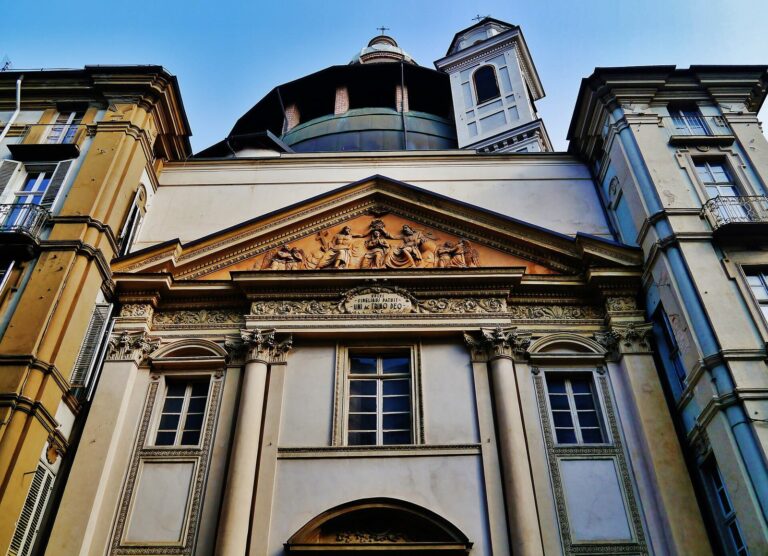
The church has an octagonal plan and richly decorated Baroque interior. Its façade and the enclosure around the octagonal dome face Via San Francesco d’Assisi, while adjoining houses constrain the façade. The dome and its supporting drum, the structure beneath a dome, are described as unfinished.
Exterior
The façade has two tiers of shallow, column-like projections. Niches beside the entrance contain statues of St Roch and St Expeditus, an early Christian martyr traditionally invoked for urgent needs; the statues were installed in 1924.
Interior structure
The large octagonal dome has frescoes and eight windows. Twenty pairs of columns support the horizontal architectural band above them, the dome’s supporting drum, and the lantern, the small structure crowning it. A semi-dome vault bears a large fresco glorifying St Roch.
Altars and devotional art
High altar and apse
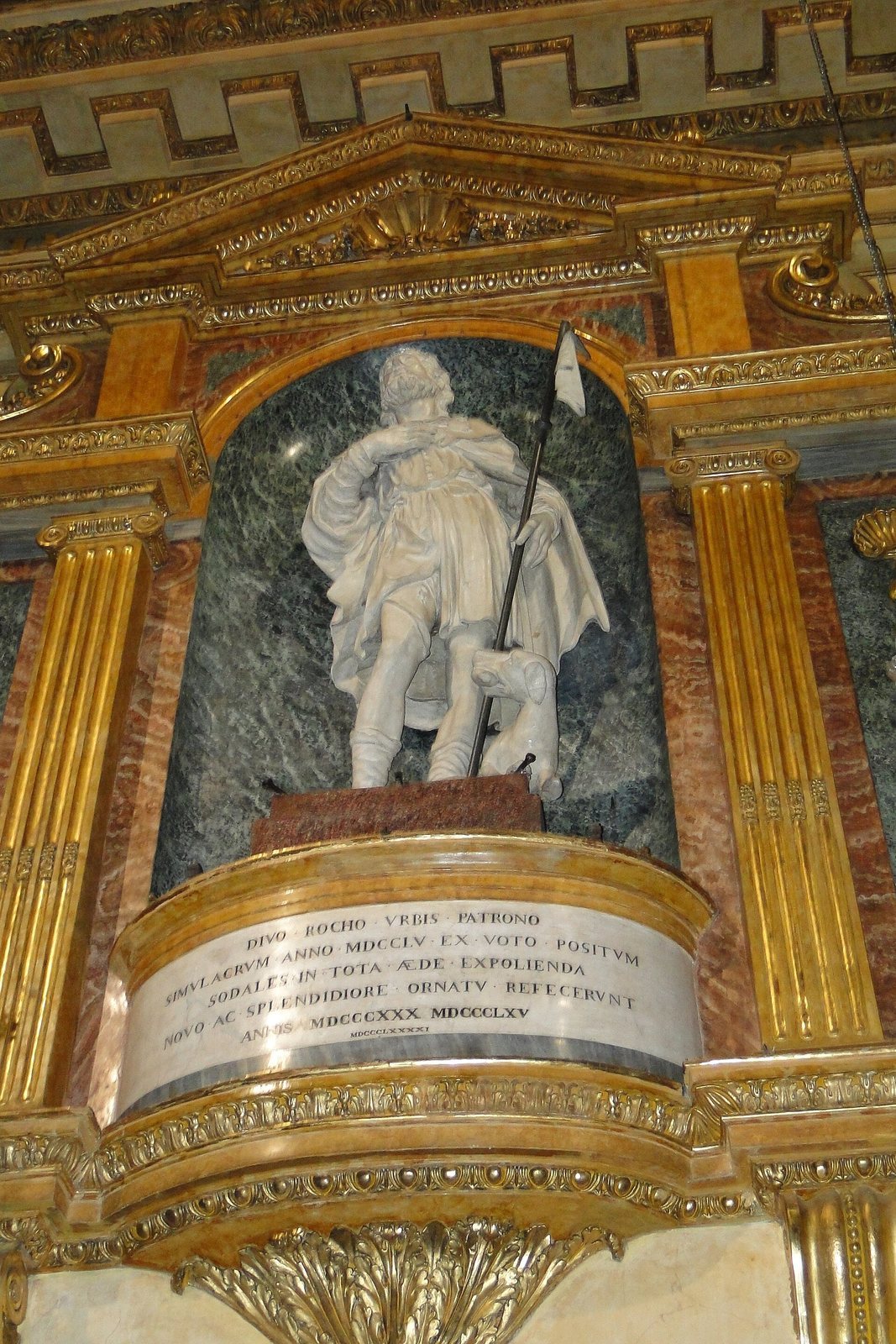
The presbytery, the area around the main altar, has a floor inlaid with differently colored marble slabs and a balustrade dating to 1754. The high altar combines polychrome marble from Valdieri, Susa, and Frabosa with alabaster from Busca. Sculptures by Carlo Amedeo Botto enrich the altar, whose upper section holds a crucifix among four gilded saint figures, with silvered and gilded candlesticks between them. A wooden statue carved by Pietro Botto stands in a niche in the apse, the recess at the end of the church. It was first placed on the exterior façade, and the vault above depicts episodes from St Roch’s life.
Side chapels and altars
Columns painted to resemble marble line the side chapels. In the right-hand chapel, a stone statue of Our Lady of Graces stands in a niche, while a wooden figure of St Aventine, invoked against headaches, is beneath the altar. The right-hand altar has an altarpiece by Alessandro Mari depicting the Birth of the Virgin. Stories of St Roch, painted by Mari and Tarquinio Grassi, are in the apse; the left-hand altar has a Crucifixion by Stefano Maria Clemente. Two confessionals stand against the inner face of the façade.
Choir
The choir walls carry a large altarpiece by Giovanni Antonio Mari showing St Roch preaching to people suffering from plague, as well as a large canvas depicting the Passing of St Roch. Above the choir stalls, a niche holds a large wooden statue of the saint by Carlo Amedeo Botto, a member of the Camaldolese, a Catholic monastic order in the Benedictine tradition.
Sacristy and underground chapel
The sacristy, where clergy prepare for services and keep liturgical objects, contains a large walnut cabinet that spans an entire wall. Small columns, friezes, and figures of children decorate its surface. A marble basin dated 1670 stands in a recess along a passage and served as a baptismal font. Many inscriptions remain on the walls of the underground chapel, associated with family tombs.