Padua Baptistery: Cathedral Baptistery and Fourteenth-Century Fresco Cycle in Italy


Site at a Glance
- Rating
- 4.5
- Popularity
- Medium
- Country
- Italy
- Primary era
- Medieval
- External website
- Open
- Eras represented
- Medieval
- Civilizations
- Unclassified
- Site type
- Religious
- Remains
- Baptistery
On this page10 sections
History
Padua Baptistery is a Romanesque building in Italy that serves as the cathedral’s baptistery, a place used for Christian baptism, and is dedicated to St. John the Baptist. Standing separately within the cathedral complex on Piazza del Duomo, it began in the late twelfth century, probably over earlier structures. Its present form developed through changes made during the thirteenth century and was established between 1260 and its consecration in 1281 by Guido, patriarch of Grado.
The Carrara Mausoleum
During the 1370s, the baptistery was restored and adapted as a mausoleum, a funerary building for important burials, for Francesco il Vecchio da Carrara, lord of Padua from 1350 to 1388, and his wife, Fina Buzzaccarini. The House of Da Carrara was the ruling dynasty of medieval Padua. Fina commissioned the interior decoration from Giusto de’ Menabuoi, a fourteenth-century Italian painter known for monumental frescoes in Padua.
The date of the commission remains uncertain. It was once thought to have been made during Fina’s lifetime, but the incorporation of her tomb into the pictorial program and her testamentary provision for burial in the baptistery indicate that the decoration may have followed her death in 1378. Menabuoi’s principal fresco cycle was painted between 1375 and 1376 and later became associated with the artist’s own burial outside the building.
Destruction and Conservation
The Venetian conquest of Padua in 1405 brought about the fall of the House of Da Carrara and the destruction of the couple’s monumental tombs. Francesco’s many emblems were covered with green paint, and his sarcophagus was removed. The tomb superstructure and a votive image are the surviving parts of that funerary arrangement.
The fresco cycle is regarded as one of the most important and best-preserved fourteenth-century cycles, as well as Menabuoi’s masterpiece. In 2021, it was included in the UNESCO World Heritage serial property “Padua’s fourteenth-century fresco cycles.” The inscription uses cultural criterion II, recognizing the exchange and development of artistic values in architecture, monumental art, and the representation of space. The baptistery’s paintings belong to a broader sequence of artistic development in Padua between 1302 and 1397, following Giotto and continuing through artists such as Guariento di Arpo, Altichiero da Zevio, Jacopo Avanzi, and Jacopo da Verona.
Several partial restorations took place during the twentieth century. The large polyptych on the high altar was restored in 2020 and 2021, and modern conservation research has also examined the painted surfaces.
Remains
The baptistery occupies the northeast corner of the Romanesque predecessor of Padua Cathedral on the cathedral square. Its structure combines a cube-shaped lower body with a rotunda above it. A shallow dome covered with flat tiles rises from a windowed drum, while the east-facing apse has a flat end and a smaller dome without a drum.
Building and Entrances
Five bands of paired blind arches run beneath the entablature. Pilasters branch from these arches in alternating groups of three and two, especially around the apse. The spaces between the arches are smoothly plastered and separated from the masonry by pale bands. Entrances flank the apse. On the southeast side, toward the cathedral, a narrow white marble column supports a square bay above the entrance and its small vestibule for the faithful. A corresponding clerical entrance stands on the other side but lacks the projecting vault.
Fresco Program
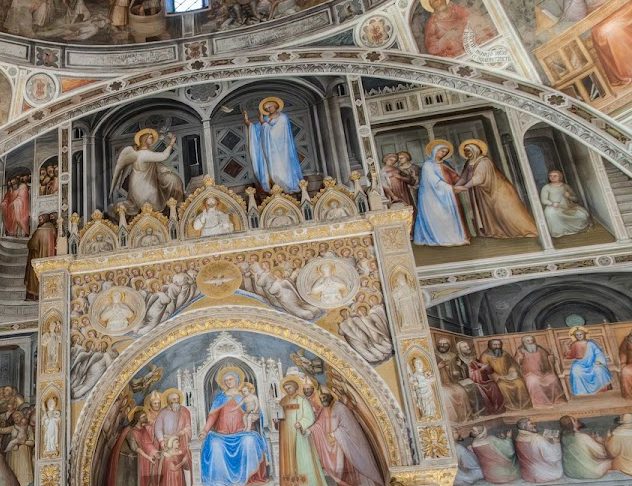
The fresco cycle covers nearly one hundred panels across almost all the walls of the main room and apse and across both domes. The lower dado zone and the altar wall are not part of the painted sequence. Extensive gilding and the costly, technically difficult pigment ultramarine contribute to the cycle’s rich surface.
Main Dome
The large dome presents Paradise around Christ Pantocrator, the image of Christ as universal ruler, surrounded by angels and perfected saints. Mary appears in glory on the central axis. Below, scenes from Genesis begin with the Creation of the World at Mary’s feet and continue toward Jacob’s Dream. The pendentives, curved triangular supports between the square room and the dome, contain the four Evangelists above their symbols and eight Old Testament prophets.
The Creation of the World includes the zodiac as an image of Christ’s authority over cosmic time. It also shows God the Father interrupting natural events, including the three-hour darkness associated with Christ’s agony and death. Angels dominate and neutralize the influence of planetary demons in the earthly world beneath the heavens.
Apse and Biblical Narratives
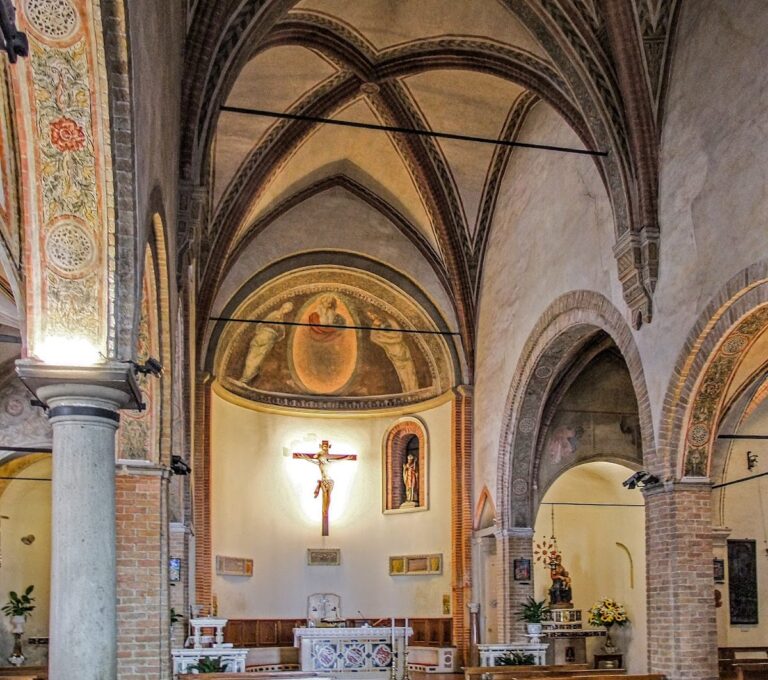
The smaller dome above the altar shows Mary and the Twelve Apostles, linked to Christ through Gothic ornamental gables. The altar area contains the Crucifixion and the Descent of the Holy Spirit, while the apse walls include fantastic and monstrous figures inspired by the Book of Revelation.
Across the walls, the paintings create a biblical sequence extending from Genesis through the Gospels and the Revelation of John. Episodes include the Annunciation to Zacharias, the birth of John the Baptist, the Presentation of Mary in the Temple, the Annunciation, the Visitation, the Nativity, the Flight into Egypt, and the Massacre of the Innocents. Other scenes show John’s preaching and beheading, Christ’s miracles, the calling of Simon Peter, Andrew, and Matthew, the Wedding at Cana, the Transfiguration, the Entry into Jerusalem, the Last Supper, Christ before Pilate, the Bearing of the Cross, the Crucifixion, the Harrowing of Hell, the Three Marys at the Tomb, and the Ascension.
Carrara Court and Pictorial Space
Members of the fourteenth-century Carrara court appear within New Testament scenes. Fina Buzzaccarini kneels before the enthroned Madonna while John the Baptist presents her to the Virgin. This votive image was incorporated into the Gothic arch that once rose above the tomb of the Carrara couple. A second image below shows John the Baptist, patron of both Fina’s family and the baptistery.
Menabuoi combined solemn, static figures with carefully calculated architectural settings. In the Wedding at Cana, servants move more naturally through the painted room than the guests. The Annunciation occupies a unified architectural space divided by a central column, with openings suggesting a loggia, a staircase, and other unseen areas. Older pictorial effects are deliberately varied for expressive and symbolic purposes.
High Altar Polyptych
The high altar contains a large polyptych, an altarpiece made from several adjoining painted panels, created by Menabuoi during the same period as the frescoes. Much of its original wooden frame has disappeared. The central panel shows Mary enthroned, with the veiled Christ Child standing on her left thigh and raising his right hand in blessing.
Two rows of six scenes from the life of John the Baptist flank the central panel. Above them are the Baptism of Christ, saints, and Church Fathers. The four innermost figures occupy almost square frames that function visually like the Evangelists in the dome pendentives. The predella, the lower section of an altarpiece, contains half-length figures of several Paduan saints and blesseds, with a Pietà at the center. The truncated spandrels, the roughly triangular areas between arches and their frames, carry applied arms of the da Carrara and Buzzaccarini families, whose patron was John the Baptist.