I Gesuiti: The Jesuit Church of Santa Maria Assunta in Venice


Site at a Glance
- Rating
- 4.7
- Popularity
- Medium
- Country
- Italy
- Primary era
- Early Modern
- External website
- Open
- Eras represented
- Medieval, Early Modern
- Civilizations
- Venetian
- Site type
- Religious
- Remains
- Church
On this page19 sections
History
I Gesuiti, formally the Church of Santa Maria Assunta, is a Roman Catholic church in Venice, Italy, dedicated to the Assumption of the Virgin Mary and affiliated with the Society of Jesus. The present Baroque church was built between 1715 and 1729 on the site of a medieval complex founded by the Crociferi, or Cross-Bearers, a religious order associated with hospitals and care for the sick.
The Crociferi Foundation
The predecessor church was traditionally founded in 1148 under the title Santa Maria Assunta dei Crociferi. Its foundation is attributed either to Pietro Gussoni or, in the account associated with Andrea Dandolo, the fourteenth-century doge and chronicler of Venice, to Cleto Gussoni. The complex received land, waterways, and marshes, creating the basis for a religious institution that combined a church, monastery, and hospital.
In 1154, Cleto Gussoni endowed the complex with a hospital for poor men and women suffering from illness. His relative and heir Buonavere Gussoni later increased its resources with vineyards and other estates in the districts of Chioggia and Pellestrina. The church was destroyed by fire in 1214 and rapidly rebuilt. Its possessions were later placed under commendatory administration, first under Cardinal Pietro Barbo, who became Pope Paul II, and then under Cardinal Bessarione.
After Bessarione’s death, the Venetian Senate attempted to assign the complex to other religious communities. Franciscan nuns, the Canons Regular of Santo Spirito in 1481, and the Servites in 1498 were each considered, but these efforts did not establish a lasting replacement for the Crociferi. A second fire devastated the church in 1514, leading to another reconstruction. During the reform of the Crociferi order under Pope Pius IV, the church was returned to the order.
Connections with the Jesuits
The Crociferi complex also became associated with the early history of the Society of Jesus. Ignatius of Loyola first came to Venice in 1523 as a pilgrim intending to travel to Jerusalem. He returned in the 1530s with companions who called themselves the Society of Jesus, was ordained a priest in Venice, and helped establish a substantial following in the Venetian lagoon before departing for Rome in 1537.
Relations between Venice and the Jesuits were interrupted during the Venetian Interdict of 1606, an ecclesiastical prohibition that prevented religious rites from being celebrated in the city during a conflict between Pope Paul V and the Venetian Republic. The Jesuits were expelled and were readmitted only in 1657.
During Venice’s war with the Ottoman Empire, Pope Alexander VII suppressed the Crociferi order and transferred its possessions to Venice. The republic then sold the complex, including its church, hospital, and convent, to the Jesuits for 50,000 ducats. The former Crociferi church was considered too small for Jesuit activities, so the decision was made to replace it.
Construction of the Present Church
In 1715, the Jesuits partially demolished the earlier church while retaining its counter-façade and campanile. Construction of the present building began with financial support from the Friulian Manin family, which had held Venetian patrician status since the seventeenth century. The design was entrusted to Domenico Rossi, who had also designed San Stae, and followed the strict planning principles associated with Jesuit churches and the reforms of the Council of Trent.
The Council of Trent was the major Catholic council of the sixteenth century, whose reforms influenced church administration, worship, and religious art. In Jesuit churches, these principles encouraged preaching, confession, clear views toward the altar, and chapels arranged along a Latin-cross plan. I Gesuiti was consecrated in 1728 and completed in 1729.
Suppression and Restoration of the Jesuits
The suppression of the Jesuits in 1773 changed the use of the complex. The convent became a school and, after 1807, a barracks. The church served as a subsidiary church of Santi Apostoli until 1844, when it was returned to the restored Jesuit order. Its present identity therefore incorporates the medieval Crociferi foundation, the early Venetian presence of the Jesuits, and the eighteenth-century rebuilding that produced the surviving church.
Remains
Exterior and Medieval Fabric
Baroque Façade
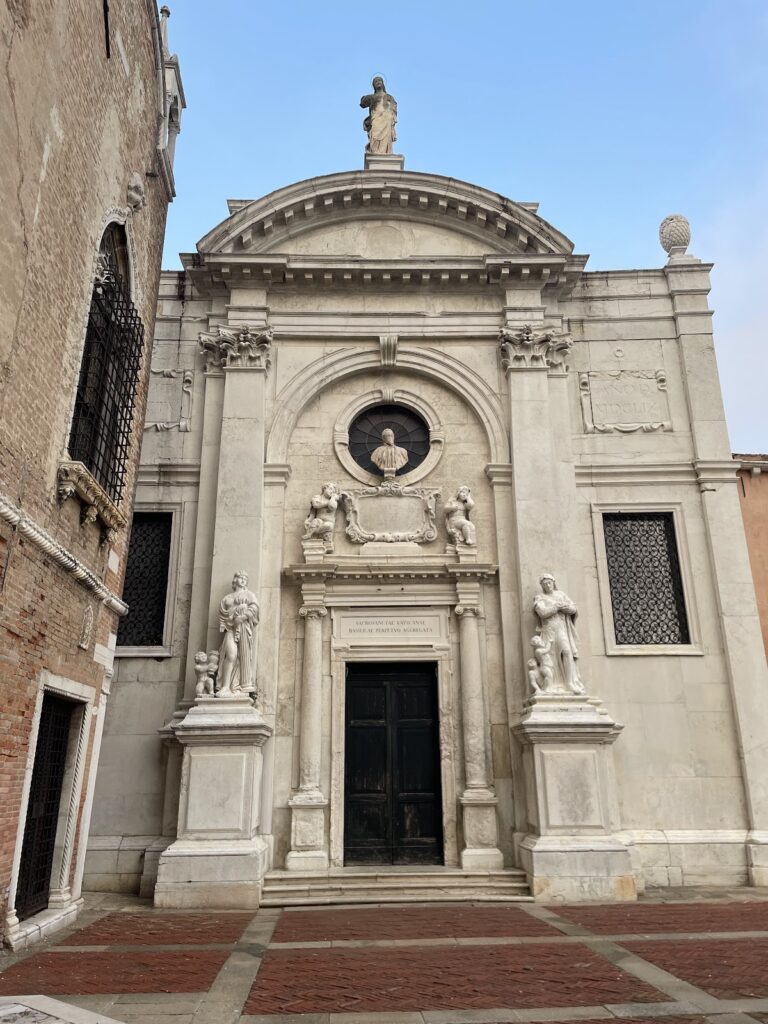
The Baroque façade designed by Domenico Rossi is divided into two orders. The wider lower order contains eight fluted columns with Corinthian-like capitals, raised on high mirrored pedestals. The four central columns project forward, giving emphasis to the entrance. Above them, the narrower upper order has four plain pilasters, broad volutes, and a large central window.
A broken, slightly offset pediment crowns the façade. Its marble group of the Assumption of Mary and angels was made by Giuseppe Torretti and is accompanied by adoring angels and putti. Eight statues above the main cornice and four more in the niches beside the portal represent the Twelve Apostles. The figures include Saint Mark, Saint Thomas, Saint James the Less, Saint Jude Thaddeus, Saint Philip, Saint Bartholomew, Saint Simon, Saint Andrew, Saint James the Greater, Saint Peter, Saint Paul, and Saint Matthew the Evangelist. Several sculptors contributed to the group, among them Paolo and Giuseppe Groppelli, Filippo Catasio, Francesco Bernardoni, Paolo Callalo, Francesco Cabianca, Pietro Baratta, and Antonio Tarsia.
Matteo Calderoni made the angels with thuribles on the broken pediment above the portal. A green-and-white marble drapery by Francesco Bonazza once stood before the central window but has been lost. The Manin family is recalled by coats of arms above the side niches and by an inscription on the portal architrave. The original portal, made from embossed and chased bronze sheet, is one of the few original portals to survive.
Campanile and Counter-Façade
The campanile is almost entirely the tower erected for the Crociferi church. Its eighteenth-century addition is the belfry, leaving a visible element of the earlier complex within the rebuilt church.
The counter-façade preserves the Da Lezze family funerary monument by Jacopo Sansovino, made in the mid-sixteenth century and transferred from the former Crociferi church to its original position in the rebuilt building. Its two orders contain four and eight columns, together with the sarcophagi and busts of Priamo Da Lezze, Andrea Da Lezze, and Giovanni Da Lezze. Alessandro Vittoria and Giulio del Moro made the busts. The monument is considered the earliest Venetian monument erected to celebrate a patrician family.
Plan and Nave
Latin-Cross Interior
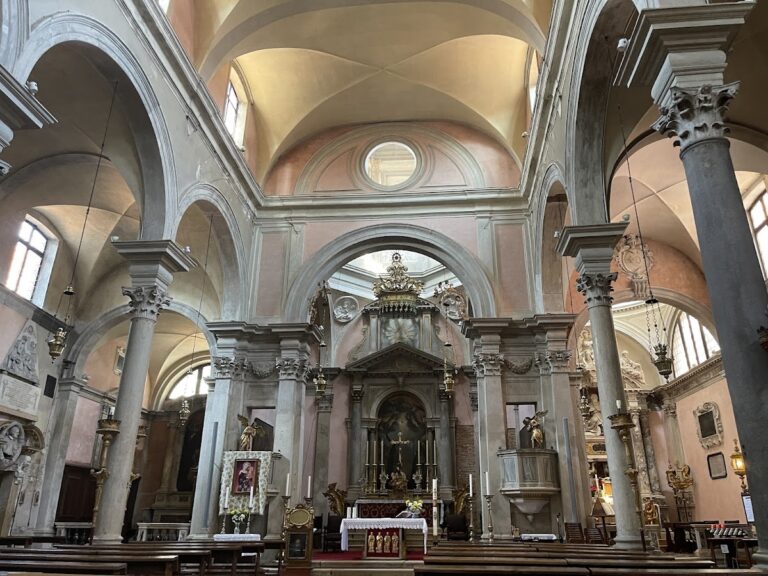
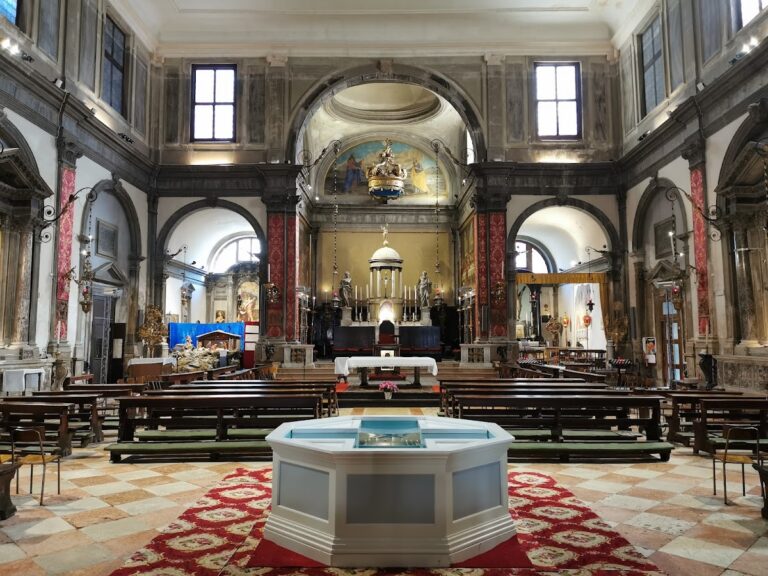
The church follows a Latin-cross plan typical of Jesuit churches. Three chapels line each side of the nave, while the flat-ended transept and presbytery are each flanked by two further chapels. Small rooms formerly used for confession separate the six nave chapels. Between the second and third chapels stands a pulpit by Francesco Bonazza, decorated with elaborate white and green stone draperies.
Along the corridor are the corretti, grilles through which convent guests could look into the church. Four pillars narrow the nave before the altar dedicated to the Holy Trinity and support the cross vault. White-and-green marble was applied to the pillars, walls, and floors between 1725 and 1731, giving the interior its distinctive patterned surface.
Nave Chapels
The first chapel on the left contains Titian’s Martyrdom of Saint Lawrence, painted between 1548 and 1559 and originally belonging to the former Crociferi church. The altar was used by the schola of the passamaneri. In Venetian church history, a schola was a devotional or occupational confraternity that could possess a chapel or altar and maintain its furnishings.
The second chapel on the left is dedicated to the Madonna and incorporates walls from the earlier Crociferi chapel. Its altar holds a Madonna and Child made before 1604 by Andrea dell’Aquila, the surviving element of that earlier chapel. The third left chapel, dedicated to the Sacred Heart, belonged to the schola of the Immaculate Conception. Its altarpiece is Alessandro Revera’s late-nineteenth-century copy of Pompeo Batoni’s Sacred Heart of Jesus. The former meeting place of the confraternity remains visible in the campo outside the church.
The first chapel on the right is dedicated to the Guardian Angel and belonged to the schola of the silk-cloth weavers, also called the samiteri. Palma the Younger’s late work, dated around 1619, depicts the Guardian Angel with angels carrying souls. The second right chapel is dedicated to Saint Barbara and belonged to the tailors’ schola, which had also possessed a chapel in the former Crociferi church. Giovanni Maria Morlaiter’s statue of Saint Barbara stands on the altar, while scissors, the confraternity’s emblem, are carved on the balustrade and lintels.
The third right chapel is dedicated to three Jesuit saints. Antonio Balestra’s altarpiece shows the Holy Spirit, the Virgin Mary, Saint Mark, and the Jesuit saints Stanislaus Kostka, Luigi Gonzaga, and Francis Borgia. Crowns placed on the ground represent the three saints’ renunciation of noble honors. Sculptures above the altar represent Humility, Charity, and the blessed rational soul.
Transepts, Presbytery, and Main Altar
Left Transept
The left transept contains a cantoria, a raised gallery or platform for singers or musicians, and the framing of an organ without a functioning instrument. Its altar of the Assumption of Mary was built in 1723 and 1724 by Giuseppe Pozzo for Paolo Querini Stampalia, a Procurator of Saint Mark, a senior Venetian republican official with administrative and financial responsibilities connected with Saint Mark’s Basilica and the state.
The altar was originally dedicated to Saint Francis Xavier and faced the Saint Ignatius altar in the right transept. Giuseppe Torretti made the fronton sculptures of Modesty, Virginity, and angels. The altarpiece is Jacopo Tintoretto’s youthful Assumption of the Virgin Mary, painted in 1555 and transferred from the destroyed Crociferi church. The Crociferi emblem remains at the center of the marble altar.
Central Transept and Presbytery
At the center of the transept, Ludovico Dorigny’s 1732 fresco, The Triumph of the Name of Jesus, is surrounded by marble statues of the archangels Michael, Gabriel, Raphael, and Selaphiel by Giuseppe Torretti. The presbytery contains Dorigny’s Angels Musicians in Glory, dated 1720, while Francesco Fontebasso painted Abraham Adoring the Three Angels and The Vision of Saint John the Evangelist on the nave ceiling in 1734.
Giuseppe Torretti created the presbytery’s marble figures of cherubim, angels, and archangels. A chapel altar bears Pietro Liberi’s Saint Francis Xavier Preaching in the East and was originally associated with the Zeno family, whose coat of arms remains at the center of the floor. The presbytery piers hold marble figures of the archangels Barachiel and Uriel with lamps, while further statues of Uriel and Barachiel stand in the presbytery area.
Main Altar
The main altar is dedicated to the Holy Trinity and was designed by Giuseppe Pozzo. A large baldachin, or canopy over the altar, has a white-and-green dome decorated with a scale pattern and supported by ten twisted columns of antique green marble. Above the lapis-lazuli-encrusted tabernacle is a marble group of God the Father and Christ seated on a globe, with the motto sufficit sola fide. Rays representing the Holy Spirit emerge beneath the dome.
The flat-ended apse contains The Death of Saint Joseph, attributed to the seventeenth-century Genoese painter Domenico Clavarino. Beside the sacristy door stands the tomb of Doge Pasquale Cicogna, begun by Girolamo Campagna in 1600. Its inscriptions recall the War of Candia, the plague at Padua, and famine suffered by the Venetian Republic.
Right Transept
The right transept was built in 1726 at the expense of Vettor Grimani, another Procurator of Saint Mark, with sculpture by Pietro Baratta. Its central statue of Saint Ignatius of Loyola displays the Constitutions of the Society of Jesus, while the pediment bears allegories of Faith and Charity.
Three bas-reliefs on the Saint Ignatius altar depict Ignatius giving clothing to a poor man, Ignatius at the monastery of Manresa in Catalonia, and his vision of La Storta near Rome. The right-transept organ is functional. Its gilded wooden case has three arched openings, and part of its relief decoration has been lost. The organ in the left transept is a symmetrical replica without a functioning instrument.
Sacristy and Painted Cycles
The sacristy contains a cycle by Jacopo Palma the Younger, including The Fall of the Manna, David Receiving the Showbread from the Priest Ahimelech, and Elijah Fed by the Angel, together with images of the Four Evangelists and the Four Doctors of the Church. Other paintings show Saint Helena, Saint Helena Finding the True Cross, The Martyrdom of Saint John the Baptist between Saint Lanfranc Beccari and Saint Liberius, and The Emperor Heraclius Returning the Cross to Calvary.
A further series depicts Saint Cyriacus of Jerusalem, Alexander III confirming the Crociferi and granting them their rule, Pope Pius II giving them a silver cross and blue habit, and Saint Lanfranc Beccari. The sacristy also contains The Bronze Serpent and a portrait of Pope Saint Cletus, both dated 1592 and 1593, along with paintings of Saint Cletus founding the Crociferi order and Saint Cyriacus reconfirming it.
Memorials and Religious Associations
The church contains a memorial to Prince Orazio Farnese of Parma, erected in 1676 at the request of the Senate to commemorate his conduct in the battle of the Dardanelles. Baldassarre Longhena designed the monument, and Giusto Le Court sculpted it. Together with the Da Lezze monument, the tomb of Pasquale Cicogna, and the many confraternity chapels, it preserves the institutional and devotional associations that shaped the church across several centuries.
Nearby sites