San Pietro Cathedral, Modica: A Baroque Mother Church in Italy


Site at a Glance
- Rating
- 4.7
- Popularity
- Medium
- Country
- Italy
- Primary era
- Early Modern
- External website
- Open
- Eras represented
- Early Modern, Modern
- Civilizations
- Habsburg, Kingdom of Sicily, Spanish
- Site type
- Religious
- Remains
- Church
On this page22 sections
History
San Pietro Cathedral, Modica, is a Roman Catholic church in Modica, Italy, dedicated to Saint Peter and serving as one of the city’s two mother churches. It stands in the lower town and belongs to the Diocese of Noto. A church existed on the site by the early fourteenth century, with its first construction placed approximately between 1301 and 1350. The place of worship was substantially completed or improved in 1504, before Modica’s later expansion and the rebuilding that followed the earthquake of 1693.
Medieval origins and collegiate status
San Pietro’s early history is connected with the growth of Modica’s lower town. From the sixteenth century, urban development extended into the ravine and increased the population of the lower area. San Pietro was enlarged during this period, while San Giorgio, the church associated with the Counts of Modica, developed as the other major ecclesiastical centre of the city.
The church became a collegiate church through a papal bull issued by Clement VIII on 2 January 1597. A collegiate church is served by a college of clergy rather than functioning solely as a parish church. The new status reinforced San Pietro’s claim to be Modica’s mother church, but it also intensified competition with San Giorgio. The two parish communities disputed their boundaries and precedence for many years.
The dispute with San Giorgio
The rivalry between the San Pietro and San Giorgio factions produced repeated confrontations. Boundary violations, clashes during processions, stone-throwing, collective beatings, mutual damage, insults, threats, and restrictions on religious activity brought the matter before both the Sicilian Consulta and the Roman Curia. A royal decree of Charles III of Bourbon, dated 16 September 1757, finally fixed the territorial boundaries and brought the dispute to an end.
San Pietro was also linked with the Congregation of Santa Maria Immacolata and with the subordinate or sacramental churches of Santissimo Salvatore, Santa Maria del Soccorso, and San Paolo Apostolo. The presbytery, the area around the main altar reserved especially for clergy, was under the patronage of Giovanni Enriquez de Cabrera in 1588. He served as governor-general and military captain of the County of Modica and of Avola and Spaccaforno.
Earthquake, rebuilding, and completion
Repeated earthquakes damaged San Pietro, and the earthquake of 1693 mostly destroyed the church. Reconstruction began around 1697 in the highly ornamental Sicilian Baroque style associated with the rebuilding of southeastern Sicilian towns after the late seventeenth-century earthquakes. The work was directed by the local master builders Rosario Boscarino of Modica and Mario Spada of Ragusa, and it continued until about 1780.
The rebuilding benefited from the substantial legacies of Petra Mazzara, her sister Francesca, and their brother Giuseppe Mazzara, a priest. Petra’s will of 1666 and the wider Mazzara family donations were especially important. King Philip IV also supported the church by surrendering to it the annual payment that the County of Modica had owed to the Spanish Royal Treasury.
The Chapel of the Immaculate Conception, dated to 1620 by an inscription on its dome, survived the earthquake and remains an element of the earlier church. It is now used as the sacristy. A procession dedicated to Saint Peter takes place on 29 June. San Pietro is included within the UNESCO World Heritage property “Late Baroque Towns of the Val di Noto,” inscribed in 2002 under criteria (i), (ii), (iv), and (v).
Later artistic and institutional history
The parish’s artistic heritage is presented in the Cappella Mazara, now a parish museum. Its holdings include chalices, monstrances, paintings, and statues, some dating from the sixteenth century. The monumental organ made by the Polizzi brothers was inaugurated in 1924, adding a twentieth-century feature to the church’s older architectural and artistic fabric.
Remains
Exterior approach and facade
Baroque facade
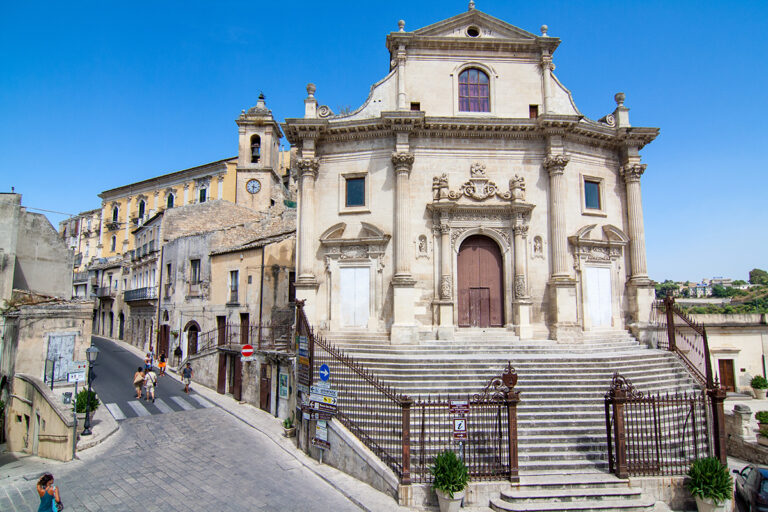
San Pietro has a richly ornamented facade arranged in two principal orders. Its pilasters use rusticated masonry, with the individual blocks emphasized at the bases and along the shafts. An upper cornice with an iron railing separates the two orders. The lower level contains three portals crowned by broken-arch pediments. The side portals have volutes and rectangular windows topped by crowns, while the central portal carries a coat of arms inscribed “Mater Ecclesia.”
The upper order contains a decorated window and statues of San Cataldo, the Immaculate Virgin, San Marziano, and Santa Cirilla. San Marziano is traditionally identified as a disciple of Saint Peter and the first bishop of Syracuse. A central frieze shows Christ in triumph within rays, above which are volutes, a sphere, and an iron cross. Saint Peter’s tiara and keys recur as decorative motifs associated with the church’s dedication.
Monumental stairway
Three flights of steps connect Corso Umberto I with the church forecourt. Statues of the twelve apostles stand on pedestals along the stairway and in the forecourt. Locally called santoni, meaning large saint statues, they represent Saint Thomas, Saint Matthew, Saint Matthias, Saint James son of Zebedee, Saint Bartholomew, Saint Philip, Saint Jude, Saint Simon, Saint Andrew, Saint Peter, Saint Paul, and Saint John. Salvatore Ammatuna and his pupil Pietro Petracolo made the figures, while the stairway ramps were completed in 1876.
Bell tower
The quadrangular bell tower is attached to the Chapel of the Blessed Sacrament. Its three levels belong to different periods, and the upper space was prepared for a dome. Four arches hold four bells of different construction. One of them, called Petra, is described together with its twin Ippolita in the bell tower of San Giorgio as the largest bell in Modica.
Nave, vault, and counterfacade
Central nave and ceiling cycle
The interior has three naves divided by fourteen columns with Corinthian capitals. Corinthian is a classical column order characterized by richly carved capitals. The floor, laid in 1864, combines white marble, polychrome marble, and black pitch in an inlaid design.
Frescoes cover the vault with scenes from the Old and New Testaments and sixteen medallions showing saints and doctors of the Church. Along the central axis are Faith, the Sacrifice of Abraham, Hope, Jacob’s Ladder, Charity, King David composing the Psalms, and Good Works. Gian Battista Ragazzi began the cycle around 1760 with the collaboration of his son Stefano, and the work was completed around 1780, probably by Stefano alone.
Organ and mausoleums
A choir loft supported by pillars occupies the counterfacade. It contains the monumental Polizzi organ, inaugurated in 1924, with 1,800 pipes, 35 stops, and two keyboards. The central portal is flanked by two mausoleums. One commemorates Giuseppe Campailla and dates from 1858; the other commemorates Carlo Interlandi and dates from 1797.
Right nave chapels
Chapels of the Souls, San Liborio, and San Nicola
The right nave is divided into seven bays. The first contains the Chapel of the Souls in Purgatory, whose altarpiece represents the Holy Trinity and the Souls in Purgatory. The next is the Chapel of San Liborio and San Leonardo. Its altarpiece shows San Liborio and San Leonardo of Porto Maurizio, and the chapel also contains a statue of San Biagio and Domenico La Bruna’s Adoration of the Magi, dated 1735.
The Chapel of San Nicola of Bari contains an altarpiece showing Saint Nicholas and the three generals. The seventeenth-century painting is by an unknown artist and was discovered in 2019. Its left altar holds a marble Madonna of Trapani, attributed to the fifteenth century and to Francesco Laurana.
Later chapels and sculptures
A lateral entrance occupies the fourth bay and is accompanied by Stefano Ragazzi’s 1767 painting of the Virgin with the Archangel Michael and Saint Francis of Paola. The Chapel of the Sacred Heart of Jesus has an altar and niche covered with elaborate stucco ornament, together with a sculptural group of the Sacred Heart and Saint Margaret Mary Alacoque.
The Chapel of San Pietro contains a wooden group of Saint Peter and the Paralytic. Benedetto Civiletti of Palermo carved the oak sculpture in 1893. The Chapel of the Holy Crucifix contains a wooden crucifix attributed to the nineteenth century and to Salvatore Ammatuna.
Left nave and Cappella Mazara
Chapels and devotional images
The left nave contains seven bays. They include the baptismal font, the Chapel of Madonna delle Grazie, a bay with the Mystical Marriage of Saint Catherine and the entrance to the Cappella Mazara, the Chapel of the Passion of Christ, the Chapel of the Relics, the Chapel of Santa Lucia, and the Chapel of San Giuseppe.
The first bay contains Valente Assenza’s painting of the Baptism of Jesus in the Jordan River. The Chapel of Madonna delle Grazie holds a nineteenth-century painting of Madonna delle Grazie and San Cataldo, attributed to Raimondo Zaccaria. The Mystical Marriage of Saint Catherine, attributed to the eighteenth century and to an unknown artist, came from the Church of San Domenico.
The Chapel of the Passion of Christ contains images of Jesus scourged at the column, the dead Christ, and Ecce Homo, dating from the eighteenth and nineteenth centuries. The Chapel of the Relics contains a silver reliquary urn from 1643. A reliquary is a container made to preserve or display relics. The urn’s four sides carry high-relief figures of the twelve apostles in niches framed by pilasters and caryatids, sculpted female figures used as architectural supports.
The Chapel of Santa Lucia contains an anonymous nineteenth-century papier-mache statue of the Syracusan martyr. The Chapel of San Giuseppe contains another anonymous nineteenth-century papier-mache statue.
Cappella Mazara
Beside the baptismal font, the Cappella Mazara contains four Baroque altars and serves as the parish museum. Its first altar holds a marble Madonna of Succour, also called Madonna of the Mace, made in 1507 in the Lombard school. The sculpture was transferred from the demolished Church of Santa Maria del Soccorso to the Church of the Holy Names of Jesus and Mary in the Jesuit College, and later to San Pietro.
The second altar contains the eighteenth-century Transit of Saint Joseph, attributed to the local Ragazzi school. The chapel also contains the burial of Giuseppe Mazzara, who died in 1639. He was a priest, patron, financier, administrator, and procurator of the chapel.
The third altar contains the eighteenth-century painting Jesus Giving the Keys of Paradise to Saint Peter, by an unknown artist. Francesca Mazzara, who died in 1635, is buried there. She was the wife of Francesco Echebelz, a Knight Hospitaller who held several administrative offices in the County of Modica.
The fourth altar forms a reliquary shrine containing the burial of Petra Mazzara, who died in 1666. A commemorative plaque on the right pillar of the third chapel identifies her burial.
Apse and sacristy
Apse sculpture and paintings
The concave apse is articulated by Doric columns with Corinthian capitals and a richly ornamented cornice. Doric and Corinthian are classical column orders, here combined within the apse design. A large central aedicule, a framed architectural shrine, is flanked by two slightly offset niches.
The central group consists of a polychrome wooden statue of the Immaculate Virgin with Saints Peter and Paul at her sides. Pietro Padula made all three sculptures between 1773 and 1775. Two large paintings complete the apse arrangement: the Miraculous Catch on the left and the Crucifixion of Saint Peter on the right, both by Valente Assenza.
Sacristy
The former Chapel of the Immaculate Conception now serves as the sacristy. Its 1620 date survives in an inscription on the dome. The room contains twentieth-century portraits of the prelates Antonino Morana and Blandino by Enrico Maltese, as well as a Crucifixion by the canon Orazio Spadaro.