San Michele: A Parish Church in Piantonia, Italy
Site at a Glance
- Popularity
- Very Low
- Country
- Italy
- Primary era
- Early Modern
- Eras represented
- Early Modern, Modern
- Civilizations
- Duchy of Parma and Piacenza, Italian
- Site type
- Religious
- Remains
- Church
On this page11 sections
History
San Michele is a Roman Catholic parish church in Piantonia, a hamlet of Fornovo di Taro in the Province of Parma, Italy. The church originated in the Middle Ages and has Baroque forms. Its original site at Pianello lay beside a branch of the Monte Bardone route, used by pilgrims travelling from northern Europe to Rome.
Medieval church and changing jurisdiction
The church’s earliest known mention is from 1230, when it appeared as Ecclesie S. Michaelis de Rochetta in the Diocese of Parma’s register of tithes. It depended on the nearby Monastery of Rocchetta, which was subordinate to the Benedictine Chaise-Dieu Abbey in France. The church nevertheless lay within the territory administered by the parish church of Fornovo.
Around 1520, jurisdiction passed to the Abbey of St John the Evangelist in Parma. In 1558, people from Piantonia rebuilt the church in the village centre in thanksgiving for surviving a plague. It became an independent parish in 1564.
Landslides and rebuilding
A landslide damaged the church in 1683, and repairs were finished two years later. After heavy rain triggered renewed movement in 1894, the slide damaged several buildings in Piantonia by the following year. It also brought down the apse’s semi-dome and left the bell tower leaning. The landslide gained force again in 1900 and struck the church. Five of its seven side chapels were later demolished.
Ground movement continued at a slower pace. In 1920, work to stabilize the slope below the hamlet focused in particular on the church. Another landslide in 1957 caused further damage, and renovation followed. The work, which included rebuilding the bell tower, was completed in 1961. Dedicated to Saint Michael, the church now serves as a parish in the Diocese of Parma’s Pedemontana area, a regional grouping of parishes.
Remains
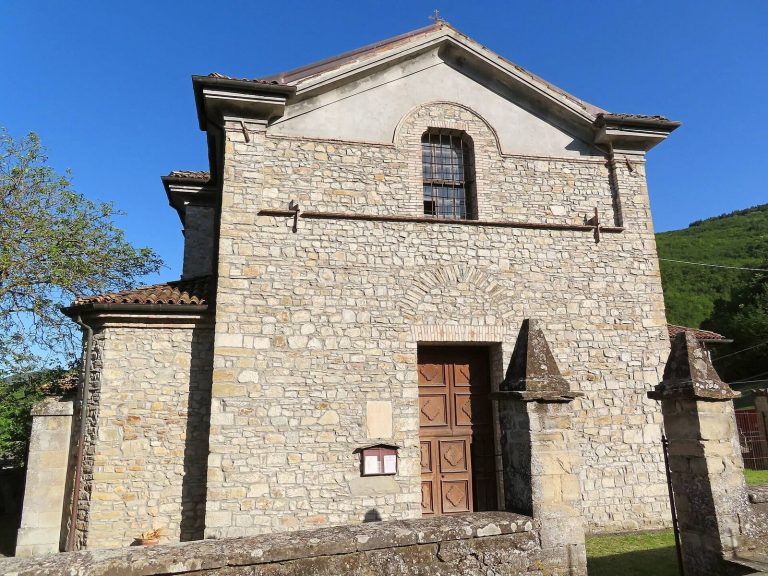
The church has Baroque forms and a single-nave plan, with its entrance at the west end and its apsidal presbytery at the east. A chapel and a large niche occupy each side of the nave.
Exterior
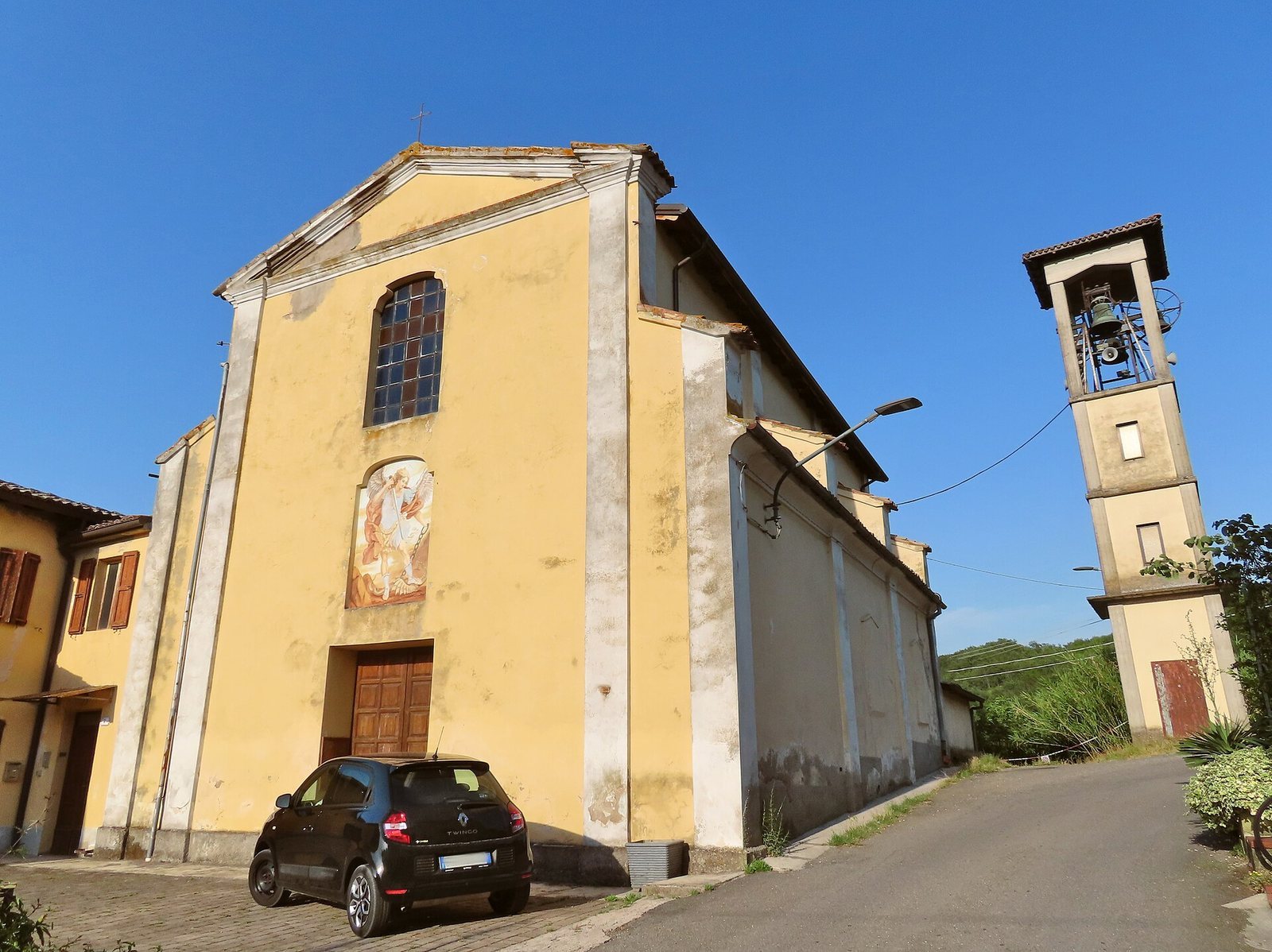
The plastered west façade is symmetrical, with four pilasters dividing it into three sections. Its broad central doorway is topped by a panel with a shallow-curved arch and a painting of Saint Michael. Above that is a window with an arch combining straight and curved lines. A triangular pediment with raised moulding crowns the façade. Buttresses project along the exposed right side. Behind the church stands an isolated, three-stage bell tower of exposed reinforced concrete. Its belfry, the part that houses the bells, is open on all four sides.
Interior
Nave
The nave, the church’s main interior space, has a ceiling formed by two sloping planes supported on wooden joists. Pilasters, shallow column-like features attached to the walls, divide its interior surfaces. Broad round arches open into the side chapels.
Presbytery
The slightly raised presbytery, the area around the altar, is entered beneath a tall round arch of exposed brick. Brick pilasters articulate its walls, and its ceiling also has two sloping planes. A canopy dating to the nineteenth century hangs from the ceiling. At the centre stands a wooden, table-form high altar added between 1970 and 1980. Behind it is an older high altar from about 1720 to 1730. The presbytery ends in an apse, a recess at the church’s east end.
Artworks and liturgical objects
Paintings and sculpture
An eighteenth-century altarpiece at the centre of the apse depicts Saint Michael defeating the devil. In the left chapel is an oil painting of the Baptism of Christ by Giuseppe Peroni, made after 1770. Other paintings include the Madonna and Child with Saints Benedict and Charles Borromeo, and the Eucharist adored by Saints Clare, Blaise, Donnino, and Apollonia. Both are probably by Giovanbattista Zanolini and date to the late sixteenth or early seventeenth century. The church also preserves a wooden Madonna and Child statue from the late eighteenth century.
Liturgical objects
A small, throne-like stand used for Eucharistic exposition dates to about 1750. The church also preserves a thurible dated 1839 and other objects used in worship.