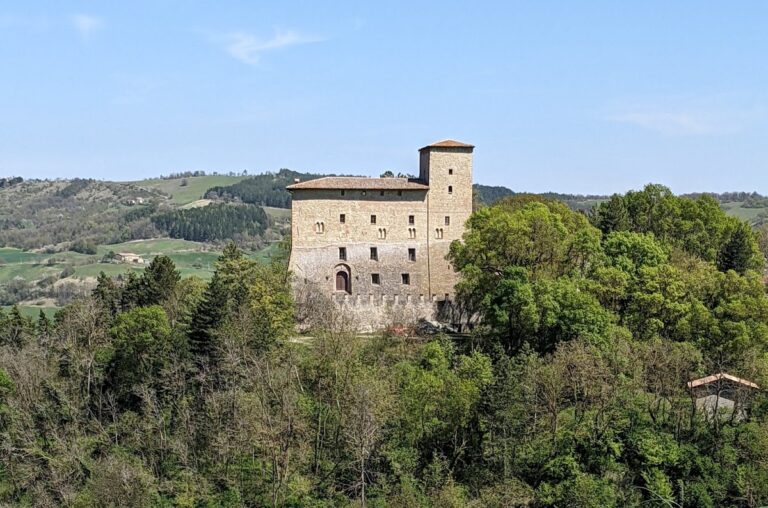
Castle of Roccalanzona: A Medieval Hilltop Fortress in Italy


Site at a Glance
- Rating
- 4.2
- Popularity
- Very Low
- Country
- Italy
- Primary era
- Medieval
- Eras represented
- Medieval
- Civilizations
- Holy Roman Empire
- Site type
- Military
- Remains
- Castle
On this page9 sections
History
The Castle of Roccalanzona is a medieval hilltop fortress in Italy, probably built around the tenth century on the summit of a rocky spur. Its first known documentary mention dates to 1028, when it was listed among the possessions of Hildegard, wife of the Lombard nobleman Odone. The Lombards were a Germanic people who ruled much of Italy during the early medieval period. Hildegard’s holdings were sold to the rector of San Pietro in Paderna, a rector being an official responsible for administering a church or religious institution.
Early records and monastic ownership
The 1028 description, “Rocha Petraluizoni cum portione castro et Capella seu tutti ibi habente,” may indicate that a place of worship stood near the castle. That chapel was demolished in 1739. In 1043, the lands connected with Roccalanzona, including the settlements of Vianino and Viazzano, were donated to the monastery of San Savino in Piacenza.
Rossi, Pallavicino, and Varano rivalries
Control of the castle was later disputed for a long period by the Pallavicino family and the Vinciguerra family of Varano de’ Melegari. In 1418, Giacomo de’ Rossi, then bishop of Verona and archbishop of Naples, left both rival families a monetary bequest in his will so that Roccalanzona would be assigned to the Rossi.
The castle consequently became a fief of Pier Maria I de’ Rossi. A fief was a territory held by a noble in return for obligations to a superior ruler. Pier Maria called the stronghold “Rocha Leone,” apparently alluding to the rampant lion on the Rossi family coat of arms.
War with the Sforza
In 1464, Pier Maria II de’ Rossi assigned Roccalanzona to his son Guido in his will, although Guido never exercised lordship over it. After Pier Maria II died in 1482 during the conflict between the Rossi and the Sforza, Guido commanded the Rossi garrisons while many of the family’s fortresses were under siege.
Niccolò Pallavicino, an ally of the Sforza, launched the first assault on Roccalanzona. When it failed, Sforza Secondo Sforza attacked after defeating the defenders of the nearby Castle of Carona. His forces used bombards, large early guns designed for siege warfare, but still failed to capture the fortress. They withdrew after burning several houses in the settlement as a reprisal.
Following Guido de’ Rossi’s definitive defeat, the castle submitted to his brother and rival Bertrando de’ Rossi, count of Berceto. Bertrando died without heirs in 1502, and his fiefs passed to his nephew Troilo I de’ Rossi. Roccalanzona was then incorporated into the territories of the Rossi of San Secondo.
Confiscation and decline
In 1635, Odoardo I Farnese, duke of Parma, banished Marquis Troilo IV de’ Rossi from the state and confiscated his lands. In 1657, Troilo’s brother Scipione I de’ Rossi, assisted by Philip IV of Spain, persuaded Duke Ranuccio II Farnese to annul the decree, although the settlement left Scipione heavily indebted.
Scipione was forced in 1666 to cede Roccalanzona and the other Apennine fiefs to the ducal administration of Parma, the governing and estate-management apparatus of the duchy. The castle was already ruinous, with its interior walls deteriorating. In 1692, the administration transferred it to the Ercolani della Rocca family of Senigallia. The family did not restore the fortress, and by 1804 it had declined to a few ruins.
The castle was depicted in 1463, during the period identified as its greatest splendour, by Benedetto Bembo in the Camera d’Oro of Torrechiara Castle. The Camera d’Oro is a decorated chamber at Torrechiara, and Bembo was a fifteenth-century Italian painter.
Remains
Fortified summit
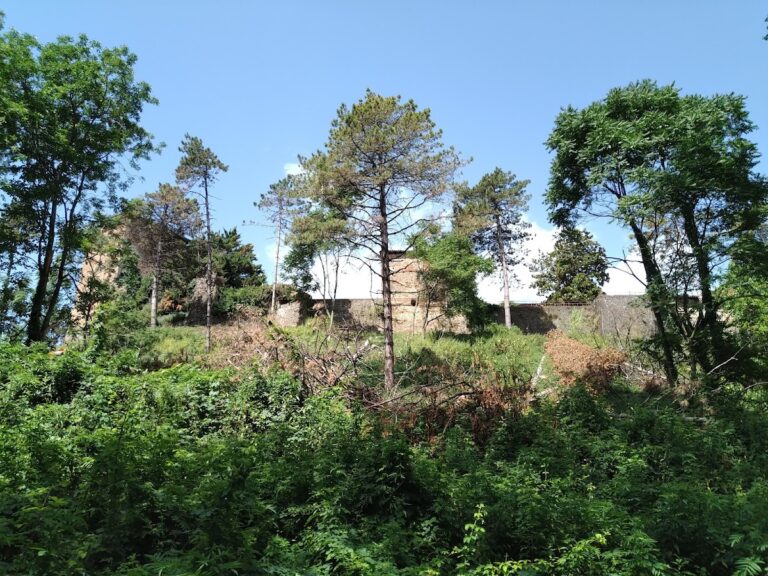
The abandoned ruins occupy the summit of an ophiolitic rocky spur at the boundary between the Ceno Valley and the Dordone Valley, near Roccalanzona, at an elevation of about 444 metres. Ophiolite is rock formed from material originating in oceanic crust and the upper mantle. The fortress originally covered considerable dimensions, and its surviving remains are scattered across a relatively extensive area.
Keep and defensive walls
The principal surviving feature is the base and remains of a large rectangular keep, the main fortified tower of a medieval castle. The bases of the former walls extend from the keep and contain numerous loopholes, narrow openings that allowed defenders to fire while protected behind the masonry.
Vaulted interior room
A partially intact interior room survives with a vaulted ceiling. It opens outward through a crossbow loophole, a narrow wall opening through which defenders could fire crossbows from a protected position.
Nearby sites