San Martino: A Carmelite Basilica in Bologna


Site at a Glance
- Rating
- 4.6
- Popularity
- Low
- Country
- Italy
- Primary era
- Medieval
- External website
- Open
- Eras represented
- Medieval, Early Modern, Modern
- Civilizations
- Italian, Papal States
- Site type
- Religious
- Remains
- Basilica
On this page22 sections
History
San Martino, also known as Basilica di San Martino Maggiore, is a Roman Catholic parish church in Bologna, Italy. Founded in 1227, it developed through Gothic, Renaissance, and Baroque phases and remains associated with the Carmelite order, whose spirituality is linked to Mount Carmel and devotion to the Virgin of Mount Carmel.
Foundation and Carmelite Administration
The church was granted to the Carmelite monks in 1293. Construction of the present building is also described as beginning in the first half of the fourteenth century. The church underwent repeated modifications between the fourteenth and sixteenth centuries, creating a complex structure in which later interventions stand alongside elements of the earlier building.
The artistic furnishings reflect this long development. Works dating from the fourteenth through the eighteenth centuries preserve successive stages of the church’s history, while the Chapel of the Madonna del Carmine expresses its Carmelite identity through scenes connected with devotion to the Virgin of Mount Carmel.
Gothic and Renaissance Transformations
The brick tracery vaults were added in 1457, reinforcing the Gothic character of the interior. Renaissance additions followed, including the Boncompagni portal and a series of chapels and paintings commissioned during the fifteenth and sixteenth centuries. The former polygonal apse was reduced to a square form in 1929, another alteration to the building’s historic fabric.
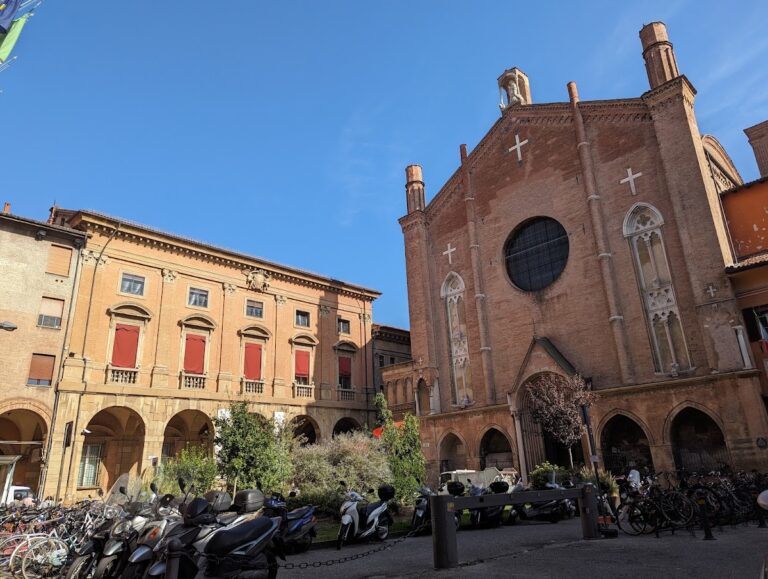
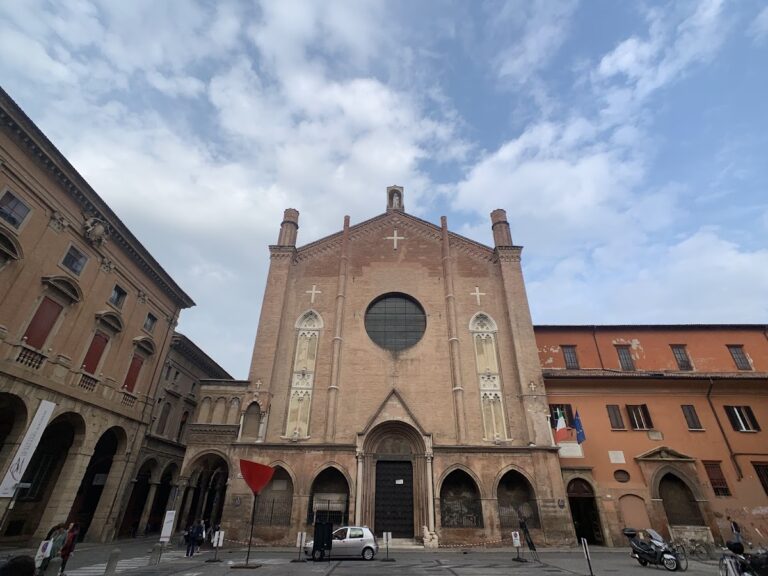
In 1879, the facade was completely remade to designs by Giuseppe Modonesi in a Gothic style. The work gave the exterior its present appearance while the older right-side portal survived as an earlier architectural element.
Devotion and Modern Status
Devotion to the Virgin of Mount Carmel has remained central to San Martino’s religious identity. Pope Clement XI crowned the venerated image on 10 August 1704. The associated statue of the Virgin and Child with a Scapular, a devotional badge associated with Carmelite practice, was made by Andrea Ferreri in 1705 and stands in the piazza directly before the church.
In August 1941, Pope Pius XII elevated San Martino to the status of a minor basilica. This is a special papal honor granted to a church because of its religious, historical, or devotional importance, distinct from the larger category of major basilicas.
The Carmelite convent’s former cemetery survives as the Cloister of the Dead, built in 1511 to designs by Giovanni da Brensa. The old bell tower was rebuilt in its upper section during the eighteenth century. Its clock later ceased to function, although the mechanism remains inside the tower. Full electrification of the bells in the 1960s ended the traditional manual double ringing at the church, while other forms of bell ringing continued.
A concert of four bells was cast in 1949 by the Bolognese founder Cesare Brighenti. Traditional bell ringers continued to take part in major festivals on the bell towers of Bologna and the archdiocese.
Remains
Church Layout and Medieval Fabric
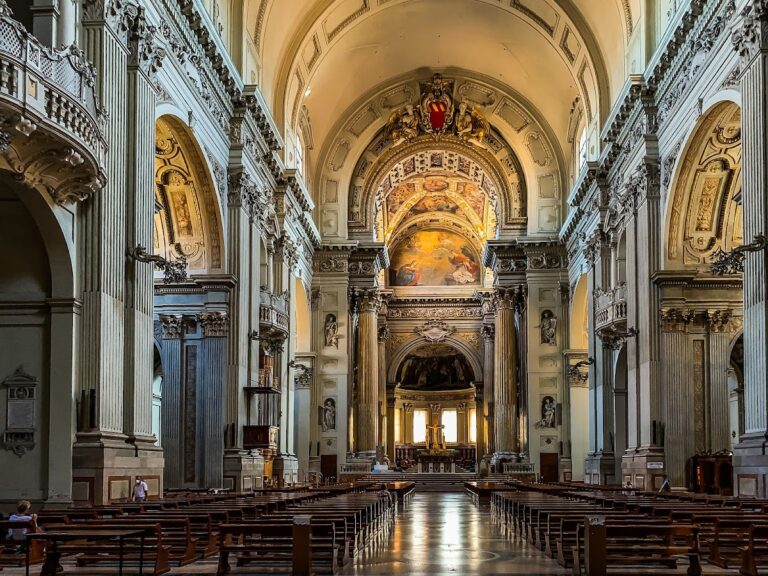
The basilica has a Gothic interior organized into three naves. Pilasters and pointed arches divide the space, while ribbed cross vaults cover it above. The dominant character is Gothic, though Renaissance and Baroque interventions are integrated into the building and its furnishings.
Facade and Boncompagni Portal
The present facade dates from 1879 and is decorated with statues of various saints. On the right side, the older Boncompagni portal retains classical decoration with bucrania, sculpted ox skulls used as an architectural motif. Its lunette, the semicircular field above the doorway, contains Francesco Manzini’s 1531 bas-relief of Saint Martin on horseback giving half his cloak to a beggar.
Apse and Choir
The square apse contains Girolamo Siciolante da Sermoneta’s 1548 painting of the Madonna and Child with saints and the donor Matteo Malvezzi. Formigine made the monumental frame in 1554. The choir houses an old organ built by Giovanni Cipri in 1556. The instrument is set in a wooden case made by Giacomo Marcoaldi and was restored by Franz Zanin of Camino al Tagliamento.
Left Nave and Chapels
First Left Chapel
The first chapel on the left was built by Giovanni da Brensa in 1506 and uses Tuscan architectural forms. Its altar has Francesco Francia’s Madonna and Child with Saints, together with a lower predella panel showing Christ and a crowning Pieta. Amico Aspertini painted the monochrome altar frontal with the Deposition.
Uccello Fragments and Carmelite Imagery
Fragments of Paolo Uccello’s Adoration of the Child, dated 1437, are preserved on the left side of the church. They were accidentally found in the sacristy and placed in the chapel after restoration. Nearby stands a terracotta Madonna of Mount Carmel by Jacopo della Quercia, set on a small pedestal, while Alessandro Guardassoni painted a fresco of the Prophet Elijah.
Later Left Chapels
The third chapel on the left contains Bartolomeo Cesi’s Crucifixion with Saints. The fourth holds Ludovico Carracci’s Saint Jerome, dated 1591. The fifth contains Lorenzo Costa’s altarpiece of the Assumption, dated 1506.
Former Fourteenth-Century Church
Further along the left nave are remains of the former fourteenth-century church. They include an Immaculate Madonna by Simone dei Crocifissi and fragmentary frescoes by Vitale da Bologna. The frescoes show Abraham receiving the blessed beneath his mantle, along with groups of the damned and the apostles.
Baptistery and Sacristy Entrances
The left nave ends in the Baptistery Chapel, which contains two Romanesque columns and an early fifteenth-century triptych from the Bolognese school. Nearby are the entrance to the sacristy and the entrance to the bell tower. The sacristy contains important seventeenth-century paintings and once held a small section of Paolo Uccello’s Nativity fresco. The original composition extended across the entire side of the room before later reconstructions destroyed it.
Right Nave and Chapels
First Right Chapel
The first chapel on the right is richly decorated with capitals, pilasters, and a balustrade by Bernardino da Milano. Its altarpiece is Girolamo da Carpi’s Adoration of the Magi, dated 1532.
Fourth Right Chapel
The fourth chapel contains Lippo Dalmasio’s fresco of the Madonna and Child. On the pilaster towards the next chapel is a fragmentary Crucifixion attributed to Vitale da Bologna. A nearby stone column carries fifteenth-century frescoes by Lippo Dalmasio depicting Saint Anthony, Saint Onofrius, and Elijah.
Fifth Right Chapel
The fifth chapel contains Amico Aspertini’s Madonna and Child with Saints, dated approximately 1510 to 1515. The work is described as one of the artist’s most accomplished paintings.
Chapel of the Madonna del Carmine
The terminal chapel of the right nave was richly decorated in Baroque forms to designs by Alfonso Torreggiani in 1773. Vittorio Bigari painted its small dome with the Virgin of Mount Carmel giving the scapular to Saint Simon Stock, a Carmelite religious figure traditionally associated with the devotion.
The chapel also contains a wooden Madonna and Child by Guglielmo Bergognone, colored by Guercino. Giovan Giacomo Sementi’s Martyrdom of Saint Ursula occupies the right wall, while Alessandro Tiarini’s Saint Charles and Other Saints is on the left wall. A transferred statue of Saint Mary Magdalene de Pazzi from the Carmelite monastery of Santa Maria in Florence is also kept in the church.
Campanile and Cloister
Bell Tower
The campanile, or bell tower, rises on the basilica’s left side above the cloister. It is a plain tower approximately 40 metres high, capped by a simple four-pitched roof. Its west wall, facing Piazza San Martino, retains traces of a former clock face below the belfry, the section of the tower where the bells are housed.
The tower’s stairway is entirely wooden and in precarious condition. Single openings with semicircular arches light the belfry. Four bells cast by Cesare Brighenti in 1949 remain there, tuned to A-flat major and sounding A-flat3, B-flat3, C4, and E-flat4.
Cloister of the Dead
The Cloister of the Dead is a four-sided enclosure formed by arcaded galleries around an open courtyard. Built in 1511 as the cemetery of the Carmelite convent, it was designed by Giovanni da Brensa. In the piazza directly in front of the church, Andrea Ferreri’s 1705 statue of the Madonna and Child with a Scapular stands on a pillar, extending the basilica’s Carmelite devotional imagery into the surrounding space.