San Lorenzo in Panisperna: A Roman Catholic Titular Church in Rome


Site at a Glance
- Rating
- 4.7
- Popularity
- Very Low
- Country
- Italy
- Primary era
- Early Modern
- Eras represented
- Medieval, Early Modern
- Civilizations
- Papal States
- Site type
- Religious
- Remains
- Church
On this page20 sections
History
San Lorenzo in Panisperna is a Roman Catholic titular church on Via Panisperna in Rome, Italy, dedicated to Saint Lawrence. It also serves as the rectoral church of the parish of Santi Vitale e Compagni Martiri in Fovea and as a station church for the Thursday of the first week of Lent. Tradition places the first church here in the fourth century, during the reign of Emperor Constantine I, about a century after Saint Lawrence, a Christian deacon martyred in Rome in 258. The site is traditionally identified as the place of his martyrdom, although another tradition locates it on the Via Tiburtina.
Early Church and Medieval Communities
The Liber Pontificalis, a collection of papal biographies, associates a restoration of the church with the pontificate of Pope Hadrian I in the eighth century. Medieval inventories called it San Lorenzo in Formoso, a name referring to Pope Formosus, who is also credited with erecting the first church firmly associated with the site. Pope Boniface VIII rebuilt and reconsecrated the church in 1300, adding an abbey to the complex.
The Poor Clares, the female branch of the Franciscan tradition founded by Saint Clare of Assisi, entered the complex in 1308. The institution also passed through a Benedictine phase in 1451, involving members of the monastic order founded on the Rule of Saint Benedict, before returning to a later Poor Clare phase. The convent maintained a close relationship with Saint Bridget of Sweden. Funeral ceremonies for Bridget were held here after her death, and although her body was later taken to Sweden, the Poor Clares retained her prayer book, mantle, and one hand.
Rebuilding and Changing Names
The church’s title of San Lorenzo in Panisperna was established by Pope Leo X on 6 July 1517 for a cardinal-priest. A titular church is assigned to a cardinal as the symbolic seat of his title, and San Lorenzo in Panisperna remains a titular church. Its current titular cardinal is Michael Michai Kitbunchu, a Thai cardinal and archbishop emeritus of Bangkok.
The present building resulted from a rebuilding commissioned by Pope Gregory XIII and directed by Carlo Rainaldi in 1575 and 1576. Rainaldi was a leading Roman architect of the seventeenth century. During this work the church became known as San Lorenzo in Panisperna rather than San Lorenzo in Formoso. The origin of the newer name remains uncertain. One tradition connects it with the Poor Clares’ distribution of bread and ham on Saint Lawrence’s feast day, 10 August, recalling his distribution of church wealth to the poor. Other explanations derive it from two local families, Pane and Perna, or from the term “Parasperna,” interpreted as referring either to a church hidden among convent vineyards or to a boundary between important properties. The street Via Panisperna takes its name from the church.
Later Alterations and Religious Continuity
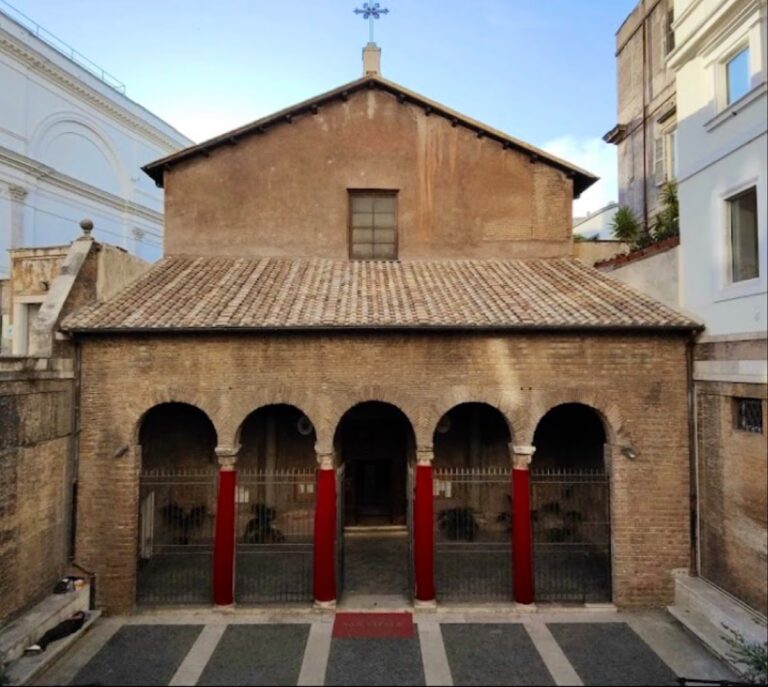
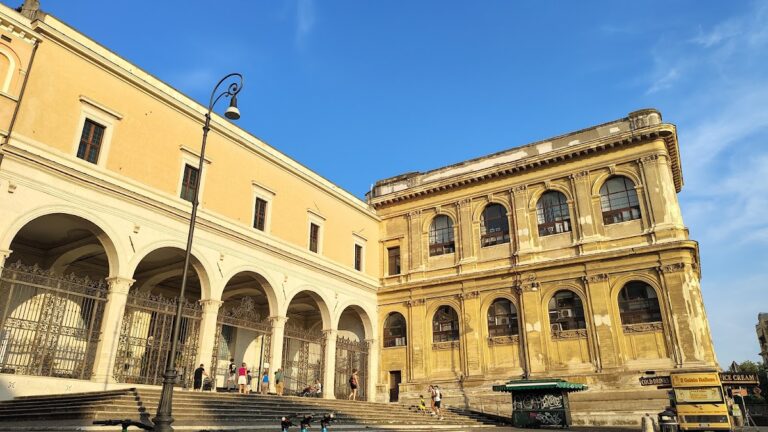
A new gate on the Via Panisperna side was added in 1754, when the interior underwent substantial restoration. Road works lowered the street level in front of the convent and made a new staircase necessary. The entrance and staircase were restored or renewed under Pope Leo XIII in 1893. An outer portico had been added in the seventeenth century and was restored and decorated in 1893 and 1894.
Pope Leo XIII had been ordained bishop in this church in 1843. The Poor Clares were expelled in February 1872 during confiscations carried out by the new Italian government, but returned in 1896 through the efforts of Cardinal Jacopo Colonna, who also restored the church and convent. Franciscans now serve the church. A modern statue of Saint Bridget of Sweden stands in the tree-lined courtyard in front of the building.
Remains
San Lorenzo in Panisperna combines a two-storey late-sixteenth-century facade with a single-nave interior containing six side chapels. The approach consists of two ramps leading to the entrance gate and courtyard, while the surviving portico, bell tower, medieval house, chapels, paintings, and devotional objects preserve successive stages of the complex’s history.
Entrance and Exterior
The entrance gate opens toward the courtyard from Via Panisperna. Its pediment bears the coat of arms of Pope Leo XIII. The square bell tower is built of red brick, with two round openings on each side separated by a stone pillar. The two-storey facade was constructed in 1575 and 1576, although its present appearance reflects the restoration of 1893.
The lower storey has four Doric pilasters supporting an entablature and a large entrance framed by narrow pilasters and a pediment. The tympanum contains a winged putto head with festoons and ribbons. The wooden entrance doors have carved panels and are considered a design by Carlo Rainaldi. The two central upper panels were replaced in 1893 and depict Saint Lawrence and Saint Francis.
Four Ionic pilasters on pedestals organize the upper storey. They support an upper entablature and a small triangular pediment above the inner pair. A framed round window occupies the centre. Above it, a dedication plaque reads “Divi Laurentii M[arty]ris aedes inpanis perna MDLXXIIII.”
Nave and High Altar
Nave
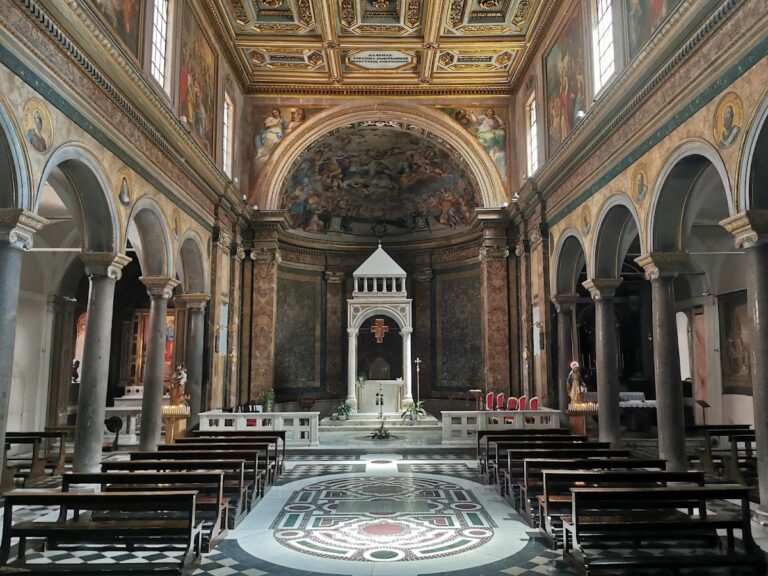
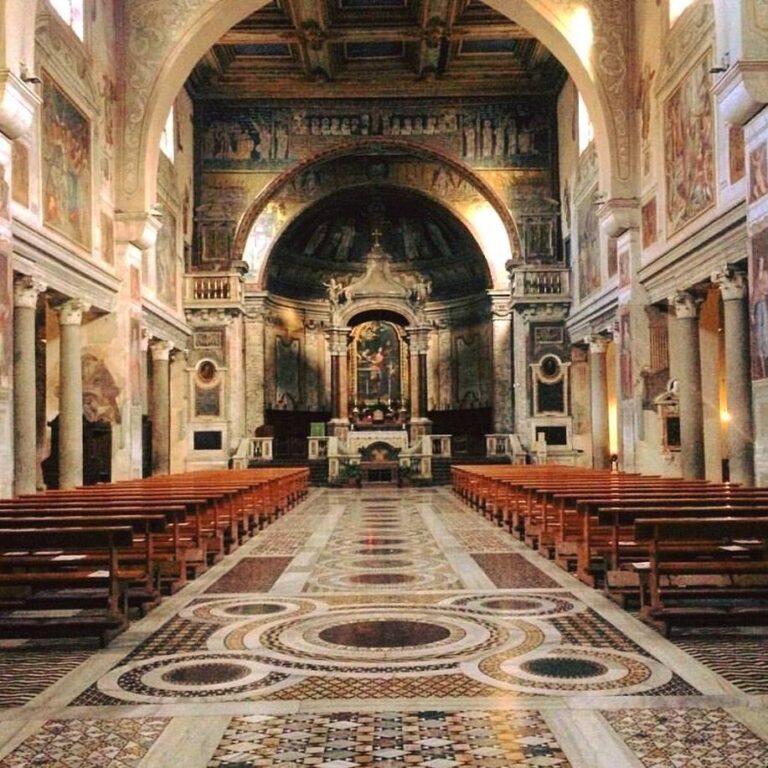
The church has one main nave with three side chapels on either side. Its interior form dates chiefly from the eighteenth century. Broad piers separate the chapels, and each pier carries a shallow Corinthian pilaster supporting an internal entablature with a frieze. Above the nave is a barrel vault, with a semicircular window lunette over each chapel. Antonio Bicchierai painted the large central ceiling fresco, the Apotheosis or Glory of Saint Lawrence, around 1700.
Presbytery
The square-plan presbytery, the area reserved for the high altar and clergy, has a rear-wall fresco of the Martyrdom of Saint Lawrence. Pasquale Cati painted it between 1585 and 1591, and it serves as the reredos, or painted work positioned behind an altar, for the high altar. The altar also has a fourteenth-century crucifix.
Right-Hand Chapels
Chapel of Saint Clare
The first chapel on the right is dedicated to Saint Clare. Its 1756 altarpiece, the Miracle of Saint Clare, was painted by Antonio Nessi. The altar also contains a small copy of the image of Our Lady of Pompeii.
Chapel of Saints Crispin and Crispinian
The second chapel is dedicated to the martyr brothers Saints Crispin and Crispinian, patrons of shoemakers. Its altar image shows the two saints receiving martyr’s crowns from angels. The chapel also contains their tomb and a painting attributed to Giovanni Francesco Romano.
Chapel of the Immaculate Conception
The last chapel on the right contains Giuseppe Ranucci’s 1757 altarpiece of the Immaculate Conception.
Left-Hand Chapels
Chapel of Saint Francis
The first chapel on the left is dedicated to Saint Francis of Assisi. Its altarpiece depicts the Stigmata of Saint Francis and is by Niccolò Lapiccola. A small altar painting shows Saint Lucy holding a vessel containing her removed eyes.
Chapel of Saint Bridget
The second chapel is the Chapel of Saint Bridget. Bridget was buried there before her body was translated to Sweden, and a later martyr named Victoria is interred beneath the chapel altar. Its 1757 altarpiece, Saint Bridget Praying before the Crucifix, was painted by Giuseppe Montesanti.
Chapel of Calvary
The last chapel on the left contains an eighteenth-century altarpiece depicting Calvary and an eighteenth-century Roman-school crucifix.
Portico and Medieval House
Chapel with the Traditional Martyrdom Oven
Under the portico is a chapel containing an oven traditionally believed to have been used in Saint Lawrence’s martyrdom, when he was burned on a gridiron. The feature preserves the local physical association between the church and the saint’s traditional place of death.
Medieval House
A medieval house survives beside the church. It has an exterior staircase and is described as one of the few preserved examples of this type of house in Rome.