Palazzo Koch: Headquarters of the Bank of Italy in Rome


Site at a Glance
- Rating
- 4.7
- Popularity
- Very Low
- Country
- Italy
- Primary era
- Modern
- External website
- Open
- Eras represented
- Modern
- Civilizations
- Italian
- Site type
- Civic
- Remains
- Palace
On this page15 sections
History
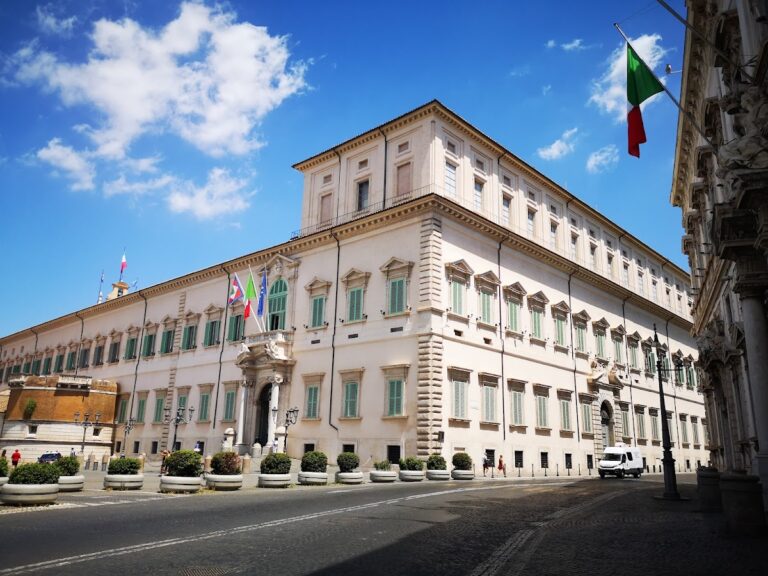
Palazzo Koch is a banking palace in Rome, Italy, built for the National Bank of the Kingdom of Italy, predecessor of the Bank of Italy, in the late nineteenth-century Renaissance Revival and Baroque tradition. Its foundation stone was laid in 1888, construction ended in 1892, and the building opened in 1893. Located on Via Nazionale, a major thoroughfare created during the development of Rome as the capital of the Kingdom of Italy, the palace gave architectural expression to the public standing of the banking institution.
From Florence to Rome
After the bank moved its headquarters from Florence to Rome in 1873, it used the Palazzo Lazzaroni as a temporary base for more than two decades. In 1882, a competition was held for a permanent headquarters. The design by Gaetano Koch, a prominent Italian architect of the second half of the nineteenth century, was chosen over Pio Piacentini’s proposal. Koch’s plan was preferred for its rational arrangement of the interior, although its exterior was initially criticised as insufficiently monumental.
The completed palace housed the bank’s general management, its Rome branch, and its banknote-printing facility. Its position on Via Nazionale connected the new financial headquarters with the large-scale architectural transformation of post-unification Rome. As the Bank of Italy required more space, some services moved first into adjoining buildings and later into premises farther away. Palazzo Koch nevertheless remains the address of the bank’s central administration.
Archaeology and later history
Excavation for the foundations brought earlier Roman remains to light. These included residential structures and a sanctuary from the period of the emperor Domitian, dedicated to Silvanus, a Roman deity associated with woodland, agriculture, and rural life. A statue of Antinous, a young Greek favourite of the emperor Hadrian whose image became an important subject in Roman imperial art, was also found. The statue was incorporated into the palace’s second courtyard.
During Benito Mussolini’s regime, Italy’s Fascist dictator from 1922 to 1943, the palace’s iron railings were removed so that the metal could be used in arms production. The railings were restored to their original design in the late 1960s. Palazzo Koch is an Italian cultural property and continues to serve as the headquarters of the Bank of Italy.
The palace has also developed a public museum function. Since 1993, the Money Museum has presented a collection extending across approximately 5,000 years, from Mesopotamian cuneiform tablets to modern currencies. An Oriental Art exhibition room opened in 2019 with works from Cambodia, China, Tibet, India, and Persia. In February 2025, the museum received the original design for Italy’s first 1,000-lire paper currency, issued in 1746. Donated by the numismatist Gerardo Vendemia, the design was used to prepare intaglio printing plates, a process that transfers ink from recessed engraved lines under pressure, and begins the museum’s larger display on Italian paper currency.
Remains
Palazzo Koch occupies an entire city block and forms a large quadrilateral with later extensions. It measures approximately 109 by 60 metres and rises 37 metres. The palace has five floors, including two below ground, and a moat about 8 metres wide and 5 metres deep along three sides. Basement windows open onto this moat. The main building is organised around two interior courtyards, while its representative rooms contain elaborate decoration, historic furnishings, and works of art.
Exterior and courtyards
Via Nazionale facade
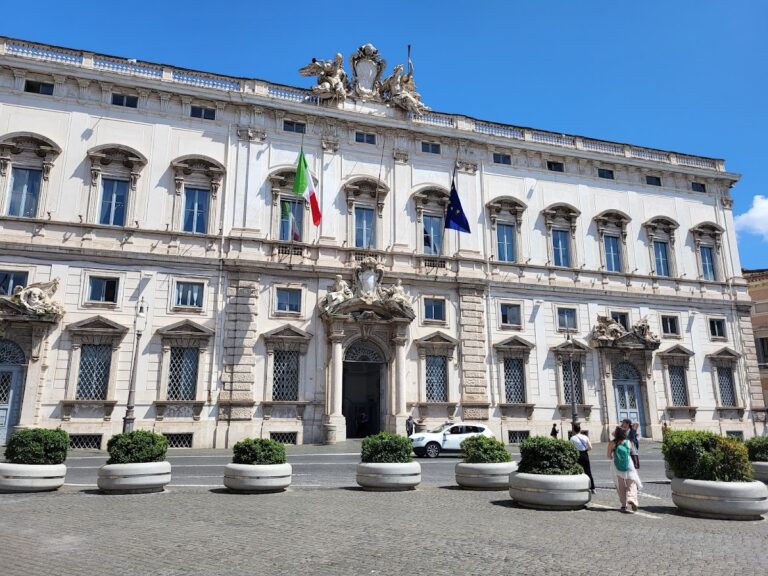
The principal facade is three orders high and entirely faced in travertine. Its symmetrical composition combines Renaissance Revival and Baroque elements with superimposed classical orders. These include Tuscan, Ionic, and Corinthian Composite forms, systems distinguished by their column shapes and entablature details. Regularly spaced windows have stucco frames and are topped by triangular or curved pediments. Two matching principal entrances open onto Via Nazionale, although only one is currently used. A broad central portal leads to the monumental interior staircase. Two large sculptural groups once stood in the wide central section of the facade but were later removed.
Court of Honour
The western Court of Honour repeats the three classical orders on its surrounding facades. A niche contains a bust of Gaetano Koch. An archway toward the former banknote-printing building faces a fountain crowned by the statue of Antinous, linking the second courtyard with the ancient sculpture discovered during the palace’s construction.
Staircase and representative rooms
Sala della Lupa and Scalone d’Onore
The wing between the two courtyards contains the Sala della Lupa, a room with a copy of the Capitoline Wolf. It gives access to the Scalone d’Onore, or main ceremonial staircase. More than 3 metres wide, the staircase rises to the top floor without central supports. Two third-century sarcophagi stand at its foot.
Salone delle Assemblee
The Salone delle Assemblee is a monumental room used for meetings and official ceremonies. Frescoed ceilings and large chandeliers form part of its formal interior decoration.
Salone dei Partecipanti
The Salone dei Partecipanti lies at the centre of the facade facing Via Nazionale and covers more than 300 square metres. The room is used for meetings of the Bank of Italy’s shareholders and for the governor’s annual speech.
Decorative interiors and garden
Other representative interiors contain frescoes, gilded stucco, valuable and polychrome marbles, silk wall hangings, furnishings, and Murano-glass chandeliers. Their works of art include statues, European paintings dating from the sixteenth to the nineteenth centuries, Chinese lions associated with the Han and Wei dynasties, Cambodian Buddha heads, and Indian and Persian artefacts. From the palace’s opening in 1893, the garden was decorated with a series of clocks made by the Hausmann firm, which had operated in Rome since 1794.
The palace incorporated air-conditioning, electrical, and hydraulic systems that were advanced for its time. Among its most prominent architectural features, the Scalone d’Onore was regarded as the most imposing staircase among Rome’s modern palaces.
Archaeological remains and collections
Roman sanctuary and Antinous
The foundation excavations revealed residential remains and a sanctuary dedicated to Silvanus, dating to the period of Domitian. The statue of Antinous from the reign of Hadrian survives as part of the palace’s second courtyard, where it stands above the fountain facing the archway toward the former banknote-printing building.
Money Museum
The Money Museum occupies part of the working palace and presents material from approximately 5,000 years of monetary history. Its holdings range from Mesopotamian cuneiform tablets to modern currencies. The Oriental Art room includes works from Cambodia, China, Tibet, India, and Persia, while the 2025 acquisition of the 1,000-lire design adds an early example of Italian paper-currency production to the museum’s displays.
Nearby sites