San Pietro in Vincoli: A Roman Basilica and Titular Church


Site at a Glance
- Rating
- 4.7
- Popularity
- High
- Country
- Italy
- Primary era
- Classical
- External website
- Open
- Eras represented
- Classical, Medieval, Early Modern, Modern
- Civilizations
- Byzantine, Papal States, Roman
- Site type
- Religious
- Remains
- Basilica
On this page25 sections
History
San Pietro in Vincoli is a Roman Catholic minor basilica and titular church in Rome, Italy, built by the Romans and reshaped through late antique and Renaissance phases. Also called the Eudoxian Basilica, it occupies the Oppian Hill and is entrusted to the Lateran Canons Regular, a Catholic canonical community associated with Rome’s Lateran Basilica.
Roman foundations and the late antique basilica
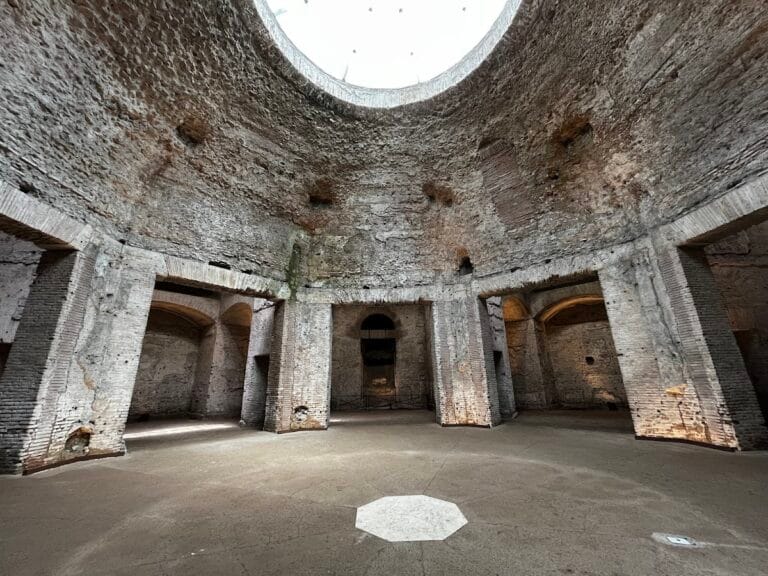
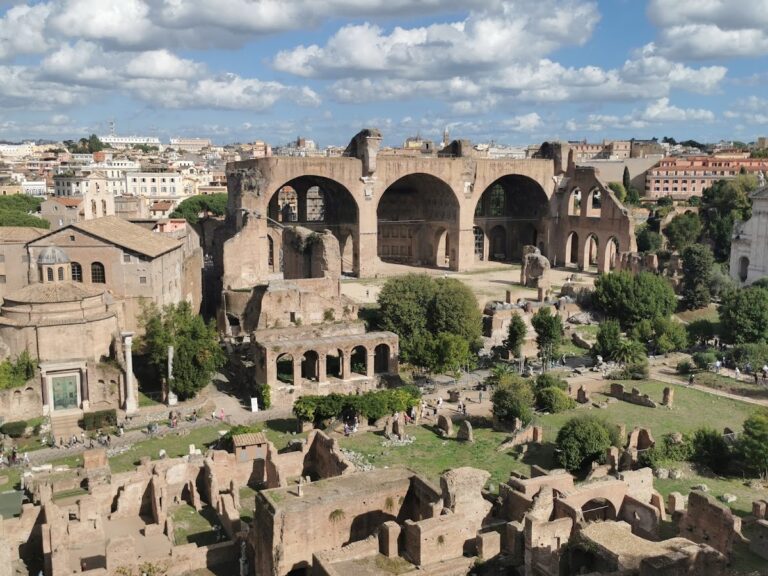
Archaeological investigations beneath the church have revealed an urban complex used from the third century BC to the third century AD. It stood on the western summit of Nero’s Domus Transitoria, the imperial palace complex associated with Emperor Nero, and included a courtyard, a portico with a pool, a covered gallery, and gardens. The Roman complex was later demolished, making way for a Christian church.
In the second half of the fourth century, a spacious basilica dedicated to the Apostles was erected on the site. The presbyter Philip, a papal representative appointed by Pope Celestine I to the Council of Ephesus in 431, served as its titular priest. He referred to the church as the Ecclesia Apostolorum, meaning Church of the Apostles. That building was later destroyed for reasons that are not known.
Licinia Eudoxia, a fifth-century Roman empress and the daughter of Theodosius II, ordered the church’s rebuilding in 432. She was the wife of Valentinian III, and the basilica took its alternative name, the Eudoxian Basilica, from her. The new building retained the earlier dimensions of about 28 metres in width and 60 metres in length. Work continued from 432 to 470, and Pope Sixtus III consecrated the basilica in 439.
The chains of Saint Peter
The church’s identity is closely linked with the chains said to have bound Saint Peter during his imprisonment in Jerusalem. Christian tradition relates that Eudoxia’s mother, Aelia Eudocia, received them from Juvenal, the patriarch of Jerusalem, during a pilgrimage to Palestine around 432 or in 438–439. She entrusted them to Eudoxia so that they could be taken to Rome.
Eudoxia presented the chains to Pope Leo I, bishop of Rome from 440 to 461. Tradition holds that when Leo brought them near the chains associated with Peter’s imprisonment in Rome’s Mamertine Prison, the two sets fused permanently. The miracle came to represent a connection between eastern and western Christian traditions at a time when the Roman Empire and the papacy faced threats from barbarian incursions.
The fused chain remains the basilica’s principal relic. A link has been kept since 1894 in St Peter’s Church in Rutland, Vermont, while other fragments or objects regarded as contact relics are preserved in churches in Italy and elsewhere in Europe. The chains and their miraculous joining are commemorated each year on 1 August. The same date also preserves the annual remembrance of the seven Maccabean martyrs.
Medieval continuity and Renaissance rebuilding
Pope Adrian I restored the basilica in 780. Its later character was shaped especially by the rebuilding and remodelling campaigns associated with Pope Sixtus IV from 1471 and with Cardinal Giuliano della Rovere, who later became Pope Julius II, between 1471 and 1503. The campaign under Julius II produced much of the church’s present institutional and architectural identity, including the entrance portico and the remodelling of the attached convent.
The original design of the cloister was attributed by Giorgio Vasari to Giuliano da Sangallo, a Florentine Renaissance architect and military engineer. After Italian unification, the former convent became the seat of the Faculty of Engineering of La Sapienza University. The university institution consequently shares the name San Pietro in Vincoli with the basilica.
The church has remained a cardinalial title since the medieval period. Nicholas of Cusa held it from 1449 to 1464, Giuliano della Rovere from 1471 to 1503, and Albrecht von Brandenburg from 1521 to 1545. Later titular cardinals included Girolamo Agucchi, Cinzio Passeri Aldobrandini, Lanfranco Margotti, Lorenzo Casoni, Niccolò Maria Lercari, Antonio Andrea Galli, Adolphe Perraud, Pio Laghi, and Donald Wuerl, who became cardinal-priest in 2010. Giovanni II and Gregory VII are also stated to have been appointed to the church.
The basilica’s later religious and commemorative traditions include the cult of Saint Peter’s chains and the traditional identification of the crypt as Peter’s first Roman prison before his transfer to the Mamertine Prison. That identification belongs to tradition rather than archaeological proof. Restorations continued in the eighteenth and nineteenth centuries, including work carried out in 1875.
Remains
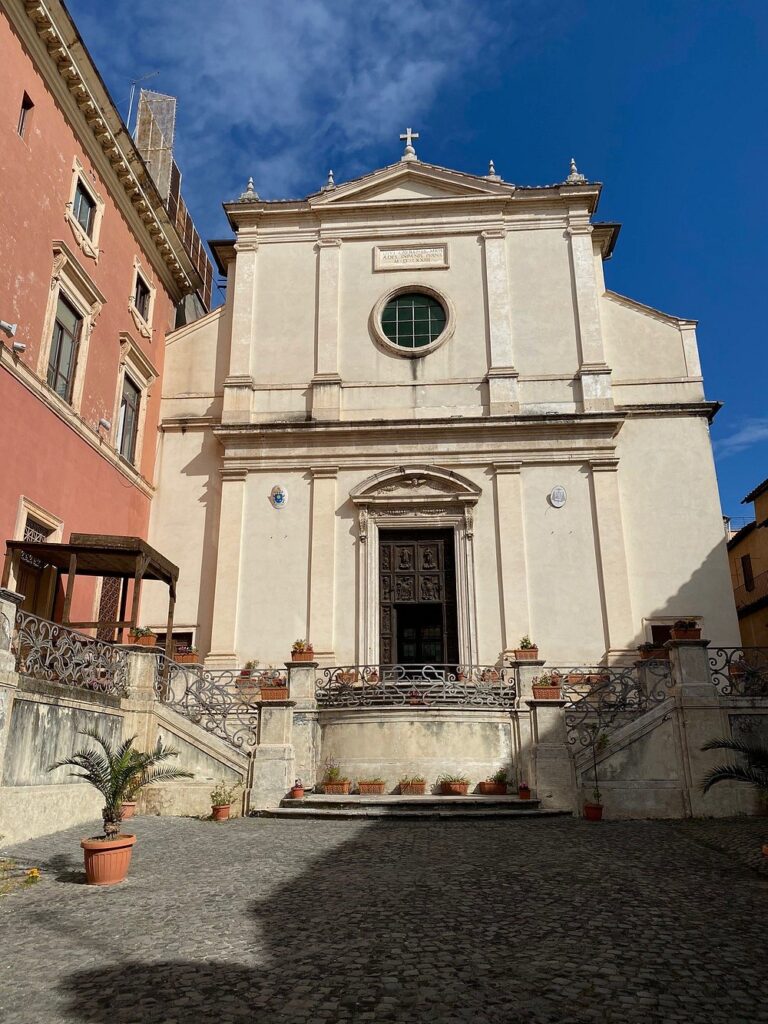
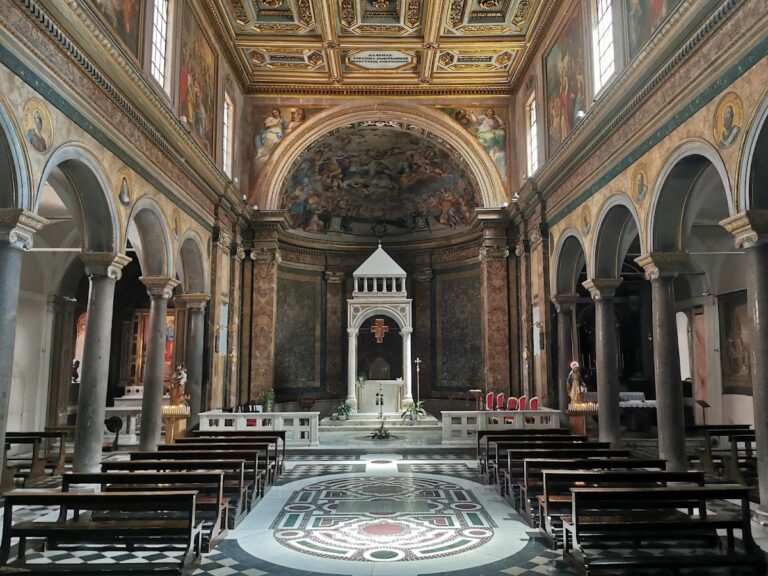
San Pietro in Vincoli retains a three-aisled basilical plan, with a central nave separated from two lower aisles by columns. The church is approximately 70 metres long and 40 metres wide. Its off-axis apse incorporates the apse-ended hall of an earlier Roman structure. The fifth-century outer walls and apse exterior can be seen from Via delle Sette Sale, while the facade and entrance portico chiefly reflect the interventions of Sixtus IV and Julius II.
Facade, portico, and cloister
Entrance portico
Added in 1475 and attributed to Baccio Pontelli, the entrance portico has five arches carried by six octagonal columns. A bronze grille encloses the space, and the capitals bear the arms of Julius II. The external marble portal dates from the fifth century, although its inner side was altered in the sixteenth century. A sculpture titled When I Was Naked, by the Canadian artist Timothy Schmalz, stands in the portico. It formed part of the Matthew 25 series installed in Rome for the Extraordinary Jubilee of Mercy.
Cloister courtyard
The cloister courtyard contains a central well made by Simone Mosca in 1517. Mascarons decorate the well, which stands among four columns supporting an entablature attributed to Antonio da Sangallo the Younger. The well later became a symbol of the Faculty of Engineering. The courtyard also contains a fountain dated 1642 and presented by Cardinal Antonio Barberini.
Nave, aisles, and early modern decoration
Central nave and columns
Antique Doric columns divide the nave from the aisles. The twenty principal columns are made of Hymettian marble and are regarded as imports from Greece, probably taken from the nearby Portico of Livia. Their bases are fifth-century reconstructions. The aisles have cross-vaults, while the nave is covered by a lowered barrel vault with coffering constructed by Francesco Fontana in 1706.
A central chain beam from the remodelling of 1465 is displayed in two sections at the base of the vault. Cardinal Nicholas of Cusa paid for the beam, and his name and the date appear in Roman numerals. Giovanni Battista Parodi painted the large ceiling fresco in 1706. It represents a miracle dated to 969, when a count in the retinue of Emperor Otto I was freed from a demon through contact with Saint Peter’s chains.
Counterfacade and left aisle
Immediately to the left of the entrance is the tomb of the Florentine painters Antonio and Piero del Pollaiuolo. Luigi Capponi’s sculptures, made between 1498 and 1510, show Antonio on the left and Piero on the right beneath a blessing Christ. Above the monument is the 1476 fresco Procession of Sixtus IV for the End of the Plague, attributed to Antonio di Benedetto degli Aquili, known as Antoniazzo Romano. A Face of Christ, probably surviving from the original fifth-century frescoes, occupies a niche cut into the counterfacade plaster.
The tomb of Cardinal Nicholas of Cusa stands on the perimeter wall at the beginning of the left aisle. Andrea Bregno sculpted it in 1465. Its relief shows the cardinal venerating Saint Peter, with the liberating angel beside him, and includes a crab, his heraldic emblem. The first altar of the aisle contains Cristoforo Roncalli’s Deposition of Christ, painted in the early seventeenth century.
The third altar contains a seventh-century mosaic icon of Saint Sebastian. The saint appears as an elderly, bearded Roman tribune in Byzantine dress, an unusual form of representation. The altar and icon were originally placed on the left wall of the counterfacade and were moved in 1683. An old painting of the Virgin and Child is positioned above them. The altar was made as a votive offering after the plague that struck Rome from June to September 680, and its imagery is connected with the parallel cult of Saint Sebastian in Pavia, where his relics were associated with protection against plague.
Right aisle and transept paintings
An altar dedicated to Saint Peter Fourier stands against the right pillar of the counterfacade. Guercino’s painting of Saint Augustine, dated 1621–1623, occupies the first altar of the right aisle. The third altar contains a copy of the composition made in 1683 by Pietro Santi Bartoli, adapted to the altar’s different proportions. Domenichino’s 1602 painting Liberation of Saint Peter is displayed in the new sacristy.
The pavement was installed after the earlier floor was dismantled in 1956 to allow archaeological excavations beneath the basilica. A portion of the earlier pavement survives in front of the tomb of Cardinal Mariano Pietro Vecchiarelli.
Presbytery, relic, and crypt
Altar and chain reliquary
The present presbytery was designed by Virginio Vespignani and built in 1876–1877. Its central altar, made during Nicholas of Cusa’s remodelling of 1465, is an earlier surviving element. The presbytery includes a marble altar, a nineteenth-century neoclassical canopy by Vespignani, a sunken confessio providing access toward the crypt, and two marble stairways leading to the altar and apse.
At the centre of the marble altar is the reliquary of Saint Peter’s chains. Two gilded-bronze doors made by Giovanni Matteo Foppa, known as Caradosso, in 1477 close the shrine. Inside is a chain urn made by Andrea Busiri Vici in 1856. A statue of Saint Peter stands to its left and a liberating angel to its right.
The chains comprise two welded sections. The Roman section has twenty-three links ending in a collar, while the Jerusalem section has eleven smaller links. The confessio around the reliquary has a marble balustrade with four small black angel statues. Two ramps descend to an altar before the urn, and grilled openings on either side lead toward the crypt.
Crypt and Maccabean sarcophagus
The crypt is a small chamber beneath the central altar. Tradition identifies it as Saint Peter’s first Roman prison, before his transfer to the Mamertine Prison. It contains the sarcophagus of the seven Maccabean brothers, Jewish martyrs of the second century BC who are also venerated by Christians and other eastern religions.
The sarcophagus was probably brought from Antioch to Rome by Pope Pelagius II and was discovered in 1876 during the rebuilding of the presbytery. It is divided into seven compartments containing human remains and sealed with authenticity-marking seals. Five carved scenes show the raising of Lazarus, the multiplication of the loaves and fishes, the Samaritan woman, Christ foretelling Peter’s denials, and the delivery of the Law.
Above the sarcophagus is Silverio Capparoni’s fresco of the Maccabean brothers’ martyrdom, painted in 1876–1877. Floral frescoes of the same period cover the crypt.
Apse and side chapels
Apse decoration
The high altar is surmounted by a large gilded wooden canopy supported by four granite columns with Baroque capitals. Jacopo Coppi decorated the apse with frescoes in 1577, commissioned by Raffaello Campioni, prior general of the Congregation of the Lateran Canons Regular of Saint Saviour.
The apse paintings depict the Recrucifixion of Beirut, a seventh-century episode in which a profaned image of Christ was said to bleed. Three large wall frescoes represent an angel freeing Peter from the Jerusalem prison, Eudocia receiving the chains from Juvenal, and Eudoxia presenting them to the pope.
Transept apses
Two small apses open toward the transept. The nineteenth-century left apse contains Giuseppe Bravi’s Immaculate Conception. The right apse, formerly associated with the Silvestri counts, contains Guercino’s 1644 altarpiece Saint Margaret of Antioch.
Julius II’s tomb and Michelangelo’s Moses
The monument
The mausoleum of Pope Julius II occupies the right transept. Michelangelo received the commission in 1505, but repeated interruptions delayed completion until 1545, thirty-two years after Julius II’s death. The original project called for more than forty statues and was large enough to require an enlargement of the basilica. After six revisions, the completed monument contained seven statues.
Michelangelo’s Moses stands at the centre. Completed in 1515, it is 2.35 metres high. The figure was initially shown frontally and was modified by Michelangelo about twenty-five years later, probably so that its gaze turned away from Saint Peter’s chains. The changes included lowering the seat by 7 centimetres, reducing the left knee, moving the leg backward, twisting the beard to the right because of a shortage of marble, and carving the nose from the left cheek.
The horns on Moses’ head derive from Michelangelo’s reading of a Hebrew text in which rays of light were understood as horns. Their presence represents the radiance of the Lord within an established tradition of sacred imagery.
Figures surrounding Moses
Above Moses is the sarcophagus intended for Julius II, with a large figure of the pope reclining on its lid. Recent studies attribute this figure to Michelangelo. Rachel, representing the contemplative life, stands to the right of Moses, while Leah, representing the active life, stands to his left. Michelangelo executed both figures, which were completed by Raffaello da Montelupo. The Sibyl and Prophet are also by Raffaello da Montelupo, and the central Virgin and Child above them is by Domenico Fancelli.
Organ, sacristy, and funerary monuments
Pipe organ
The pipe organ stands above its own choir gallery near the end of the left transept. Giacomo Alari built it in 1686–1687. Attilio Priori enlarged it in 1884, Paolo Quaresima modified it in 1924, and Michel Formentelli restored it between 2012 and 2014, reinstating its nineteenth-century characteristics.
The pipes are enclosed in a richly sculpted and gilded wooden case. The principal pipes are arranged in three cusps and three fields. The window console has one manual and a pedalboard, with twenty-two stops operated by draw knobs in two columns. Its action is entirely suspended mechanical.
Sacristy
The sacristy lies behind Julius II’s tomb and is entered through two doors beside the monument. The room originated in the fifth century and was transformed by Sixtus IV and Julius II between the late fifteenth and early sixteenth centuries to house Saint Peter’s chains. It was also accessible from the portico by a stairway ramp, later restored and closed with a window opening toward the portico.
The original room was divided into a chamber for storing the chains and a small chapel. Its final arrangement was established around 1620 by Albrecht of Brandenburg. The vault contains an oval painting and four scenes from the life of Saint Peter. Twelve lunettes below show saints and members of the Lateran Canons Regular. These paintings are attributed to Ottavio Mazzienti on the basis of payment receipts from 1661.
A painting of Saint John the Baptist, attributed to a supposed Roman master, was formerly kept in the sacristy and was later stolen. A tradition connected it with the anecdote that Giotto painted a deceptively realistic fly on the saint’s face for Cimabue.
Cardinalial and episcopal memorials
The basilica contains numerous funerary monuments to cardinals and bishops. They include the tombs of Cinzio Passeri Aldobrandini, Mariano Pietro Vecchiarelli, Lanfranco Margotti, Girolamo Agucchi, Girolamo della Rovere, and Antonio Andrea Galli, together with tombs or memorial slabs for Castruccio Castracane degli Antelminelli, Sisto Gara della Rovere, Giovanni Andrea Bussi, Niccolò Maria Lercari, Lorenzo Casoni, and others.
Lanfranco Margotti’s tomb, in the second right-aisle altar, has a 1611 tondo by Domenichino. Domenichino also designed the tomb of Girolamo Agucchi and painted Agucchi’s portrait in 1605. The tomb of Girolamo della Rovere stands at the end of the right aisle, while Antonio Andrea Galli’s tomb lies beneath the organ in the left transept.
Cinzio Aldobrandini’s tomb was erected in 1705–1707 by Prince Giovanni Battista Pamphili Aldobrandini to a design by Carlo Francesco Bizzaccheri. Its decoration includes putti and a winged skeleton by Pierre Le Gros the Younger. The slab of Castruccio Castracane degli Antelminelli was moved from the pavement to the inner face of the left counterfacade pillar. The slabs of Sisto Gara della Rovere and Bishop Giovanni Andrea Bussi were likewise transferred to the left counterfacade wall.
The only tomb slab remaining in the pavement is that of Eustachio Giovenale Orsini, a Roman noble who died in 1483. It lies near the right side of the counterfacade. The slab of Niccolò Maria Lercari is on the right counterfacade wall near the entrance. Antonio Benci, known as Antonio del Pollaiuolo, is buried to the left upon entering the church, and a painted slab commemorating Cardinal Lorenzo Casoni is set on old plaster in the left transept.
A commemorative plaque associated with Cardinal Hélie de Talleyrand-Périgord, who held the title of San Pietro in Vincoli from 1331 to 1348, was moved from the pavement to the left counterfacade wall. Although the fragment lacks his name, its reference to Toulouse makes the identification probable. The left transept also contains a plaque for Cardinal Adolphe-Louis-Albert Perraud. A plaque for Agostino Steuco is set in the left apse pillar, while the tomb of the miniaturist Giulio Clovio, dated 1578, stands on the opposite pillar.
Nearby sites