San Leonardo in Treponzio: A Romanesque Parish Church and Pilgrim Hospital
Site at a Glance
- Rating
- 4.7
- Popularity
- Very Low
- Country
- Italy
- Primary era
- Medieval
- Eras represented
- Medieval, Modern
- Civilizations
- Holy Roman Empire
- Site type
- Religious
- Remains
- Church
On this page9 sections
History
San Leonardo in Treponzio is an ancient Romanesque Roman Catholic parish church in Italy, with a history reaching back to the early twelfth century. Dedicated to Saint Leonard of Limoges, a sixth-century Christian saint traditionally associated with protecting prisoners and captives, it belongs to the Roman Rite within the Archdiocese of Lucca. The church and its associated hospital served pilgrims travelling south, giving the complex a religious and charitable role beside an ancient Roman road.
Foundation and Romanesque development
The church and hospital were established or functioning by the early twelfth century. The earliest surviving reference dates to 30 November 1115, when an olive grove was donated to the church and hospital so its produce could feed passing pilgrims. Other donations from the same period are preserved in the Fregionaia collection of the State Archive of Lucca.
Most art historians place San Leonardo in Treponzio within Tuscan Romanesque architecture, the medieval tradition associated with massive masonry, rounded arches, clearly expressed structural elements, and strongly defined interior spaces. Its principal expressions around Lucca and Pisa belong to the twelfth century. Archaeological discoveries suggest that the existing building replaced a smaller earlier church, and the church has also been characterized as an archetype for other twelfth-century churches.
Religious administration and disputes
Benedetto served as rector of the religious complex from 1179 to 1193 and gave the institution strong impetus. After his death, local believers proclaimed him a saint, and his remains were transferred to Lucca Cathedral in 1387.
The hospital’s position was also involved in disputes over patronage, the right to oversee or claim authority over a religious institution. In 1221, Vitale, procurator of the Hospital of San Leonardo in Treponzio, brought a case before Pope Honorius III against Guglielmo, son of Maluso, who claimed that right. The claim was rejected. Enrico Baldinotti revived it in 1231 after a judgment by the Lucchese podestà Parenzo, but that judgment was declared void because it had been issued by a secular court.
Later changes and modern status
In 1426, the church and hospital were annexed to the monastery of Santa Maria della Fregionaia, which received their documentation. In 1679, the inhabitants temporarily became part of the parish of Castel Durante. The church reopened for worship in 1804 and is now a nationally designated monument. In November 2025, lightning damaged its bell tower.
Remains
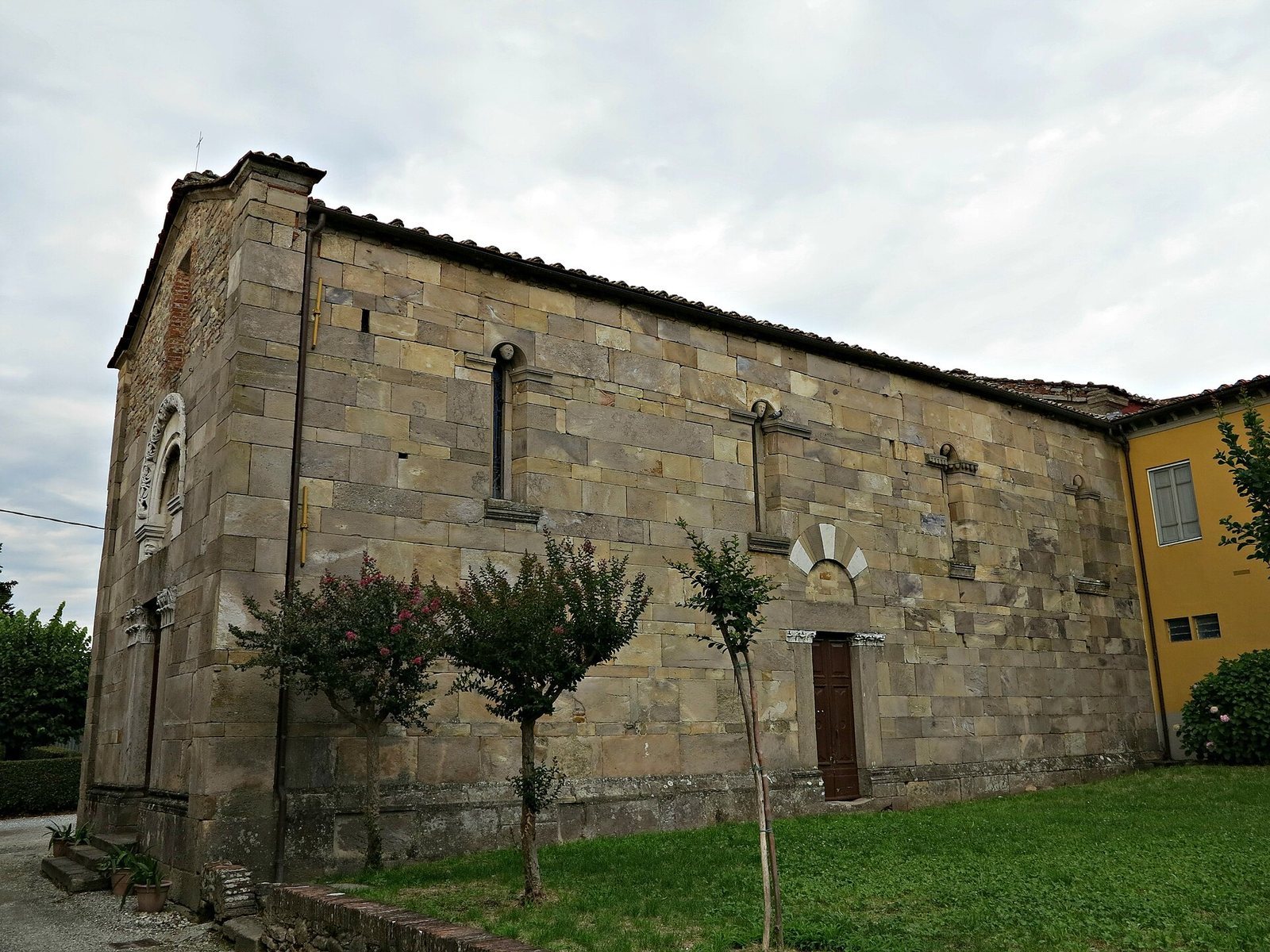
The church stands beside an ancient Roman road. Its Latin-cross plan consists of a long central nave crossed by a shorter transept, ending in a semicircular apse, the sanctuary space at the eastern termination of the church. The building follows a basilical spatial conception also shared with Sant’Alessandro in Lucca. Carefully executed wall masonry and alternating dimensions in the masonry courses create patterned effects, while architectural members stand out against otherwise smooth wall surfaces to define the interior space.
Church and facade
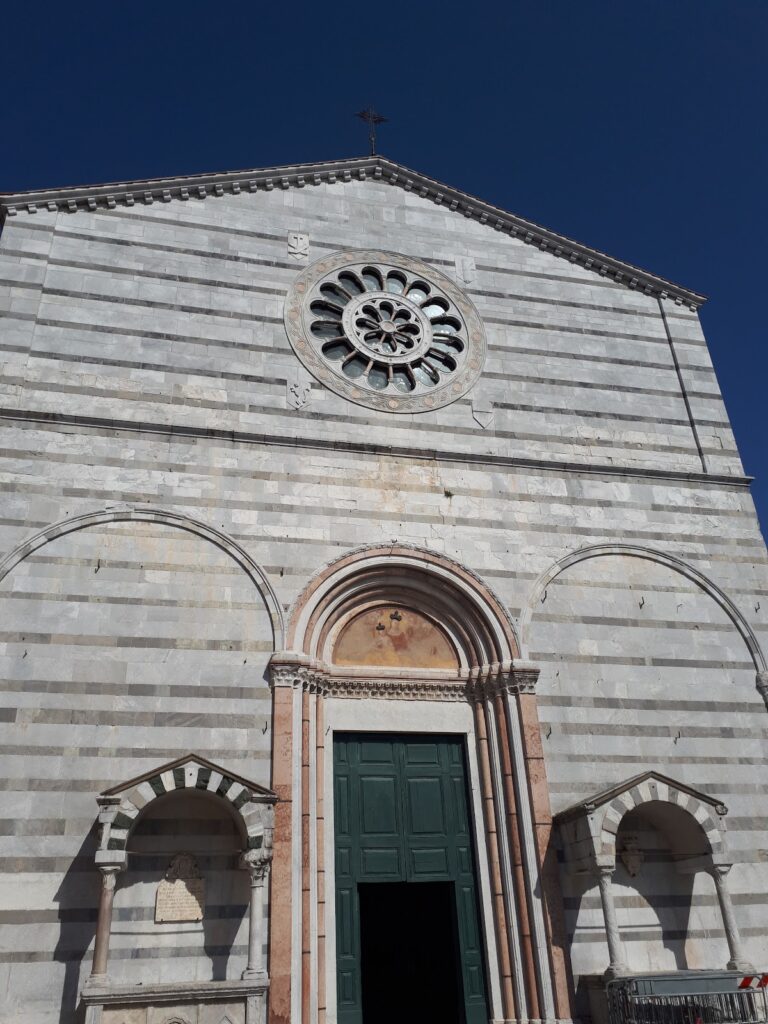
The facade was completed at the end of the twelfth century. Its portal draws on motifs associated with Guidetto’s workshop, a medieval architectural workshop whose sculptural vocabulary influenced Romanesque churches in the Lucca area. The archivolt, the molded band surrounding an arch, carries a vegetal scroll with swollen leaf clusters, imaginary animals, and hunting scenes.
Roadside markers and bell tower
Milestones
A milestone stands south of the church in the area of the former cemetery. This roadside marker bears an unrecognizable coat of arms, a date, and an inscription stating that in 1276 the municipality of Carraia lay toward Lucca at a distance of 160 pertiche. A second milestone, whose location is unknown, carried an inscription referring to the community of the parish territory of Compito, including six chapels, and placing it 1,755 pertiche toward Lucca. It was later moved 15 pertiche south. Here, a pertica was equivalent to almost 3 metres.
Bell tower
The bell tower stands considerably apart from the church. It is a nineteenth-century replacement for an earlier tower, although its precise date is uncertain. The tower houses ten bells forming a ten-note carillon in E-flat 3. The original group contained four bells: Luigi Magni of Lucca cast the large bell, while Lorenzo Lera of Borgo Giannotti made the three smaller bells after the Second World War. Six further bells were cast in the 1990s by the Capanni foundry of Castelnovo ne’ Monti.