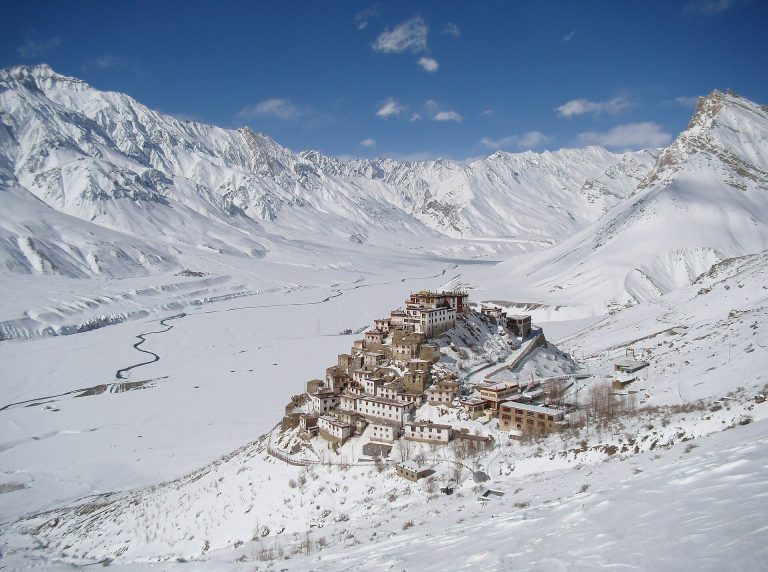
Tabo Monastery, Himachal Pradesh: A Tibetan Buddhist Monastic Complex
Site at a Glance
- Rating
- 4.8
- Popularity
- Medium
- Country
- India
- Primary era
- Medieval
- External website
- Open
- Eras represented
- Medieval, Early Modern, Modern
- Civilizations
- Tibetan
- Site type
- Religious
- Remains
- Fortified Monastery
On this page21 sections
History
Tabo Monastery, Himachal Pradesh is a Tibetan Buddhist monastery above Tabo village in Himachal Pradesh, India, founded in 996 CE by the translator Rinchen Zangpo on behalf of Yeshe-Ö, king of the western Himalayan kingdom of Guge. Also known as Tabo Chos-Khor, it was established during the later spread of Buddhism in Tibet and became a daughter monastery of Tholing Monastery in Ngari, western Tibet.
Foundation and Buddhist learning
Yeshe-Ö and his ruling dynasty supported the reintroduction of Indian Mahayana Buddhism into Tibet. Their monasteries and trade networks linked Ladakh, Mustang, and other parts of the western Himalayas. Rinchen Zangpo served as Yeshe-Ö’s preceptor and played a leading part in translating Buddhist scriptures from Sanskrit into Tibetan. Indian Buddhist scholars also came to Tabo to study the Tibetan language.
Forty-six years after the foundation, the royal priest Jangchub O’d, Yeshe-Ö’s grandnephew, renovated the monastery. He is associated with the renovation imagery and inscription in the main temple. Tabo subsequently became an important centre of the Kadampa school, a Tibetan Buddhist tradition that later developed into the Gelug school, with its strong emphasis on monastic discipline and scholarship. It is described as the oldest continuously operating Buddhist enclave in India and the Himalayas.
The monastery’s paintings, sculptures, inscriptions, and extensive wall texts preserve material dating from 1042 and later. Its artistic traditions include Nyingmapa and Sakyapa elements as well as early Kadampa work, while later paintings represent the Gelug tradition.
Conflict, damage, and reconstruction
Tabo and the bridge across the Spiti River became involved in political turmoil between the seventeenth and nineteenth centuries. The Tabo Kanjur manuscripts mention violent confrontations, while an inscription records attacks on the Assembly Hall in 1837. Damage to parts of the walls is attributed to troops acting under the kings of Ladakh.
British rule began in the area in 1846, after which Tabo experienced a period of peace. Political tensions connected with the Indo-China border re-emerged in the 1950s. The monastery had 32 monks in 1855.
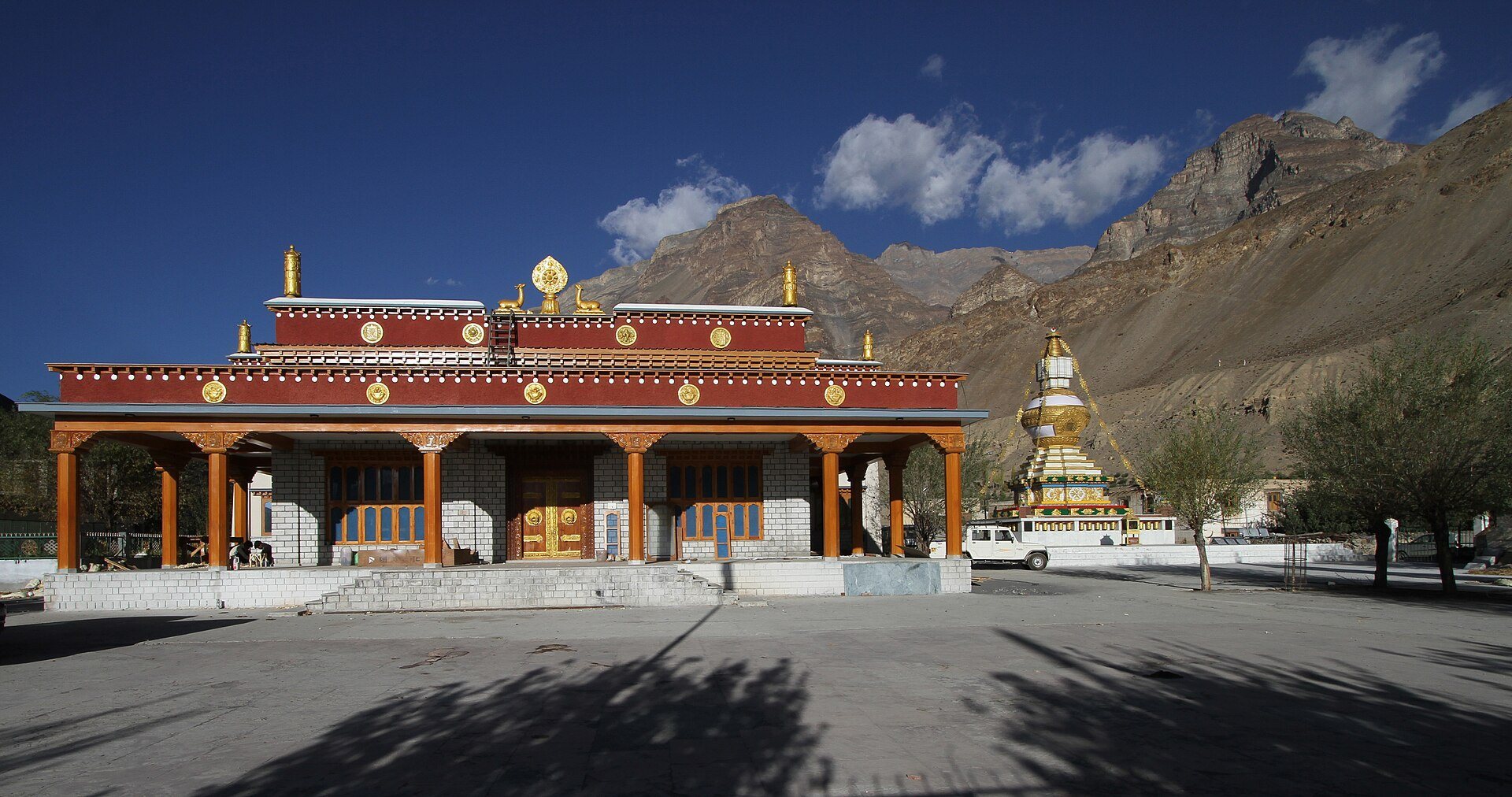
The 1975 Kinnaur earthquake severely damaged the original monastery. Restoration and rebuilding followed, with additional structures added to the complex. A new Assembly Hall was constructed in 1983. In the same year, the 14th Dalai Lama conducted Kalachakra ceremonies at Tabo, a tantric Buddhist system concerned with time, cosmology, meditation, and spiritual practice. He conducted another ceremony there in 1996, when the monastery’s millennium was celebrated and Buddhists came from many parts of the world.
Continued religious and educational life
A Kalachakra Stupa was built as an auspicious monument after the Dalai Lama’s earlier Kalachakra blessings, with its inauguration planned for 2009. Sakya Trizin and other Tibetan teachers and meditation masters also visited Tabo and encouraged Buddhist practice among local people.
Tabo remains a centre of worship. Daily chanting begins at 6 a.m., and resident lamas perform tantric rites. The monastery holds the Chakhar Festival every three years, usually in September or October. The festival includes masked dances, songs, and other Buddhist and regional performances dedicated to peace and happiness.
The monastery currently has 45 monks. Geshe Sonam Wangdui became its abbot in 1975 after Kyabje Serkong Tsenshap Rinpoche, who had served as Head Lama. The abbot cares for the monastery and its monks, teaches Buddhist scripture, and serves the local community. Tsenshap Serkong Rinpoche is identified as the monastery’s spiritual head.
On 29 May 1999, the monastery established the Serkong School. It provides classes from 1 to 8 for 274 students aged between five and fourteen. Subjects include English, Hindi, Spiti Bhoti, social studies, mathematics, general knowledge, information technology, Sanskrit, and art.
Protection and modern threats
The Archaeological Survey of India, the government institution responsible for protecting nationally important monuments, safeguards Tabo as a national historic treasure of India. The agency has proposed the monastery for UNESCO World Heritage recognition because of its importance to Trans-Himalayan Buddhism.
In 2002, the Archaeological Survey of India replaced a roof-supporting beam in the old monastery’s main hall. The original Deodar beam measured about 10 by 10 inches and was 4 feet long. Since Deodar of that size could not be found, Sal timber was used instead. Increased rainfall associated with climate change has damaged some murals and external mud structures in recent decades, while more frequent flash floods in parts of the Spiti Valley create an additional risk.
Remains
Tabo stands at approximately 3,050 metres above sea level on the left bank of the Spiti River, in a cold, very arid, rocky valley. Unlike several other monasteries in Spiti, it occupies the valley floor rather than a hilltop. A high mud-brick wall, about 0.91 metres thick, encloses roughly 6,300 square metres. The complex contains nine temples, four decorated stupas, 23 chortens, monks’ quarters, and an extension with a nuns’ residence. Caves cut into the cliff above the monastery were used for meditation and include an assembly hall and faded paintings on the rock face.
The main temple
Entry halls and shrine areas
The main temple, or Tsug la Khang, contains an entry hall, an Assembly Hall, a western apse with a shrine area, and an ambulatory passage. The old entry hall retains paintings attributed to 996, while a newer entry hall has paintings dated to the late nineteenth or twentieth century. Images of Yeshe-Ö and his two sons, Nagaraja and Devaraja, appear on the south wall. The temple is conjectured to represent the Vajradhatu Mandala, a Buddhist tantric diagram of a sacred realm centred on Vairocana.
Three very large life-size sculptures stand on a raised platform in the shrine area, each flanked by two painted goddesses. The temple also contains a partially restored seated Buddha whose throne base bears two facing lions. Devotees circumambulate the temple clockwise through the Assembly Hall.
Assembly Hall
In the newer Assembly Hall, Vairocana sits on a single lotus throne on the back wall. The image is approximately 110 centimetres high and is accompanied by life-size painted clay sculptures. Thirty-two additional life-size clay figures of deities are embedded in the walls.
The hall contains bright paintings associated with the protector deity Dorje Chenmo, originally known as Wi-nyu-nin. These paintings date to the fifteenth or early sixteenth century. Beside an image of Vajrapasa, an inscription records renovation work and includes a painted representation of Jangchub O’d and the great Buddhist monastic community of Tabo.
Narrative paintings on the south and adjoining walls show the pilgrimage of Sudhana, while paintings on the north and adjoining walls depict the life of the Buddha. The central hall contains a lotus-position Buddha flanked by divine figures, brass images of lamas on nearby pedestals, tapestries on walls, doors, and columns, and paintings of Buddha incarnations from Siddhartha onward together with images of the Panchen Lamas. Approximately 50 clay images and full-size busts of gods and demons occupy the rear wall. The hall also holds 108 holy scriptures weighing about 500 pounds.
Texts and interior furnishings
Scriptures written on wooden planks hang on the walls of the main temple. A small sky window leaves the principal room dark, and an inner vestibule contains colourful paintings of Buddhist and Hindu-Buddhist deities. A small adjoining room stores garments used for ritual dances.
The main temple’s paintings date mainly from the tenth and eleventh centuries, although the wider complex contains works from the tenth through the twentieth centuries. The monastery preserves thangkas, traditional Tibetan Buddhist painted or embroidered scroll images, manuscripts, Pramana texts concerned with valid knowledge and reasoning, statues, frescoes, stucco paintings, clay figures, brass images, and ritual furnishings. Some murals retain bright cobalt colouring.
Early and principal temple groups
Golden Temple
The Golden Temple, or gSer-khang, is traditionally said to have once been covered with gold. Sengge Namgyal, a king of Ladakh, renovated it in the sixteenth century. Its walls and ceilings retain well-preserved sixteenth-century murals, including a representation of Vajradhara, a tantric Buddhist form associated with the transmission of Buddhist teachings.
Maitreya Temple
The Maitreya Temple, or Byams-Pa Chen-po Lha-khang, was built within the first century after the main monastery. Its wooden door frame supports this early dating, while a surviving fragment of painting is attributed to the fourteenth century. A sketch in the Mandala Temple and damage to the entrance wall indicate that the building was originally double-storied.
The temple contains a representation of Maitreya, the future Buddha, more than six metres high. Its murals depict Tashilhunpo Monastery at Shigatse and the Potala in Lhasa. A carved stone column base bears a lion.
Initiation Temple
The Initiation Temple, or dKyil-Khor-khang, contains a large painting of Vairocana surrounded by eight bodhisattvas, Buddhist figures who seek enlightenment while aiding other beings. Its other walls are covered with mandalas, and the building was used for monastic initiations.
Temple of Dromton
The Temple of Dromton, or Brom-ston Lha-khang, is traditionally attributed to Dromton, one of Atisha’s principal disciples. Its large interior contains seventeenth-century murals of the eight Medicine Buddhas, with a narrative depiction of the life of Shakyamuni Buddha, the historical Buddha traditionally identified with Siddhartha Gautama, at the base.
Mandala and Small Dromton temples
The Small Mandala Temple was used for tantric rituals and teachings and may belong to the early period of the complex. The Small Dromton Temple contains elegant paintings and surviving carvings on its entry doors attributed to the thirteenth or fourteenth century.
Nuns’ Temple
The small Nuns’ Temple stands against the rear wall of the compound. Its paintings date to the eighteenth century.
Later temples and defensive religious imagery
Later temple group
The later temple group includes the Chamber of Picture Treasures, or Z’al-ma, the White Temple, or dKar-abyum Lha-Khang, the large Dromton Temple, and the Mahakala Vajra Bhairava Temple, or Gon-khang. The large Dromton Temple is the largest building after the Assembly Hall. It contains numerous wall paintings, while its wooden ceiling planks are decorated.
Mahakala Vajra Bhairava Temple
The Mahakala Vajra Bhairava Temple contains the Gelug protective deity and other fierce deities. It is entered only after protective meditation. A large panel on the east wall of the main entrance depicts the monastery’s protector deity with its retinue. Water seepage damaged the painting, which was extensively restored by the Archaeological Survey of India.
Stupas, chortens, and cliff caves
Four of the complex’s many stupas contain interior paintings, and two are dated to the thirteenth century on the basis of those paintings. One stupa also contains a carved wooden lintel. The 23 chortens are Tibetan Buddhist reliquary monuments associated with remembrance and sacred practice.
The meditation caves cut into the cliff above the monastery include an assembly hall and faded paintings on the rock face. Together with the enclosed temples, stupas, chortens, residences, and painted interiors, these spaces form a complex whose surviving decoration extends from the tenth century to later works in the newer temples. Murals and external mud-built structures remain vulnerable to increased rainfall and flash floods.