San Giovanni Theristis: An Orthodox Monastery in Bivongi, Italy


Site at a Glance
- Rating
- 4.7
- Popularity
- Low
- Country
- Italy
- Primary era
- Medieval
- Eras represented
- Medieval
- Civilizations
- Byzantine, Norman
- Site type
- Religious
- Remains
- Monastery
On this page8 sections
History
San Giovanni Theristis is an Orthodox Christian monastery in Bivongi, Italy, founded by Byzantine Christians in the eleventh century at a holy spring associated with Saint John Theristus. Its church combines Byzantine traditions with Norman-scale architecture, and the monastery became an important centre of Basilian monasticism in southern Italy.
Byzantine Origins
Calabria remained under Byzantine rule until the beginning of the eleventh century. Greek language and culture, together with Byzantine-rite Christianity, continued to shape the region. From the seventh century onward, southern Italy also attracted Orthodox monks from the East, and monasteries developed in valleys such as the Stilaro and Amendolea.
Saint John Theristus was a ninth-century Byzantine or Greco-Italian monk who lived and worked in the Stilaro Valley. After his death, local devotion to him expanded. Places connected with his life, including the aghiasma, a holy spring associated with religious devotion and pilgrimage, became destinations for worshippers. A Byzantine monastery dedicated to him was founded at the spring in the eleventh century.
Basilian Prosperity and Decline
After the Norman conquest of southern Italy, the monastery became one of the most important Basilian institutions in the region. The Basilian tradition was a form of Eastern Christian monasticism following the rule attributed to Saint Basil the Great. At San Giovanni Theristis, it supported a prosperous community with a large library and rich artistic treasures, and the monastery retained its importance until the fifteenth century.
Its condition later deteriorated. In 1457, a papal apostolic visitor reported the monastery’s poor state. The establishment of the Basilian Order of Italy in 1579 restored San Giovanni Theristis as the principal Basilian centre of southern Calabria. Brigandage then brought serious difficulties and damage during the seventeenth century. In 1662, the monks definitively abandoned the monastery and moved to the larger San Giovanni Theristis monastery outside the walls of Stilo. They took with them the relics of Saint John Theristus and those of Saints Nicholas and Ambrose.
Municipal Ownership and Orthodox Revival
In the early nineteenth century, legislation under Napoleonic rule concerning ecclesiastical property, followed by the conquest of the Kingdom of the Two Sicilies, led to the monastery becoming municipal property in Bivongi. Several private owners subsequently adapted it for agricultural use. The heirs of the last owner donated the property back to the municipality in 1980.
Paolo Orsi discovered the abandoned monastery during the first decade of the twentieth century, but its distance from Bivongi and the lack of convenient roads prevented effective conservation at that time. In 1965, Bivongi mayor Franco Ernesto promoted its recognition and protection. Restoration and rehabilitation began in 1990, with the intention of returning the site to Orthodox prayer. The first monks from Mount Athos, an autonomous Orthodox monastic territory in northern Greece, settled there permanently in 1994.
In December 1994, the Regional Council of Calabria declared the area between the Stilaro and Assi rivers sacred to facilitate the monks’ settlement. On 24 February 1995, Bivongi formally granted the monastery to the Orthodox Archdiocese of Italy and Malta for 99 years. It was described as the first monastery in Italy founded by monks who came directly from Mount Athos. During the 1990s, the monastery was restored to the Italian Basilian Order while reconstruction continued, and rebuilding of the katholikon, the principal church of an Orthodox monastery, was completed in 2002.
On 21 March 2001, Bartholomew I, Patriarch of Constantinople, visited San Giovanni Theristis and brought back a relic of Saint John Theristus from the saint’s church at Stilo. In 2008, after the Greek Orthodox community had failed to maintain the monastery, Bivongi’s municipal council granted its use for 99 years to the Romanian Orthodox Church in Italy. The monastery consequently became part of the Romanian Orthodox Diocese for Italy and now houses a permanent monastic community.
Remains
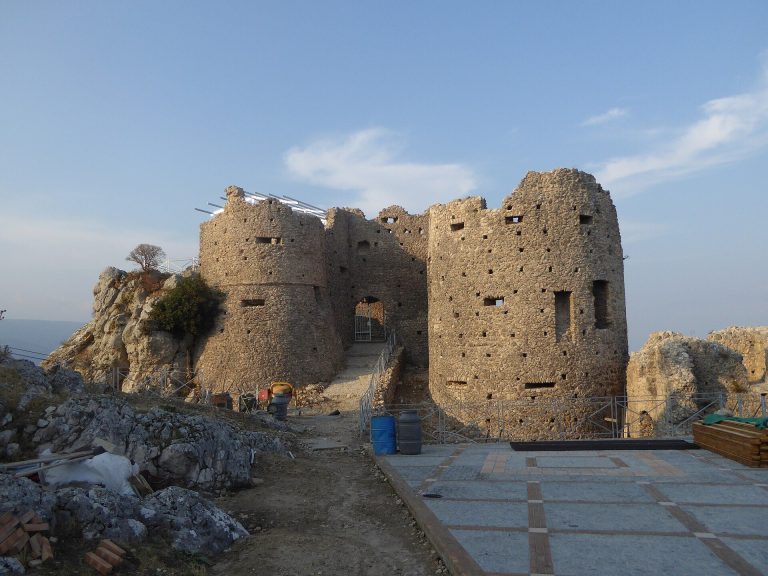
The surviving complex is centred on a basilica built in the second half of the eleventh century. Its design occupies a transition between Byzantine and Norman traditions, combining the character of a Byzantine church with dimensions associated with Norman construction. The church’s walls, dome, apses, transept arms, painted decoration, and liturgical furnishings together preserve the principal architectural and devotional features of the monastery.
The Basilica
Exterior and Dome
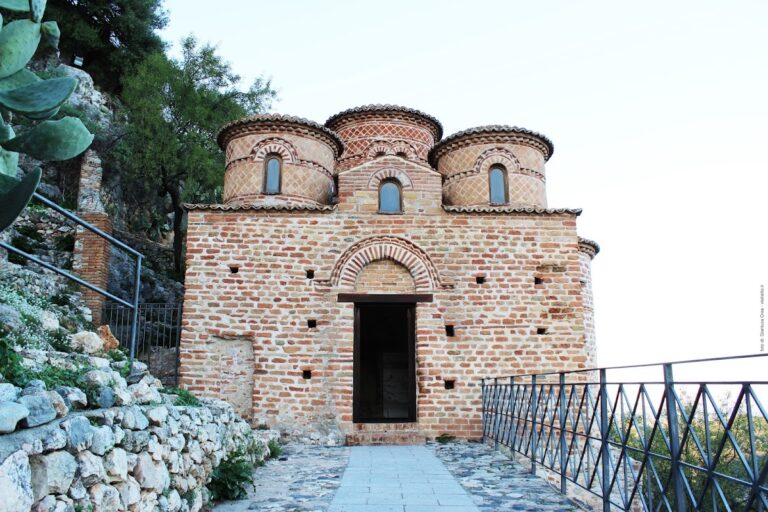
The exterior is predominantly Byzantine in character. Its perimeter walls use alternating courses of dressed stone and terracotta, framed by brick pilasters laid both flat and on edge. These pilasters end in arches, while those on the exterior of the main apse intersect to form pointed and rounded arches. The resulting motifs have been compared with forms associated with Arabic architecture.
The main apse, smaller exterior apses, sloping roofs, transept arms, and dome create a strongly vertical composition. Four corner pillars inside the church are enclosed by four arches that support the dome. Its base is cubic and bordered by two rows of saw-tooth ornament. Four niches at the level of four small windows chamfer the corners, changing the base into an octagonal form. An octagonal prism then supports the cylindrical dome, which ends in a shallow, flattened cap. The dome drum, the structural base supporting the dome, is encircled by 16 slender semicircular terracotta columns.
Interior and Furnishings
The arches over the nave and presbytery are pointed. The presbytery is the part of the church reserved for the clergy beside the sanctuary. Traces of frescoes show that painted imagery decorated the basilica from the time of its construction, including a notable depiction of Saint John Theristus.
The restored interior contains icons, paintings, frescoes, and liturgical furnishings. An iconostasis, the screen of icons separating the sanctuary from the nave, stands among these furnishings. A gold chandelier hangs in the central nave. Its large twelve-sided base carries a representation of an apostle on each side. The church is also materially connected with the monastery’s relic tradition through the relic of Saint John Theristus brought back from Stilo in 2001.