San Giovanni Battista: Parish Church and Black Christ Sanctuary in Chiavari
Site at a Glance
- Popularity
- Medium
- Country
- Italy
- Primary era
- Early Modern
- Eras represented
- Medieval, Early Modern, Modern
- Civilizations
- French, Genoese, Italian
- Site type
- Religious
- Remains
- Church
On this page18 sections
History
San Giovanni Battista is a Roman Catholic parish church in Chiavari, Italy, dedicated to John the Baptist. It belongs to the Diocese of Chiavari and serves as the seat of a parish in the Chiavari-Lavagna vicariate, a local grouping of parishes. Its first chapel was founded in 1181 by Count Bardone Fieschi, a Benedictine archpriest, or senior priest in a monastic order following the Rule of Saint Benedict.
Foundation and medieval parish
Fieschi’s cousin, a member of the Ravaschieri, another prominent Ligurian noble family, donated an orchard and a house near the road to Chiavari Castle for the chapel. The building was completed in 1182. In 1311 it became a parish church, although it remained dependent on the parish church of Santo Stefano in Lavagna until the seventeenth century.
By the fifteenth century the church had become too small and required repairs. A rebuilding project began in 1462 and was completed in 1468. In later years, a bell-tower project required structural reinforcement and led to the closure of the chapel of Saint Bartholomew. During the second half of the seventeenth century, the facing chapel of Our Lady of Mercy was also closed to create a symmetrical arrangement.
Rebuilding and the Black Christ
On 12 October 1623, the prior and the Major Council, Chiavari’s civic governing body, decided to demolish the fifteenth-century church and replace it with one of the same length and dimensions. A bequest helped pay for the work. The foundation stone was laid on 5 July 1624, and the rebuilt church was consecrated on 2 March 1631. In 1626, the brothers Achille and Prospero Costaguta, patrons of the presbytery and choir, commissioned the main chapel.
On 3 May 1641, a wooden crucifix was brought from the former Oratory of the Annunciation, also called the Arena or Marina Oratory. Placed in a chapel at the end of the right aisle, it made the church a sanctuary, a place of particular religious devotion, for the Black Christ. The church was then served by Franciscans, members of the Catholic religious order founded by Francis of Assisi.
The crucifix is linked by tradition to a fire in 1600 that destroyed the church of the Disciplinants. According to the story, it was the only object to survive, and the fire caused its dark color, which could not be removed by cleaning. Some historians placed its veneration as early as the thirteenth century, while later art-historical dating places the sculpture around the first half of the fifteenth century.
Devotion and later changes
The church’s principal feasts honor John the Baptist on 24 June and the Black Christ on 25 August. The latter recalls a penitential procession on 25 August 1835, when more than 7,000 people followed archpriest Antonio Maria Gianelli in prayer for the end of a cholera epidemic. Popular tradition connects the epidemic’s end with the procession and with a grace received from Our Lady of the Garden, a title of the Virgin Mary. Pope John Paul II recalled the traditionally attributed miracle during his visit to Chiavari on 18 September 1998. A procession carrying the crucifix is held every 25 years. The church formerly marked the octave of Corpus Christi, the eight-day observance following the Catholic feast honoring the Eucharist.
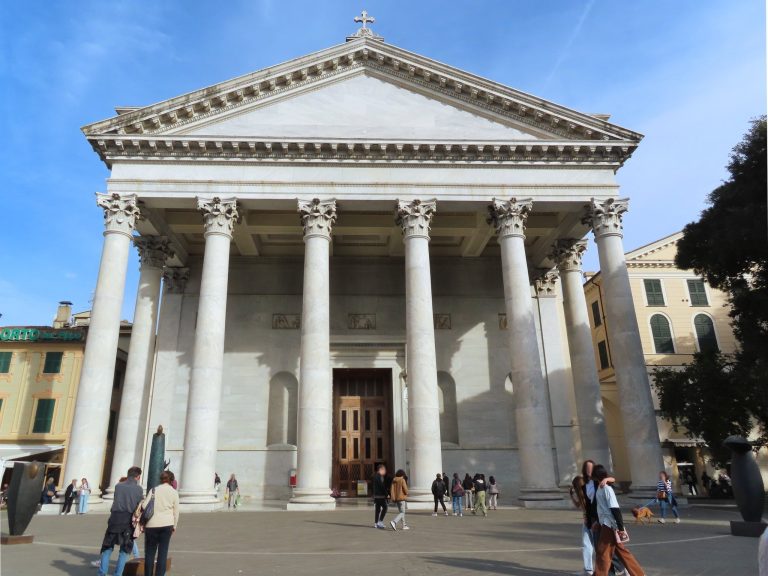
During the 1930s, the church’s marble façade was redesigned and rebuilt. San Giovanni Battista continues to serve as a parish church and as a focus of devotion to the Black Christ.
Remains
Plan and exterior
Church and bell tower
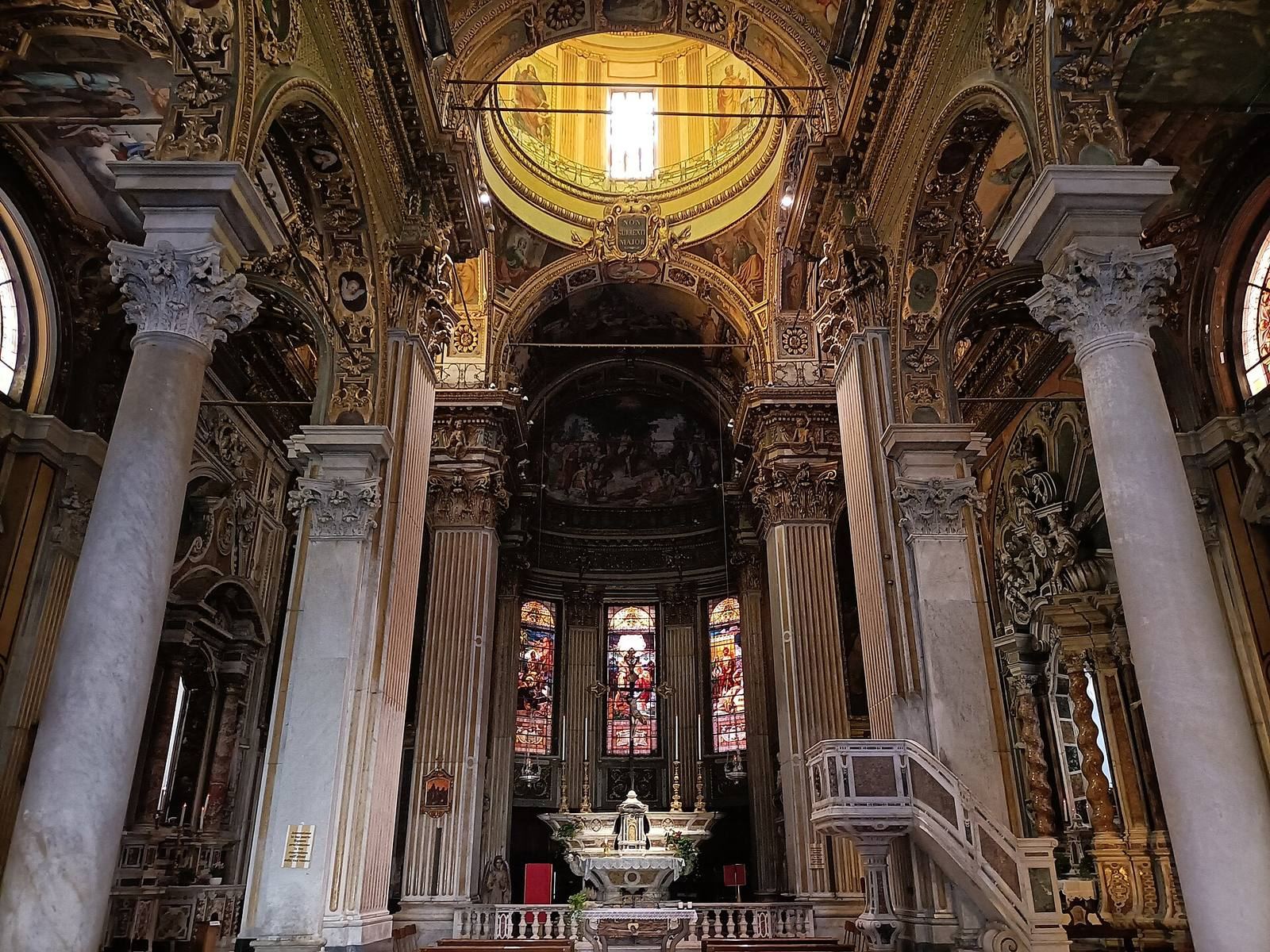
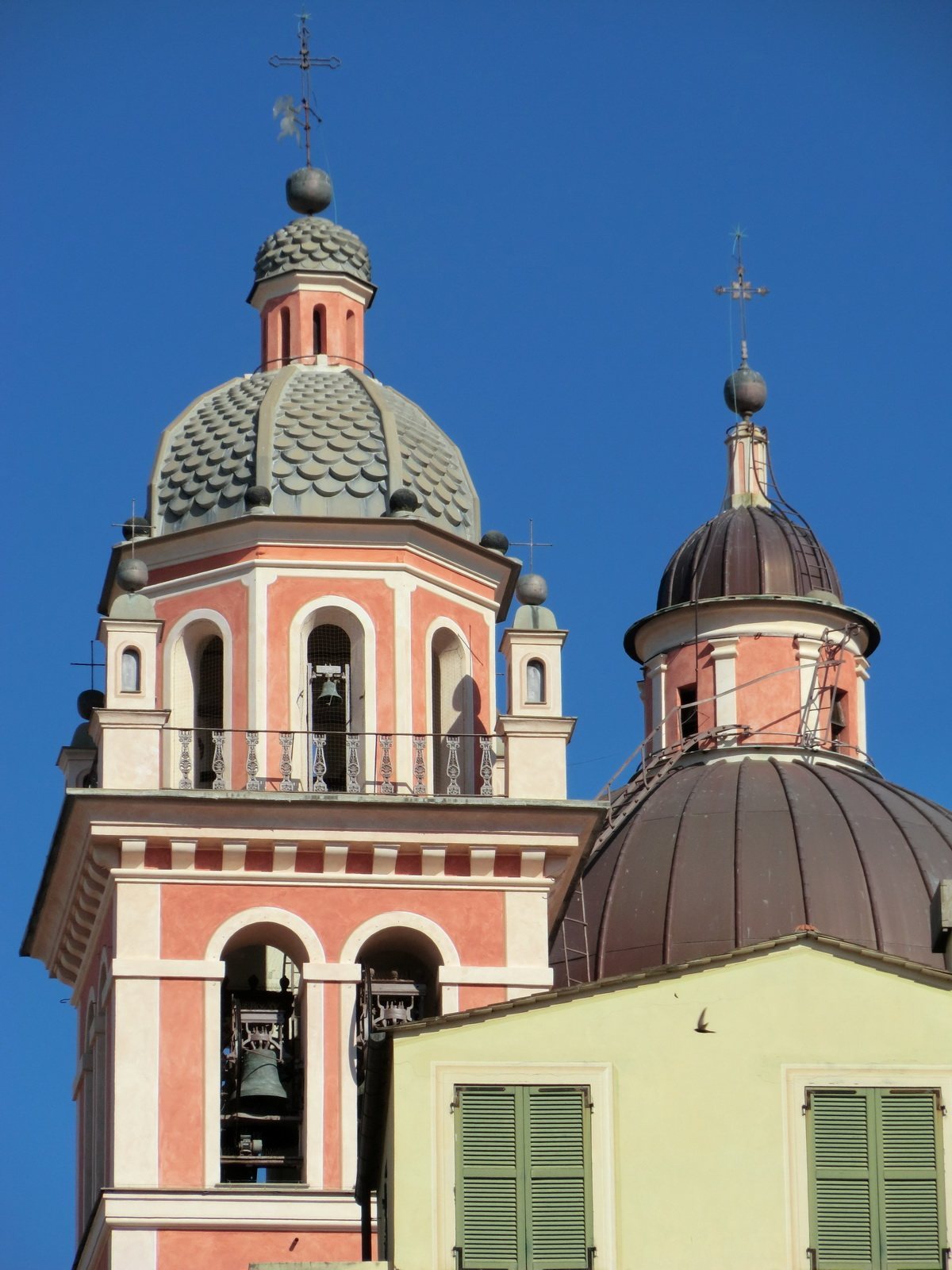
The church has three aisles, a dome, and four marble columns supporting smaller arches. Its central nave, the main lengthwise space, has a barrel-vaulted ceiling. Each side aisle is divided into three sections roofed with sail vaults, curved ceilings rising from square or rectangular spaces. The choir is semicircular, with eight altars along its sides. The bell tower, commissioned by the Ravaschieri family in 1557, contains eight bells tuned to D3.
Façade and side entrance
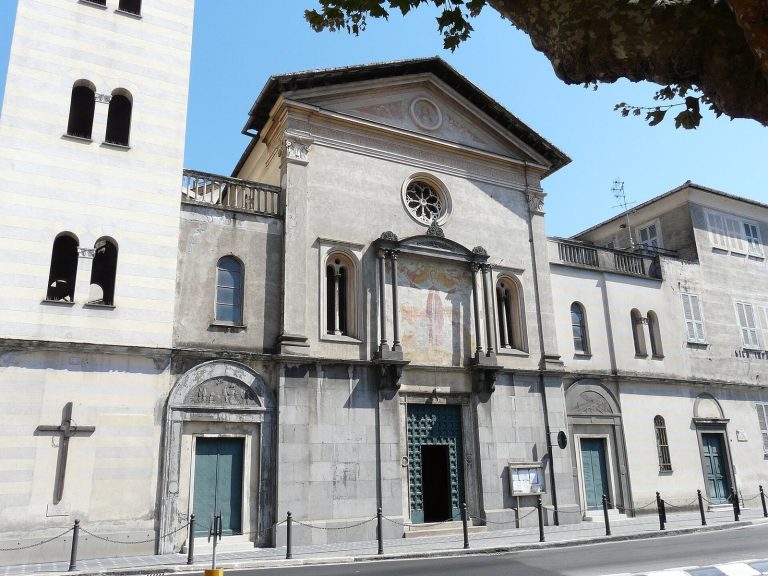
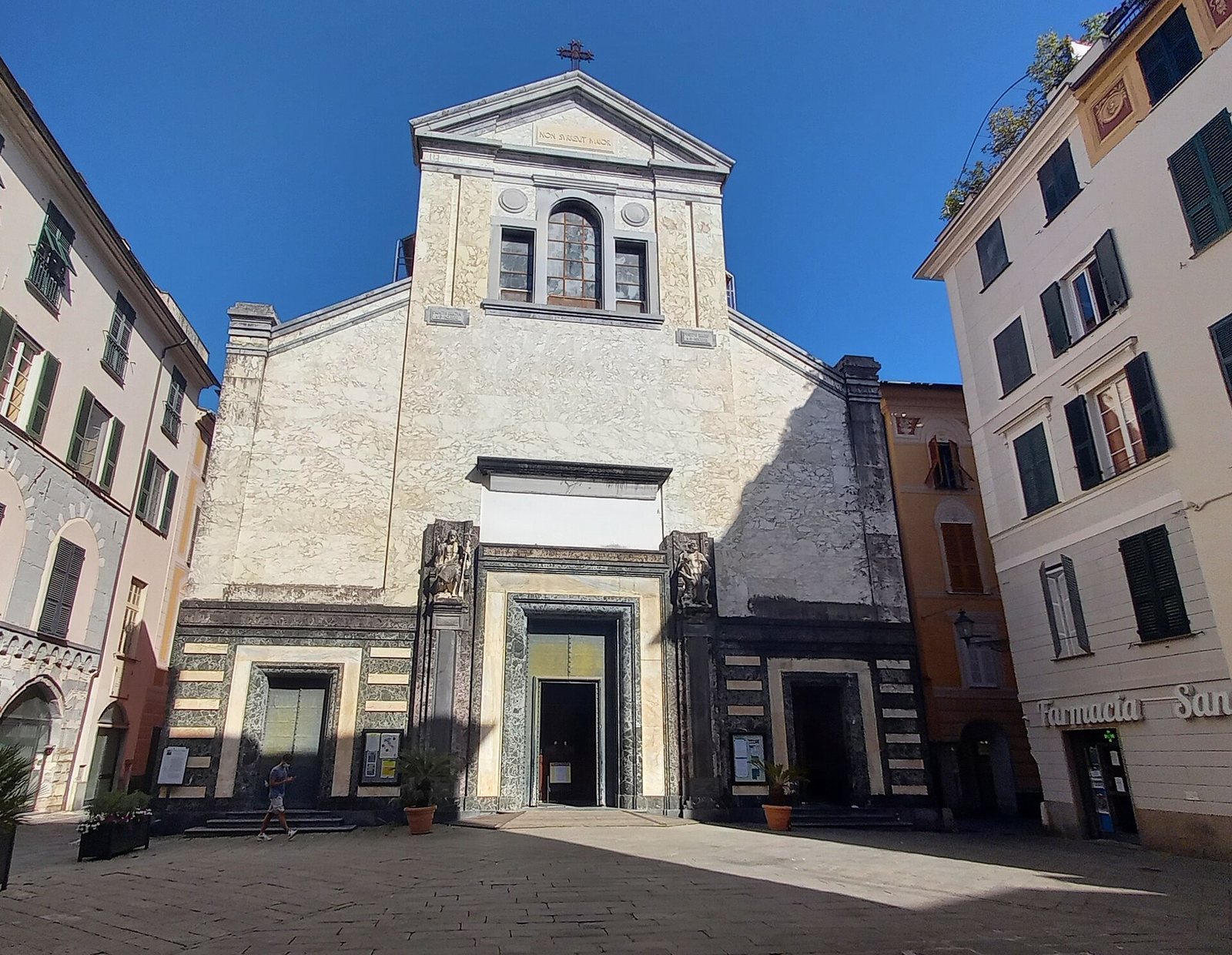
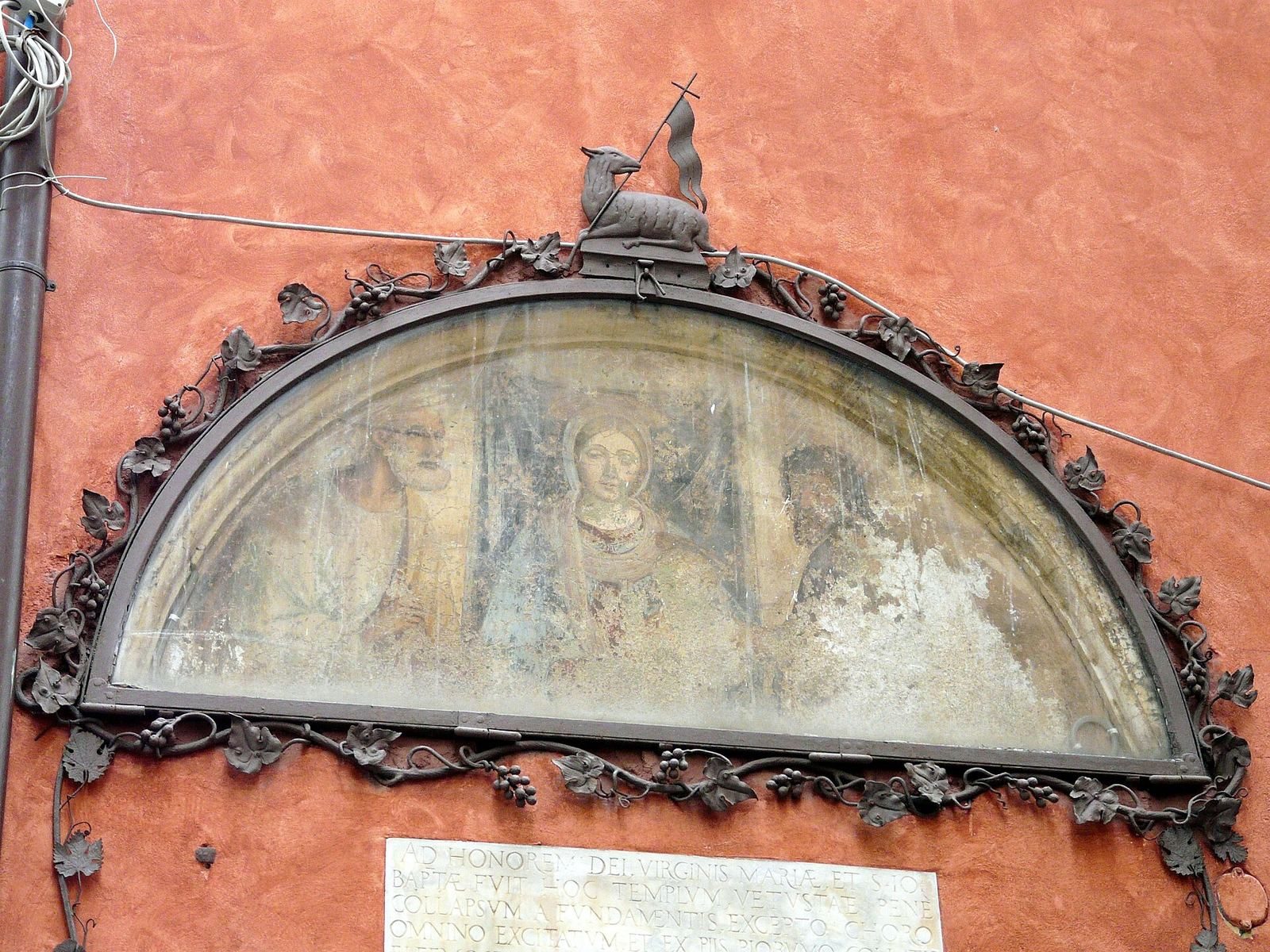
The façade combines white and black marble and has square portals, with a larger entrance at the center. Niches holding statues flank the main doorway and are supported by dark-stone pilasters, shallow supports attached to a wall. Its restrained design contrasts with the more richly decorated interior. The façade’s colors also differ from those of the bell tower and the dome, which is covered in green tiles. Above a portal on the church’s right side, a sixteenth-century fresco of the Madonna and saints fills an arched panel.
Altars and sacred sculpture
Main altar and choir
The main altar, made by Francesco Maria Schiaffino in 1728, has a shell-shaped design and combines Spanish Broccatello and white marble. A wooden crucifix by the Genoese sculptor Anton Maria Maragliano stands above it. The wooden choir stalls were made by Michele Torriglia in 1632.
Chapel of the Swallows Crucifix
At the end of the right transept, the crosswise arm of the church, a sculptural altar by Schiaffino holds the Black Christ. The altar was formerly dedicated to Saint Bartholomew and is now associated with the Swallows Crucifix. Statues of the prophets Isaiah and Malachi, made by Luigi Brizzolara in 1900, stand in the chapel.
Altars in the right aisle
The first altar on the right is dedicated to the Assumption. Built in the eighteenth century, it contains Domenico Piola’s Assumption of the Virgin, painted in 1676, and a fifteenth-century Madonna and Child attributed to Fra Bernardino Fasolo above the altar’s horizontal upper section. The next altar, dedicated to Saint Peter, holds Orazio De Ferrari’s Saint Peter Receiving the Keys, a seventeenth-century painting. The third, dedicated to Saint Joseph, contains Fiasella’s Death of Saint Joseph. The three altars were made by Giuseppe Ferrandini.
Rosary altar
The left transept altar, dedicated to Our Lady of the Rosary, was made in 1656 from French red marble. Carlo Borzone’s depictions of the Mysteries of the Rosary appear on it, while statues of Saint Dominic and Saint Catherine of Genoa, made by Francesco Falcone in 1933, flank it. The altar houses a carved, painted, and gilded wooden Madonna of the Rosary made by Maragliano and his workshop in 1718. The Virgin sits on a throne of clouds among angels and cherub heads, holding Jesus and offering the faithful rosary beads.
Other side altars
The altar of Our Lady of the Angels, made by Ferrandini, contains a painting of that subject and a statue of Saint Anthony Abbot. An altar dedicated to Antonio Maria Gianelli holds Ubaldo Oppi’s painting of Gianelli preaching penance to protect Chiavari from plague, with the associated miracle of the swallows. The eighteenth-century Annunciation altar contains Domenico Fiasella’s Annunciation and a sixteenth-century panel of God the Father by an unidentified artist.
Paintings and organ
Presbytery and apse
Giovanni Battista Carlone’s paintings in the presbytery, the area around the altar, depict episodes from the life of John the Baptist: John the Baptist Rebuking Herod, The Dance of Salome, The Baptism of Jesus, The Birth of John the Baptist, and The Martyrdom of John the Baptist. His Preaching of John the Baptist is painted on the curved ceiling at the church’s end.
Aisle and chapel paintings
Giuseppe Galeotti’s eighteenth-century Invention of the Cross is displayed high in the right aisle. A painting of the Battle of Lepanto in the left aisle has a lower part by Galeotti and an upper part by Carlone. Other works include Barnaba da Modena’s Virgin of Mercy; Davide Beghè’s paintings in the Saint Peter and Assumption chapels, dated 1888 and 1889 respectively; and Angelo Barchi’s work in the Chapel of the Angels and a separate painting of Saint Anthony.
Further paintings include Chiarella’s depiction of Blessed Father Baldassare Ravaschieri and Pianello’s Rosary. Three medallions in the main nave, attributed to Pianello, show episodes from John the Baptist’s life. Pianello’s depiction of Saint Joseph and a crucifix by Coppola are in the right nave, along with Beghè’s ceiling paintings of Saint Nicholas of Bari and Saint Peter. A painting of Saint Anthony is attributed to Solari dello Schoner.
Organ
The church’s organ was built in 1808 by the Serassi brothers of Bergamo.