San Giorgio: A Baroque and Neoclassical Church in Genoa
Site at a Glance
- Rating
- 4.5
- Popularity
- Very Low
- Country
- Italy
- Primary era
- Early Modern
- Eras represented
- Early Modern, Modern
- Civilizations
- Genoese, Kingdom of Sardinia
- Site type
- Religious
- Remains
- Church
On this page16 sections
History
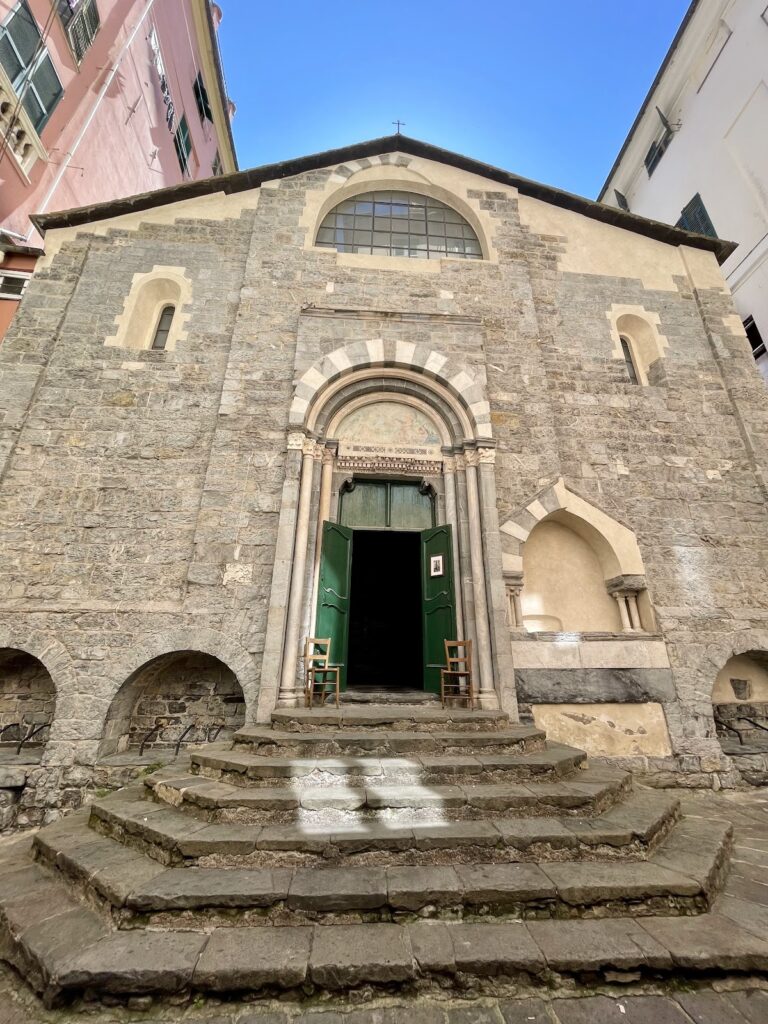
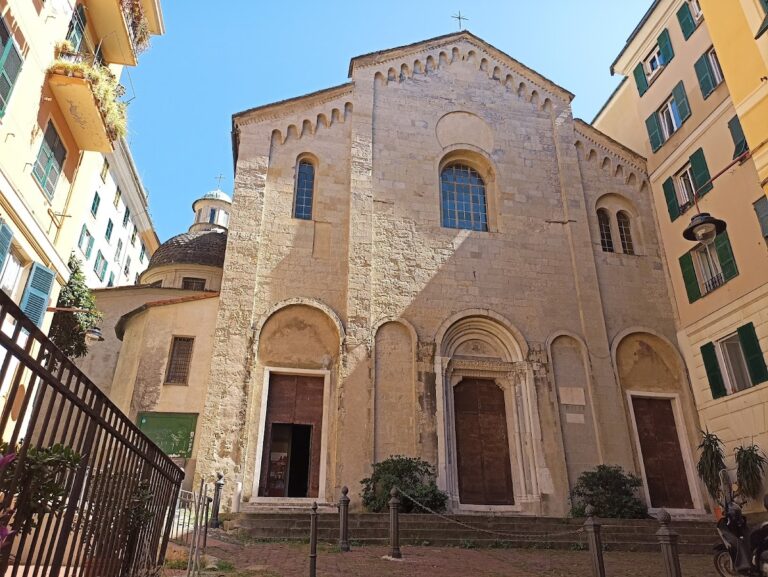
San Giorgio is a Baroque and Neoclassical church in Genoa, Italy, rebuilt on a greatly enlarged scale during the seventeenth century and completed through nineteenth-century works. The church stands in Piazza San Giorgio, an area traditionally identified with Genoa’s Roman Forum, and its dedication reflects the long local veneration of Saint George, the Christian martyr widely regarded as a military patron.
Roman and Early Medieval Setting
Piazza San Giorgio continued to serve as a place where the population assembled during the early Middle Ages. Roman-mile measurements on the Via Aurelia and Via Postumia were calculated from this area, reinforcing its importance within the ancient city. The cult of Saint George is traditionally said to have reached Genoa during the Byzantine period and remained associated with the army. His image appeared on the Vexillum, the military standard of the Republic of Genoa, which was kept beside the commanders’ sceptre.
In 544, Genoa had a Byzantine garrison under Bono, the nephew of the general Giovanni. This military presence has prompted the hypothesis that an early chapel dedicated to Saint George stood beside the garrison, although the chapel’s existence at that date is not directly established. The first document confirming the church’s existence dates from 947. A parchment of 964 records the chapel in a property exchange between Eldeprando, son of Zangulfo, and Teodolfo, bishop of Genoa.
Collegiate Church and Civic Devotion
By January 1139, a donation made at San Giorgio shows that the institution had developed from a chapel or basilica into a collegiate church. After Siro II became Genoa’s first archbishop in 1132, the reorganization of the archdiocese converted cathedral-dependent minor churches into parishes. San Giorgio acquired a chapter, a body of canons serving the church, headed by a provost, the senior cleric of the chapter.
San Giorgio also took part in Genoa’s military and civic religious life. In 1147, an offering was made there to support the expedition against Almería. After the conquest of Almería, the priest Vassallo brought two bronze doors to the church. Following Luciano Doria’s victory over the Venetians commanded by Vettor Pisani in 1379, an altar dedicated to Saint John was established at San Giorgio. Every 6 May, the city authorities and inhabitants solemnly offered a golden pallium, a ceremonial cloth or banner, at the altar.
An altar dedicated to Saint Bernardino was added in the mid-fifteenth century and administered by the merchants’ guild. It was still standing, though ruined, to the left of the entrance in the eighteenth century.
Rebuilding and Theatine Administration
By 1550, the medieval church had become dangerous. A proposal to replace it was neglected, and the building remained unused for twelve years. The parishioners then petitioned to repair and rebuild the church at their own expense. A papal bull dated 9 August 1565 commissioned the Genoese archbishop Agostino Salvago to supervise the work. Gio Batta Chiappe received administration of the parish through an apostolic letter of 14 April 1564, and in 1566 the resident parishioners gained the right of patronage, meaning the legal right to nominate the provost permanently.
Restoration proceeded slowly. Nicolò Raggi commissioned Luca Cambiaso to paint a fresco cycle, which was later destroyed when Gio Battista Castello redecorated the church in the seventeenth century. Cambiaso probably also received the commission for three choir canvases between 1570 and 1580. After Chiappe died in 1608, the parishioners elected Gio Maria Gando as provost, and Archbishop Orazio Spinola confirmed the election in 1609.
The Theatines, a Catholic religious order founded in Rome in 1524, entered Genoa during the second half of the sixteenth century. In 1624 they opened an oratory dedicated to Saint Charles Borromeo on the ground floor of their house in Piazza San Giorgio. Opposition from the provost led the Senate to close it, but the oratory reopened in 1629.
After Gando’s death in March 1629, the parishioners transferred their patronage rights to the Theatines of San Siro. Pope Urban VIII confirmed the transfer on 30 May 1629. Disputes with Archbishop Domenico De Marini delayed the change in administration, which was established between 1631 and 1632, when the priest Domenico Giordano was assigned to the church.
Seventeenth-Century Reconstruction
The Theatines sought permission to enlarge and rebuild San Giorgio in 1657, initially without success. Pope Alexander VII granted them full control of the church and parish in 1660, after which reconstruction began. The architect is not known with certainty. The completed design was associated with Giacomo Lagomaggiore, while Giovanni Antonio Viscardi has been proposed as an influence on the dome.
Lagomaggiore’s plan was approved in 1695 in connection with road enlargements in Via Giustiniani and Piazza San Giorgio. The rebuilt church was approximately twice the size of its predecessor in both plan and elevation. Its perimeter walls and dome were completed in 1701, while the consecration was renewed in 1700.
Nineteenth and Twentieth-Century Changes
The dome began to settle in 1812 and was repaired at the city’s expense to a design by Agostino Pareto. Part of the dome collapsed on 6 January 1821, leading to a prolonged dispute among the parish, the city administration, and authorities in Turin over scaffolding and repair costs. The dispute involved petitions, legal arguments, and correspondence concerning confiscated Theatine and parish property. In 1825, Pietro Rell recovered some improperly confiscated real estate and used it, together with donations from the faithful, to complete the restoration.
Nineteenth-century improvements included work on the baptistery and several chapels between 1816 and 1821, restoration and redecoration campaigns from the 1840s onward, completion of the facade after Andrea Carpineti’s design was approved in 1859, dome repairs in 1890, and further strengthening ordered in 1892. The former Theatine administration ended with the death of the last Theatine provost, Leandro Nasi, in 1800.
Bombing on 23 October 1942 damaged the roof and service areas. A heavier raid on 13 August 1944 caused the collapse of Palazzo Lagorio against the church wall near the Chapel of Our Lady of Mercy. The impact destroyed the chapel’s altar, raised base, and balustrades, while the fresco depicting Esther and Ahasuerus was lost. The altar was later restored under parish priest Rodolfo Serra, in cooperation with the municipal fine-arts office and parishioners.
The parish was abolished on 7 March 1961. The parish priest of San Lorenzo became San Giorgio’s rector, and the title was transferred to Sestri Ponente. The church is currently entrusted temporarily to Genoa’s Orthodox community, which celebrates the services of the Church of the Most Holy Transfiguration under the Moscow Patriarchate.
Remains
Plan, Dome, and Facade
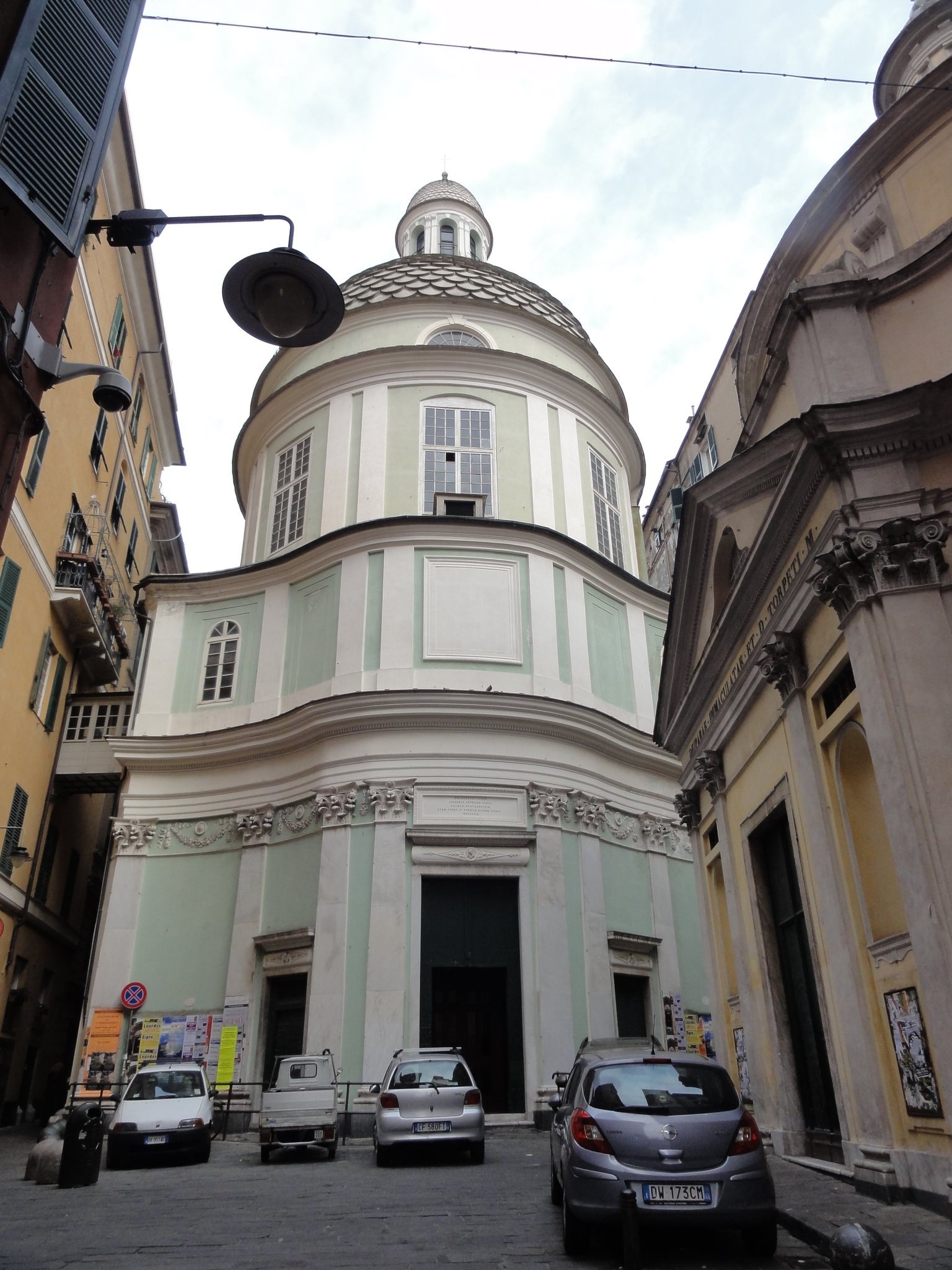
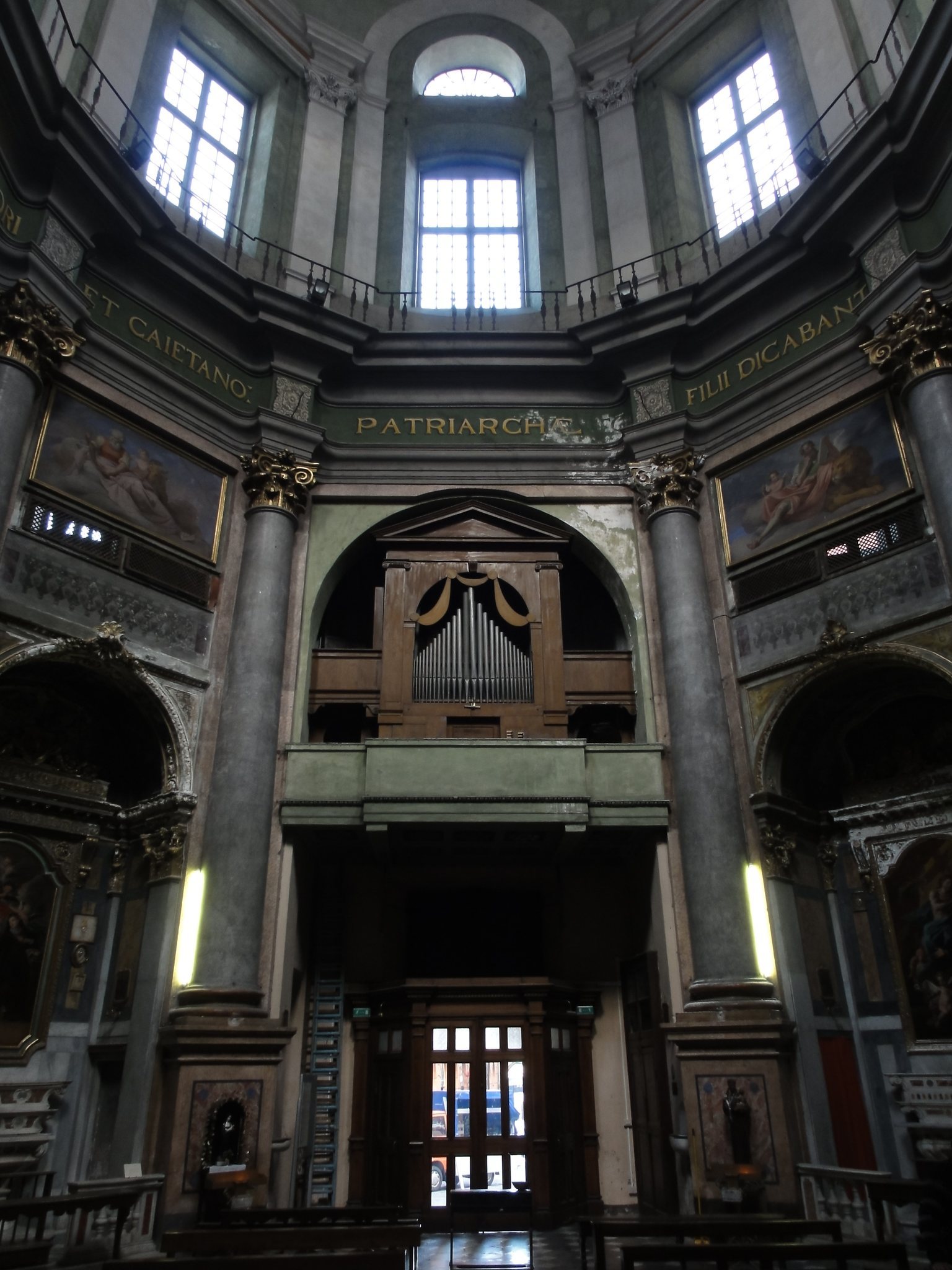
San Giorgio survives as a large Baroque and Neoclassical church organized around a central dome. The reconstruction expanded both the floor plan and the elevation to roughly twice the dimensions of the medieval building. An early surviving project shows an oval dome supported by four pillars. A second project, dated 26 July 1697, shows a round dome carried by eight pillars and closely resembles the executed design. The dome was intended to cover the entire interior and to push the facade outward around the enlarged centre.
The facade remained unfinished and covered in rough masonry in 1859. Andrea Carpineti’s approved design introduced marble pilasters, capitals decorated with stucco festoons, and two lateral doors. Giuseppe Isola painted a fresco of Saint George in the upper rectangular section. The painting is now almost completely lost.
Bell Tower and Connecting Structure
Former Alberici Tower
The bell tower incorporates the former Alberici Tower. Its original crenellated upper section was replaced by two later storeys, one square in plan and the upper one round with a small dome. The tower was incorporated into the restored convent building at the end of the seventeenth century.
Bridge and Bells
The tower’s foundations rest on the stream running parallel to the Clavica dei Giustiniani, making the structure unstable. An aerial bridge connected the tower with the church and convent. Carpineti’s restoration design of 1847 was approved on condition that the planned iron-and-glass bridge be made simpler. Unsafe wrought-iron rosettes and a wrought-iron figure of Saint George were removed from the tower.
The tower underwent consolidation in 1894, repairs after storm damage in 1935, replacement of its connecting ties in 1938, and repairs after bombing in 1945. Three of its four bronze bells were recorded in 1836 and remained in place after the requisition decree of 1942.
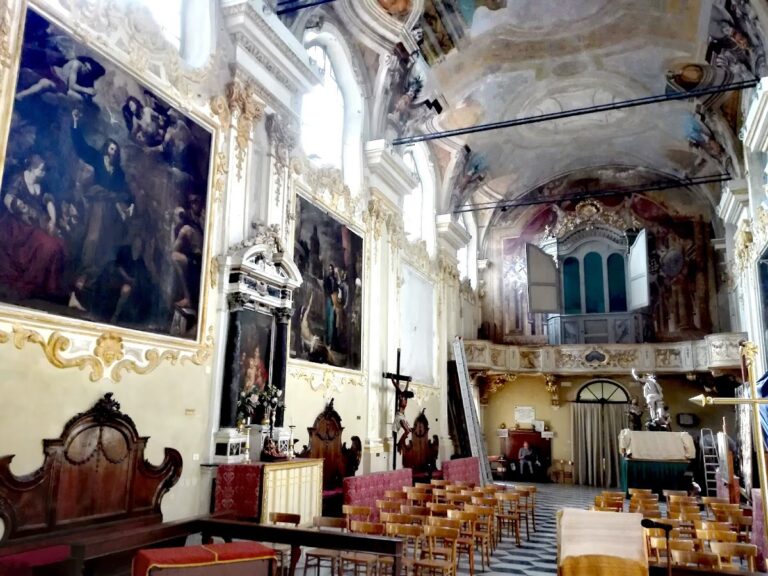
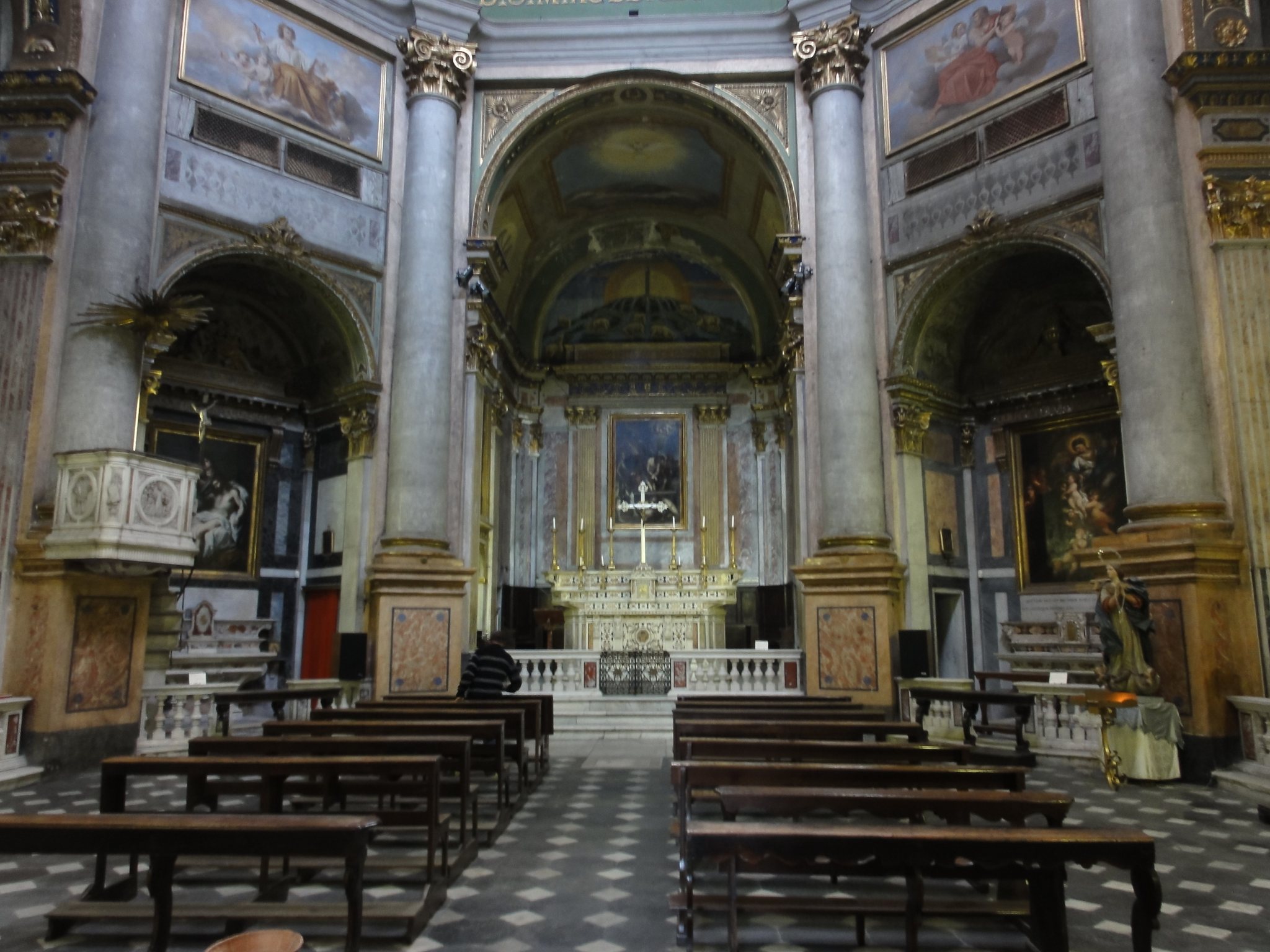
Interior Chapels and Decoration
Right-Hand Chapels
The first chapel on the right is dedicated to Saint Catherine of Genoa. Its altarpiece, attributed to Domenico Guidobono, depicts the Patient Christ and Saint Catherine of Genoa. The Iccardo sisters financed the chapel’s decoration in 1883.
The second chapel is dedicated to Our Lady of Mercy and commemorates the Savonese Marian miracle of 18 March 1536. It contains a marble Madonna donated by Giacomo Celesia and a statue of Blessed Antonio Botta. The chapel suffered heavy damage in 1944, but the statues survived among the rubble. Its altar, raised base, and balustrades were destroyed and later restored.
The third chapel is dedicated to Saint Cajetan of Thiene. Domenico Piola’s altarpiece shows the saint receiving the Child from the Madonna. An inscription states that Pittaluga financed the work in 1751. Marble, balustrades, stucco, and gilding were added in 1851.
Sancta Sanctorum
The Sancta Sanctorum, a specially revered inner sanctuary, was transformed in 1851. It contains Luca Cambiaso’s Decapitation of Saint George, Saint George in the Cauldron, and Martyrdom of Saint George on the Toothed Wheel. Filippo Bernacca restored the Cambiaso paintings between September 1851 and October 1852.
Mid-nineteenth-century frescoes above the altar depict the Holy Spirit over Chaos, a pelican as a symbol of Christ the Redeemer, and an eagle as a symbol of innocence. Three floor slabs lie outside the sanctuary. The left-hand slab dates from 1677 and is difficult to read, while the other two are illegible.
Left-Hand Chapels
The fourth chapel, to the left of the Sancta Sanctorum, is dedicated to Our Lady of Sorrows. It contains Claudio Coello’s painting of the Son taken down from the Cross and placed in the Madonna’s arms, together with Santo Panario’s Sacred Heart of Jesus. Antonio Ramorino donated Coello’s painting on 17 October 1844. It was installed in the third chapel on the left, where a wooden crucifix had previously stood.
The fifth chapel is dedicated to the Archangel Raphael. Before 1811 it was dedicated to Saint Charles Borromeo and served as the chapel of a confraternity associated in 1612 with the Confraternity of Saints Ambrose and Charles Borromeo. Its altarpiece by Gerolamo Costa stands in a gilded wooden frame, and Giuseppe Passano painted the lunette fresco.
The last chapel on the left is dedicated to Blessed Angelo Marinoni, one of the early followers of Cajetan of Thiene. Giuseppe Isola painted the Four Evangelists above the windows and in the curved triangular supports of the dome. The chapel received stucco and marble work in 1885.
Paintings, Furnishings, and Later Works
Giuseppe Isola painted the Evangelists in the arches above the tribune and the Stories of Esther before Ahasuerus in the upper part of the Chapel of Our Lady of Mercy. The Esther fresco was destroyed during the Second World War, although a photograph survives in the sacristy.
The church contains a marble pulpit acquired during Giuseppe Parodi’s tenure as parish priest. Santo Panario supplied a statue of Saint Joseph and a Stations of the Cross, which was canonically established in 1879. A bust of the former parish priest Giuseppe Terrile, made by Giuseppe Molinari, was originally installed outside the first chapel on the left and is now kept in the sacristy.
The central pillars were restored in the early twentieth century using Sicilian jasper, Spanish brocatello, antique yellow marble from Siena, African breccia, and rods and bands of lapis lazuli. The Chapel of Saint Catherine of Genoa received stucco, marble, and gilding in 1887, completing a series of later interventions that shaped the church’s present interior.