San Geremia: A Baroque Parish Church and Sanctuary in Venice


Site at a Glance
- Rating
- 4.6
- Popularity
- Medium
- Country
- Italy
- Primary era
- Early Modern
- External website
- Open
- Eras represented
- Medieval, Early Modern, Modern
- Civilizations
- Venetian
- Site type
- Religious
- Remains
- Church
On this page13 sections
History
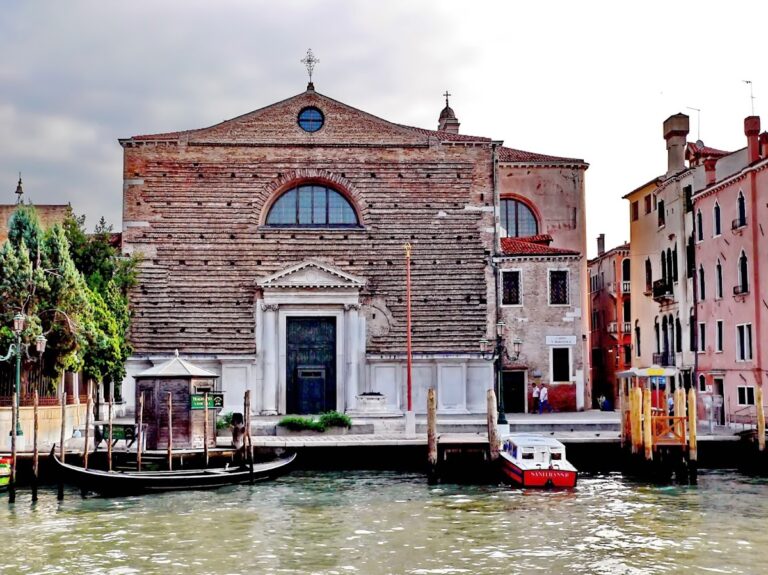
San Geremia is a Roman Catholic parish church in Venice, Italy, rebuilt as a Baroque church from 1753 and dedicated to Saint Jeremiah the Prophet and Saint Lucy the Martyr. It belongs to the Patriarchate of Venice, the Catholic ecclesiastical jurisdiction headed by the Patriarch of Venice, and remains a place of parish worship, pilgrimage, and devotion to Saint Lucy.
Medieval origins
The first church was established in the eleventh century. Mauro Tosello and his son Bartolomeo are traditionally regarded as its founders, intending the building to house relics of Saint Bartholomew brought from Apulia in 1043. Its dedication to Jeremiah, an Old Testament prophet, was shared with the Venetian churches of San Giobbe and San Moisè and reflected the influence of Eastern Christianity in Venice.
Under Doge Sebastiano Ziani, the elected head of the Venetian Republic in the twelfth century, the church was rebuilt and then reconsecrated in 1292. A plaque beside the main entrance commemorates that consecration. In 1206, the church sheltered the remains of Saint Magnus of Oderzo, who had taken refuge there while fleeing the Lombards.
Eighteenth- and nineteenth-century rebuilding
The medieval church was demolished and replaced by a new structure designed by Carlo Corbellini. Construction began in 1753, and the first Mass in the rebuilt church was celebrated on 27 April 1760, while work was still under way. Building continued into the early nineteenth century, and Patriarch Giacomo Monico consecrated the completed church in 1839.
During the siege of Venice in 1848–49, part of the First Italian War of Independence, Austrian shelling caused a fire and damaged the facades. The two principal facades were rebuilt later in the nineteenth century with financial support from Baron Pasquale Revoltella.
Saint Lucy and the modern sanctuary
When the nearby Church of Santa Lucia was demolished for the construction of Venice’s railway station, Saint Lucy’s remains were transferred to San Geremia in 1861. A chapel for the relics was completed in 1863 using material from the demolished church’s presbytery, and Saint Lucy was then added to San Geremia’s dedication.
On 15 June 1930, Patriarch Pietro La Fontaine consecrated a new altar by Gaetano Rossi, which contained a marble urn for the saint’s remains. In 1955, Angelo Giuseppe Roncalli, then Patriarch of Venice and later Pope John XXIII, arranged for a silver mask to protect the relics’ face. The chapel and urn were restored in 1968 through the initiative of parish priest Aldo Fiorina and parish donations.
Armed men stole Saint Lucy’s body from the church in 1981. Her head became detached during the theft, but the relics were recovered outside Venice in December of the same year without a ransom being paid. Since 2018, San Geremia has also held the title of Sanctuary of Saint Lucy.
Remains
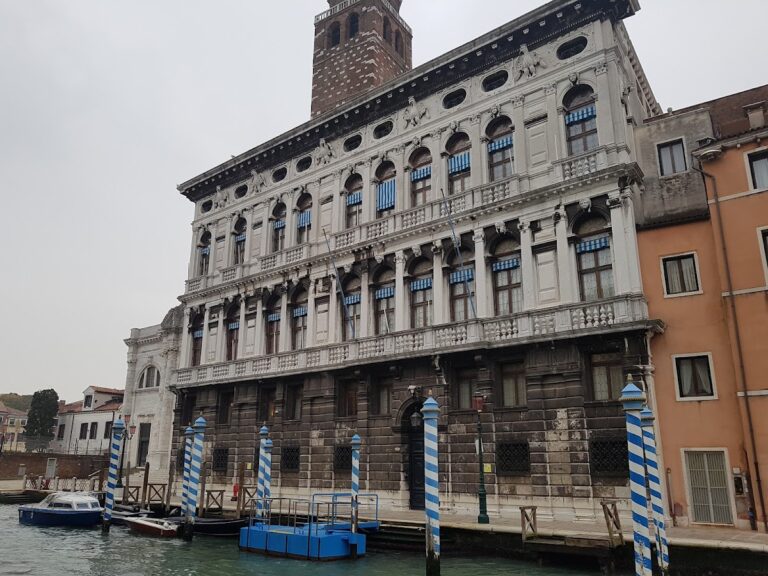
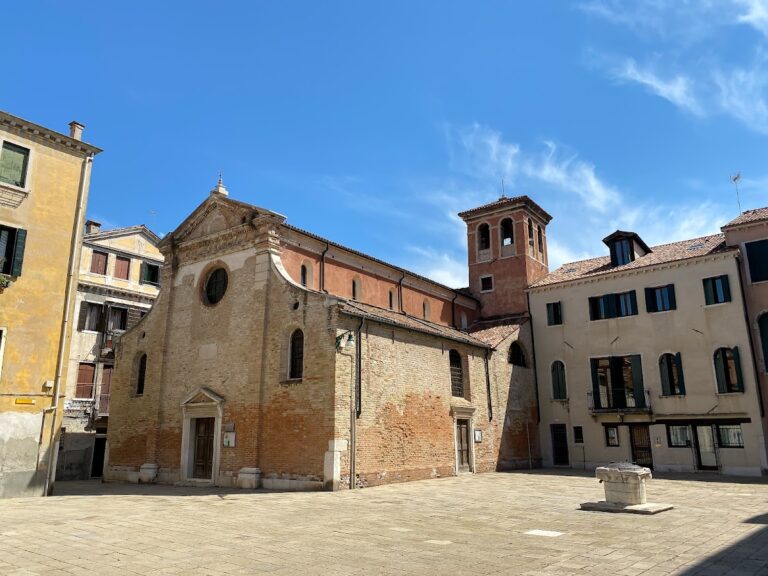
San Geremia stands between the Grand Canal and the palaces of Labia and Flangini. Its apse faces the Grand Canal, while its other principal elevations face Campo San Geremia and the Rio di Cannaregio. The present brick-and-marble church has a Greek-cross plan, with four arms of approximately equal length meeting beneath a central dome. Each arm ends in a semicircular apse, and half-domes cover the ends of the cross arms.
Exterior and medieval campanile
Nineteenth-century facades
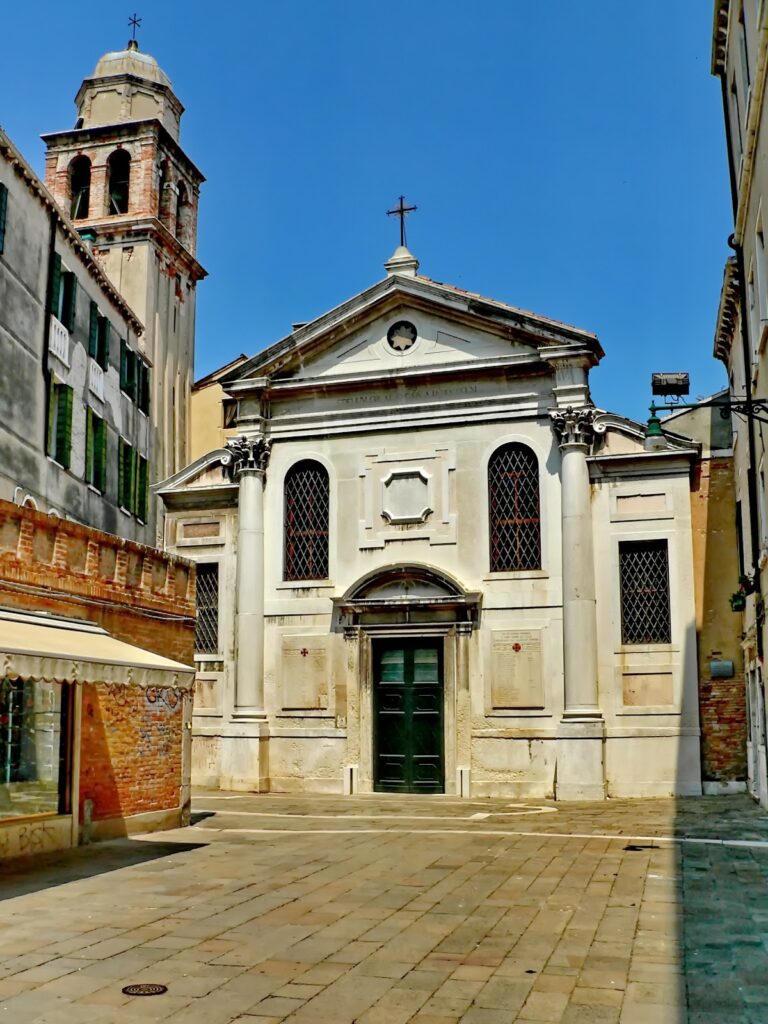
The church has two similar marble facades, one facing Campo San Geremia and the other facing the Rio di Cannaregio. They were built during the nineteenth century after the earlier elevations were damaged by Austrian bombardment and fire. Their construction was financed by Baron Pasquale Revoltella.
Brick bell tower
The 43-metre brick campanile, a bell tower associated with an Italian church, survives from the earlier building and probably dates from the twelfth century. It is among the oldest bell towers in Venice. Two narrow Romanesque mullioned windows, openings divided by slender supports, appear at its base, while an octagonal drum crowns the tower.
Interior and artworks
Main altar and counter-facade
The interior uses relatively sober off-white surfaces enlivened by coloured details. The main altar and presbytery, the area around the principal altar reserved for the clergy, contain marble statues of Saint Jeremiah and Saint Peter made by Giovanni Ferrari in 1798. Behind the altar, Agostino Mengozzi Colonna’s monochrome fresco shows two angels supporting a globe.
The counter-facade, the interior wall opposite the main external facade, displays Palma the Younger’s Meeting of Saint Joachim and Saint Anne, dated 1595, and Leandro Bassano’s The Glory of Saint Augustine, painted in 1619–1622 for the altarpiece of the demolished Church of the Annunciation. The organ doors, attributed to Palma the Younger, depict the Annunciation, Saint Augustine, and Saint Lucy. Two organ cases stand on opposite sides of the main altar, although only one contains the actual organ. A bronze bell from 1813 stands at the foot of the counter-facade, and a restored clock mechanism dating from 1500 is displayed on its left side.
Transept and right-side works
The right transept, an arm crossing the church’s main axis, contains Palma the Younger’s The Virgin Assisting at the Coronation of Venice by Saint Magnus and Bernardino Lucadello’s Presentation of Mary in the Temple. The first right-hand altar holds Pietro Antonio Novelli’s Purification of Mary, while the second contains Johann Carl Loth’s Christ Supported by Angels.
In the right chapel are two paintings by Palma the Younger and Giovanni Marchiori’s marble group showing the Virgin Mary between Saint Francis de Sales and Saint John Nepomucene. The right apsidal chapel contains Palma the Younger’s Victory of Saint Thomas Aquinas over Temptation and The Expectation of the Birth, both dated 1628.
Left-side altars and other paintings
The left-side altars contain Giambattista Mengardi’s Holy Family and Agostino Ugolini’s Descent from the Cross. Other paintings include Sebastiano Santi’s Crucifixion, Francesco Maggiotto’s Death of Saint Joseph from 1805, and Palma the Younger’s Saint Lucy.
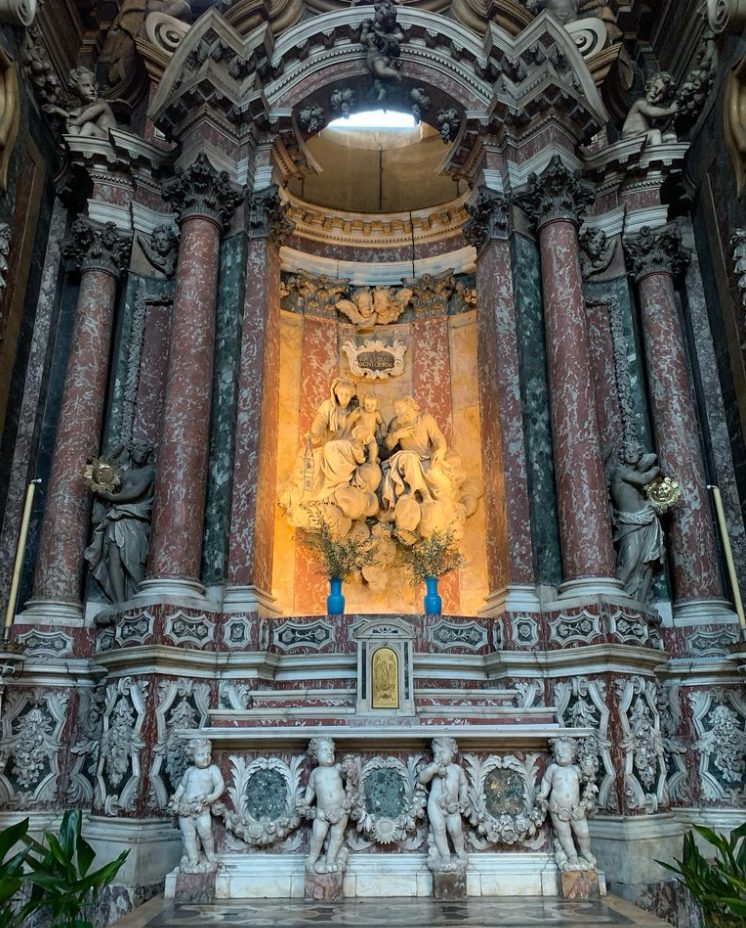
Giovanni Maria Morlaiter’s Madonna of the Rosary, also known as Madonna in the Rose Garden, and Giovanni Marchiori’s Immaculate Conception add further Venetian works to the interior. Marchiori is also represented by the marble group of the Virgin Mary between Saint Francis de Sales and Saint John Nepomucene. Palladio, the sixteenth-century Italian architect whose classical designs influenced later architecture in the Veneto, is associated with elements used to embellish the Saint Lucy chapel.
Saint Lucy chapel and relics
The Saint Lucy chapel occupies the left side of the church. It contains the saint’s partially preserved body in a marble urn. Her dried hands and feet remain visible, while a silver mask covers her face. The chapel also incorporates material from the demolished Santa Lucia church and includes Francesco Fontebasso’s Two Episodes from the Life of Saint Leonard and a Saint Vincent Ferrer attributed to A. Marinetti.
Other relics preserved at San Geremia include bones attributed to Saints Thomas and Bartholomew and a rib attributed to Saint Mary Magdalene. A Latin inscription on the apse wall facing the Grand Canal states that Saint Lucy of Syracuse, a virgin and martyr of Christ, rests in the church and asks for light and peace for Italy and the world. In Christian art, Saint Lucy is traditionally associated with the protection of sight and is often identified by eyes shown on a small plate.