San Filippo Neri: A Baroque Parish Church in Perugia
Site at a Glance
- Popularity
- Medium
- Country
- Italy
- Primary era
- Early Modern
- Eras represented
- Early Modern, Modern
- Civilizations
- Italian, Papal States
- Site type
- Religious
- Remains
- Church
On this page25 sections
History
San Filippo Neri, also known as the Church of the Immaculate Conception, is a Catholic parish church in Perugia, Italy. Founded by Filippini Fathers Orazio Mancini and Sozio Sozi, it was built in the seventeenth century in the Roman Counter-Reformation tradition. The Filippini are members of the Congregation of the Oratory, a Catholic community of priests founded by Saint Philip Neri.
Foundation and construction
Before construction, nine houses, several shops and cellars, and the eleventh-century baptistery of San Giovanni Rotondo were demolished to clear the site. Work began in May 1627 with a cornerstone ceremony led by Virginio Florenzi, bishop of Nocera Umbra, on behalf of Perugia’s bishop, Cardinal Cosimo de Torres, who was in Rome. Paolo Maruscelli designed the church and directed its construction, which was completed in 1665.
Maruscelli had worked for the Filippini in Rome since 1622. His design drew on Roman Counter-Reformation architecture and the Roman church of Santa Maria della Vallicella, also called Chiesa Nuova. The single nave, the church’s main lengthwise space, followed principles promoted by the Council of Trent, a major Catholic council whose reforms shaped Counter-Reformation practice. The arrangement encouraged worshippers to focus on services and made spoken words easier to hear.
The main façade was built between 1647 and 1663. Marcantonio Degli Oddi, Perugia’s vicar and a bishop from 1659, sponsored its completion. His family arms were placed in the façade’s pediment, the triangular upper feature, but were removed during the Napoleonic period.
The oratory and later history
The adjoining Oratory of Saint Cecilia was built in 1687–90 as a small theatre for religious exercises and musical performances. The Filippini regarded music as a means of spiritual recreation and education. After decades of neglect and disuse, the oratory was restored. Together, the church and oratory are Perugia’s only fully Baroque monuments.
In 1797, Commissioner Tinet removed Guido Reni’s Assumption of the Virgin from the church during the Napoleonic seizures of artworks. Its loss was a major blow to the church. From the first half of the nineteenth century, the Confraternity of the Addolorata, a Catholic lay association devoted to Our Lady of Sorrows, venerated a statue of her. A chapel for the statue was built in 1905.
Each year on Passion Friday, two weeks before Easter, the church holds La Desolata, a sacred performance with the Cantori Umbri directed by Maestro Sabatini.
Remains
The church stands in Perugia’s historic centre, in the Porta Santa Susanna district, along the axis of Via dei Priori, Via della Cupa, and Via della Stella. Its main façade faces Piazza Baldassarre Ferri, while the adjoining Oratory of Saint Cecilia forms part of the same Baroque ensemble.
Exterior
Main façade
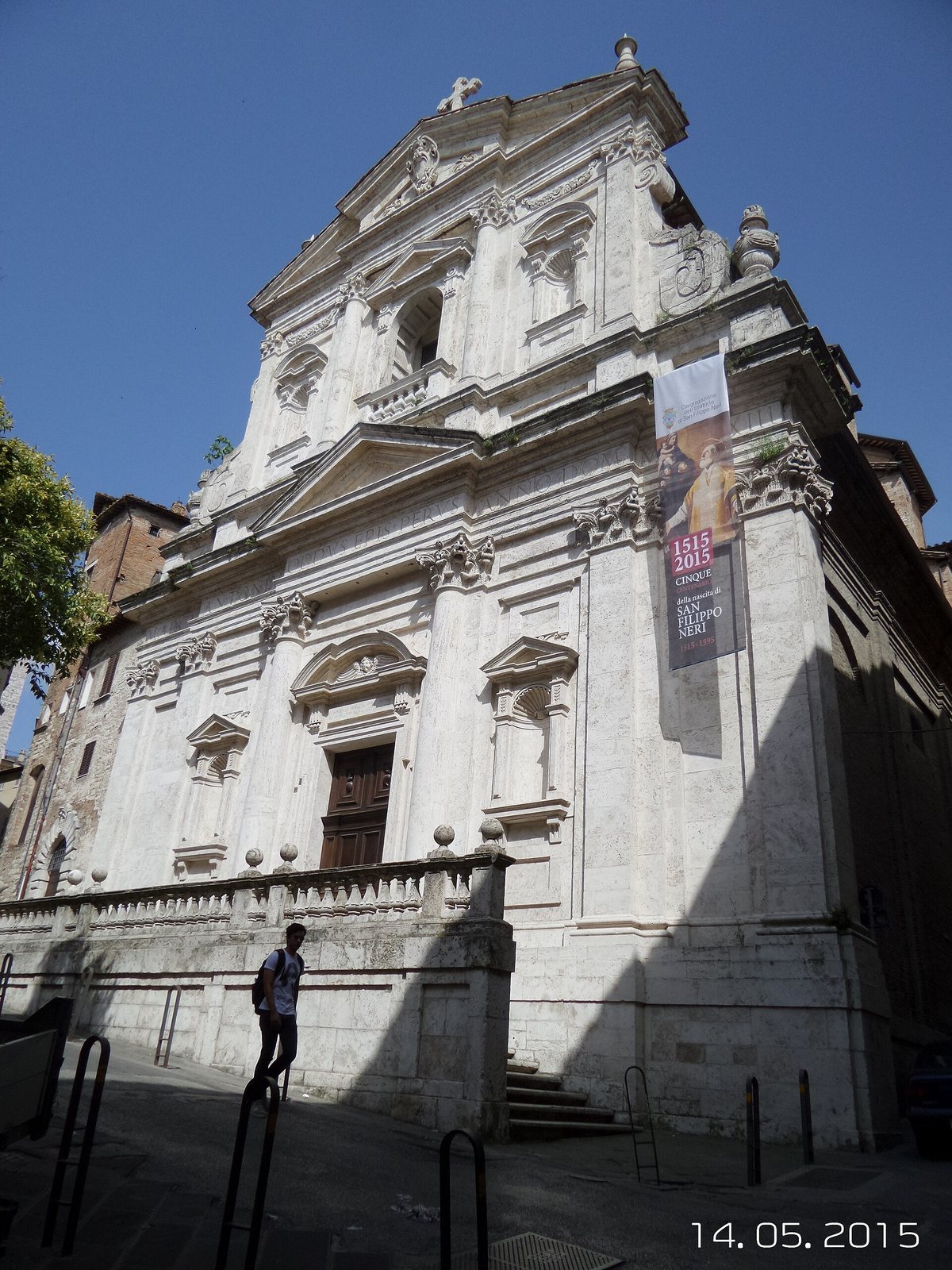
The main façade is built of travertine. Its two levels have Corinthian pilasters, shallow attached columns with ornate capitals, and empty niches. Above these are two scroll-shaped stone forms, two stone vases, and a triangular pediment. A broad staircase with two flights and a balustrade leads to the main entrance.
Side façade
Along Via dei Priori, the side façade is exposed brick. It has a small entrance, decorative mouldings, and traces of large arches that have been filled in.
Interior layout
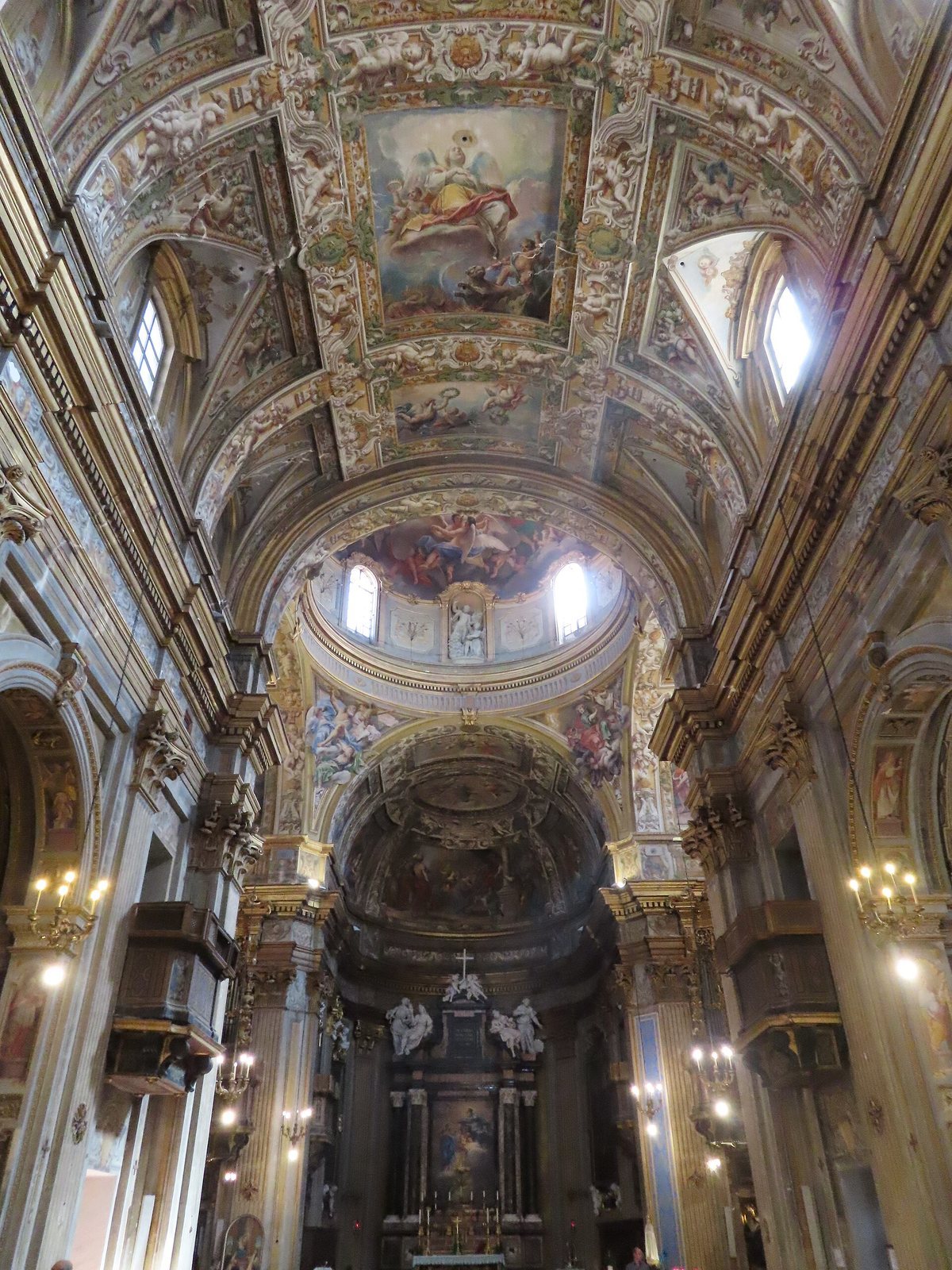
The interior is arranged around a single nave with barrel vaults, curved ceilings shaped like half-cylinders. Side chapels open off the main space, while a transept, the crosswise section of the church, leads toward the dome and the rounded apse at the far end. Painted architectural effects draw the eye upward toward the dome and apse. Much of the decoration from the seventeenth and eighteenth centuries has Marian subjects, including the Immaculate Conception, the Catholic belief that Mary was preserved from original sin from the moment of her conception.
Painted decoration
Nave, dome, and presbytery
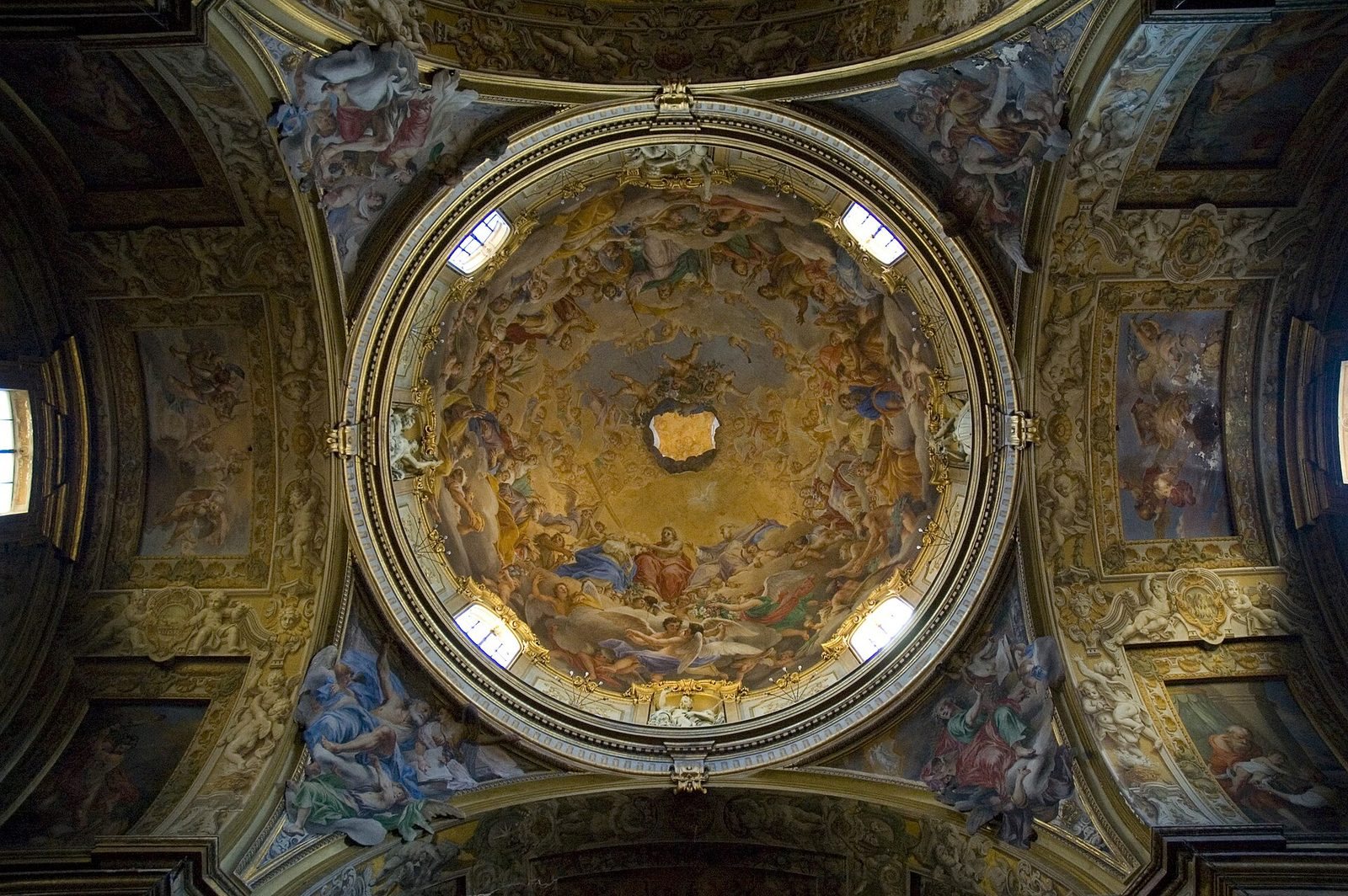
The nave vault has frescoes, paintings made on wet plaster, by Francesco Appiani depicting themes from the Apocalypse of John. Nicola Giuli provided decorative work for the vault in 1762. Francesco Mancini painted the dome’s Coronation of the Virgin in 1728. Giovanni Andrea Carlone’s 1668 work includes the Four Evangelists on the dome’s pendentives, curved triangular surfaces supporting the dome. In the presbytery, the area around the main altar, his frescoes celebrate the Immaculate Conception through the figures of Esther, Moses’ sister, Jael, and Deborah. Carlone’s Baroque style drew on Pietro da Cortona and Giovan Battista Gaulli. Francesco Martini was also among the church’s fresco painters of the seventeenth and eighteenth centuries.
Transepts
Giacinto Boccanera and Paolo Brizi painted the left transept in 1735. The right transept has biblical scenes painted by Sebastiano Ceccarini and Paolo Brizzi in 1737.
Main altar
Tommaso Stati designed the main altar in 1655, and Francesco Caselli made it. It holds Pietro da Cortona’s large Immaculate Conception, painted in 1662. On either side are Pietro Montanini’s 1674 paintings of Saint Gregory the Great and Saint John the Baptist. These works commemorate the patron saints of two churches that had stood in the area before the new church was built.
Side chapels
Chapel of the Visitation of Mary
Vincenzo Monotti and Girolamo Perugini painted the chapel’s frescoes in 1776. Its altarpiece, a painting placed above an altar, is Giuseppe Passeri’s work of 1709.
Chapel of the Purification
Bernardino Gagliardi painted the chapel’s frescoes in 1649. Its former altarpiece, a 1631 canvas by Andrea Sacchi, was transferred to the Galleria Nazionale dell’Umbria in 1879.
Chapel of the Assumption
Maruscelli designed the chapel, whose frescoes were painted by Anton Maria Fabrizi in 1636–37. Its present altarpiece is a seventeenth-century canvas by Giovanni Francesco Romanelli. It replaced Reni’s 1637 Assumption of the Virgin, now in the Musée des Beaux-Arts in Lyon.
Chapel of Saint Philip Neri
In the left transept, this chapel has frescoes by Boccanera from 1740 and biblical scenes on its vault, with decoration by Paolo Brizi. Its altar, designed by Stati, contains a copy of Guido Reni’s image of Saint Philip Neri.
Chapel of Our Lady of Sorrows
The chapel contains the statue venerated by the Confraternity of the Addolorata.
Chapel of the Crucifix
Also in the left transept, this chapel has biblical scenes painted by Ceccarini in 1737, with decoration by Paolo Brizi. Its bronze crucifix was made by Pasquale Pasqualini of Vicenza in 1645; copper figures of the Virgin and Saint John were added later.
Chapel of Saint Joseph
This chapel originally served as a passage to the Filippini fathers’ residence. In 1894, the Perugian painter Alceste Ricci made its carved and gilded wooden altar dedicated to Saint Joseph.
Chapel of the Nativity of Mary
Fabrizi painted the chapel’s frescoes in 1642. It formerly held Pietro da Cortona’s Nativity, now in the Galleria Nazionale dell’Umbria. In its place is a seventeenth-century canvas by Simone Ciburri showing Saint Francis receiving the stigmata, marks resembling the wounds of Christ.
Chapel of the Presentation of Mary
Also called the Bigazzini Chapel, it has frescoes by Carlone. A canvas by Luigi Scaramuccia formerly stood here and was transferred to the Galleria Nazionale. The replacement is a nineteenth-century painting by Luigi Ribustini.
Chapel of the Annunciation
Monotti and Perugini painted the chapel’s frescoes in 1766. Its altarpiece is Francesco Trevisani’s work of 1710.
Sacristy
The sacristy vaults have eighteenth-century paintings on canvas by Appiani and Valentino Carattoli. Its altar holds a painting by Vincenzo Pellegrini showing the Virgin between Saint Michael the Archangel and Saint Mary Magdalene.
Other paintings
Two works by Montanini, The Nativity and The Deposition, were painted on copper. They were stolen from the church in 1980, later recovered, and secured.