Idnakar (Soldyrskoe First Hillfort): A Medieval Fortified Settlement in Russia
Site at a Glance
- Popularity
- Medium
- Country
- Russia
- Primary era
- Medieval
- Eras represented
- Medieval
- Civilizations
- Unclassified
- Site type
- Military
- Remains
- Fortified Town
On this page9 sections
History
Idnakar, also known as the Soldyrskoe First Hillfort, is a medieval fortified settlement on Soldyr Hill in Russia, about four kilometres from Glazov. It was occupied from the ninth to the thirteenth century and belonged to the Cheptsa archaeological culture, a classification for medieval sites and material remains in the Cheptsa region. Its oldest archaeological layers date to the late ninth century.
Settlement and growth
A northern Udmurt legend tells that the hero Dondy and his sons founded settlements in the area. Idna stayed on Soldyr Hill while Dondy and his younger sons established other settlements; the story also recounts Idna’s hunting and conflict with the Russians. This later tradition is not considered an account of the hillfort’s actual medieval beginnings.
Regional role and connections
Idnakar served as a fortified craft center with an agricultural and hunting hinterland. Its position beside the Cheptsa River supported trade with neighboring districts and close commercial ties with Volga Bulgaria, a medieval polity in the Volga-Kama region. Some interpretations describe Idnakar as a Volga Bulgarian trading post. Its wider role among northern Udmurts has also been understood as military, commercial, craft-based, and administrative, though its status as a political or religious center, or as a capital, remains uncertain.
The inhabitants’ ethnic composition is also uncertain. Most are thought to have spoken Permic languages, a group that includes Udmurt and Komi; East Slavic and Volga Bulgarian communities may also have been present.
Destruction and archaeological study
The hillfort was captured and burned in the thirteenth century, possibly during Mongol incursions. The decline and abandonment of Cheptsa hillforts during the thirteenth and fourteenth centuries has been linked to the destruction of Volga Bulgaria in 1236. Cheptsa communities had close economic and cultural ties with Volga Bulgaria, and may also have had political connections with it.
Investigations took place in 1885–1889, 1926–1929, and 1961. Systematic research began in 1974 under historian M. G. Ivanova; by 1995, about 8,000 square metres had been excavated. Historian A. V. Korobeynikov undertook a comprehensive study in the early twenty-first century, and excavations continue. The hillfort received state protection in 1960 and is now a federal cultural heritage site.
Remains
Setting and defenses
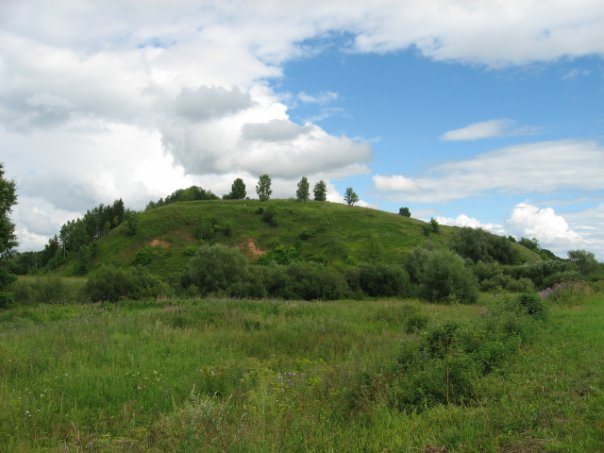
The four-hectare settlement occupies a high cape on Soldyr Hill, where the Cheptsa and Pyzep rivers meet. Its elevated position aided defense and offered views across the surrounding area for tens of kilometres. Three lines of fortifications developed as the settlement expanded. The earliest consisted of an earthen bank and ditch, with poles reinforcing the bank’s slopes. A second line followed as settlement spread beyond the first, and a later line appears to have been intended to protect a water source. The earliest defenses eventually ceased to serve that purpose, and settlement grew over their former line.
Settlement layout and material evidence
Fortified core and adjoining settlement
Idnakar had a two-part layout comparable to medieval Rus towns, which included a fortified inner area and an adjoining settlement. Excavations have exposed remains of buildings, dwellings, and fortifications within the site.
Craft production and exchange
The cultural layer, about 100–150 centimetres thick, contains evidence of varied activity. Finds point to metalworking, especially bloomery iron smelting, which produced workable iron rather than molten metal, as well as skilled blacksmithing and jewelry-making. Potters made undecorated vessels by hand and tempered the clay with crushed shell. Boneworkers produced objects including combs and ear-cleaning implements. Excavated imports came from the Middle East, Volga Bulgaria, Kievan Rus, a medieval East Slavic polity, and Scandinavia.