San Basso: A Former Baroque Church in Venice
Site at a Glance
- Rating
- 4.7
- Popularity
- Very Low
- Country
- Italy
- Primary era
- Early Modern
- Eras represented
- Early Modern
- Civilizations
- Venetian
- Site type
- Religious
- Remains
- Church
On this page7 sections
History
San Basso is a former Roman Catholic church in Venice, Italy, rebuilt in the seventeenth century as a Baroque building after earlier fires. Its foundation is variously attributed to the Elia family in 1017, and the church was first dedicated to Saint Saba before receiving the dedication to Saint Bassus. Saint Bassus of Nice was traditionally regarded as an early Christian bishop who was executed during the reign of the Roman emperor Decius. The historian Flaminio Corner placed the original construction in the 1070s.
Early church and rebuilding
Fire destroyed or severely damaged San Basso in 1105 and again in 1661. The present structure belongs to the rebuilding that followed the later disaster. Giuseppe Benoni was probably associated with its design, while the facade was created by Baldassarre Longhena, a major Venetian Baroque architect. The upper part of the facade remained unfinished.
Confraternities and music
From February 1642 until about 1750, the Furlani maintained their own scuola at San Basso. In Venetian usage, a scuola was a confraternity or charitable religious association. The Furlani were men from the Venetian mainland engaged in heavy manual work. The Scuola del Santissimo Sacramento, one of the smaller confraternities, left the church in 1681. A new organ by Francesco Merlini was installed in 1788, and Sebastiano Ricci was commissioned to produce portraits for the church.
Suppression and later uses
During the Napoleonic occupation, the parish and church were suppressed in 1806–07. The building closed and was sold to a private owner. Cardinal Jacopo Monico, Patriarch of Venice from 1827 to 1851, reacquired San Basso and transferred it to the administration of Saint Mark’s Basilica on 28 December 1847.
For about a century, the former church served as storage for marble and sculptures and as a technical office. It was renovated in 1951 and subsequently used as an antiques shop, exhibition space, and concert hall. On 25 March 1953, Patriarch Angelo Giuseppe Roncalli inaugurated the building after its conversion into a conference room. Roncalli later became Pope John XXIII. San Basso now houses the Ateneo di San Basso and hosts conferences and musical events, including concerts.
Remains
San Basso stands immediately north of Saint Mark’s Square, opposite a side entrance of Saint Mark’s Basilica and near the Saint Mark’s Clocktower. Saint Mark’s Basilica is Venice’s cathedral and one of the city’s principal historic churches, while the Clocktower marks the entrance to Saint Mark’s Square. The facade of San Basso faces the Piazzetta dei Leoncini. The building block is bounded by the Calle di San Basso to the west, the Calle della Razza to the east, and the Calle Larga di San Marco to the north.
Facade
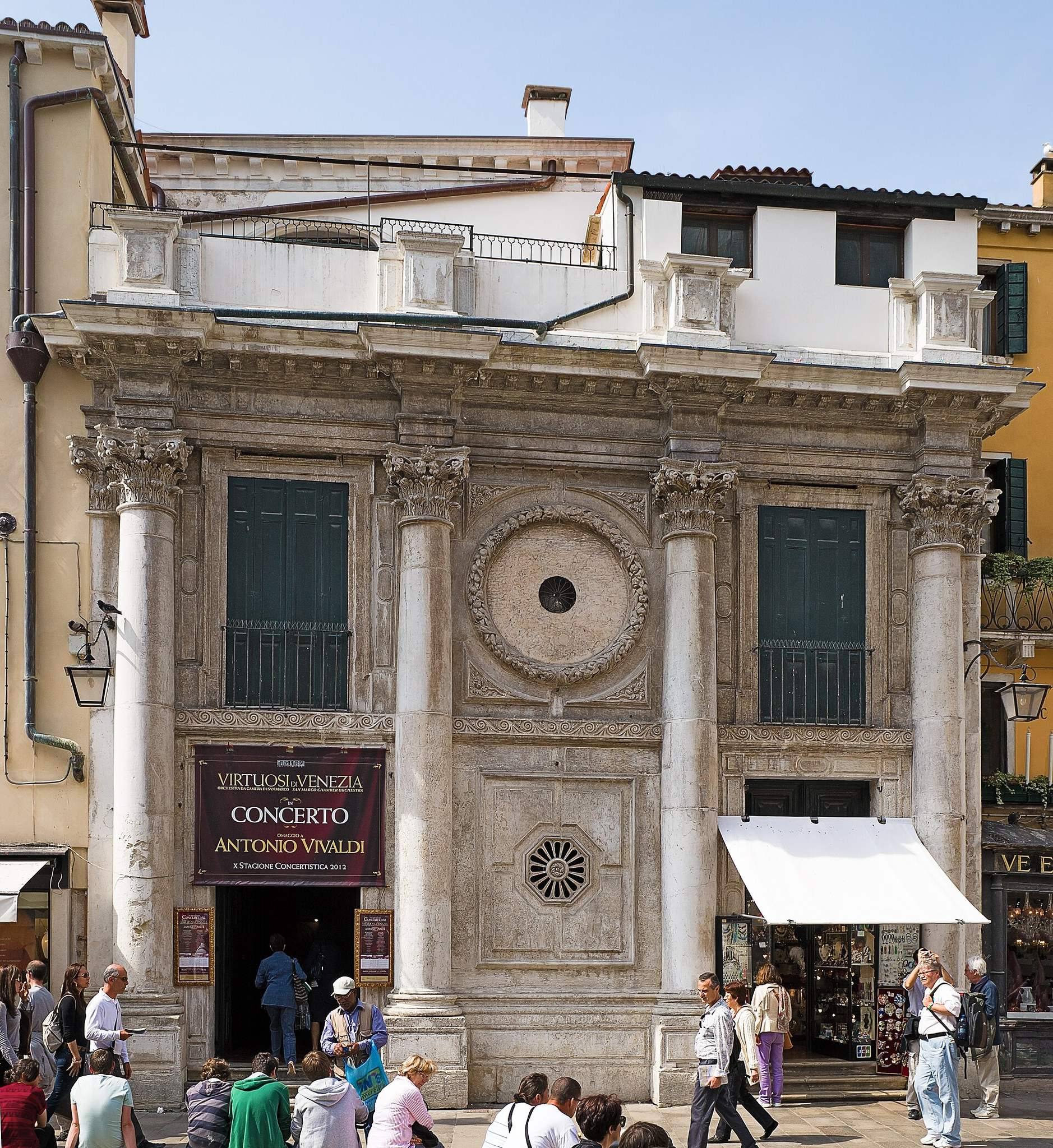
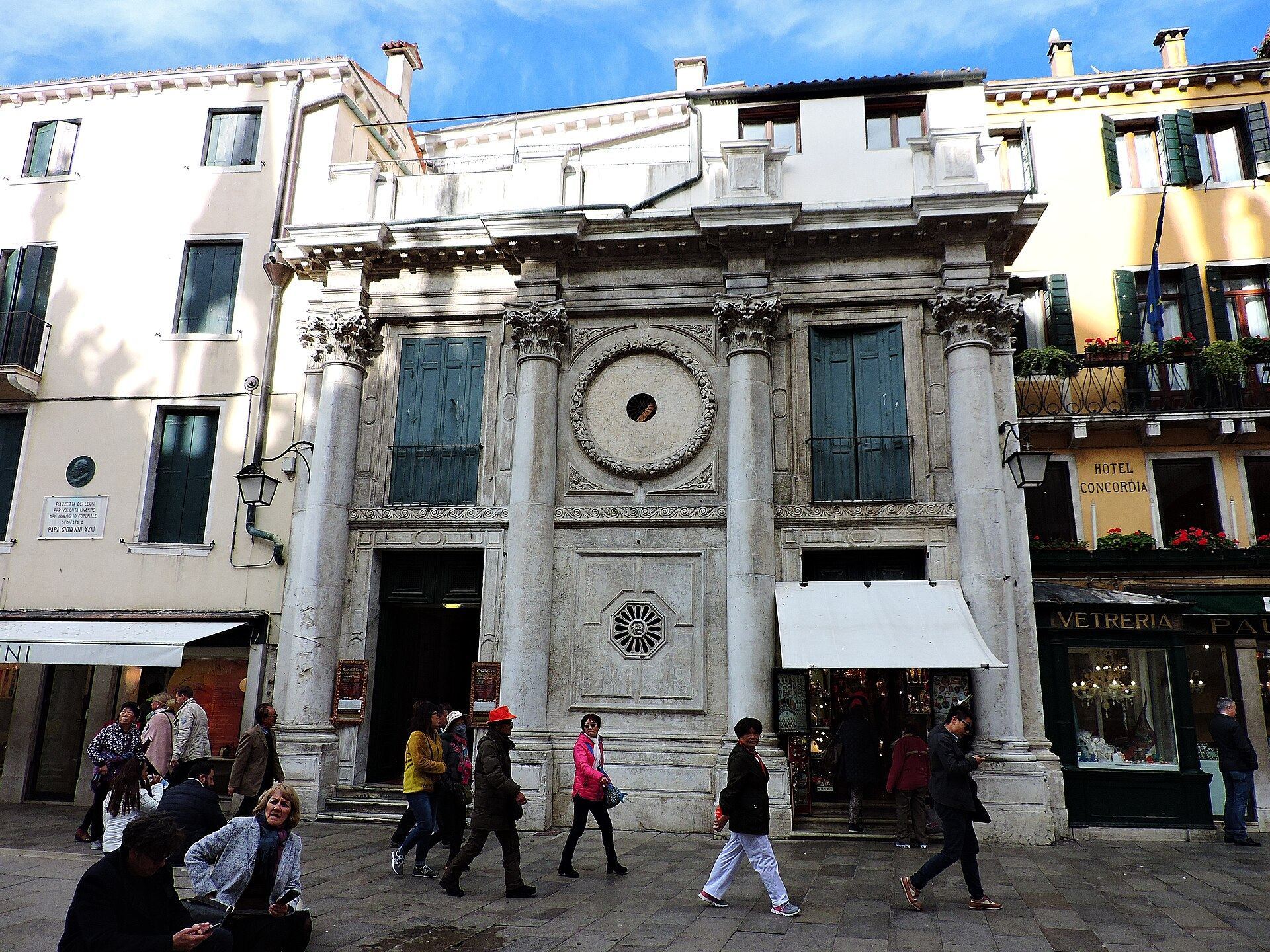
The facade facing the Piazzetta dei Leoncini is a square-shaped lateral elevation set among neighboring buildings. Designed by Baldassarre Longhena during the seventeenth-century rebuilding, it contains four Corinthian columns, two openings with superimposed rectangular single-light windows, and a large circular decoration at the center. Its upper portion remained unfinished.
Bell tower
San Basso formerly had a seventeenth-century campanile alla romana, meaning a Roman-style bell tower. The tower was removed in 1834 and transferred to the church of the Clarisses of Gesù at Sant’Andrea. A smaller bell tower shown in an eighteenth-century depiction was later transferred to the church of Santissimo Nome di Gesù.