Biblioteca Nazionale Marciana: Venice’s Renaissance Library
Site at a Glance
- Popularity
- Very High
- Country
- Italy
- Primary era
- Early Modern
- Eras represented
- Early Modern
- Civilizations
- Venetian
- Site type
- Civic
- Remains
- Library
On this page15 sections
History
Bessarion’s bequest and the early library
Biblioteca Nazionale Marciana is a public library in Venice, Italy, founded in 1468 around the manuscript collection of Cardinal Bessarion. Its Renaissance building was commissioned in 1536 and construction began the following year. Bessarion gave the Republic of Venice 482 Greek and 264 Latin manuscripts on the condition that they be preserved and made available to scholars. His collecting had focused on finding, buying, and copying rare works in Greece and Italy, particularly after Constantinople fell in 1453. Venice appealed to him for its Greek refugee community and longstanding connections to Byzantium, the medieval empire centred on Constantinople.
Bessarion, a Byzantine Greek scholar and churchman who became a cardinal in the Latin Church, first visited Venice in 1438 as part of a Byzantine delegation to the Council of Ferrara-Florence. He returned in 1460–61 and entered the Venetian aristocracy in 1461. He initially planned to leave his Greek manuscripts to the monastery of San Giorgio Maggiore, where he stayed as a papal representative in 1463–64, but cancelled that bequest in 1467 because the island location would hinder access. The donation to the republic was legally accepted in Rome in 1468. A consignment of 466 manuscripts arrived in Venice in 1469; after Bessarion’s death in 1472, further books followed from Urbino in 1474.
Venice had previously received the poet Petrarch’s manuscripts, but that collection, given to the republic in 1362, dispersed after his death. Bessarion’s books first remained packed in the Doge’s Palace. During the war with the Ottomans from 1463 to 1479, resources were directed toward the conflict. In 1485 the manuscripts were compressed into a smaller space in the palace, making consultation difficult. Some were lent and later surfaced in private collections or bookshops. Copying was allowed selectively, while printers generally faced restrictions.
A purpose-built library
Access improved under the curator Andrea Navagero, who served from 1516 to 1524. Scholars consulted the manuscripts more often, and copying for distinguished patrons became more frequent. Pietro Bembo took up the curatorship in 1530. In 1532, after the War of the League of Cognac had ended, the collection moved to an upper floor of the Church of Saint Mark. A Senate declaration supporting a public library had been made in 1515; in 1532, Vettore Grimani pressed the procurators of Saint Mark, Venetian magistrates responsible for public buildings and related affairs, to construct one.
The project formed part of an urban-renewal programme begun under Doge Andrea Gritti, the elected head of the Venetian Republic. After Venice’s defeat at Agnadello and the sack of Rome in 1527, this programme aimed to restore civic confidence and present Saint Mark’s Square as a classical forum, with Venice cast as heir to the Roman Republic. The library was intended to house Bessarion’s gift and to express the city’s commitment to learning.
The procurators commissioned Jacopo Sansovino on 14 July 1536. An initial plan for three storeys was reduced to two in March 1537, with the upper floor assigned to the library and procurators’ offices. Building began in 1537, paused during the Ottoman–Venetian War of 1537–40, and resumed in 1543. On 18 December 1545 a masonry vault collapsed. Sansovino blamed the early removal of its wooden supports before the concrete had set, as well as a cannon salute from a galley in Saint Mark’s Basin. He was held responsible for the damage, his stipend was suspended until 1547, and the debt took him twenty years to repay. The roof support was redesigned in lighter wood.
Work proceeded in stages as funds and space became available. By 1552 at least seven bays of the reading room were complete, and a plaque dated 1554 marked the next three. Fourteen bays had been built by then. The removal of a hostelry in 1556 permitted construction to reach a sixteenth bay, but a meat market beyond it blocked further progress. Interior decoration continued until about 1560. Although the market’s removal was approved in 1565, construction did not resume before Sansovino died in 1570. After the market was demolished in 1581, Vincenzo Scamozzi took charge of adding five bays and continuing the design. In 1588 it was decided to keep the building at two storeys; Scamozzi also oversaw its rooftop statues and obelisks, completed between 1588 and 1591. The intended total number of bays remains uncertain.
The building also served public and scholarly functions beyond the library. Its vestibule was used for lectures by the School of Saint Mark, founded in 1446 to train officials for the Doge’s Chancery. From 1460, teaching in poetry, public speaking, and history gave the school a humanistic character. The vestibule hosted meetings of the Accademia Veneziana from 1560 until the academy dissolved in 1561. In 1591 Scamozzi converted it into a public hall for ancient sculptures donated to Venice by Giovanni Grimani in 1587. The collection entered the new building between 1559 and 1565, probably before July 1560.
Governance and the growth of the collection
In 1544 the Council of Ten, a governing body of the Venetian Republic, placed the collection under the Senate’s education committee. The first catalogue followed in 1545. From 1558 the committee selected a librarian for life; the Senate resumed direct appointments in 1626, and in 1775 the Great Council set a three-year term. A reform in 1626 created assistant custodian and attendant posts. From 1633 the committee and librarian appointed the custodian, who opened and closed the library. Readers had previously needed appointments; Monday, Wednesday, and Friday mornings became its initial regular opening times. In 1680 the Senate approved removing manuscripts from chains, placing them in cabinets, replacing reading benches with four large tables, limiting loans, and opening the library daily. In the eighteenth century, manuscript bindings were standardized and ownership bookplates added. Antonio Maria Zanetti’s catalogues of 1740 and 1741 described manuscripts’ shelfmarks, age, origin, physical form, and contents.
Collection growth was uneven. A 1603 rule requiring printers to deposit copies had little early effect, and a 1650 decree promising annual purchase funds was neglected. Bequests began to add substantially to the holdings from 1589, and printer deposits were enforced more consistently in the early eighteenth century. From 1724 the Senate financed purchases of newly printed foreign books; the library also sold works judged to have little interest or value to acquire material considered more important.
Among the early gifts were physician and botanist Melchiorre Guilandino’s 2,200 printed books in 1589, and Girolamo Fabrici d’Acquapendente’s thirteen volumes of hand-coloured anatomical illustrations in 1619. Giacomo Gallicio gave twenty-one Greek manuscripts containing more than ninety works in 1624. Jacopo Contarini’s bequest of 175 Greek and Latin manuscripts and 1,500 printed books was delayed until the male line of his family ended in 1713. Giambattista Recanati’s 216 manuscripts arrived in 1734, including illuminated medieval books once owned by the House of Gonzaga, the ruling dynasty of Mantua.
Later additions included Tommaso Giuseppe Farsetti’s 386 Latin and Italian manuscripts and more than 1,600 printed books in 1792, Amedeo Schweyer’s purchase of more than 340 manuscripts in 1794, including Marco Polo’s will, and Jacopo Nani’s 716 manuscripts in 1797. Girolamo Ascanio Molin left 2,209 printed books and early printed works, 3,835 prints, 408 drawings, and 136 maps in 1814. Girolamo Contarini’s 1843 bequest included about 4,000 printed books and 956 manuscripts, among them 170 musical manuscripts. Giovanni Rossi added 470 manuscripts, chiefly on Venetian history, and Venetian operas in 1852.
Disruption, relocation, and national status
In 1789, after an investigation found that three religious libraries could not adequately protect their holdings from theft, 303 manuscripts and 88 rare printed books were transferred to the Marciana. Between 1792 and 1795 the Council of Ten also moved items from its Secret Archives that were no longer considered politically sensitive. These included scientific writings once submitted to the Inquisition and historically important political documents.
After the Venetian Republic fell in 1797, French authorities selected 470 manuscripts from Venetian collections for transfer to France; 203 came from the Marciana, along with two musical scores. During the first Austrian occupation, from 1798 to 1805, six rare early printed books and ten important manuscripts were removed. In the following French occupation, from 1805 to 1815, the library received 4,407 volumes, including 630 manuscripts, from dispersed convent and monastery libraries.
In 1811 the collection was moved to the former Hall of the Great Council in the Doge’s Palace. The library building and adjoining Procuratie Nuove had been converted into the viceroy’s residence in the Napoleonic Kingdom of Italy, and the original building became known as the Old Library. The books remained in the palace during the second period of Austrian rule, from 1814 to 1866. Following Venice’s annexation to the Kingdom of Italy, the Marciana was designated a national library in 1876. Its collection moved to the former mint, the Zecca, in 1904, and the institution regained use of its historic rooms in 1924 after extensive restoration. The original building now serves largely as a museum, while offices, reading rooms, and most of the collection occupy the adjoining Zecca. The Marciana remains the only official institution founded by the Venetian Republic that continues to function.
Bessarion’s library remains the historic core of the collection. It included religious and theological works, Greek history, Platonic philosophy, and science, particularly astronomy. He established copying workshops on Crete and at his residence in Rome for works he could not acquire. The library holds 548 Greek and 337 Latin manuscripts, along with 27 early printed books, that once belonged to him. In 2019 its holdings comprised 13,117 manuscripts, 2,887 books printed before 1501, 24,060 books printed in the sixteenth century, and about one million later books. Its collecting strengths include classical texts, the humanities, and Venetian history.
Remains
Setting and exterior
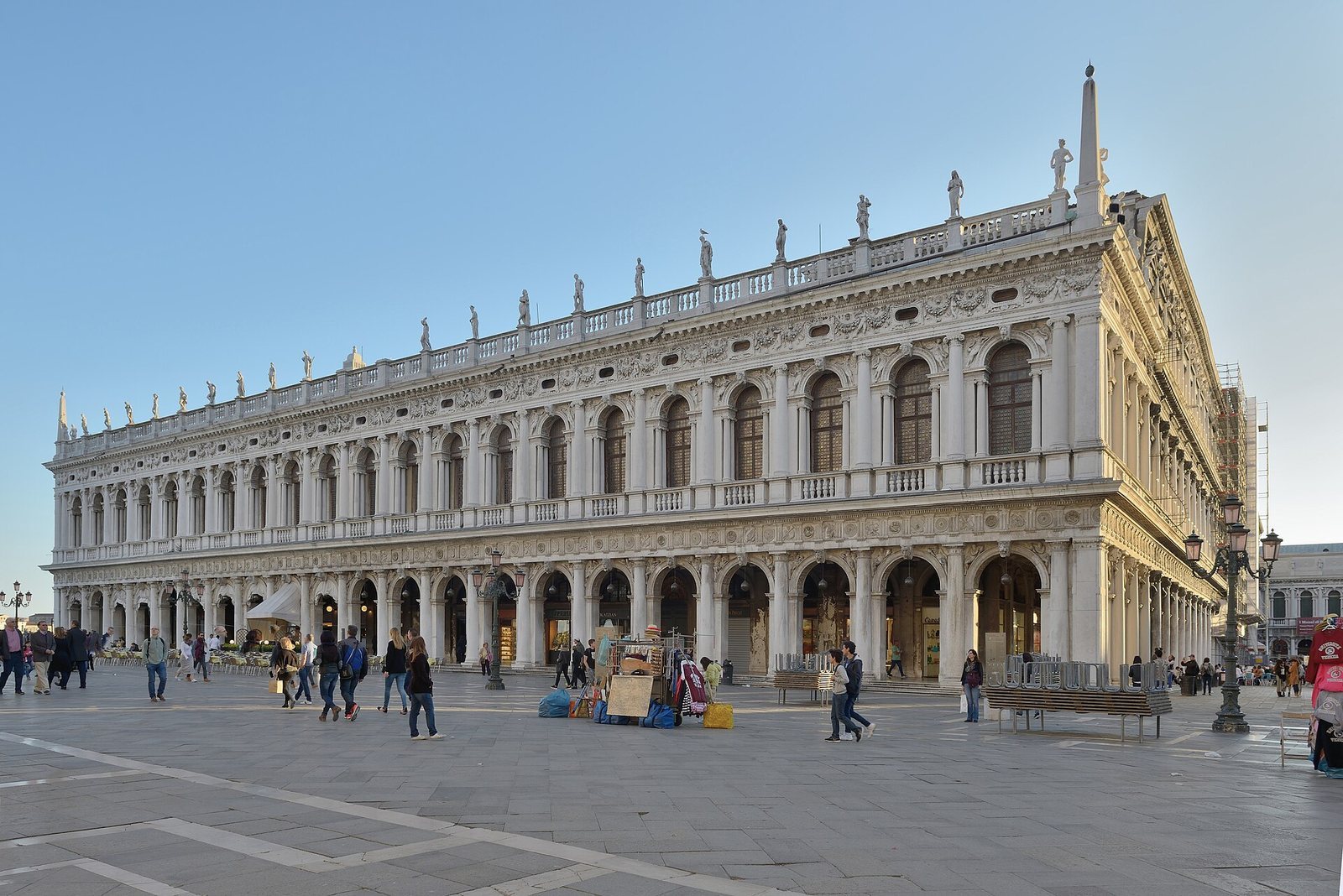
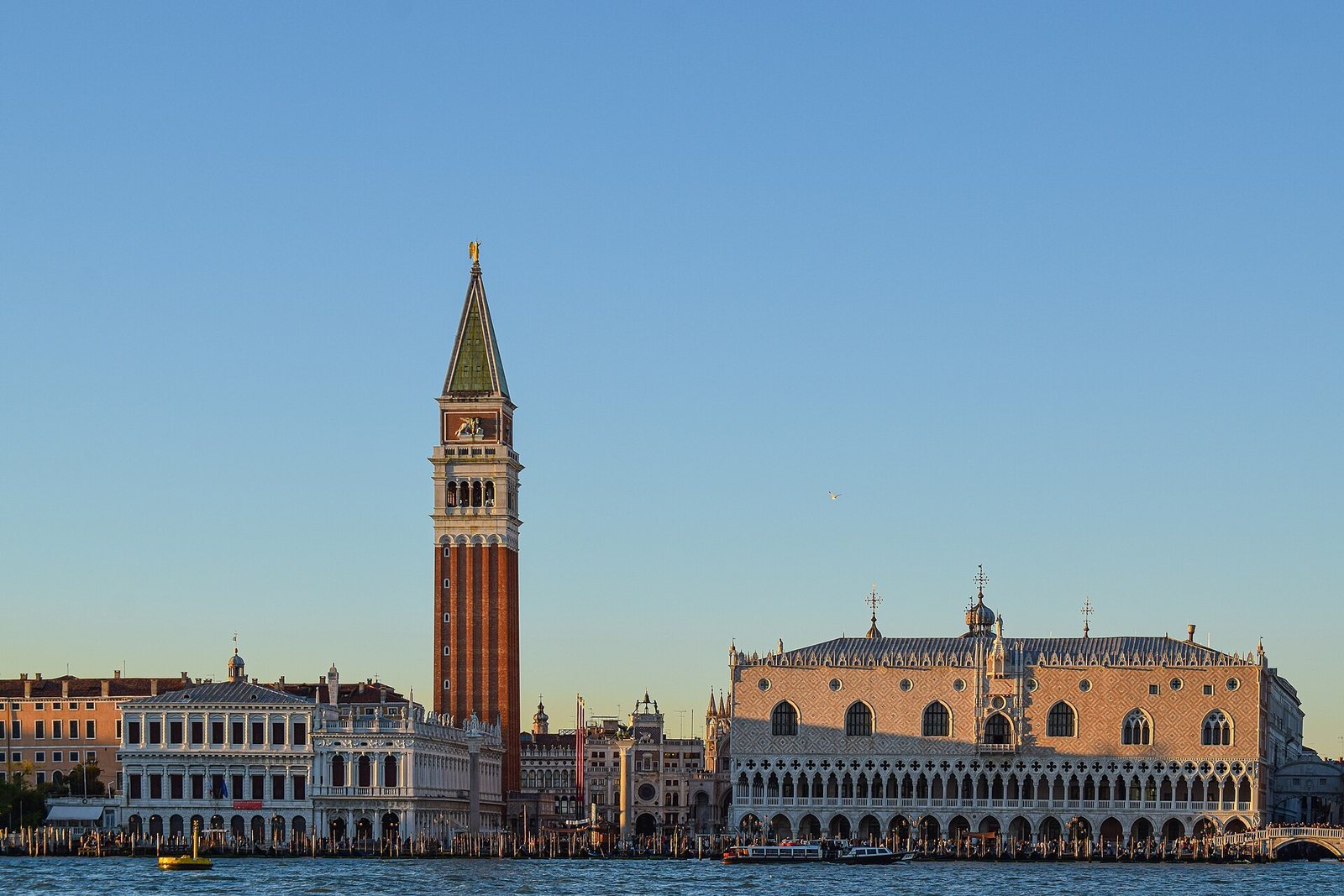
The original library stands on Saint Mark’s Square, once the centre of Venetian government. Its long front faces the Doge’s Palace and extends to the edge of Saint Mark’s Basin, aligning with the mint’s main façade. The detached building helped leave the bell tower freestanding and gave the square its trapezoidal outline, a plan intended to draw attention to the Church of Saint Mark at the eastern end. Designed by Sansovino and extended by Scamozzi, the two-storey structure is a major work of Venetian Renaissance architecture. Istrian limestone, also used for the Doge’s Palace, forms its exterior.
Façade and roofline
Windows and classical orders
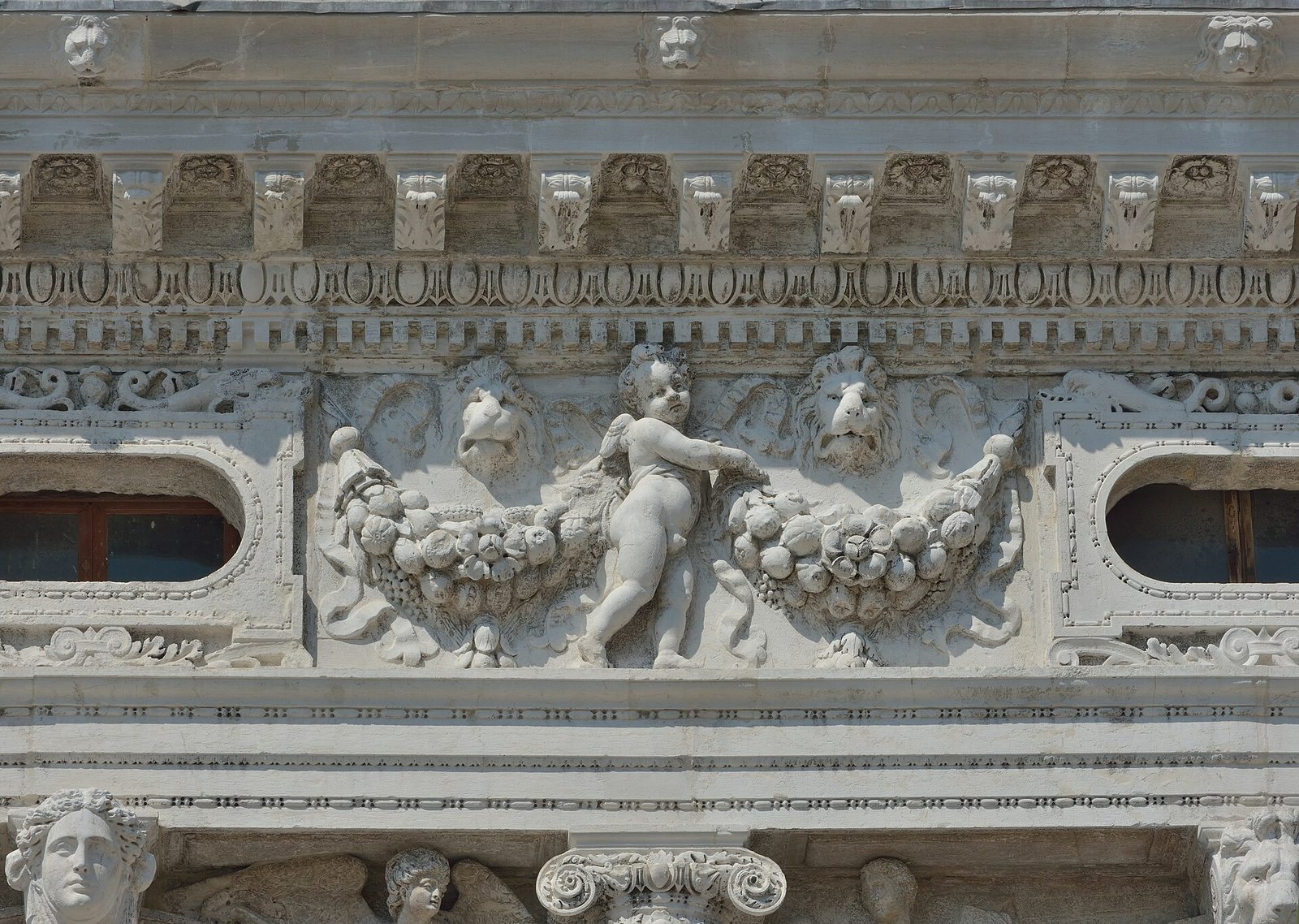
The upper façade is organized around Serlian, or Palladian, windows: each has a tall central arch between two shorter openings. In Sansovino’s design, paired columns set one behind the other divide the side openings from the arch. This arrangement strengthened the wall against the outward pressure of the barrel vault originally planned for the upper floor. Large Ionic columns rise above the windows. Their capitals feature carved egg shapes, flame-like leaf forms, and masks; the band above them alternates decorative garlands with windows and small winged figures. The lower storey combines arches resting on piers with Doric columns. Doric and Ionic are classical column styles, each with its own proportions and ornament. The horizontal structure carried above columns is unusually tall relative to the Ionic supports, a proportion Scamozzi criticized, as he did the squat appearance of the ground-floor arches.
Carving and roof figures
Arches, columns, piers, and projecting horizontal bands give the façade a layered, deeply carved appearance. Male figures in high relief occupy the spaces above the ground-floor arches and represent rivers. At the entrance, Neptune holds a trident, while Aeolus appears with a wind-filled sail. Large stones at the crowns of the arches alternate between lions’ heads and pagan divinities. The undersides of the arches carry mythological scenes or grotesque ornament, while winged female allegories appear in relief above. A stone railing at the roofline supports statues of pagan gods and ancient heroes, with obelisks between them. Some original statues were later damaged or weathered and replaced by figures that do not always represent the same subjects.
Interior decoration
The gilded rooms contain paintings by sixteenth-century Venetian artists, including Titian, Tintoretto, Paolo Veronese, and Andrea Schiavone. Mythological scenes, allegorical figures, and symbolic imagery form a programme describing the soul’s ascent toward divine wisdom. This idea draws on Neoplatonism, a tradition adapting Plato’s philosophy to describe the soul’s movement toward a higher spiritual reality; the programme culminates in an ideal state associated with Venice.
Staircase
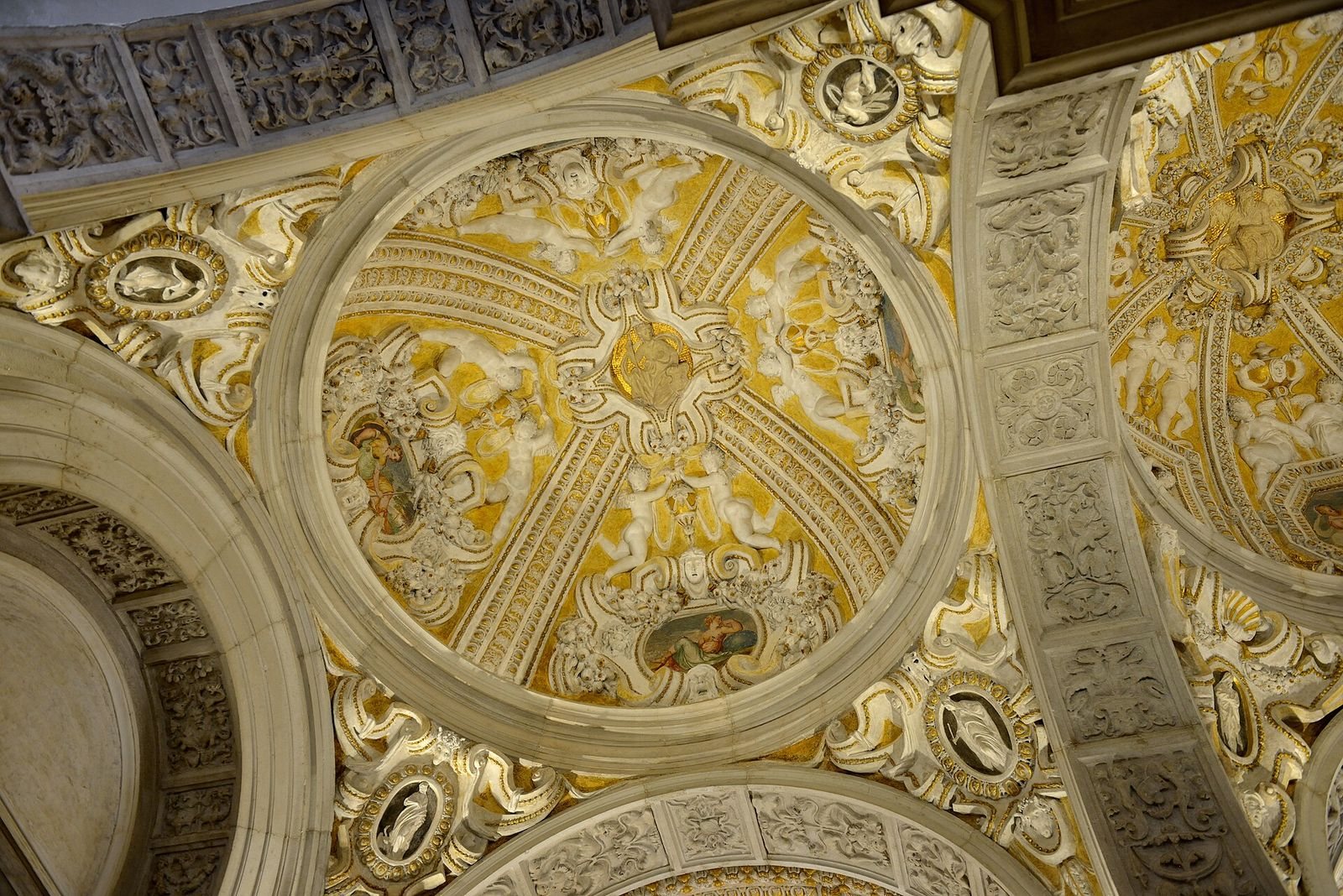
The staircase has two flights and four domes named for Ethics, Rhetoric, Dialectic, and Poetics. On the vaults, molded plaster patterns alternate with octagonal paintings. Alessandro Vittoria made the stucco decoration; Battista Franco painted the first flight, and Battista del Moro the second. At the entrance and landings, Sansovino repeated the façade’s arched-window pattern using ancient columns taken from the deteriorating sixth-century Byzantine Church of Santa Maria del Canneto in Pola.
Vestibule ceiling
The vestibule retains an illusionistic ceiling design by Cristoforo and Stefano De Rosa of Brescia, dated 1559. Titian’s central octagonal painting has been interpreted as either Wisdom or History; Poetry, Philosophy, Rhetoric, and Love of Letters have also been proposed as its subject.
Reading room
The reading room originally contained 38 desks in two rows, with valuable manuscripts chained by subject. Painted portraits of ancient thinkers once hung between its windows and in the vestibule. They were transferred to the Doge’s Palace in 1763 to make space for bookshelves; some portraits and their identifying inscriptions were lost. Ten surviving portraits returned in the early nineteenth century and were combined with other paintings in 1929. Tintoretto’s Diogenes is the only portrait securely linked to a particular ancient figure.
The ceiling holds 21 circular oil paintings in gilded, painted woodwork, accompanied by 52 decorative paintings by Battista Franco. The original circular works were commissioned in 1556. Water damage made two beyond repair, and Bernardo Strozzi and Alessandro Varotari supplied replacements in 1635 for paintings by Giulio Licinio and Giambattista Zelotti. The subjects remain open to interpretation, with proposals ranging from the seasons, Theology, Virtue and Fortune, and the arts to mathematical sciences, Music, and the triumph of military leaders. Some interpretations identify philosophical ideas or political figures. Two paintings, numbers 19 and 20, were turned upside down sometime between 1819 and 1839, probably during building work or restoration.
Maps and manuscripts
The collection includes the Fra Mauro map, which came to the Marciana in 1811 from the suppressed Camaldolese monastery of San Michele in Isola. The library’s manuscripts and books also preserve the legacy of Bessarion’s original collection, which formed the basis for the institution’s foundation.