Gochi Kokubun-ji Temple: A Tendai Buddhist Temple in Joetsu, Japan
Site at a Glance
- Rating
- 4
- Popularity
- Low
- Country
- Japan
- Primary era
- Early Modern
- External website
- Open
- Eras represented
- Early Modern
- Civilizations
- Tokugawa
- Site type
- Religious
- Remains
- Temple
On this page12 sections
History
Gochi Kokubun-ji Temple is a Tendai Buddhist temple in Joetsu, Japan, regarded as the successor of Echigo Province Kokubun-ji, one of the provincial temples established across Japan under Emperor Shomu’s eighth-century order. Its formal name is Ankoku-zan Kazo-in Kokubun-ji. The foundation date and original founder are uncertain, but the present institution preserves historical associations extending from the medieval period through the Uesugi and Edo eras.
The provincial temple tradition
Emperor Shomu’s government promoted a network of Kokubun-ji, or provincial Buddhist temples, to support the state and the Buddhist order. The original location of Echigo Province Kokubun-ji is unknown. It has been identified with the abandoned temple site at Honchojohara, while other interpretations propose that coastal erosion destroyed the earlier site or that the temple was founded at the inner sanctuary of Mount Iwadono.
Before its traditional refoundation by Uesugi Kenshin, the temple appears in the Engishiki as receiving 20,000 bundles of temple dues. In the medieval period, it was a subordinate temple of Mitsugon-in, the administrative institution of Izusan, now represented by Izusan Shrine. The institution is also said to have formerly belonged to the Shingon tradition, an esoteric Buddhist tradition centered on ritual and sacred mandalas, before becoming associated with Tendai Buddhism.
Shinran and the medieval precinct
Temple tradition connects the precinct with Shinran, the medieval Buddhist teacher later regarded as the founder of the Jodo Shinshu tradition. After his exile to Echigo Province in 1207, he is said to have lived in a hut within the temple grounds known as the Takenouchi hermitage. A visitor in the Muromachi period also described the appearance of the precincts in the work Baika Mujinzo.
Uesugi revival and later support
Tradition attributes the relocation and revival of the institution at its present site in 1562 to Uesugi Kenshin, a major sixteenth-century warlord. Although this was a relocation rather than the original foundation, the continuing historical associations of the former provincial temple led to the precinct being designated a historic site by Joetsu City.
The revived temple received the support of Uesugi Kagekatsu, Kenshin’s successor in the Uesugi leadership. In 1584, Kagekatsu issued a vermilion-seal document confirming that the temple’s lands were exempt from various services. During the Edo period, the shogunate granted 200 koku of stipendiary land to Kokubunji Village and exempted the village from various obligations. The temple was considered part of the Tendai tradition by 1648.
Fires, rebuilding, and protection
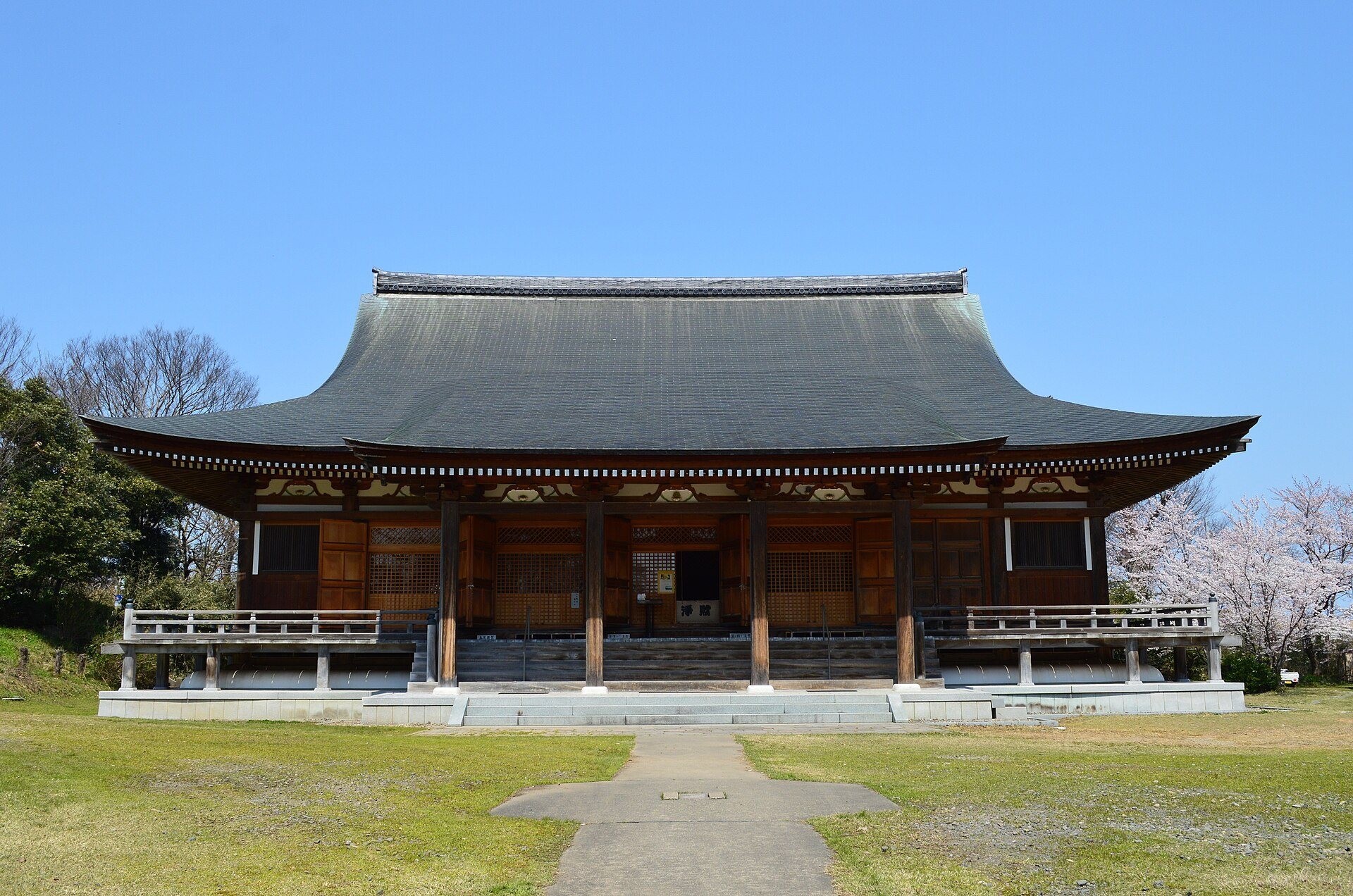
Fires destroyed all of the temple buildings in 1689 and again in 1794. The structures were subsequently rebuilt or repaired. The main hall burned in 1988 and was rebuilt in 1997. The three-story pagoda, sutra repository, gate, statue traditionally identified as Shinran, copper Kannon, Kagekatsu’s document, and the wider precinct have received prefectural or municipal cultural-property protection.
The wooden seated Dainichi Nyorai associated with Gochi Kokubun-ji is officially registered as an Important Cultural Property belonging to the temple, although the image is physically enshrined at another temple in Gochikokubun identified as the site’s inner sanctuary. That inner-sanctuary temple has been managed by Gochi Kokubun-ji.
Gochi Hakusan Shrine originally stood within the temple precincts but was moved about 500 meters to Kokufu 1 in the early Edo period. Deterioration and concerns about earthquakes at its later location led to the construction of a new shrine building in the original precincts. The shrine was transferred there on March 30, 2025.
Remains
Precinct layout
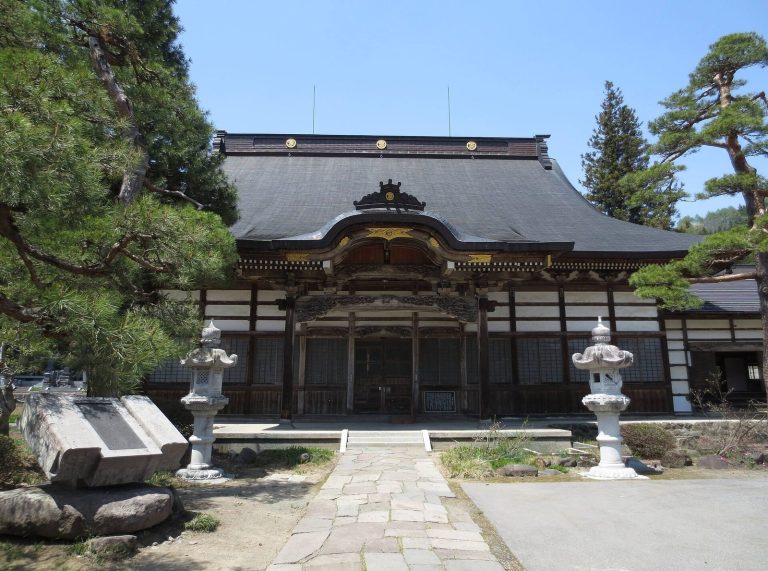
The temple precinct is centered on the main hall and enclosed by earthen banks. This enclosed arrangement has led to the interpretation that the site may previously have been the residence of a powerful local clan. The main hall, rebuilt in 1997 after the 1988 fire, contains the principal image group of five Wisdom Buddhas. Dainichi Nyorai occupies the center, with Yakushi Nyorai, Hoshō Nyorai, Amida Nyorai, and Shaka Nyorai arranged around it. The Five Wisdom Buddhas are an esoteric Buddhist group associated with different forms of enlightened wisdom.
Three-story pagoda
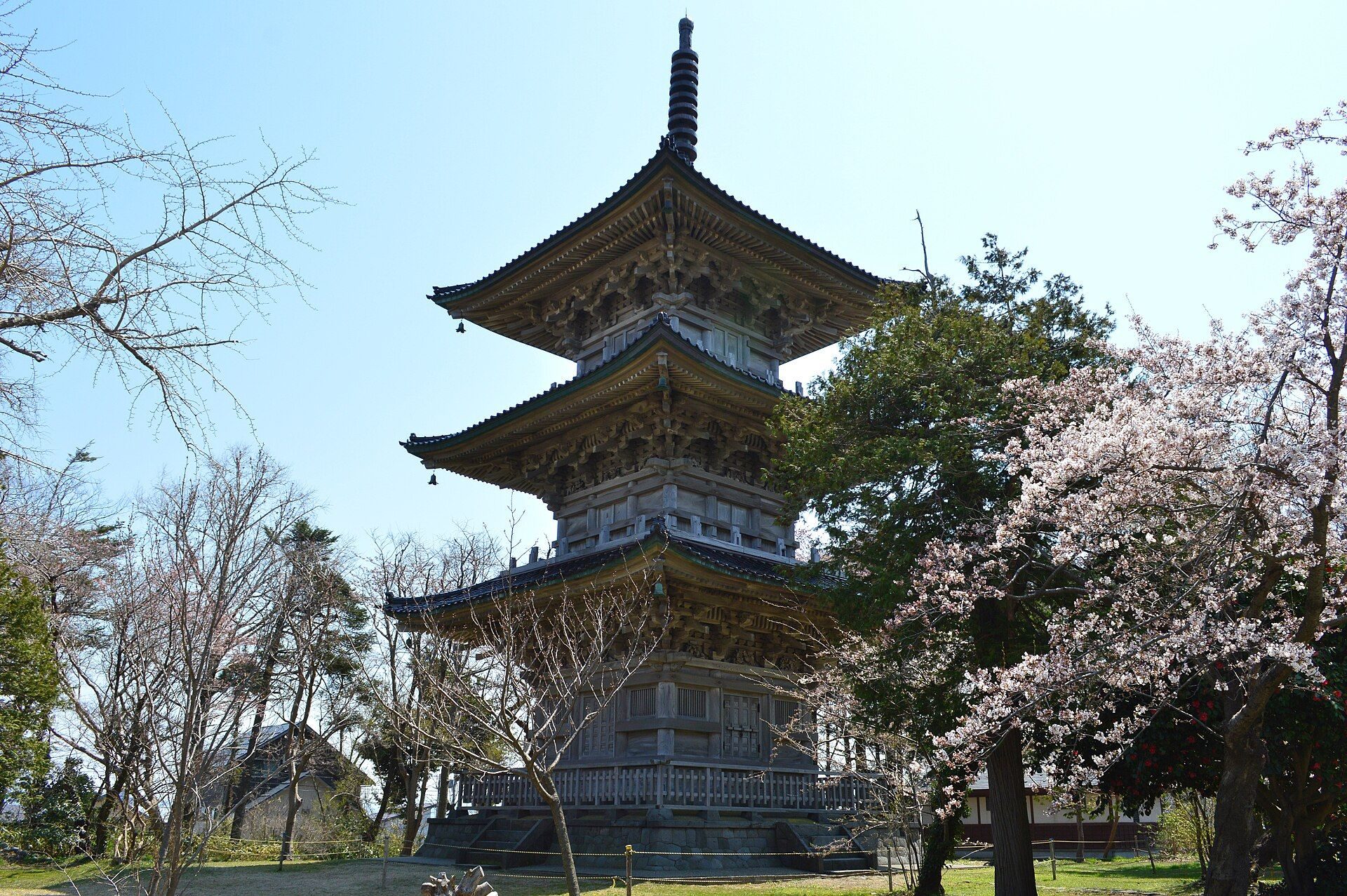
A three-story pagoda stands in front of the main hall and is described as the only surviving pagoda in the Joetsu region. Reconstruction following the 1794 fire began in 1856, and the structure was topped out in 1865. Its balustrades and some other elements remained unfinished. The central foundation stone uses a late-Edo construction method in which the stone is suspended by chains rather than fixed directly to the ground.
Sutra repository
The sutra repository dates to 1693, according to its ridgepole tablet, a wooden inscription placed within the roof structure. It is the oldest building in Joetsu City whose construction date can be identified. Inside is a Tetsugen edition of the Buddhist canon bearing an inscription recording its donation in 1692.
Gate and guardian figures
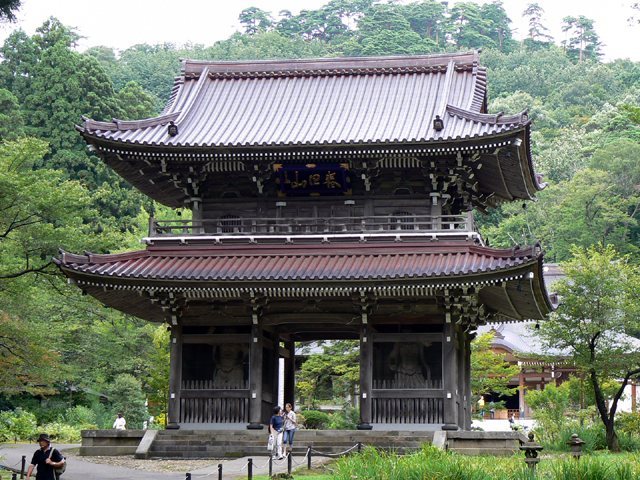
The entrance gate was rebuilt in 1835 and bears the temple’s mountain name, “Ankoku-zan,” on its front. Two Nio guardian statues stand inside the gate. These paired Buddhist guardians, traditionally placed at temple entrances, were made in 1836.
Shinran associations
The Takenouchi hermitage, regarded as the former site associated with Shinran, remains within the precincts. It houses a seated statue traditionally identified as Shinran, and a separate statue of Shinran is also present. Together, the hermitage and images preserve the temple’s longstanding connection with the account of Shinran’s exile in Echigo Province.
Buddhist images and the inner sanctuary
A copper standing Kannon is traditionally transmitted at the temple as a hidden Buddhist image. It is considered a work of the Hakuhō period, an early eighth-century phase of Japanese Buddhist art noted for continental influence. Kannon is the bodhisattva associated with compassion.
The wooden seated Dainichi Nyorai associated with Gochi Kokubun-ji is enshrined at the inner-sanctuary temple in Gochikokubun rather than in the main precincts. Its physical location reflects the continuing relationship between the present temple and the institution identified as its inner sanctuary.